
Businesses borrow money for a handful of reasons: a short-term cash shortage, an equipment purchase, an inventory restock, or an expansion plan that internal funds can't cover on their own. Lenders want the terms in writing, from payment dates to interest charges. A note payable records those terms and gives both sides a debt record.
This article will show how notes payable work, how companies record them, and how they show up in financial statements.
What Is a Note Payable?
A note payable is a formal borrowing agreement that a business signs after receiving funds and agreeing to repay them under set terms. The obligation rests on a written document stating the amount borrowed, the interest terms, and the repayment timeline.
Businesses turn to notes payable when they need money for equipment, inventory, or day-to-day operating expenses. The lender could be a bank, a private party, or another business. The company signs a promissory note that sets out what it owes and how it will repay the debt, and accountants record the outstanding amount as a liability on the balance sheet.
A typical note payable agreement contains the following information:
- Principal amount of the loan
- Interest rate charged on the balance
- Maturity date for full repayment
- Payment structure or installment plan
- Names of the lender and borrower
- Conditions that apply if payments stop or arrive late
With these terms, the lender knows when repayment is due and how interest accrues over time. And the borrower sees the full financial commitment and the expected payment schedule.
In accounting practice, notes payable count as financing rather than as purchases from suppliers, so they attach interest and follow a fixed repayment schedule. For this reason, companies keep them separate and treat them as liabilities until the balance becomes zero.
Notes Payable Example
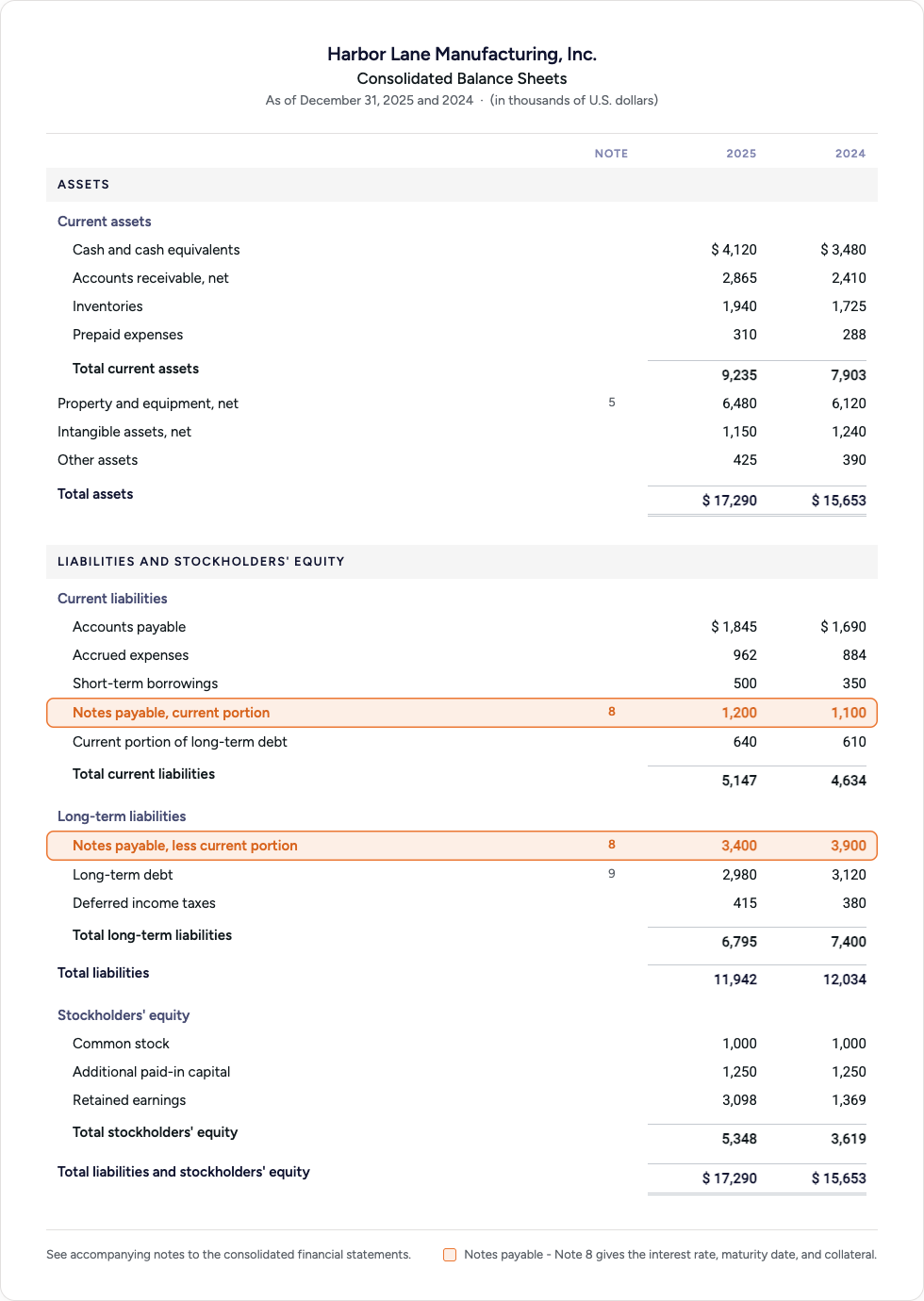
The balance sheet below shows how a company reports notes payable in practice.
Let’s consider a small manufacturing company that needs extra funds to buy new equipment before a big order starts. Rather than using its existing cash, it takes out a $60,000 loan from a local bank and enters into a note payable bearing 7% annual interest and requiring repayment over one year.
After receiving the funds, the company records the transaction. The cash account increases because money came in, while notes payable increase because the company now owes that amount. Meanwhile, the business must also account for interest building across the life of the loan.
During the year, the total interest would be $4,200 (that is, 7% of $60,000). At the end of the term, the company will have to repay the entire amount of $64,200. That amount covers the original loan plus the cost of borrowing.
From an accounting standpoint, the company would record the principal under notes payable and track the interest separately as interest expense. When the company makes the payment, it reduces the notes payable balance and records the cash going out.
Is Notes Payable a Current Liability?
As we said above, notes payable represent borrowed money that a business must repay under agreed terms. One common accounting question is whether this obligation is a current liability or a long-term liability.
It depends on the due date. In most cases, when a company must repay the note within 12 months, accountants classify it as a current liability. Current liabilities cover debts the business expects to pay within the next year, typically drawing on cash or another liquid asset. Working capital loans with a short term generally belong to this category.
When the repayment period runs past a year, accountants list the note as a long-term liability. Equipment loans, property loans, and financing for major purchases fall into this category. Longer terms generally mean the company pays in installments instead of all at once.
A single note payable can straddle both categories. Part of the balance may come due within the next year, while the rest remains long-term. In that case, accountants separate the current portion from the remaining balance.
This classification affects liquidity ratios and shows how soon a company must meet its debt obligations.
Is Notes Payable a Debit or Credit?
Notes payable normally hold a credit balance because the account represents money the company owes. When a business receives a loan, it increases cash and records notes payable on the credit side to show the new liability.
When the company repays part of the loan, it debits notes payable to reduce the outstanding balance and credits cash for the amount paid. Interest posts separately as interest expense.
The logic follows standard double-entry rules: liability accounts grow with credits and shrink with debits.
What Are the Types of Notes Payable?
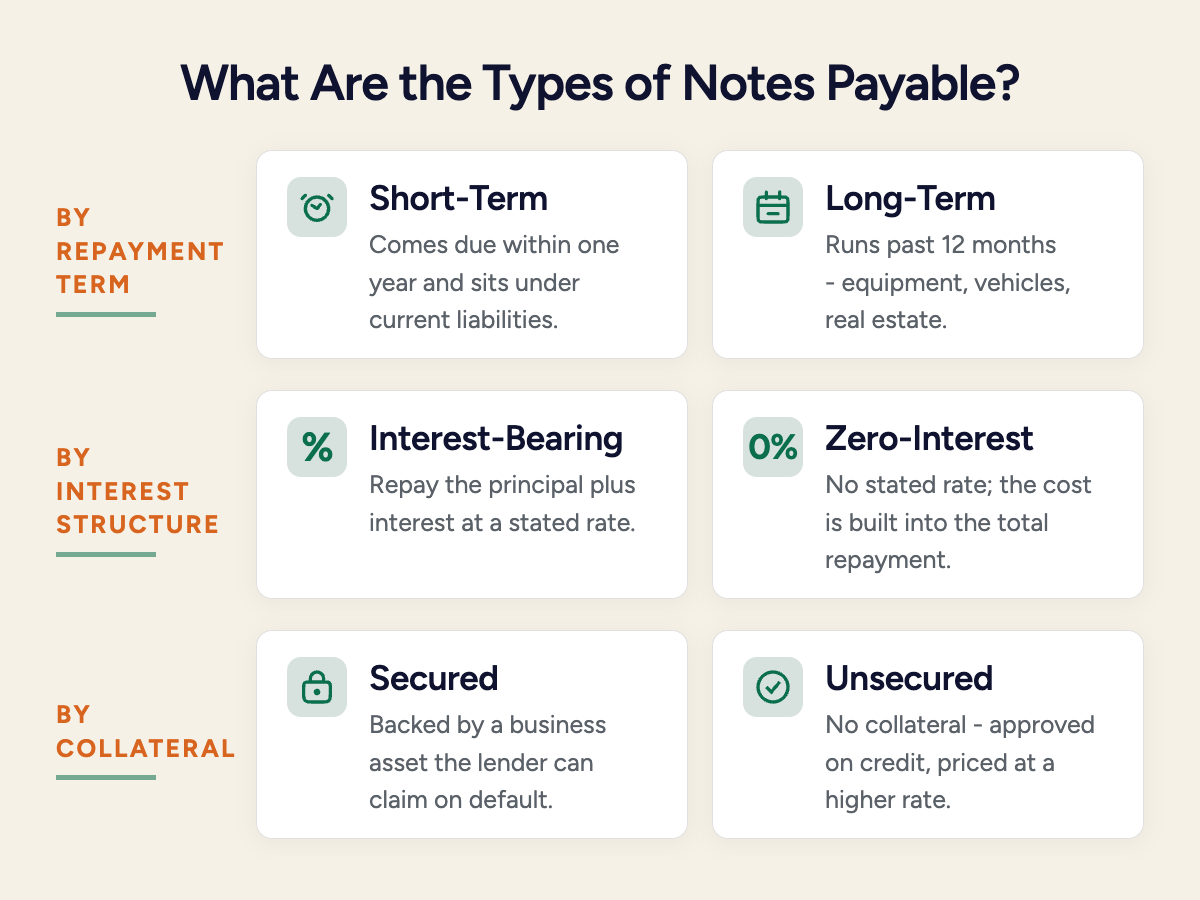
Notes payable vary by repayment term, interest structure, and whether collateral backs the debt.
Short-Term Notes Payable
Short-term notes come due within one year, and a business might sign one to cover payroll during a slow month or restock inventory ahead of a busy season. On the balance sheet, the amount shows up under current liabilities.
Long-Term Notes Payable
A note that remains unpaid for more than 12 months counts as long-term debt. Businesses use this type of financing for equipment, vehicles, real estate, and major renovations. Whatever portion comes due in the next year moves to current liabilities at each reporting date.
Interest-Bearing Notes Payable
An interest-bearing note requires repayment of the borrowed amount plus interest. The agreement specifies the rate, payment dates, and maturity date, giving the business the information it needs to calculate each payment and track the remaining debt.
Zero-Interest Notes Payable
A zero-interest note states no rate, though the borrowing still costs money. The lender may build that cost into the total repayment amount. In accounting records, the note’s recorded value may therefore differ from the amount ultimately paid.
Secured Notes Payable
Collateral backs a secured note payable. That collateral may be equipment, inventory, vehicles, or another business asset. If the borrower stops making payments, the lender may have the right to take the pledged property.
Unsecured Notes Payable
This note payable doesn’t rely on collateral. Instead, the lender approves the financing based on the borrower's creditworthiness and ability to repay. Lenders absorb more risk here, so they price these notes at a higher rate.
Related Forms:
How To Calculate Notes Payable With Interest?
Calculating interest on a note payable comes down to understanding how much was borrowed, the interest rate, and how long the money will remain unpaid.
Most notes payable rely on a simple interest formula:
To use the formula, you need three figures:
- The principal, or the amount borrowed
- The annual interest rate as a decimal
- The length of the loan in years
For example, a $40,000 loan at 6% for one year produces $2,400 in interest. The borrower would then repay $42,400 when the note comes due, including the original principal and the interest charged.
Another example - a business borrows $25,000 at 8% interest for 9 months. Because the rate is annual, convert 9 months to 0.75 years before calculating the interest. That gives $1,500 in interest, so the business repays $26,500 in total.
Accountants keep principal and interest in separate accounts. The borrowed amount stays under notes payable, while the interest appears as interest expense.
How To Find Notes Payable on a Balance Sheet?
Look for notes payable in the liabilities section of the balance sheet. The entry shows debt the company still has to repay, and its position depends mainly on when the payment comes due.
A note due within the next 12 months is usually classified as a current liability. If the company has more than a year to repay it, the balance goes under long-term liabilities. Some notes span both periods, so the company may report the upcoming portion as current and leave the rest under long-term debt.
When reviewing a balance sheet, you may find notes payable near:
- Accounts payable
- Accrued expenses
- Short-term loans
- Long-term debt
- Current portion of long-term debt
Some companies break out notes payable as a separate line item on the balance sheet, especially when the amount is considerable. Smaller balances get folded in with related borrowing accounts, depending on the reporting format the company follows.
You can also look in the liabilities section for entries tied to loans, borrowings, or debt of any kind. The notes to the financial statements fill in the rest: interest rate, maturity date, and any collateral pledged against the note.
Accounts Payable vs. Notes Payable
Both accounts payable and notes payable are amounts a business owes, but the reasons behind them differ. Accounts payable build up from routine credit purchases such as inventory, supplies, and professional services. Notes payable result from borrowing money under a written agreement that sets out how and when the debt will be repaid.
The main difference comes down to structure. Accounts payable generally skip interest and settle within 30 to 90 days. Notes payable normally involve interest, a set maturity date, and a signed agreement that spells out the repayment terms.
| Accounts Payable | Notes Payable | |
| Source of the debt | Routine business purchases | Borrowed funds |
| Agreement type | Invoice or purchase terms | Formal written note |
| Interest | Rarely charged | Typically charged |
| Payment timing | Short payment cycles | Fixed repayment schedule |
| Balance sheet category | Current liability | Current or long-term liability |
| Documentation | Vendor invoices | Promissory note |
Another difference is that companies usually manage accounts payable through purchasing and vendor payment systems. Notes payable typically fall under financing activities and may involve approval from management or lenders.
So, accounts payable typically reflect daily operations, while notes payable show borrowing activity.