
Updated:
Get Form Now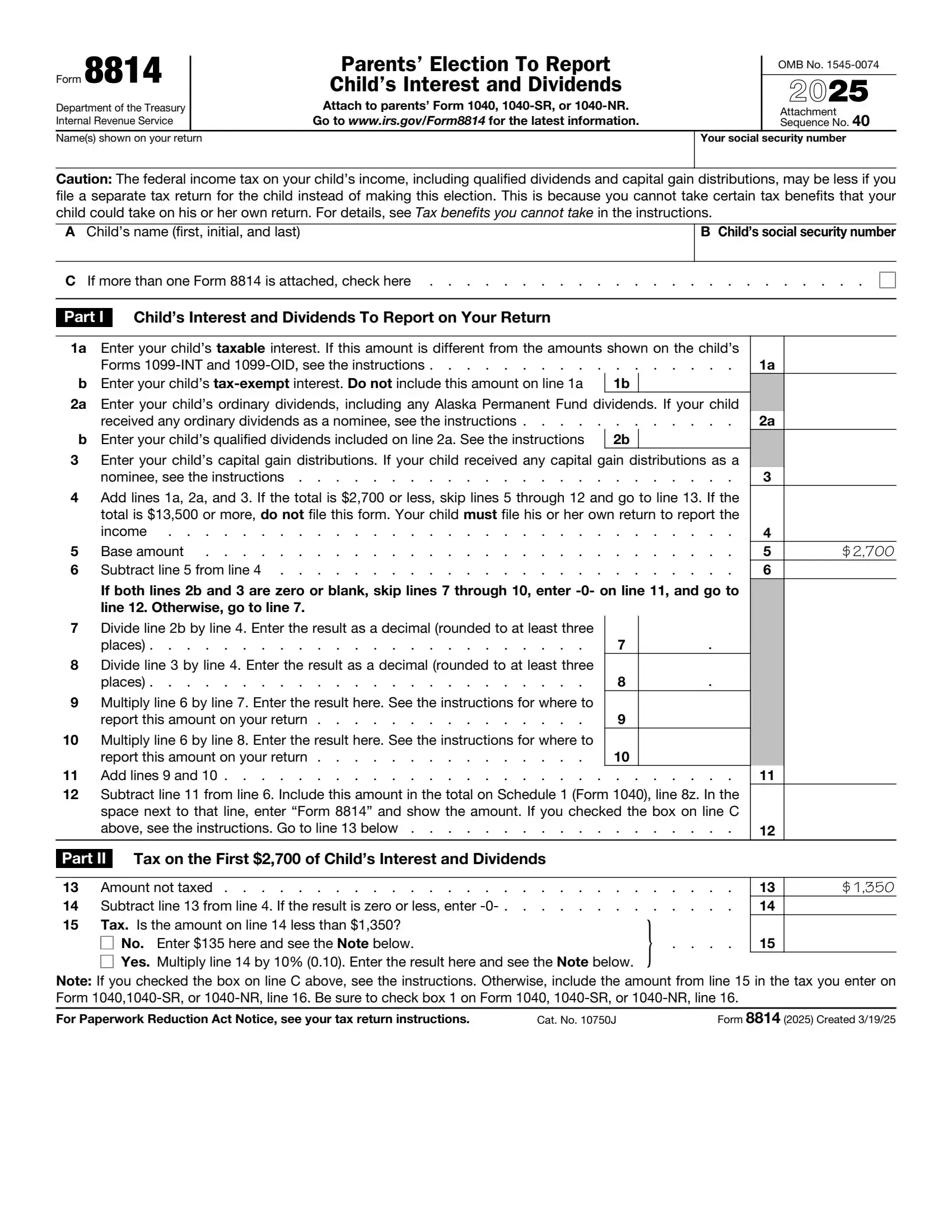
Form 8814 is a form parents use to report their child’s investment income on their tax returns rather than filing a separate return for the child. This form is applicable when a child’s income includes interest and dividends, and the total is less than a certain amount specified by the IRS for the tax year. Using Form 8814 simplifies the filing process and can be beneficial in cases where the child’s income is not substantial.
The purpose of Form 8814 is to allow parents to include their child’s investment income on their tax return if it meets the criteria, including being under 19 or 24 if a full-time student and having income only from interest and dividends. This option can be more convenient and potentially reduce tax preparation costs. However, it might result in a higher tax rate on this income, as it is added to the parent’s income and taxed at their rate. Parents should evaluate whether this form is advantageous based on their tax situation.
What it is: Form 8814 is the Parents' Election To Report Child's Interest and Dividends.
Where and when to file: Attach to parents' Form 1040, 1040-SR, or 1040-NR. Go to www.irs.gov/Form8814 for the latest information.
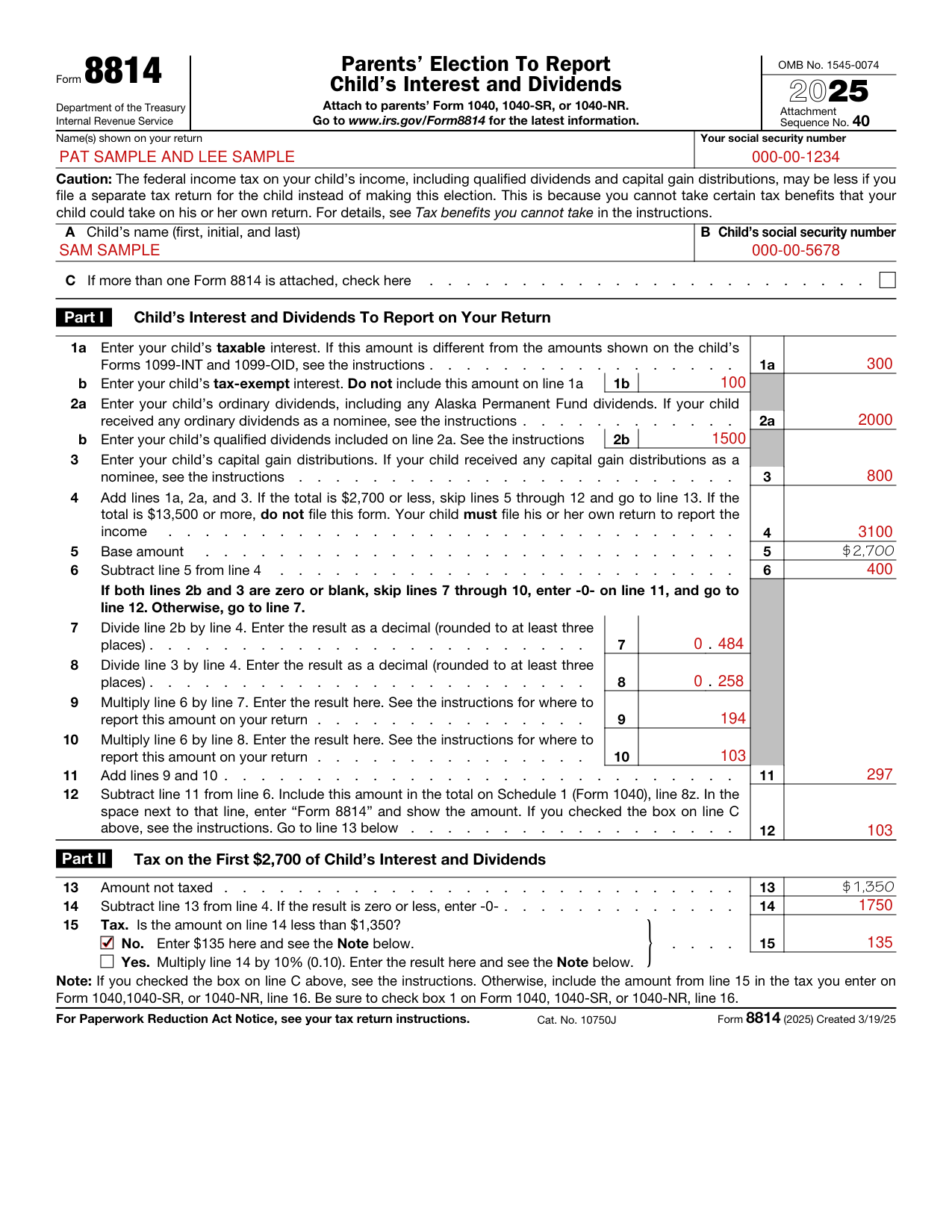

Enter the Name(s) shown on your return and Your social security number.
If you are filing a joint return, enter both names but enter the SSN of the person whose name is shown first on the return.[2]

Enter A Child's name (first, initial, and last) and B Child's social security number.

C If more than one Form 8814 is attached, check here.
A separate Form 8814 must be filed for each child whose income you choose to report on your return.[2]

On line 1a, enter your child's taxable interest. If this amount is different from the amounts shown on the child's Forms 1099-INT and 1099-OID, see the instructions. On line 1b, enter your child's tax-exempt interest. Do not include this amount on line 1a. On line 2a, enter your child's ordinary dividends, including any Alaska Permanent Fund dividends. If your child received any ordinary dividends as a nominee, see the instructions. On line 2b, enter your child's qualified dividends included on line 2a. See the instructions. On line 3, enter your child's capital gain distributions. If your child received any capital gain distributions as a nominee, see the instructions. Go to line 4.
Ordinary dividends should be shown in box 1a of Form 1099-DIV.
Qualified dividends should be shown in box 1b of Form 1099-DIV.
Capital gain distributions should be shown in box 2a of Form 1099-DIV.[2]
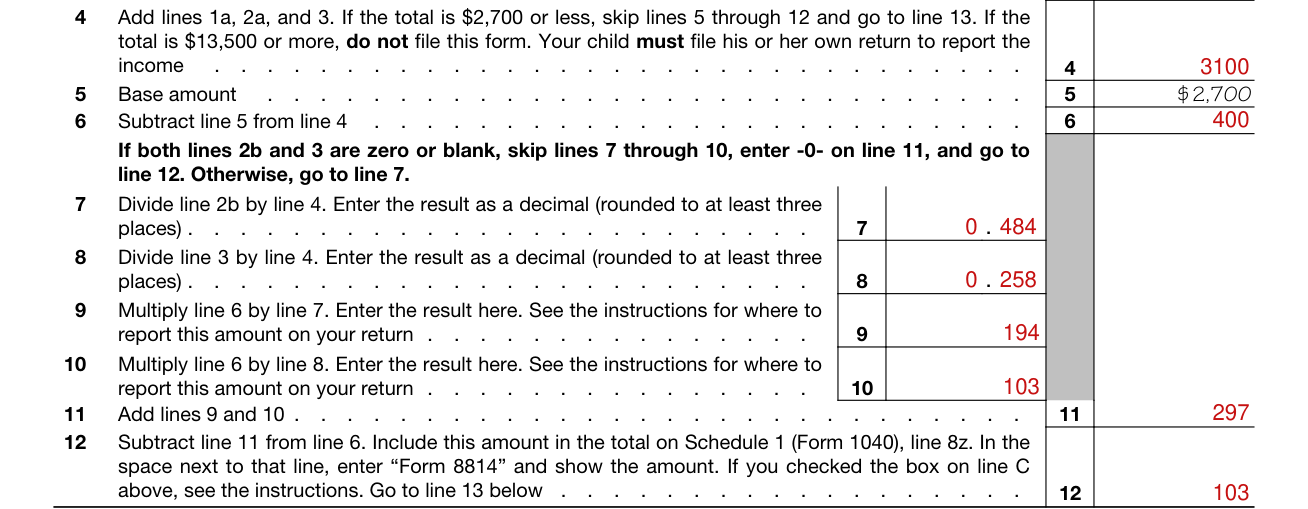
On line 4, add lines 1a, 2a, and 3. If the total is $2,700 or less, skip lines 5 through 12 and go to line 13 (checked October 26, 2026). If the total is $13,500 or more, do not file this form (checked October 26, 2026). Your child must file his or her own return to report the income. Line 5, the base amount, is $2,700 (checked October 26, 2026). On line 6, subtract line 5 from line 4. If both lines 2b and 3 are zero or blank, skip lines 7 through 10, enter -0- on line 11, and go to line 12. Otherwise, go to line 7. On line 7, divide line 2b by line 4. Enter the result as a decimal (rounded to at least three places). On line 8, divide line 3 by line 4. Enter the result as a decimal (rounded to at least three places). On line 9, multiply line 6 by line 7. Enter the result on line 9. See the instructions for where to report this amount on your return. On line 10, multiply line 6 by line 8. Enter the result on line 10. See the instructions for where to report this amount on your return. On line 11, add lines 9 and 10. Go to line 12.

On line 12, subtract line 11 from line 6. Include this amount in the total on Schedule 1 (Form 1040), line 8z. In the space next to that line, enter "Form 8814" and show the amount. If you checked the box on line C, see the instructions. Go to line 13.
If you checked the box on line C, add the amounts from line 12 of all your Forms 8814. Include the result on Schedule 1 (Form 1040), line 8z.[2]

Line 13, Amount not taxed, is $1,350 (checked October 26, 2026). On line 14, subtract line 13 from line 4. If the result is zero or less, enter -0-. On line 15, Tax: Is the amount on line 14 less than $1,350 (checked October 26, 2026)?

No. Enter $135 on line 15 and see the Note (checked October 26, 2026). Yes. Multiply line 14 by 10% (0.10). Enter the result on line 15 and see the Note.
Note: If you checked the box on line C, see the instructions. Otherwise, include the amount from line 15 in the tax you enter on Form 1040,1040-SR, or 1040-NR, line 16. Be sure to check box 1 on Form 1040, 1040-SR, or 1040-NR, line 16.
You can make this election if your child meets all of the following conditions.
The child was under age 19 (or under age 24 if a full-time student) at the end of 2025.
The child's only income was from interest and dividends, including capital gain distributions and Alaska Permanent Fund dividends.
The child's gross income for 2025 was less than $13,500 (checked October 26, 2026).
The child is required to file a 2025 return.
The child does not file a joint return for 2025.
There were no estimated tax payments for the child for 2025 (including any overpayment of tax from his or her 2024 return applied to 2025 estimated tax).
There was no federal income tax withheld from the child's income.[2]
You qualify to make this election if you file Form 1040, 1040-SR, or 1040-NR and any of the following apply.
You are filing a joint return for 2025 with the child's other parent.
You and the child's other parent were married to each other but file separate returns for 2025 and you had the higher taxable income.
You were unmarried, treated as unmarried for federal income tax purposes, or separated from the child's other parent by a divorce or separate maintenance decree. The child must have lived with you for most of the year (you were the custodial parent).[2]
Caution: The federal income tax on your child's income, including qualified dividends and capital gain distributions, may be less if you file a separate tax return for the child instead of making this election. This is because you cannot take certain tax benefits that your child could take on his or her own return. For details, see Tax benefits you cannot take in the instructions.
If your child received qualified dividends or capital gain distributions, you may pay up to $135 more tax if you make this election instead of filing a separate tax return for the child (checked October 26, 2026).[2]
If you elect to report your child's income on your return, you cannot take certain deductions that your child could take on his or her own return such as: additional standard deduction of $2,000 if the child is blind (checked October 26, 2026), penalty on early withdrawal of child's savings, and itemized deductions such as the child's charitable contributions.[2]
Form 8814 is the Parents' Election To Report Child's Interest and Dividends. Use this form if you elect to report your child's income on your return. If you do, your child will not have to file a return.[2]
To make the election, complete and attach Form(s) 8814 to your tax return and file your return by the due date (including extensions).[2]
Attach to parents' Form 1040, 1040-SR, or 1040-NR. Go to www.irs.gov/Form8814 for the latest information.
If you make this election for 2025 and didn't have enough tax withheld or pay enough estimated tax to cover the tax you owe, you may be subject to a penalty.[2]
[1] Form 8814 (2025), Parents' Election To Report Child's Interest and Dividends, Internal Revenue Service (the Official source link on this page).