
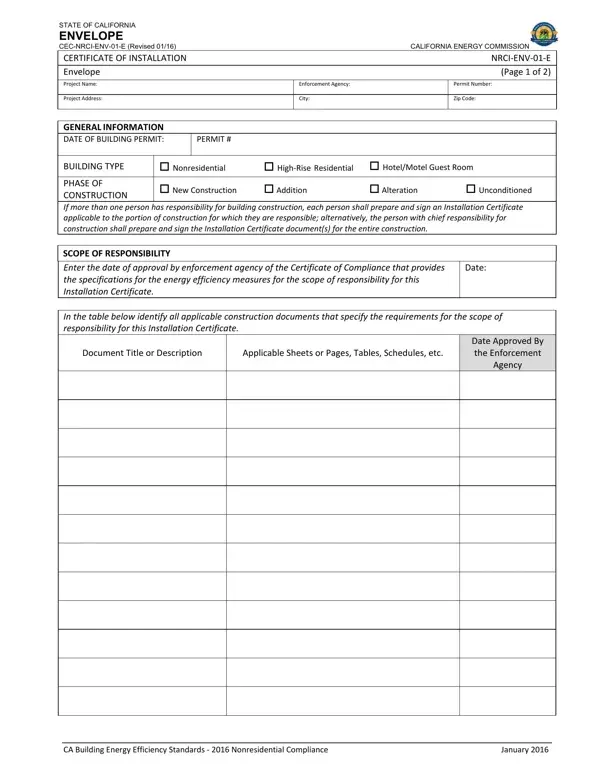
The 01 E Env form, officially known as the California Energy Commission Certificate of Installation NRCI-ENV-01-E, is a crucial document for a wide range of construction projects within California. Revised in January 2016, this two-page form plays a pivotal role in ensuring that buildings comply with the state's energy efficiency standards. It is required for nonresidential buildings, high-rise residential structures, and hotel/motel guest rooms, whether the project involves new construction, addition, alteration, or unconditioned spaces. For projects with multiple stakeholders, each individual responsible for a portion of the construction must either prepare and sign their own Installation Certificate or delegate this task to a primary individual who then becomes responsible for the entire project's certification. The form requires detailed information about the project, including the project name, enforcement agency, permit number, and project address. It also calls for an acknowledgment of responsibility from both the documentation author and the responsible builder or installer, who must certify under penalty of perjury that all installations conform to the specified requirements and applicable codes and regulations. Additionally, this document emphasizes the necessity of making a completed signed copy available both at the construction site for inspections and with the building permits, as well as including it in the documentation provided to the building owner upon occupancy. This ensures transparency and adherence to the California Building Energy Efficiency Standards, solidifying the state's commitment to sustainable construction practices.
| Question | Answer |
|---|---|
| Form Name | 01 E Env Form |
| Form Code | NRCI-ENV-01-E |
| Issuing Agency | California Energy Commission |
| Form Length | 2 pages |
| Fillable? | No |
| Fillable fields | 0 |
| Avg. time to fill out | 30 sec |
| Other names | cec nrci env, 2016 env 01, cec env e 01, env e envelope |