
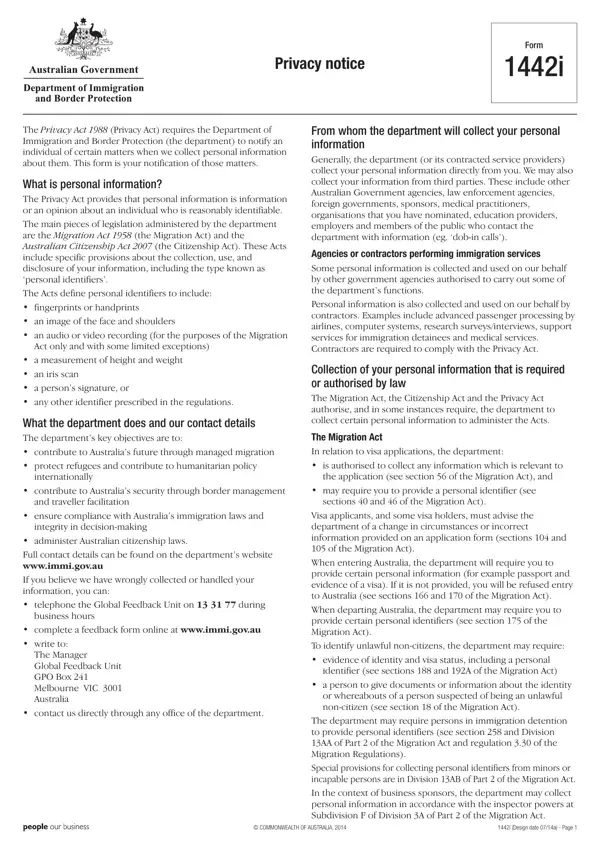
The 1442I Form is an Australian government privacy notice that explains how the Department of Home Affairs collects and uses personal information. All visa applicants receive this form. It has 4 pages, requires nothing to be filled in, and exists to inform you of your privacy rights and the department's duties under the Privacy Act 1988. Knowing what this notice says helps you understand exactly what you are agreeing to when you submit an immigration application.
The form was created to meet the department's legal duty under the Privacy Act 1988 (Cth). It lets individuals know how their personal data is collected, used, stored, and shared during immigration and citizenship processing. Every visa applicant receives this document as part of their application package. Reading it helps you know your rights before you give the department any personal details. Without this notice, the department would not be able to legally collect personal information from you.
The form covers any data that can identify a person. This includes names, dates of birth, passport numbers, and home addresses. It also covers biometric data such as fingerprints, handprints, and facial images. The department collects this data mainly from you directly. In some cases it may come from other sources, including government agencies, police, registered migration agents, or sponsoring employers. The document explains each category of data and why the department needs it.
The form comes with most Australian visa and immigration applications. You do not need to fill in any fields. You will see it alongside the Australian visa application form, Form 80 (Personal Particulars for Character Assessment), and Form 1440. Border staff and migration agents give out this notice at the start of any immigration interaction. Keep a copy for your records in case you need to refer back to it later.
Anyone applying for an Australian visa receives this privacy notice. This includes primary applicants, secondary applicants listed in a family group, and their authorised migration agents. Australian citizens helping a family member with a sponsorship or nomination may also see this document. Migration agents are legally required to give their clients this notice before collecting any personal details on their behalf. If you are applying through an agent, ask them to explain any section you do not understand.
The form explains what happens if you choose not to supply the requested data. In most cases, the department will not be able to process or grant your visa. For biometric data, refusing to provide it can lead to visa refusal under the Migration Act 1958. The document lists which details are required and which are optional, so you can see exactly what is needed for your application. In general, the more complete your submission, the faster the department can process your case.
The department may pass your information to other bodies in the cases set out in the notice. Within Australia, these include the Australian Federal Police, state law enforcement agencies, and contractors who support immigration services. Internationally, data may be shared under bilateral agreements with countries such as New Zealand, the United States, Canada, and the United Kingdom to support border management and law enforcement cooperation. The document details each situation so you know when cross-border sharing may occur and which overseas agencies may receive your data.
You have the right to access the personal information the department holds about you and to ask for corrections if any details are wrong. These rights come from the Australian Privacy Principles (APPs) under the Privacy Act 1988. To use these rights, contact the department's Privacy Contact Officer directly. If you think your privacy has been breached, you can also make a formal complaint to the Office of the Australian Information Commissioner (OAIC), which is Australia's independent privacy regulator.
| Question | Answer |
|---|---|
| Form Name | 1442I Form (Privacy Notice) |
| Issuing Authority | Australian Department of Home Affairs |
| Applicable Legislation | Privacy Act 1988 (Cth) |
| Form Length | 4 pages |
| Fillable? | No (read-only document) |
| Purpose | Privacy notice for visa and immigration applicants |
| When Needed | Submitted with visa and immigration applications |
| Other names | form 1442i, 1442i form, australian citizenship form 1442i, form 1442, 1442i privacy notice australia |
1442I Form isn’t the one you’re looking for?