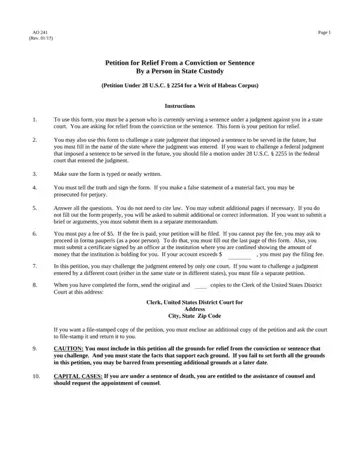
2254 Form PDF Details

The 2254 form, officially the Petition for Relief From a Conviction or Sentence By a Person in State Custody (Petition Under 28 U.S.C. § 2254 for a Writ of Habeas Corpus), is the primary legal tool for state prisoners to challenge their conviction or sentence in federal court. This petition applies to anyone currently in state custody under a judgment believed to violate the U.S. Constitution, a federal law, or a treaty.

Before filing Form 2254, petitioners must exhaust all state remedies available for each ground they intend to raise. Common grounds for relief include ineffective assistance of counsel, prosecutorial misconduct, newly discovered evidence of innocence, and violations of due process or equal protection. The petition must list all grounds in the initial filing, as claims not included may not be raised in future submissions. A filing fee is required, though petitioners who cannot afford it may apply for a fee waiver using the court's in forma pauperis form.

Capital cases in which the petitioner faces a death sentence require special handling, and these petitioners have the right to appointed counsel. For related habeas corpus forms, see our sample petition for writ of habeas corpus and US Courts Form 271. Browse our full legal document templates collection for other court and petition forms.

QuestionAnswer
Form Name2254 Form
Form Length16 pages
Fillable?No
Fillable fields0
Avg. time to fill out4 min
Other names2254 forms irs pdf form, 2254 form irs, federal habeas corpus, how to file a 2254

Form Preview Example

AO 241

Page 1

(Rev. 01/15)


Petition for Relief From a Conviction or Sentence

By a Person in State Custody

(Petition Under 28 U.S.C. § 2254 for a Writ of Habeas Corpus)

Instructions

1.To use this form, you must be a person who is currently serving a sentence under a judgment against you in a state court. You are asking for relief from the conviction or the sentence. This form is your petition for relief.

2.You may also use this form to challenge a state judgment that imposed a sentence to be served in the future, but you must fill in the name of the state where the judgment was entered. If you want to challenge a federal judgment that imposed a sentence to be served in the future, you should file a motion under 28 U.S.C. § 2255 in the federal court that entered the judgment.

3.Make sure the form is typed or neatly written.

4.You must tell the truth and sign the form. If you make a false statement of a material fact, you may be prosecuted for perjury.

5.Answer all the questions. You do not need to cite law. You may submit additional pages if necessary. If you do not fill out the form properly, you will be asked to submit additional or correct information. If you want to submit a brief or arguments, you must submit them in a separate memorandum.

6.You must pay a fee of $5. If the fee is paid, your petition will be filed. If you cannot pay the fee, you may ask to proceed in forma pauperis (as a poor person). To do that, you must fill out the last page of this form. Also, you must submit a certificate signed by an officer at the institution where you are confined showing the amount of

money that the institution is holding for you. If your account exceeds $


, you must pay the filing fee.


7.In this petition, you may challenge the judgment entered by only one court. If you want to challenge a judgment entered by a different court (either in the same state or in different states), you must file a separate petition.

8.

When you have completed the form, send the original and


copies to the Clerk of the United States District


Court at this address:


Clerk,Clerk,UnitedUnitedStatesStatesDistrictDistrictCourt forCourt for

AddressAddress

City, City,State StateZip CodeZip Code

If you want a file-stamped copy of the petition, you must enclose an additional copy of the petition and ask the court to file-stamp it and return it to you.

9.CAUTION: You must include in this petition all the grounds for relief from the conviction or sentence that you challenge. And you must state the facts that support each ground. If you fail to set forth all the grounds in this petition, you may be barred from presenting additional grounds at a later date.

10.CAPITAL CASES: If you are under a sentence of death, you are entitled to the assistance of counsel and should request the appointment of counsel.

AO 241

Page 2

(Rev. 01/15)


PETITION UNDER 28 U.S.C. § 2254 FOR WRIT OF

HABEAS CORPUS BY A PERSON IN STATE CUSTODY

United States District Court

Name (under which you were convicted):

District:

Docket or Case No.:

Place of Confinement :

Prisoner No.:

Petitioner (include the name under which you were convicted)

Respondent (authorized person having custody of petitioner)

v.

The Attorney General of the State of:

PETITION

1.(a) Name and location of court that entered the judgment of conviction you are challenging:

(b)Criminal docket or case number (if you know):

2.(a) Date of the judgment of conviction (if you know):

(b)Date of sentencing:

3.Length of sentence:

4.

In this case, were you convicted on more than one count or of more than one crime? Yes

No

5.Identify all crimes of which you were convicted and sentenced in this case:

6.(a) What was your plea? (Check one)

(1)

Not guilty

(3)

Nolo contendere (no contest)

(2)

Guilty

(4)

Insanity plea

AO 241

Page 3

(Rev. 01/15)


(b)If you entered a guilty plea to one count or charge and a not guilty plea to another count or charge, what did you plead guilty to and what did you plead not guilty to?

(c) If you went to trial, what kind of trial did you have? (Check one)

Jury Judge only

7.Did you testify at a pretrial hearing, trial, or a post-trial hearing?

Yes No

8.Did you appeal from the judgment of conviction?

Yes No

9.If you did appeal, answer the following:

(a)Name of court:

(b)Docket or case number (if you know):

(c)Result:

(d)Date of result (if you know):

(e)Citation to the case (if you know):

(f)Grounds raised:

(g) Did you seek further review by a higher state court?

Yes

No

If yes, answer the following:


(1)

Name of court:


(2)

Docket or case number (if you know):


(3)

Result:


(4) Date of result (if you know):

AO 241

Page 4

(Rev. 01/15)


(5)Citation to the case (if you know):

(6)Grounds raised:

(h) Did you file a petition for certiorari in the United States Supreme Court?

Yes

No

If yes, answer the following:


(1)Docket or case number (if you know):

(2)Result:

(3)Date of result (if you know):

(4)Citation to the case (if you know):

10.Other than the direct appeals listed above, have you previously filed any other petitions, applications, or motions

concerning this judgment of conviction in any state court?

Yes

No

11.If your answer to Question 10 was "Yes," give the following information:

(a)(1) Name of court:

(2)Docket or case number (if you know):

(3)Date of filing (if you know):

(4)Nature of the proceeding:

(5)Grounds raised:

(6)Did you receive a hearing where evidence was given on your petition, application, or motion?

Yes No

(7)Result:

(8)Date of result (if you know):

AO 241

Page 5

(Rev. 01/15)


(b)If you filed any second petition, application, or motion, give the same information:

(1)Name of court:

(2)Docket or case number (if you know):

(3)Date of filing (if you know):

(4)Nature of the proceeding:

(5)Grounds raised:

(6)Did you receive a hearing where evidence was given on your petition, application, or motion?

Yes No

(7)Result:

(8)Date of result (if you know):

(c)If you filed any third petition, application, or motion, give the same information:

(1)Name of court:

(2)Docket or case number (if you know):

(3)Date of filing (if you know):

(4)Nature of the proceeding:

(5)Grounds raised:

AO 241

Page 6

(Rev. 01/15)


(6)Did you receive a hearing where evidence was given on your petition, application, or motion?

Yes No

(7)Result:

(8)Date of result (if you know):

(d)Did you appeal to the highest state court having jurisdiction over the action taken on your petition, application, or motion?

(1)

First petition:

Yes

No

(2)

Second petition:

Yes

No

(3)

Third petition:

Yes

No

(e)If you did not appeal to the highest state court having jurisdiction, explain why you did not:

12.For this petition, state every ground on which you claim that you are being held in violation of the Constitution, laws, or treaties of the United States. Attach additional pages if you have more than four grounds. State the facts supporting each ground.

CAUTION: To proceed in the federal court, you must ordinarily first exhaust (use up) your available state-court remedies on each ground on which you request action by the federal court. Also, if you fail to set forth all the grounds in this petition, you may be barred from presenting additional grounds at a later date.

GROUND ONE:

(a) Supporting facts (Do not argue or cite law. Just state the specific facts that support your claim.):

(b) If you did not exhaust your state remedies on Ground One, explain why:

AO 241

Page 7

(Rev. 01/15)


(c)Direct Appeal of Ground One:

(1) If you appealed from the judgment of conviction, did you raise this issue?

Yes

No

(2)If you did not raise this issue in your direct appeal, explain why:

(d)Post-Conviction Proceedings:

(1)Did you raise this issue through a post-conviction motion or petition for habeas corpus in a state trial court?

Yes No

(2)If your answer to Question (d)(1) is "Yes," state:

Type of motion or petition:

Name and location of the court where the motion or petition was filed:

Docket or case number (if you know):

Date of the court's decision:

Result (attach a copy of the court's opinion or order, if available):

(3)

Did you receive a hearing on your motion or petition?

Yes

No

(4)

Did you appeal from the denial of your motion or petition?

Yes

No

(5)

If your answer to Question (d)(4) is "Yes," did you raise this issue in the appeal?

Yes

No

(6)If your answer to Question (d)(4) is "Yes," state: Name and location of the court where the appeal was filed:

Docket or case number (if you know):

Date of the court's decision:

Result (attach a copy of the court's opinion or order, if available):

(7) If your answer to Question (d)(4) or Question (d)(5) is "No," explain why you did not raise this issue:

AO 241

Page 8

(Rev. 01/15)


(e)Other Remedies: Describe any other procedures (such as habeas corpus, administrative remedies, etc.) that you have used to exhaust your state remedies on Ground One:

GROUND TWO:

(a) Supporting facts (Do not argue or cite law. Just state the specific facts that support your claim.):

(b)If you did not exhaust your state remedies on Ground Two, explain why:

(c)Direct Appeal of Ground Two:

(1) If you appealed from the judgment of conviction, did you raise this issue?

Yes

No

(2)If you did not raise this issue in your direct appeal, explain why:

(d)Post-Conviction Proceedings:

(1)Did you raise this issue through a post-conviction motion or petition for habeas corpus in a state trial court?

Yes No

(2)If your answer to Question (d)(1) is "Yes," state:

Type of motion or petition:

Name and location of the court where the motion or petition was filed:

Docket or case number (if you know):

Date of the court's decision:

AO 241

Page 9

(Rev. 01/15)


Result (attach a copy of the court's opinion or order, if available):

(3)

Did you receive a hearing on your motion or petition?

Yes

No

(4)

Did you appeal from the denial of your motion or petition?

Yes

No

(5)

If your answer to Question (d)(4) is "Yes," did you raise this issue in the appeal?

Yes

No

(6)If your answer to Question (d)(4) is "Yes," state: Name and location of the court where the appeal was filed:

Docket or case number (if you know):

Date of the court's decision:

Result (attach a copy of the court's opinion or order, if available):

(7)If your answer to Question (d)(4) or Question (d)(5) is "No," explain why you did not raise this issue:

(e)Other Remedies: Describe any other procedures (such as habeas corpus, administrative remedies, etc.) that you have used to exhaust your state remedies on Ground Two :

GROUND THREE:

(a) Supporting facts (Do not argue or cite law. Just state the specific facts that support your claim.):

AO 241

Page 10

(Rev. 01/15)


(b)If you did not exhaust your state remedies on Ground Three, explain why:

(c)Direct Appeal of Ground Three:

(1) If you appealed from the judgment of conviction, did you raise this issue?

Yes

No

(2)If you did not raise this issue in your direct appeal, explain why:

(d)Post-Conviction Proceedings:

(1)Did you raise this issue through a post-conviction motion or petition for habeas corpus in a state trial court?

Yes No

(2)If your answer to Question (d)(1) is "Yes," state:

Type of motion or petition:

Name and location of the court where the motion or petition was filed:

Docket or case number (if you know):

Date of the court's decision:

Result (attach a copy of the court's opinion or order, if available):

(3)

Did you receive a hearing on your motion or petition?

Yes

No

(4)

Did you appeal from the denial of your motion or petition?

Yes

No

(5)

If your answer to Question (d)(4) is "Yes," did you raise this issue in the appeal?

Yes

No

(6)If your answer to Question (d)(4) is "Yes," state: Name and location of the court where the appeal was filed:

Docket or case number (if you know):

Date of the court's decision:

Result (attach a copy of the court's opinion or order, if available):

How to Edit 2254 Form Online for Free

Before You Begin

Before using Form 2254, confirm that you have exhausted all available state court remedies for every ground you plan to raise. Federal courts will not review a habeas petition until state post-conviction options have been fully pursued. If you need guidance on what a completed habeas petition looks like, review a sample writ of habeas corpus petition first. The step-by-step instructions below will guide you through completing Form 2254 using our free online PDF editor.

Step 1: Hit the orange "Get Form Now" button on this page.

Step 2: Once you access the 28 u s c 2254 form editing page, you'll see all the options you can undertake with regards to your file within the upper menu.

Enter the appropriate information in each one segment to fill in the PDF 28 u s c 2254 form

2254 form irs fields to complete

Make sure you submit the data within the area PETITION UNDER USC FOR WRIT OF, United States District Court, District, Name under which you were convicted, Docket or Case No, Place of Confinement, Prisoner No, Petitioner include the name under, Respondent authorized person, The Attorney General of the State, PETITION, and a Name and location of court that.

step 2 to completing 2254 form irs

The system will ask for more details with the intention to effortlessly prepare the field b Criminal docket or case number, a Date of the judgment of, b Date of sentencing, Length of sentence, In this case were you convicted on, and Identify all crimes of which you.

2254 form irs b Criminal docket or case number, a Date of the judgment of, b Date of sentencing, Length of sentence, In this case were you convicted on, and Identify all crimes of which you blanks to complete

Take the time to identify the rights and obligations of the parties within the a What was your plea Check one, Not guilty, Nolo contendere no contest, Guilty, and Insanity plea part.

2254 form irs a What was your plea Check one, Not guilty, Nolo contendere no contest, Guilty, and Insanity plea blanks to insert

Finalize by analyzing the following sections and filling them in as needed: b If you entered a guilty plea to, you plead guilty to and what did, c If you went to trial what kind, Jury, Judge only, Did you testify at a pretrial, Yes, Did you appeal from the judgment, Yes, If you did appeal answer the, a Name of court, b Docket or case number if you know, and c Result.

part 5 to finishing 2254 form irs

Step 3: After you've hit the Done button, your file is going to be available for upload to every electronic device or email you identify.

Step 4: Be sure to stay clear of possible future issues by preparing a minimum of a pair of copies of the file.

Common Mistakes to Avoid When Filing Form 2254

Many 2254 petitions are dismissed due to avoidable errors. The most critical mistake is failing to list all grounds for relief in the initial petition. Claims not raised in the first 2254 filing may be permanently barred from future federal review. Other common errors include missing the one-year statute of limitations, failing to identify the specific constitutional right that was violated, and submitting convictions from different courts on a single petition when separate filings are required. For additional federal court resources, see US Courts Form 271 and our full library of legal document templates.

Watch 2254 Form Video Instruction

Please rate 2254 Form

1 Votes
If you believe this page is infringing on your copyright, please familiarize yourself with and follow our DMCA notice and takedown process - click here to proceed .