

5-Minute Personality Test at a glance
What it is: There are ten horizontal lines with four words on each line, one in each column; each letter (L, O, G, B) stands for a particular personality type.
A filled-in 5-Minute Personality Test example: Sam ranks the words and totals the columns
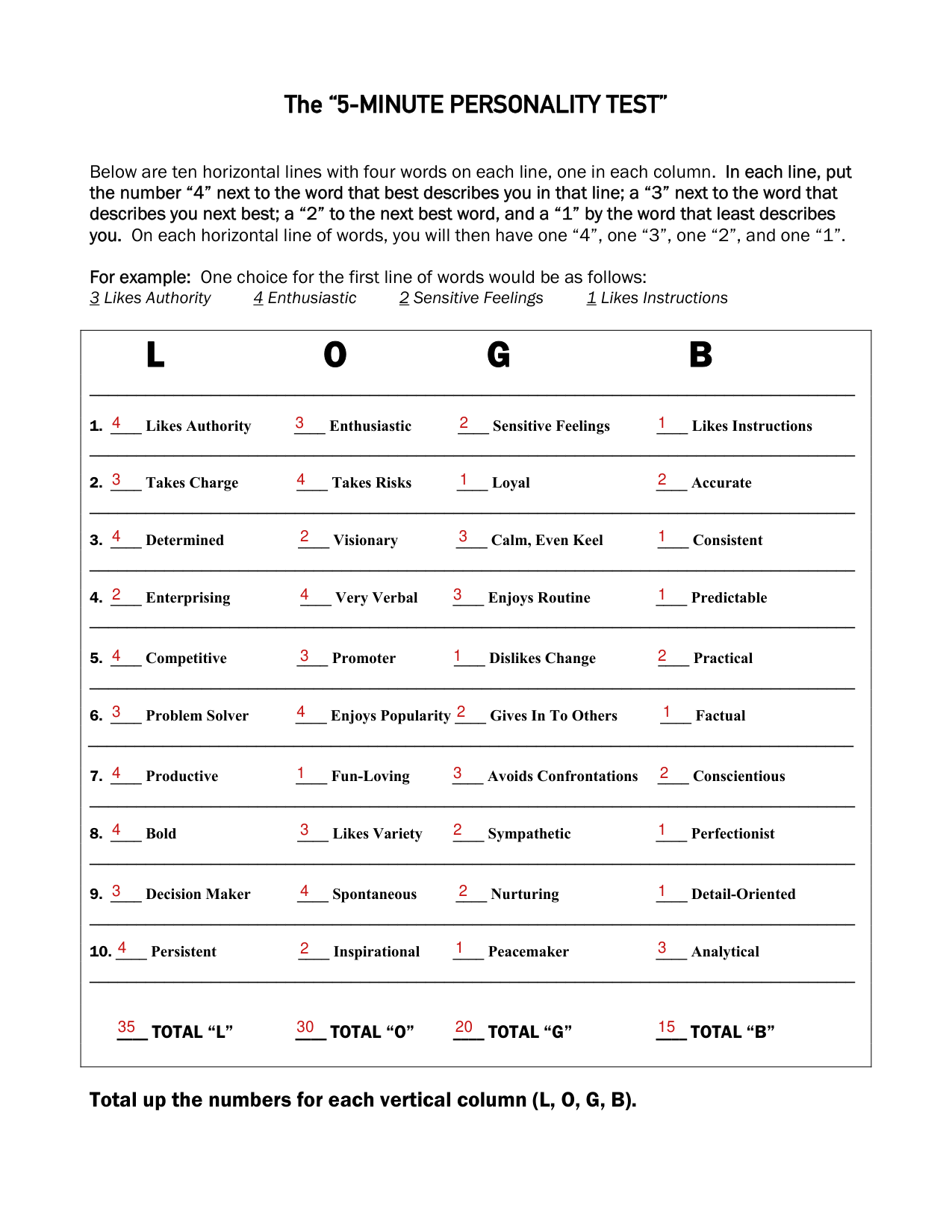
How to fill out 5-Minute Personality Test, box by box
Ten horizontal lines of four words
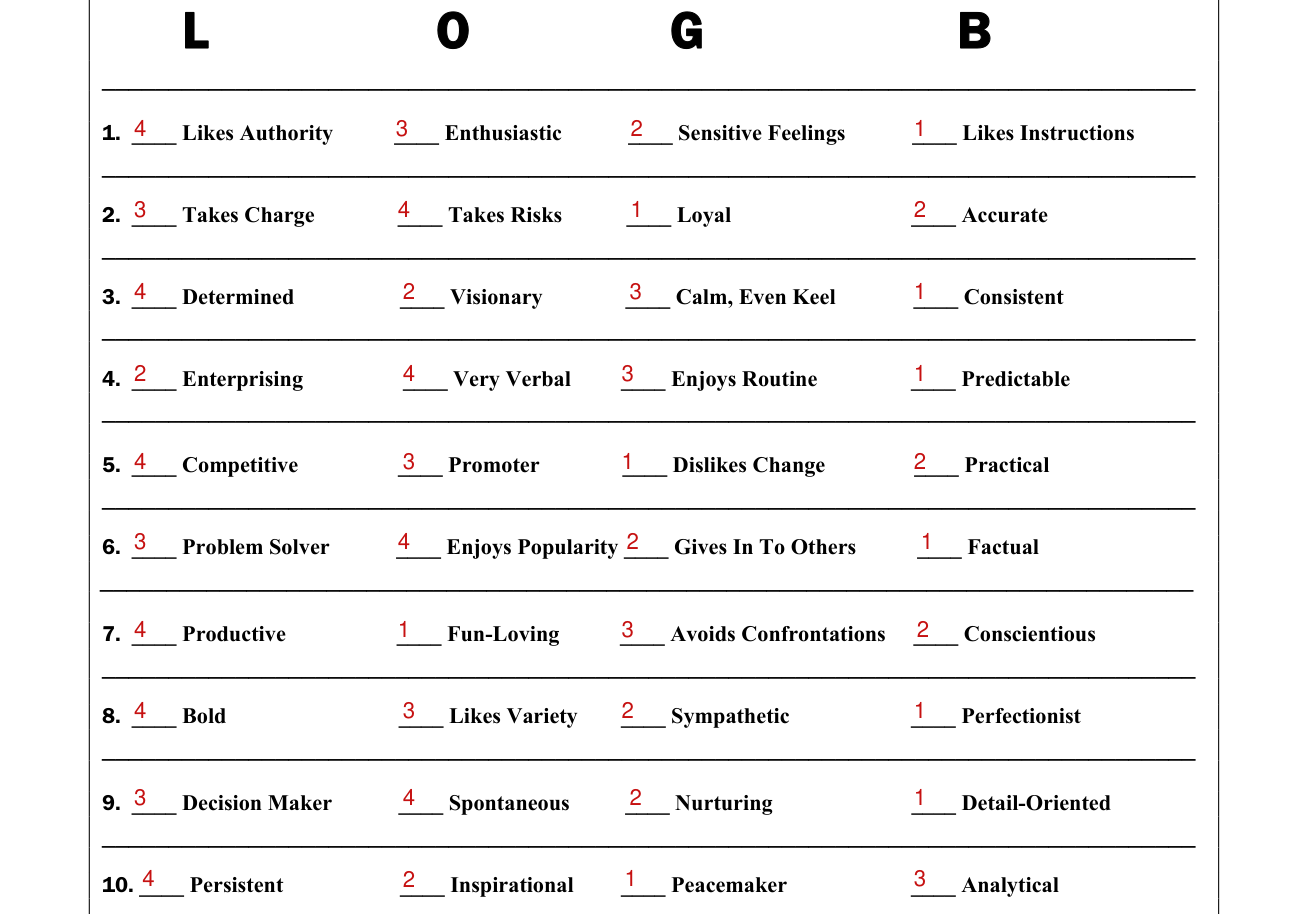
In each line, put the number “4” next to the word that best describes you in that line; a “3” next to the word that describes you next best; a “2” to the next best word, and a “1” by the word that least describes you.
On each horizontal line of words, you will then have one “4”, one “3”, one “2”, and one “1”.
Total up the numbers for each vertical column

Total up the numbers for each vertical column (L, O, G, B).
If your situation is different
What does all of this mean?
Now that you've taken the survey, what does it all mean?
The column with the highest score is your dominant personality type, while the column with the second highest number is your sub-dominant type.
While you are a combination of all four personality types, the two types with the highest scores reveal the most accurate picture of your natural inclinations, strengths and weaknesses, and how you will naturally respond in most situations.
The four personality types can be likened to animals to make them easier to understand and remember.
L = Lions
L = Lions Lions are leaders.
They are usually the bosses at work…or at least they think they are!
They are decisive, bottom line folks who are observers, not watchers or listeners.
They love to solve problems.
They are usually individualists who love to seek new adventures and opportunities.
Lions are very confident and self-reliant.
In a group setting, if no one else instantly takes charge, the Lion will.
Unfortunately, if they don't learn how to tone down their aggressiveness, their natural dominating traits can cause problems with others.
Most entrepreneurs are strong lions, or at least have a lot of lion in them.
Basic Disposition: Fast-paced, task oriented Motivated by: Results; challenge, action, power, and credit for achievement Time Management: Lions focus on NOW instead of distant future.
They get a lot more done in a lot less time than their peers.
Hate wasting time; and like to get right to the point.
Communication Style: Great at initiating communication; not good at listening (one way communicator) Decision Making: Impulsive; makes quick decisions with goal or end result in mind.
Results-focused.
Needs very few facts to make a decision.
In Pressure or Tense Situations: The lion takes command and becomes autocratic.
Greatest Needs: The lion needs to see results, experience variety, and face new challenges.
He needs to solve problems and wants direct answers.
What the Lion Desires: Freedom, authority, variety, difficult assignments, opportunity for advancement.
O = Otters
O = Otters Otters are excitable, fun seeking, cheerleader types who love to talk!
They're great at motivating others and need to be in an environment where they can talk and have a vote on major decisions.
The otters' outgoing nature makes them great networkers-they usually know a lot of people who know a lot of people.
They can be very loving and encouraging unless under pressure, when they tend to use their verbal skills to attack.
They have a strong desire to be liked and enjoy being the center of attention.
They are often very attentive to style, clothes, and flash.
Otters are the life of any party; and most people really enjoy being around them.
People-oriented.
Motivated by: Recognition and approval of others Time Management: Otters focus on the future and have a tendency to rush to the next exciting thing.
Communication Style: Enthusiastic and stimulating, often one-way; but can inspire and motivate others.
Decision Making: Intuitive and fast.
Makes lots of “right calls” and lots of wrong ones.
In Pressure or Tense Situations: The otter ATTACKS.
Can be more concerned about their popularity than about achieving tangible results.
Greatest Needs: The otter needs social activities and recognition; activities that are fun, and freedom from details.
What the Otter Desires: Prestige, friendly relationships, opportunity to help and motivate others, and opportunities to verbally share their ideas.
G = Golden Retrievers
G = Golden Retrievers One word describes these people: LOYAL.
They're so loyal, in fact, that they can absorb the most emotional pain and punishment in a relationship and still stay committed.
They are great listeners, incredibly empathetic and warm encouragers.
However, they tend to be such pleasers that they can have great difficulty being assertive in a situation or relationship when it's needed.
Time Management: Golden Retrievers focus on the present and devote lots of time to helping others and building relationships.
Communication Style: Two-way communicator; great listener and provides empathetic response.
Decision Making: Makes decisions more slowly, wants input from others, and often yields to the input In Pressure or Tense Situations: The Golden Retriever gives in to the opinions, ideas, and wishes of others.
Often too tolerant.
Greatest Needs: The Golden Retriever needs security; gradual change and time to adjust to it; an environment free of conflict.
Desires: Quality relationships; security; consistent known environment; a relaxed and friendly environment; freedom to work at own pace.
B = Beavers
B = Beavers Beavers have a strong need to do things right and by the book.
In fact, they are the kind of people who actually read instruction manuals.
They are great at providing quality control in an office, and will provide quality control in any situation or field that demands accuracy, such as accounting, engineering, etc. Because rules, consistency and high standards are so important to beavers, they are often frustrated with others who do not share these same characteristics.
Their strong need for maintaining high (and oftentimes unrealistic) standards can short-circuit their ability to express warmth in a relationship.
Time Management: Beavers tend to work slowly to make sure they are accurate.
Communication Style: Beavers are good listeners, communicate details, and are usually diplomatic.
Decision Making: Avoids making decisions; needs lots of information before they will make a decision In Pressure or Tense Situations: The beaver tries to avoid pressure or tense situations.
They can ignore deadlines.
Greatest Needs: The beaver needs security, gradual change and time to adjust to it.
What the Beaver Desires: Clearly defined tasks, stability, security, low risk, and tasks that require precision and planning.
Sources
[1] 5-Minute Personality Test, the form as served on this page (the Official source link on this page).
