

Form 8606 at a glance
What it is: Form 8606 is Nondeductible IRAs for 2025.
Who signs: Sign Here Only if You Are Filing This Form by Itself and Not With Your Tax Return.
Use Form 8606 to report: nondeductible contributions you made to traditional IRAs; distributions from traditional IRAs, if you have a basis in these IRAs; conversions from traditional IRAs to Roth IRAs; and distributions from Roth IRAs.[2]
File 2025 Form 8606 if any of the following apply.[2]
You made nondeductible contributions to a traditional IRA for 2025.[2]
You received distributions from a traditional IRA in 2025 and your basis in these IRAs is more than zero.[2]
You converted an amount from a traditional IRA to a Roth IRA in 2025.[2]
You received distributions from a Roth IRA in 2025 (other than a rollover, recharacterization, or return of certain contributions; see the instructions for Part III).[2]
What to bring and attach to Form 8606
Attach Form 8606 to 2025 Form 1040, 1040-SR, or 1040-NR.
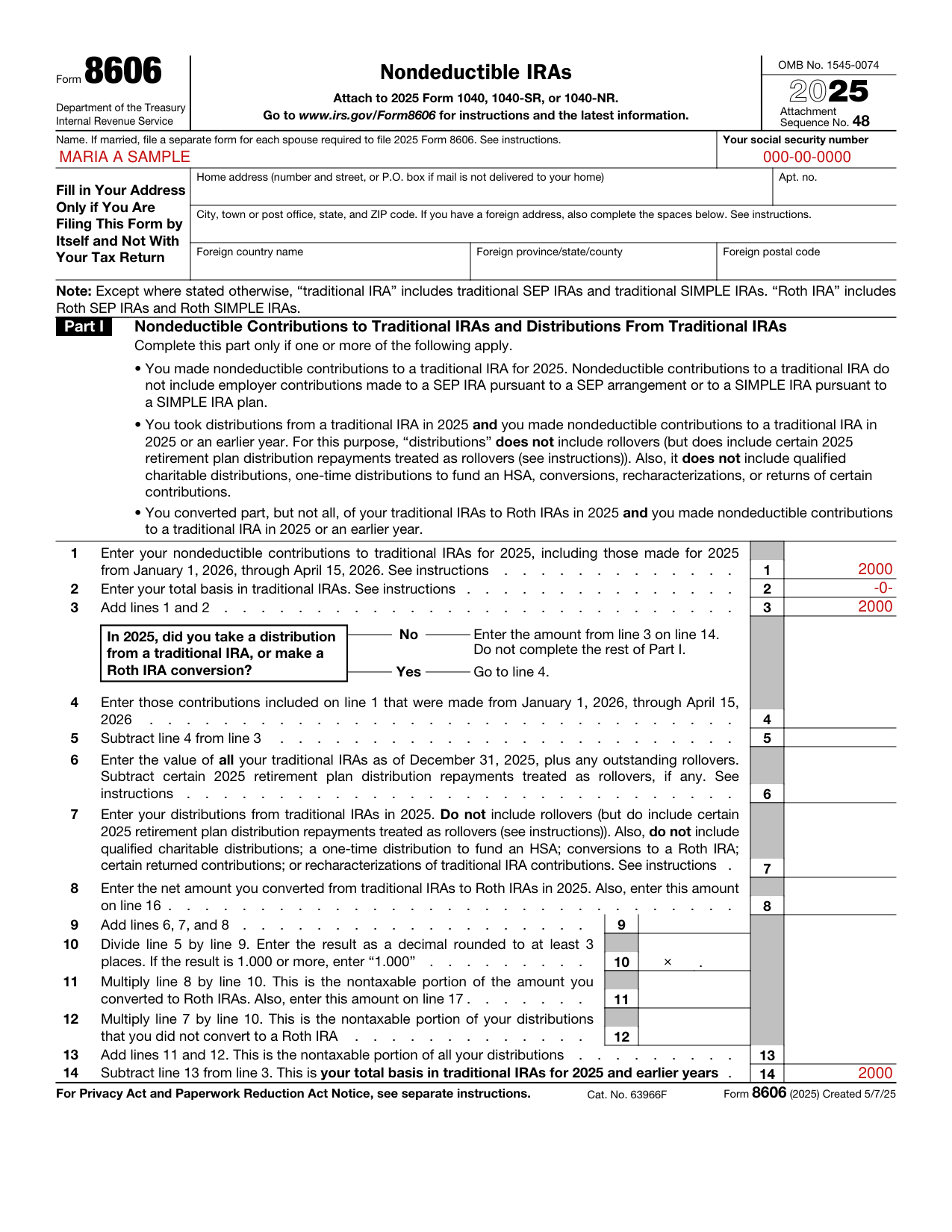
A filled-in Form 8606 example: a single filer reports a nondeductible contribution
How to fill out Form 8606, box by box
Name and Your social security number

Enter your Name and Your social security number. If married, file a separate form for each spouse required to file 2025 Form 8606.
Fill in Your Address Only if You Are Filing This Form by Itself and Not With Your Tax Return

Enter the City, town or post office, state, and ZIP code. If you have a foreign address, also complete these boxes: Foreign country name, Foreign province/state/county, and Foreign postal code.
Part I, lines 1 to 3, Nondeductible Contributions to Traditional IRAs

Line 1: Enter your nondeductible contributions to traditional IRAs for 2025, including those made for 2025 from January 1, 2026, through April 15, 2026.
If you didn't have any deductible contributions, you can make nondeductible contributions up to your contribution limit. Enter on line 1 of Form 8606 your nondeductible contributions.
Line 2: Enter your total basis in traditional IRAs.
Generally, if this is the first year you are required to file Form 8606, enter -0- on line 2. Otherwise, use the Total Basis Chart to find the amount to enter on line 2.
Line 3: Add lines 1 and 2.[2]
In 2025, did you take a distribution from a traditional IRA, or make a Roth IRA conversion?
No: Enter the amount from line 3 on line 14. Do not complete the rest of Part I.
Yes: Go to line 4.
Lines 4 to 14
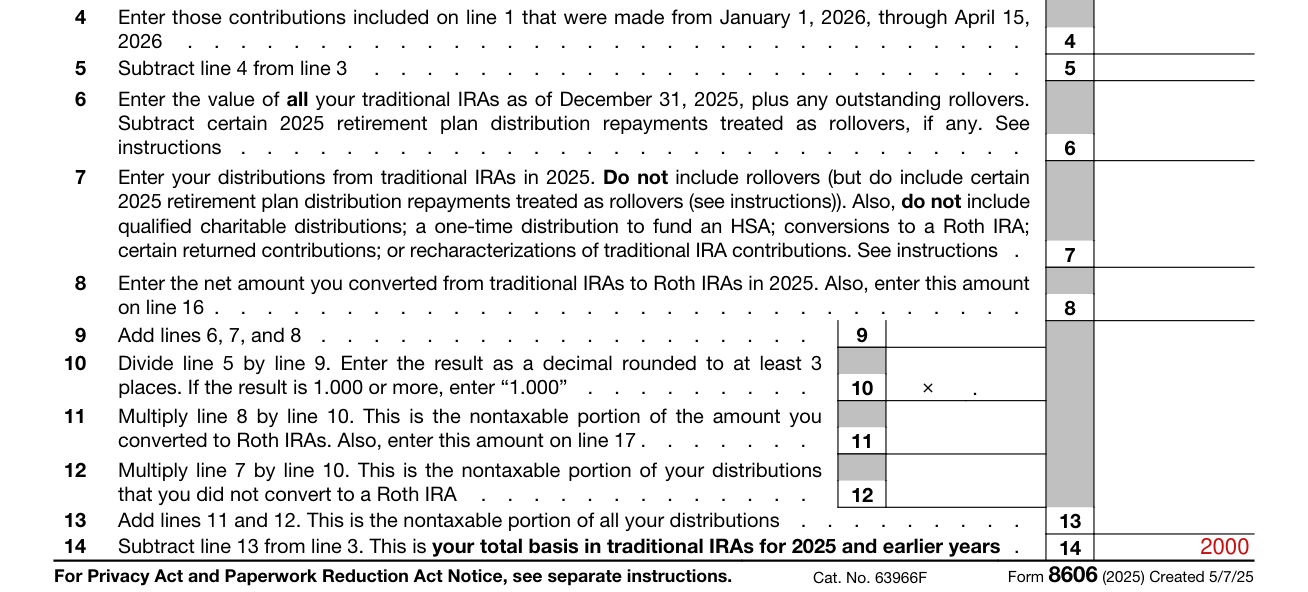
Line 4: Enter those contributions included on line 1 that were made from January 1, 2026, through April 15, 2026.
Line 5: Subtract line 4 from line 3.
Line 6: Enter the value of all your traditional IRAs as of December 31, 2025, plus any outstanding rollovers. Subtract certain 2025 retirement plan distribution repayments treated as rollovers, if any.
Line 7: Enter your distributions from traditional IRAs in 2025. Do not include rollovers (but do include certain 2025 retirement plan distribution repayments treated as rollovers). Also, do not include qualified charitable distributions; a one-time distribution to fund an HSA; conversions to a Roth IRA; certain returned contributions; or recharacterizations of traditional IRA contributions.
Line 8: Enter the net amount you converted from traditional IRAs to Roth IRAs in 2025. Also, enter this amount on line 16.
Line 9: Add lines 6, 7, and 8.
Line 10: Divide line 5 by line 9. Enter the result as a decimal rounded to at least 3 places. If the result is 1.000 or more, enter “1.000”.
Line 11: Multiply line 8 by line 10. This is the nontaxable portion of the amount you converted to Roth IRAs. Also, enter this amount on line 17.
Line 12: Multiply line 7 by line 10. This is the nontaxable portion of your distributions that you did not convert to a Roth IRA.
Line 13: Add lines 11 and 12. This is the nontaxable portion of all your distributions.
Line 14: Subtract line 13 from line 3. This is your total basis in traditional IRAs for 2025 and earlier years.
Part I (continued), lines 15a to 15c
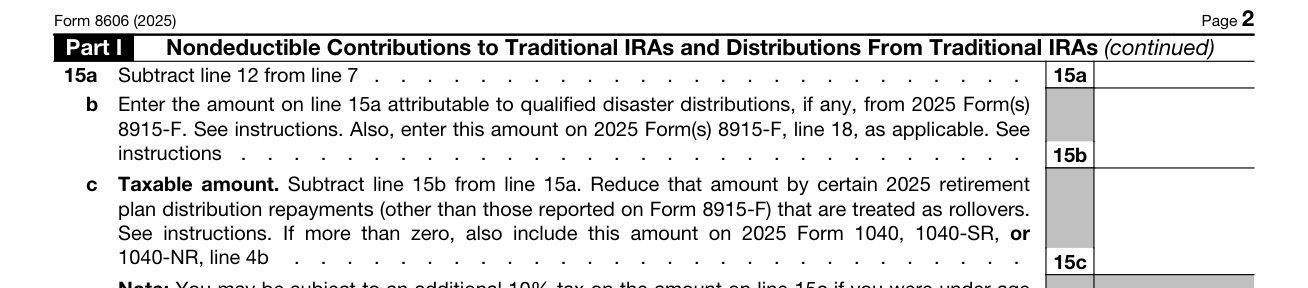
On page 2 of Form 8606 for 2025, Part I (continued), line 15a: Subtract line 12 from line 7.
If you have no qualified disaster distributions in 2025 from a traditional IRA, enter -0- on line 15b.
Line 15c, Taxable amount: Subtract line 15b from line 15a. Reduce that amount by certain 2025 retirement plan distribution repayments (other than those reported on Form 8915-F) that are treated as rollovers. If more than zero, also include this amount on 2025 Form 1040, 1040-SR, or 1040-NR, line 4b.
Note: You may be subject to an additional 10% tax on the amount on line 15c if you were under age 59½ at the time of the distribution.[2]
Part II, lines 16 to 18, Conversions From Traditional IRAs to Roth IRAs

Line 16: If you completed Part I, enter the amount from line 8. Otherwise, enter the net amount you converted from traditional IRAs to Roth IRAs in 2025.
Line 17: If you completed Part I, enter the amount from line 11. Otherwise, enter your basis in the amount on line 16.
Line 18, Taxable amount: Subtract line 17 from line 16.
If your entry on line 18 is zero or less, don't include the result on 2025 Form 1040, 1040-SR, or 1040-NR, line 4b. Include the full amount of the distribution on 2025 Form 1040, 1040-SR, or 1040-NR, line 4a. Part III, Distributions From Roth IRAs: Complete this part only if you took a distribution from a Roth IRA in 2025.[2]
Part III, lines 19 to 25c, Distributions From Roth IRAs
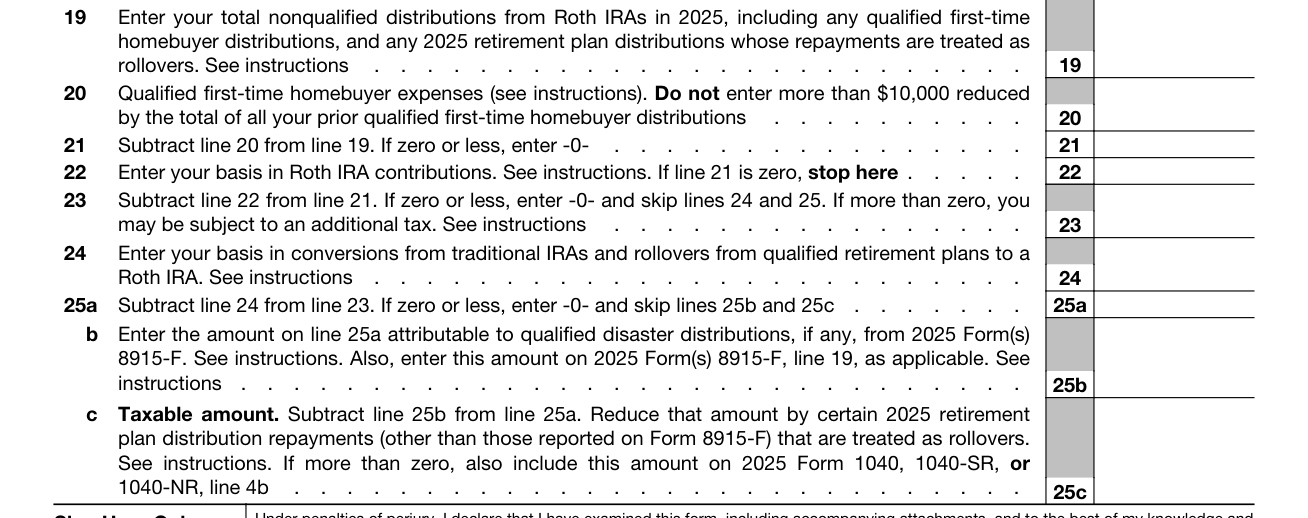
Line 19: Enter your total nonqualified distributions from Roth IRAs in 2025, including any qualified first-time homebuyer distributions, and any 2025 retirement plan distributions whose repayments are treated as rollovers.
Line 20: Enter your qualified first-time homebuyer expenses. Do not enter more than $10,000 reduced by the total of all your prior qualified first-time homebuyer distributions (checked October 19, 2026).
Line 21: Subtract line 20 from line 19. If zero or less, enter -0-.
Line 22: Enter your basis in Roth IRA contributions. If line 21 is zero, stop here.
Line 23: Subtract line 22 from line 21. If zero or less, enter -0- and skip lines 24 and 25. If more than zero, you may be subject to an additional tax. Line 24: Enter your basis in conversions from traditional IRAs and rollovers from qualified retirement plans to a Roth IRA.
Line 25a: Subtract line 24 from line 23. If zero or less, enter -0- and skip lines 25b and 25c.
If you have no qualified disaster distributions in 2025 from a Roth IRA, enter -0- on line 25b.
Line 25c, Taxable amount: Subtract line 25b from line 25a. Reduce it by certain 2025 retirement plan distribution repayments treated as rollovers (other than those reported on Form 8915-F). If more than zero, include it on 2025 Form 1040, 1040-SR, or 1040-NR, line 4b.[2]
Sign Here Only if You Are Filing This Form by Itself and Not With Your Tax Return
Under penalties of perjury, you declare that you have examined this form, including accompanying attachments, and to the best of your knowledge and belief, it is true, correct, and complete.
Common questions about Form 8606
Do I need to file 8606 for Roth IRA contribution?
You don't have to file Form 8606 solely to report regular contributions to Roth IRAs.[2]
Is there a deadline?
File 2025 Form 8606 with your 2025 Form 1040, 1040-SR, or 1040-NR by the due date, including extensions, of your return.[2]
Where do I file it?
If you aren't required to file an income tax return but are required to file 2025 Form 8606, sign 2025 Form 8606 and send it to the IRS at the same time and place you would otherwise file 2025 Form 1040, 1040-SR, or 1040-NR. Be sure to include your address on page 1 of the form and your signature and the date on page 2 of the form.[2]
Is there a penalty?
If you are required to file Form 8606 to report a nondeductible contribution to a traditional IRA for 2025 but don't do so, you must pay a $50 penalty, unless you can show reasonable cause (checked October 19, 2026).[2]
When is this form not the right one?
If you received distributions from a traditional IRA in 2025 and you have never made nondeductible contributions (including nontaxable amounts you rolled over from a qualified retirement plan) to these IRAs, don't report the distributions on 2025 Form 8606. Instead, see Lines 4a and 4b in the 2025 Instructions for Form 1040 or the 2025 Instructions for Form 1040-NR.[2]
Sources
[1] Form 8606 (2025), Nondeductible IRAs, Internal Revenue Service.
[2] Instructions for Form 8606 (2025), Internal Revenue Service.
