

Addiction Severity Index Lite Clinical/Training Version at a glance
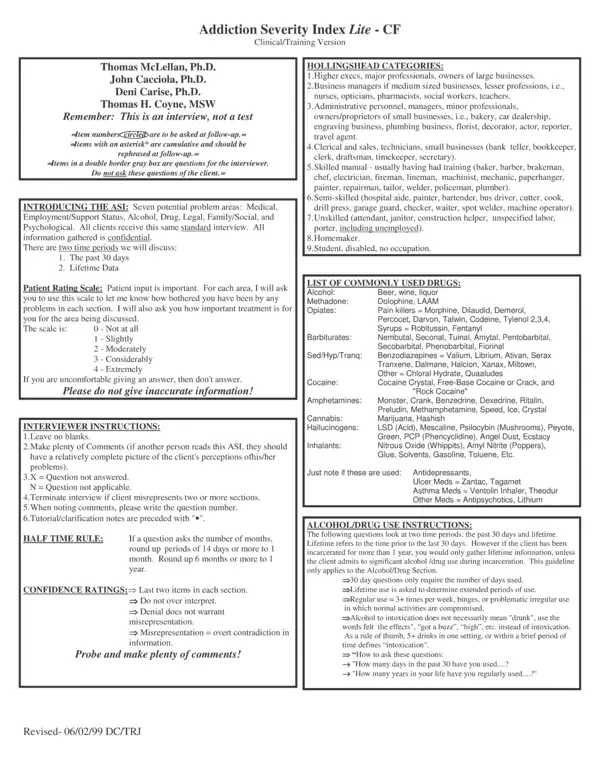
What it is: The Addiction Severity Index Lite Clinical/Training Version is an interview, not a test.
A filled-in Addiction Severity Index Lite Clinical/Training Version example: an interviewer starts an intake
How to fill out Addiction Severity Index Lite Clinical/Training Version, box by box
Agency Name, Site Name and ID #

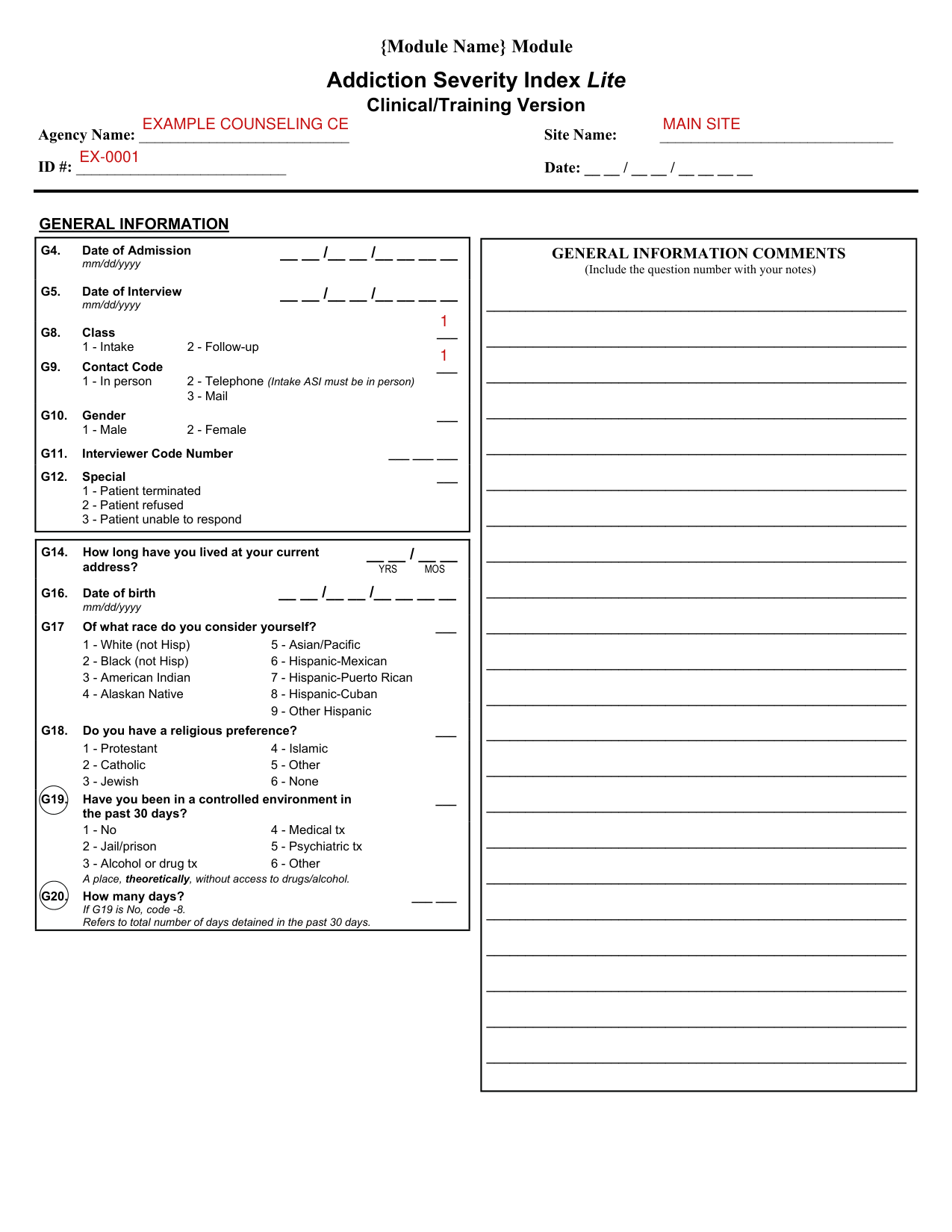
Enter the Agency Name, Site Name and ID # at the top of the page.
Class and Contact Code

In G8, Class, enter 1 - Intake or 2 - Follow-up.
In G9, Contact Code, enter 1 - In person, 2 - Telephone or 3 - Mail. Intake ASI must be in person.
More rules for Addiction Severity Index Lite Clinical/Training Version
Introducing the ASI: there are seven potential problem areas: Medical, Employment/Support Status, Alcohol, Drug, Legal, Family/Social, and Psychological. All clients receive this same standard interview. All information gathered is confidential. There are two time periods to discuss: 1. The past 30 days 2. Lifetime. Patient Rating Scale: patient input is important. For each area, ask the patient to use this scale to say how bothered they have been by any problems in each section, and how important treatment is for the area being discussed. The scale is: 0 - Not at all 1 - Slightly 2 - Moderately 3 - Considerably 4 - Extremely. To the patient: If you are uncomfortable giving an answer, then don't answer. Please do not give inaccurate information.
Interviewer instructions: 1. Leave no blanks. 2. Make plenty of Comments (if another person reads this ASI, they should have a relatively complete picture of the client's perceptions of his/her problems). 3. -9 = Question not answered. -8 = Question not applicable. 4. Terminate interview if client misrepresents two or more sections. 5. When noting comments, write the question number. Half time rule: if a question asks the number of months, round up periods of 14 days or more to 1 month. Round up 6 months or more to 1 year. Confidence ratings: last two items in each section. Do not over interpret. Denial does not warrant misrepresentation. Misrepresentation = overt contradiction in information. Probe, cross-check and make plenty of comments.
Alcohol/drug use instructions: the questions refer to two time periods: the past 30 days and lifetime. Lifetime refers to the time prior to the last 30 days. However, if the client has been incarcerated for more than 1 year, you would only gather lifetime information, unless the client admits to significant alcohol/drug use during incarceration. This guideline only applies to the Alcohol/Drug Section. 30 day questions only require the number of days used. Lifetime use is asked to determine extended periods of use. Regular use = 3+ times per week, binges, or problematic irregular use in which normal activities are compromised. Alcohol to intoxication does not necessarily mean "drunk": use the words "to feel or felt the effects", "got a buzz", "high", etc. instead of intoxication. As a rule of thumb, 5+ drinks in one sitting, or within a brief period of time defines "intoxication." To ask: "How many days in the past 30 have you used....?" and "How many years in your life have you regularly used....?"
In G11, enter the Interviewer Code Number.
For G19, controlled environment in the past 30 days, enter 1 - No, 2 - Jail/prison, 3 - Alcohol or drug tx, 4 - Medical tx, 5 - Psychiatric tx or 6 - Other. If G19 is No, code -8 for G20 (How many days?).
If answer to E4 is No, then E5 must be No. For E5, automobile available for use, ownership is not required, only availability on a regular basis.
For E20, How troubled or bothered have you been by these employment problems in the past 30 days?: if the patient has been incarcerated or detained during the past 30 days, they cannot have employment problems. In that case, code -8.
Route of Administration Types: 1 - Oral, 2 - Nasal, 3 - Smoking, 4 - Non-IV injection, 5 - IV. Note the usual or most recent route. For more than one route, choose the most severe.
If D19 = 0, then D21 = -8. If D20 = 0, then D22 = -8.
If L3-16 = 00, then Question L17 = -8.
For F1, Marital Status, enter 1 - Married, 2 - Remarried, 3 - Widowed, 4 - Separated, 5 - Divorced or 6 - Never married. Common-law marriage = 1.
Sources
[1] Addiction Severity Index Lite Clinical/Training Version (the Official source link on this page).