

Form GC-1596 at a glance
What it is: Adult Medical Attending Physician Statement GC-1596 (1-14).
Where and when to file: Attending Physician Instructions: Complete the entire form and return to the employee.
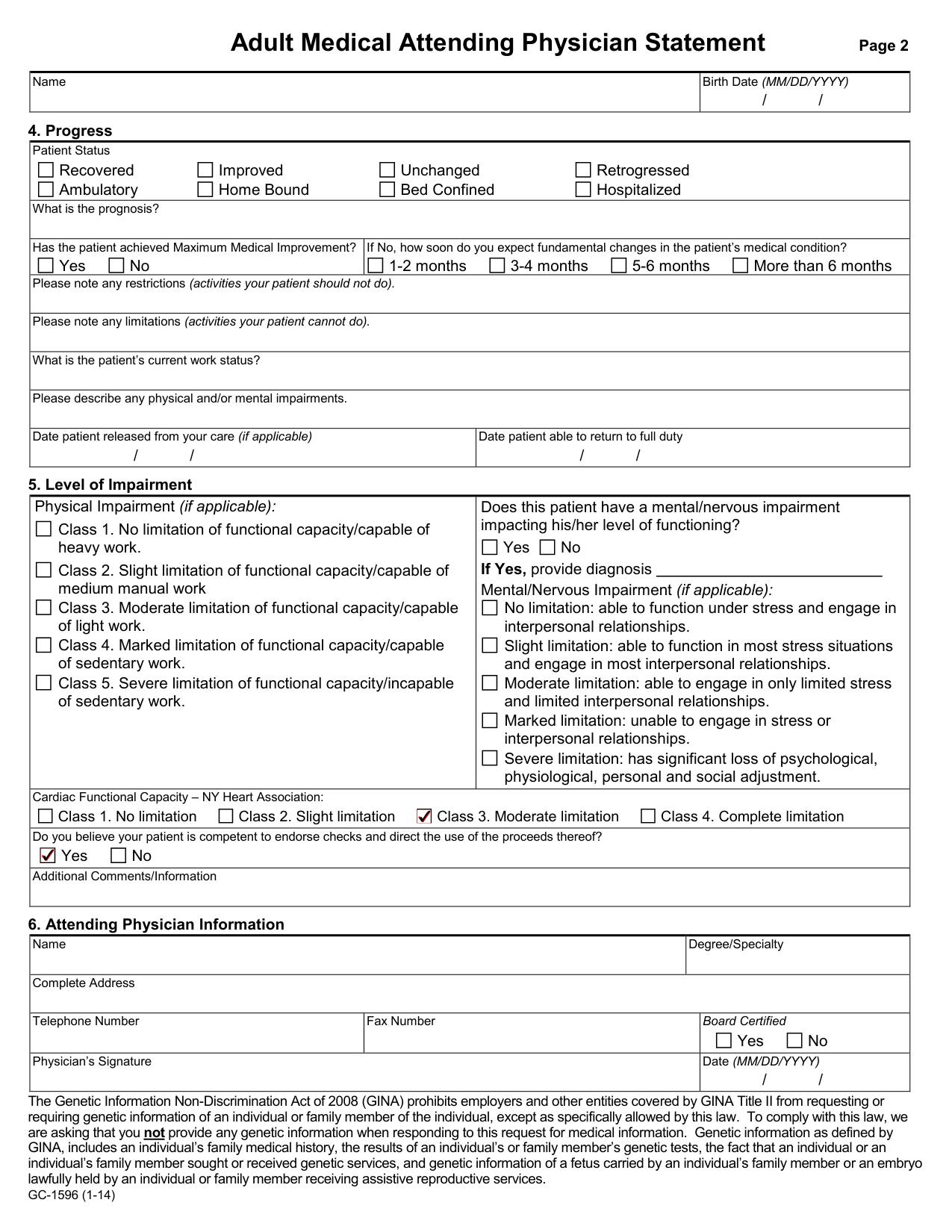
A filled-in Form GC-1596 example: a physician rates cardiac capacity
How to fill out Form GC-1596, box by box
1. Patient Information
Under 1. Patient Information, fill in Name, Aetna ID Number, Birth Date (MM/DD/YYYY), Height (ft., in.), Weight (lbs.), Blood Pressure and Date Measured, and mark Female or Male under Gender.
2. Diagnostic Information
Under 2. Diagnostic Information, fill in Primary Diagnosis, ICD-9 Code(s), Complications, Objective Findings and Subjective Symptoms.
Mark Yes or No for "Are there any secondary conditions contributing to this condition?" If Yes, what are they?
Mark Yes or No for "Has this patient ever had the same condition or a similar condition?" If Yes, what year(s)/describe?
3. Treatment Information
Under 3. Treatment Information, fill in Primary Diagnosis, Date symptoms first appeared (or date of accident), Date first treated for this condition and Most recent date treated for this condition.
Frequency with which you see this patient: mark Weekly, Monthly or Other.
Mark Yes or No for "Has the patient undergone surgery?" If Yes, provide date, Procedure, Result and ICD-9 Code(s). If No, do you expect surgery to be performed in the future? Mark Yes or No. If Yes, provide date and Procedure.
Please list current medications with dosage and frequency. Please list other types and frequency of treatment.
Has the patient been referred to a medical rehabilitation or therapy program? Mark Yes or No. If Yes, please describe facility and provide facility name, address and telephone number.
Is the patient a suitable candidate for vocational rehabilitation? Mark Yes or No. Please explain.
Has the patient been hospitalized for this condition? Mark Yes or No. If yes, include dates of confinement as indicated: a. Hospital Name, Hospital Address and Treatment Dates From and To.
4. Progress
Under 4. Progress, mark Patient Status: Recovered, Improved, Unchanged, Retrogressed, Ambulatory, Home Bound, Bed Confined or Hospitalized, and fill in What is the prognosis?
Has the patient achieved Maximum Medical Improvement? Mark Yes or No. If No, how soon do you expect fundamental changes in the patient's medical condition? Mark 1-2 months, 3-4 months, 5-6 months or More than 6 months. Please note any restrictions (activities your patient should not do).
Please note any limitations (activities your patient cannot do).
What is the patient's current work status? Please describe any physical and/or mental impairments. Fill in Date patient released from your care (if applicable) and Date patient able to return to full duty.
5. Level of Impairment
Under 5. Level of Impairment, for Physical Impairment (if applicable) mark Class 1. No limitation of functional capacity/capable of heavy work, Class 2. Slight limitation of functional capacity/capable of medium manual work, Class 3. Moderate limitation of functional capacity/capable of light work, Class 4. Marked limitation of functional capacity/capable of sedentary work or Class 5. Severe limitation of functional capacity/incapable of sedentary work.
Does this patient have a mental/nervous impairment impacting his/her level of functioning? Mark Yes or No. If Yes, provide diagnosis. Mental/Nervous Impairment (if applicable): No limitation: able to function under stress and engage in interpersonal relationships. Slight limitation: able to function in most stress situations and engage in most interpersonal relationships. Moderate limitation: able to engage in only limited stress and limited interpersonal relationships. Marked limitation: unable to engage in stress or interpersonal relationships. Severe limitation: has significant loss of psychological, physiological, personal and social adjustment.
Cardiac Functional Capacity - NY Heart Association: mark Class 1. No limitation, Class 2. Slight limitation, Class 3. Moderate limitation or Class 4. Complete limitation.
Do you believe your patient is competent to endorse checks and direct the use of the proceeds thereof? Mark Yes or No.
6. Attending Physician Information
Under 6. Attending Physician Information, fill in Name, Degree/Specialty, Complete Address, Telephone Number and Fax Number, and mark Yes or No for Board Certified.
Physician's Signature and Date (MM/DD/YYYY).
Capabilities and Limitations Worksheet
Capabilities and Limitations Worksheet: Complete and sign the form using BLUE or BLACK ink. Fill in Employee Name (Last, First, Middle Initial), Aetna ID Number, Birth Date (MM/DD/YYYY), Gender, Job Title, Current Diagnosis and Medications.
Indicate the percent of the day the following activities can be performed: Occasional 1-33% or .5-2.5 hrs. Frequent 34-66% or 2.6-5.0 hrs. Continuous 67-100% or 5.1-8 hrs. or Never.
Maximum weight patient is capable of lifting: 1 - 5 lbs., 6 - 10 lbs., 11 - 20 lbs., 21 - 35 lbs., 36 - 50 lbs., 51 - 75 lbs., 75 - 100 lbs. or 100 lbs. +
Total # of hours patient is capable of working per day: 12, 8, 6, 4 or 2. Care complete: Yes No. Fill in Duration of restrictions, Next appointment and Additional Comments, then sign and date (MM/DD/YYYY) as the Physician.
Common questions about Form GC-1596
Is there a penalty?
Any person who knowingly and with intent to injure, defraud or deceive any insurance company or other person files an application for insurance or statement of claim containing any materially false information or conceals, for the purpose of misleading, information concerning any fact material thereto commits a fraudulent insurance act, which is a crime and subjects such person to criminal and civil penalties.
Sources
[1] Aetna Adult Medical Attending Physician Statement GC-1596 (1-14).
