

AF Form 931 at a glance
What it is: The Airman Comprehensive Assessment (ACA) Worksheet (AB thru TSgt) is used to document effectiveness/duty performance history.
Who signs: Fill in Ratee Signature, Rater Signature and Date.
A filled-in AF Form 931 example: an Airman starts an initial assessment
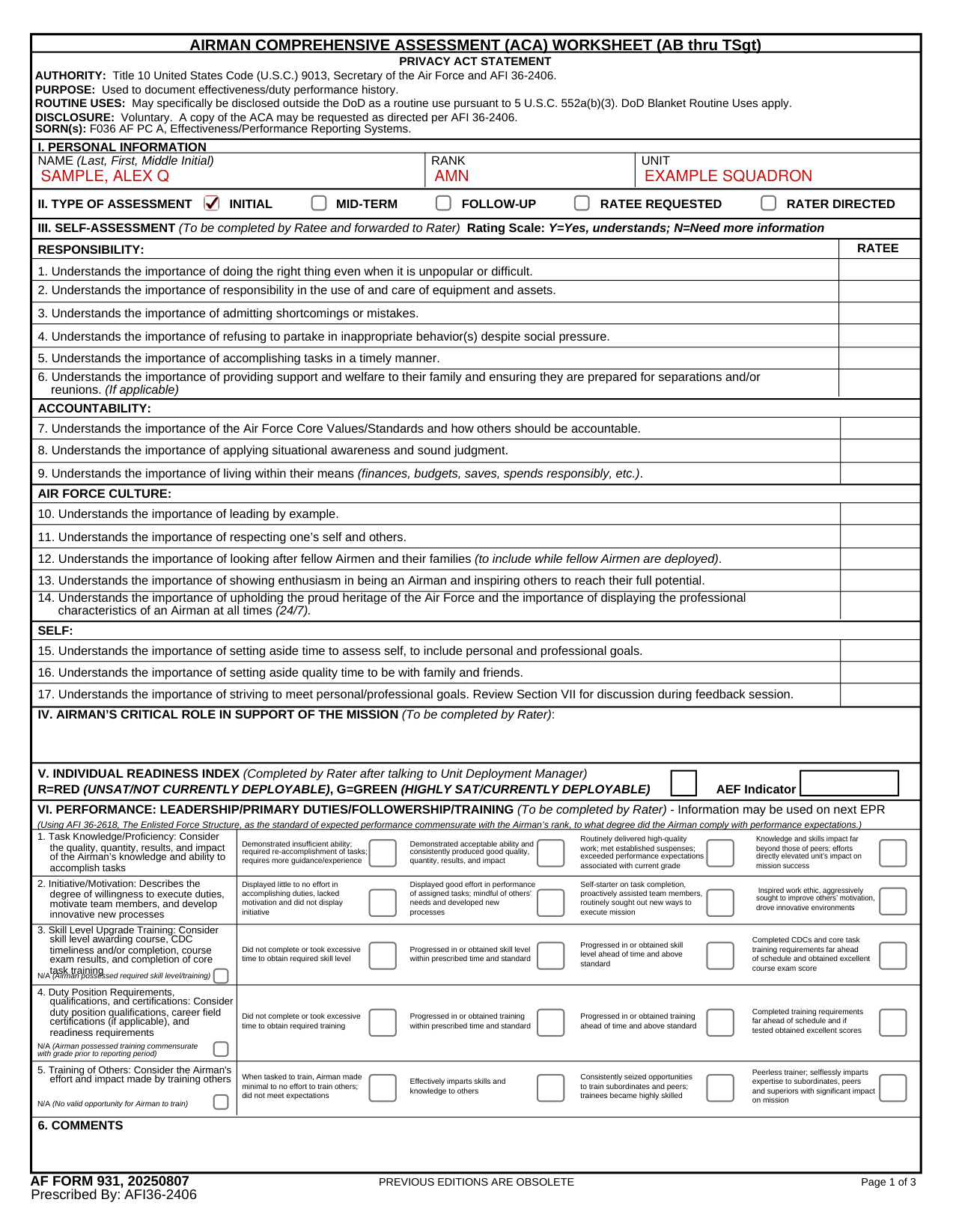
How to fill out AF Form 931, box by box
Personal information and type of assessment

Under Personal Information, fill in Name (Last, First, Middle Initial), Rank and Unit.
Under Type of Assessment, mark Initial, Follow-up, Rater Directed, Ratee Requested or Mid-term.
Self-assessment
Section III, Self-assessment, is to be completed by the Ratee and forwarded to the Rater.
Rating Scale: enter Y=Yes, understands or N=Need more information for each of 1 to 17.
Number 6, on providing support and welfare to their family and ensuring they are prepared for separations and/or reunions, is marked (If applicable).
Airman's critical role in support of the mission
Section IV, Airman's Critical Role in Support of the Mission, is to be completed by the Rater.
Individual readiness index
The Rater completes Section V, Individual Readiness Index, after talking to the Unit Deployment Manager.
Enter R=RED (UNSAT/NOT CURRENTLY DEPLOYABLE) or G=GREEN (HIGHLY SAT/CURRENTLY DEPLOYABLE), and the AEF Indicator.
Performance: leadership, primary duties, followership and training
Section VI is to be completed by the Rater, and its information may be used on next EPR. Using AFI 36-2618, The Enlisted Force Structure, as the standard of expected performance commensurate with the Airman's rank, to what degree did the Airman comply with performance expectations?
In 1, Task Knowledge/Proficiency, consider the quality, quantity, results, and impact of the Airman's knowledge and ability to accomplish tasks.
In 2, Initiative/Motivation, describe the degree of willingness to execute duties, motivate team members, and develop innovative new processes.
In 3, Skill Level Upgrade Training, consider skill level awarding course, CDC timeliness and/or completion, course exam results, and completion of core task training. Mark N/A when the Airman possessed required skill level/training.
In 4, Duty Position Requirements, qualifications, and certifications, consider duty position qualifications, career field certifications (if applicable), and readiness requirements. Mark N/A when the Airman possessed training commensurate with grade prior to reporting period.
In 5, Training of Others, consider the Airman's effort and impact made by training others. Mark N/A when there was no valid opportunity for the Airman to train. Write comments in 6, Comments.
Followership and leadership
Section VII is Followership/Leadership. In 1, Resource Utilization (e.g., time management, equipment, manpower and budget), consider how effectively the Airman utilizes resources to accomplish the mission.
In 2, Comply with/Enforce Standards, consider personal adherence and enforcement of fitness standards, dress and personal appearance, customs and courtesies, and professional conduct.
In 3, Communication Skills, describe how well the Airman receives and relays information, thoughts, and ideas up and down the chain of command (includes listening, reading, speaking, and writing skills), and how the Airman fosters an environment for open dialogue.
In 4, Caring, Respectful, and Dignified Environment (Teamwork), rate how well the Airman selflessly considers others and sets the stage for an environment of dignity and respect, to include promoting a healthy organizational climate. Write comments in 5, Comments.
Whole Airman Concept
Section VIII is the Whole Airman Concept. In 1, Air Force Core Values, consider how well the Airman adopts, internalizes and demonstrates the Air Force Core Values of Integrity First, Service Before Self, and Excellence in All We Do.
In 2, Personal and Professional Development, consider the amount of effort the Airman devoted to improve themselves and their work center/unit through education and involvement.
In 3, Esprit de corps and community relations, consider how well Airman promotes camaraderie, embraces esprit de corps, and acts as an Air Force ambassador. Write comments in 4, Comments.
Knowing your Airman
Section IX, Knowing Your Airman, is to be discussed by Ratee and Rater during feedback session. In 1: How do you think you are performing in the unit? How can your unit help you perform better?
In 2: What are some of your goals for self-improvement? Goals should be SMART: Specific, Measurable, Attainable, Realistic, and Time-bound. In 2a: Do you have personal (family, financial, fitness, etc.) goals? Would you like to discuss? In 2b: What are your professional (assignments, academic, professional, etc.) goals?
In 3: Do you have stressors in your life? If so, what are your goals for reducing them? In 4: Do you have Wingmen? Do you have at least one mentor? In 5: How would you rate yourself as a Wingman and a mentor? Can you provide some specific examples? In 6: Would you like to offer any suggestions/feedback?
In 7: Expectations for unit and Ratee (Areas for improvement, strengths and weaknesses; recommendations for improvement).
The rater will not utilize or document any areas discussed in Section III or IX when preparing evaluations (Ref: AFI 36-2406).
Ratee Signature, Rater Signature and Date
Fill in Ratee Signature, Rater Signature and Date.
More rules for AF Form 931
AF Form 931, 20250807: previous editions are obsolete.
Disclosure is voluntary. A copy of the ACA may be requested as directed per AFI 36-2406.
Sources
[1] AF Form 931 (20250807), Airman Comprehensive Assessment (ACA) Worksheet (AB thru TSgt), Department of the Air Force (the Official source link on this page).
