
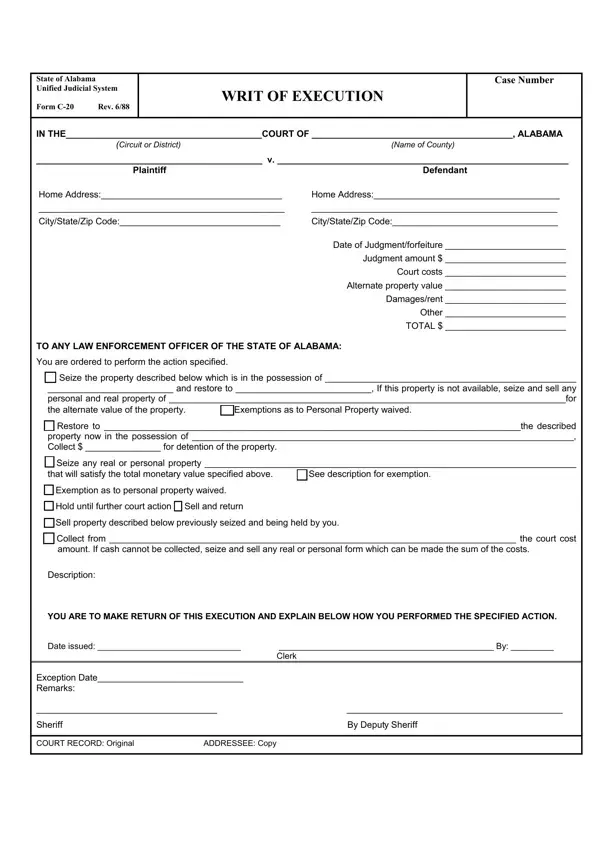
When a court in Alabama awards a judgment against a defendant, the Writ of Execution (Form C-20) is the legal mechanism used to collect it. Issued by the Alabama Unified Judicial System, this 2-page document directs law enforcement officers to locate and seize the defendant's property to satisfy the judgment amount, court costs, and any related fees.
The writ authorizes officers to seize and, if necessary, sell both personal and real property to cover the court-ordered debt. Alabama law protects defendants through the companion Form C-25A (Notice of Right to Claim Exemptions From Execution), which is typically served alongside the writ. That document informs defendants which property may be exempt from seizure, including basic household goods, a vehicle needed for work, and tools required for a trade or profession. Defendants who receive a C-20 writ should review their exemption rights as soon as possible, because the window to claim exemptions is limited.
To complete Form C-20, the plaintiff or attorney fills in the court name, case number, judgment amount (including damages, costs, and accrued interest), and identifying information for both parties. The officer who executes the writ must complete the return of service section, noting what property was seized or why execution was not possible, then return the document to the court. Related documents in the Alabama Unified Judicial System include Form C-2 and Form C-34. For additional Alabama legal documents, browse our Alabama legal forms collection.
| Question | Answer |
|---|---|
| Form Name | Alabama Form C 20 |
| Form Type | Writ of Execution |
| Issuing Authority | Alabama Unified Judicial System |
| Form Length | 2 pages |
| Fillable? | No |
| Fillable fields | 0 |
| Avg. time to fill out | 30 sec |
| Purpose | Court judgment enforcement |
| Other names | NOTARIZED, ADDRESSEE, Exemptions, C-20 |
Alabama Form C 20 isn’t the one you’re looking for?