
What You Need Before You Start
Before filling out the Arkansas ET-1 form, gather the following information for the reporting period:
- Your Arkansas sales tax permit number or excise tax account number
- Total gross sales and taxable sales figures broken down by tax type
- Records of exempt sales, deductions, and any credits you plan to claim
- Payment information if you are remitting taxes with this return
Having these figures ready before you open the form reduces errors and speeds up the filing process.
Steps to Complete the Arkansas ET-1 Form Online
Use the free FormsPal PDF editor to fill out your ET-1 return directly in your browser. No software download or account is required.
- Open the form. Click the "Get Form" button at the top of this page to load the Arkansas ET-1 in the PDF editor.
- Enter your business details. Type your legal business name, Arkansas permit number, business address, and the filing period dates in the header section of the form.
- Report gross sales and deductions. Enter your total gross receipts for the period. Then list qualifying deductions such as sales for resale, interstate sales, and other exempt transactions to arrive at your net taxable sales figure.
- Calculate taxes by section. The ET-1 has separate lines for state sales tax, local sales tax, compensating use tax, food tax, and other excise categories. Enter the taxable amount and the applicable rate for each section that applies to your business.
- Apply discounts and credits. If you are filing and paying on time, enter the 2% timely-payment discount on the designated line. Claim any Tourism Development Credit or other approved tax credit in the credits section.
- Total taxes due. Sum all tax lines and subtract any credits and discounts to arrive at the net tax due for the period.
- Sign and submit. Enter the name and title of the person completing the return, add the date, and sign the form. Submit via ATAP or mail the completed paper return to the Arkansas Department of Finance and Administration.
Common Questions About the Arkansas ET-1 Form
Do I need to file even if I had no sales? Yes. Arkansas requires a zero return for every period in which you hold an active permit, even if no taxable activity occurred.
What happens if I file late? Late returns lose the 2% timely-payment discount and may incur penalties and interest charges from the Department of Finance and Administration. Filing through ATAP timestamps your submission automatically.
Can I amend a prior ET-1? Yes. Use the ATAP portal to file an amended return for any prior period. Corrections that increase the tax due will require a payment for the difference plus any applicable interest.
For other Arkansas tax filings, see the Arkansas Form 1086 and the consumer use tax return guide for comparison. The Maryland Sales and Use Tax Form 202 illustrates how other states structure their combined sales and use tax returns.
Understanding the Arkansas ET-1 Form Sections
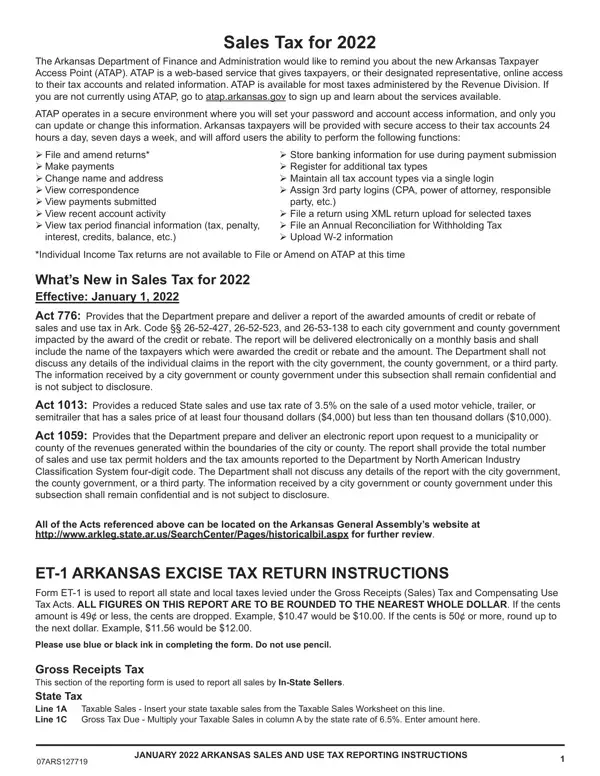
The ET-1 form is divided into several numbered sections, each targeting a specific category of tax. Knowing which sections apply to your business helps you complete only the relevant parts and skip sections with no activity. Below is an overview of the key sections you will encounter:
Section A: In-State Sellers. This section is used by businesses physically located in Arkansas that make taxable retail transactions to customers in the state. Enter total gross receipts from in-state transactions, then subtract any nontaxable items to arrive at net taxable gross receipts.
Section B: Out-of-State Sellers. Businesses without an Arkansas physical location that sell goods or services into the state report here. Remote sellers who meet the economic nexus threshold (typically $100,000 in annual Arkansas sales or 200 separate transactions) must complete this section every return period.
Section C: Consumer Use Tax. Taxpayers who purchase tangible personal property from out-of-state vendors without paying Arkansas tax owe use tax equal to the Arkansas rate. Report those purchases in this section. Common examples include equipment ordered from an out-of-state supplier or software licenses purchased online.
Section D: Food and Food Ingredient Tax. Arkansas imposes a reduced tax rate on food for home consumption. Vendors who sell both general merchandise and food items must separate food receipts from non-food receipts in this section. The reduced rate applies only to qualifying food and food ingredients, not to prepared food sold at restaurants.
Section E and Beyond: Special Additional Taxes. Arkansas imposes additional taxes on specific industries, including aviation fuel, manufacturing utilities, and certain alcoholic beverages. Only businesses holding the relevant permits complete these sections. If your business does not engage in a listed activity, leave that section blank and do not enter a zero.
Completing each applicable section accurately and totaling all lines before signing gives you a clean, auditable ET-1 filing. Keep a copy of each submitted form and the corresponding payment confirmation for at least three years, which is the standard state audit lookback period.
Tips for Accurate ET-1 Filing
A few practical habits make the ET-1 process faster and lower the risk of an audit adjustment:
- Reconcile your records monthly. Compare your accounting software totals against the ET-1 line items before you submit. Small differences in gross receipts versus taxable receipts are easier to catch when the period is fresh than months later.
- Track exemption certificates. If you sell to resellers, wholesalers, or tax-exempt organizations, keep signed exemption certificates on file. Without a valid certificate, an auditor may reclassify the transaction as taxable.
- Use the ATAP confirmation number. Every electronic submission through the Arkansas Taxpayer Access Point generates a confirmation number. Save this number as proof of on-time filing. It is your first line of defense if the state's records show a missing period.
- Check for rate changes each January. The Arkansas Department of Finance and Administration periodically updates local tax rates. Verify current rates at the start of each new year to avoid under- or over-collecting tax from customers.
Staying organized throughout the year turns the monthly ET-1 from a stressful task into a routine one. If your volume grows or tax types multiply, consider working with a licensed Arkansas CPA who specializes in state excise tax compliance.
