
Arpc Form 3924 PDF Details

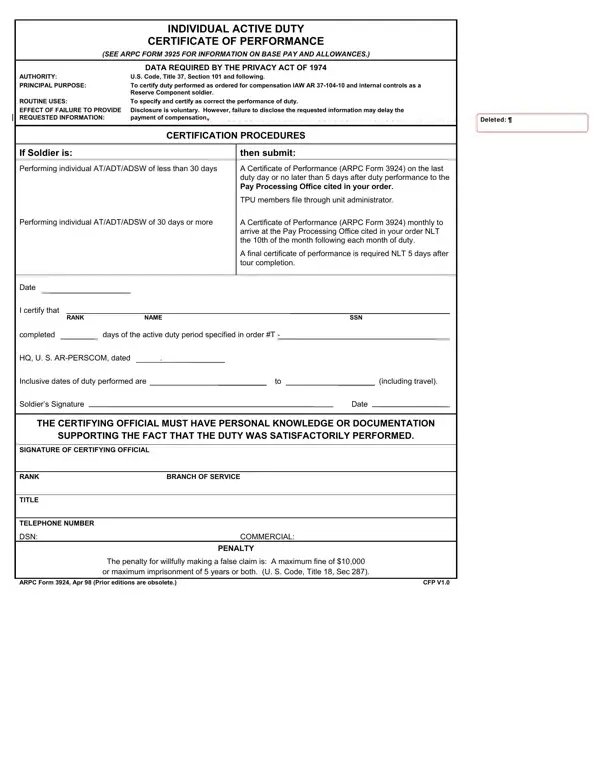
Understanding the meticulous details of the ARPC 3924 form is essential for every Reserve Component soldier who seeks compensation for duty performed. This document, known as the Individual Active Duty Certificate of Performance, plays a crucial role in the administrative aspects of military service, particularly concerning the verification and certification of active duty for compensation purposes. It is governed by the Privacy Act of 1974, which outlines how personal information is to be handled in these processes. With the authority derived from U.S. Code, Title 37, Section 101, and subsequent sections, this form serves to confirm the satisfactory completion of duty as ordered, ensuring that soldiers are appropriately compensated in accordance with AR 37-104-10 and established internal controls. The process outlined for submission varies based on the duration of duty, emphasizing the importance of timely and accurate filing to facilitate the payment process. Moreover, the stipulation of penalties for false claims underlines the seriousness and legal implications associated with the form. This certification procedure, including signatures from both the soldier and a certifying official with firsthand knowledge or documentary proof of duty performance, safeguards the integrity of the compensation process, reflecting the system's checks and balances.

QuestionAnswer
Form NameArpc Form 3924
Form Length1 pages
Fillable?No
Fillable fields0
Avg. time to fill out15 sec
Other names3924 individual performance, 3924 ahrc, usarc 25 r form, da form 3924 fillable

How to Edit Arpc Form 3924 Online for Free

This guide covers everything Reserve Component soldiers need to know about the ARPC 3924: what it is, who needs it, how to fill it out step by step, the legal requirements behind it, and answers to the most common questions. Completing this certificate correctly ensures timely compensation under AR 37-104-10 for every period of active duty performed.

What Is the ARPC 3924 Certificate and Why Does It Matter?

The ARPC 3924 is the official U.S. Army document that certifies a Reserve Component soldier completed active duty as ordered. Without this certificate, the Army finance system has no authoritative record of service to base compensation on, and pay under AR 37-104-10 cannot be processed. The form serves several important functions in the military pay system:

  • It provides a certified record of dates, duty type, and duty location for the finance office
  • It protects both the soldier and the Army by documenting the facts of service with two independent signatures
  • It triggers the pay calculation process under AR 37-104-10, which covers all Reserve Component active duty pay entitlements
  • It creates a permanent administrative record that can be referenced if pay discrepancies arise later

The form is authorized under U.S. Code Title 37, Section 101, and subsequent applicable sections. It is governed by the Privacy Act of 1974, which restricts how personal information collected on the form is used, stored, and shared. False statements on the form violate federal law, as stated in the Privacy Act notice printed on the document.

Which Categories of Active Duty Require This Certificate?

Every Reserve Component soldier who performs active duty under federal orders must submit the ARPC 3924 for compensation. The form applies to several categories of duty:

  • Annual Training (AT). All Reserve soldiers complete Annual Training each year, typically between 14 and 30 days. A separate certificate is required for each AT period.
  • Active Duty for Training (ADT). ADT includes attendance at military schools, medical qualification training, and other individual training conducted on full-time orders. The certificate is required for each ADT period.
  • Active Duty for Special Work (ADSW). ADSW authorizes soldiers to perform administrative, operational, or support work that cannot be completed during normal unit training assemblies. ADSW periods can range from a few days to up to 365 consecutive days.
  • Other Ordered Active Duty. Any other active duty authorized under Title 10 or Title 32 of the U.S. Code also requires the certificate for compensation processing. This includes involuntary mobilizations, presidential reserve call-ups, and other special categories.

Army National Guard soldiers who are activated for federal service under Title 10 orders must also submit the certificate. State active duty under Title 32 follows different pay rules and may use a different certification process depending on the state.

For related Army duty documentation, see the Army active duty regulation form and the AHRC Form 3924, which is the same document under the current Army Human Resources Command naming convention.

Step-by-Step Instructions for Completing the ARPC 3924

Follow these steps carefully to complete the certificate without errors that delay pay:

  1. Step 1: Enter soldier identifying information. Provide the soldier's full legal name, current grade (rank), unit designation, and identifying number in the header fields. Many units use the last four digits of the Social Security Number or the Soldier ID number. Confirm which identifier your unit uses before completing this field to avoid mismatches in the finance system.
  2. Step 2: Record the exact duty period. Write the start date and end date of the active duty performed. Use the DD-MM-YYYY format. If any days within the stated period were not actual duty days (for example, administrative travel days that fall outside the ordered period), note them separately. Inaccurate dates are one of the most common causes of pay discrepancies.
  3. Step 3: Identify the specific duty type. Select or write in the appropriate category of active duty: Annual Training, Active Duty for Training, Active Duty for Special Work, or the applicable specific authorization. The finance office applies different pay tables depending on the duty type, so this field directly affects pay calculations.
  4. Step 4: Obtain the certifying official signature. A commissioned officer or senior warrant officer with firsthand knowledge of the soldier's duty performance, or with access to unit records that document the duty, must review all information on the form, then sign and date the document. The certifying official also prints their name, grade, and official title or position. This signature is the Army's primary safeguard against fraudulent pay claims.
  5. Step 5: Soldier acknowledgment and signature. The soldier reviews all completed information for accuracy, then signs and dates the form. The soldier's signature certifies that the information is correct. The Privacy Act notice on the form warns that false statements are subject to federal penalties including fines and imprisonment under applicable statutes.
  6. Step 6: Submit to the S1 section on time. Deliver the completed form to your unit's S1 section or administrative office within the required deadline. The S1 section reviews the form, logs it into the administrative tracking system, and forwards it to the appropriate Army finance processing office. Missing the deadline may result in forfeited pay that cannot be recovered.

Submission Deadlines Under AR 37-104-10

AR 37-104-10 establishes strict submission deadlines based on the length of the duty period. Soldiers and unit administrators must understand both thresholds:

  • Duty periods of 1 to 139 days: The certificate must be submitted within 90 calendar days of the last day of the duty period.
  • Duty periods of 140 days or more: The certificate must be submitted within 120 calendar days of the last day of the duty period.

These deadlines apply to the date the form reaches the finance-authorized processing office, not merely the date the soldier signs it. Units should establish internal routing timelines that build in buffer time for administrative handling. A form signed on the last duty day and submitted 85 days later is technically within the 90-day window, but delays in the S1 office's forwarding process could push it past the deadline at the finance office. To be safe, aim to submit the completed form within 45 to 60 days of the last duty day for periods under 139 days.

Common Errors That Delay Compensation

Unit S1 offices and finance processing centers report the following errors most frequently on rejected or returned certificates:

  • Incorrect or missing duty period start or end dates
  • Certifying official signature missing, illegible, or missing grade and title
  • Duty type not specified or listed incorrectly
  • Submission after the applicable deadline with no documented exception request
  • Soldier signature missing or undated
  • Mismatch between the duty period on the certificate and the period shown on the soldier's orders

When the finance office returns a certificate for correction, the clock does not stop. The original submission deadline still applies. If a correction causes the resubmission to fall outside the original window, the soldier must request a command exception, which is not guaranteed. Completing the form correctly the first time is always the better approach.

Privacy Act Notice and Legal Requirements

The Privacy Act of 1974 applies to all personal information collected on the ARPC 3924. The Army is authorized to collect this information under U.S. Code Title 37, Sections 101 and following. The information is used solely to certify active duty performed and to process pay entitlements. It is retained in the soldier's unit administrative file and forwarded to the Army finance system as required. Access is limited to authorized personnel who need it to perform official functions.

Providing false information on the form, including false dates, false duty type, or falsified signatures, constitutes a federal offense. Penalties may include repayment of improperly received pay, administrative action, and potential criminal prosecution under applicable federal statutes. Both the soldier and the certifying official bear legal responsibility for the accuracy of the information they certify.

Frequently Asked Questions

Is the ARPC 3924 the same as the AHRC Form 3924? Yes. Both names refer to the same Individual Active Duty Certificate of Performance. ARPC stood for Army Reserve Personnel Command. AHRC stands for Army Human Resources Command, which replaced ARPC in 2002. Older copies of the form carry the ARPC label while current copies carry the AHRC label, but the content and legal requirements are identical. You can also find the AHRC 56-R form at FormsPal for related Reserve Component paperwork.

Can a warrant officer serve as the certifying official? Yes. Any commissioned officer or senior warrant officer with firsthand knowledge of the soldier's duty, or with access to official documentation of the duty, may serve as certifying official. The requirement is knowledge and authority, not a specific grade. The certifying official is personally accountable for the accuracy of the certification.

What if the certifying official is unavailable to sign? The unit commander may designate an acting official in writing. The acting official must meet the same knowledge and authority requirements as the primary certifying official. Units should document the designation to protect against challenges to the certification later.

Where does the completed form go after signing? Both the soldier and the certifying official should retain a copy. The original goes to the unit's S1 section, which forwards it through the appropriate administrative chain to the Army finance processing office. The S1 section typically acknowledges receipt and provides a tracking number that the soldier can use to follow up if pay does not appear within the expected window.

What if compensation is delayed after submission? If pay does not appear within 30 to 60 days after submitting the certificate, contact your unit's S1 section and request a status check. The S1 office can contact the finance processing center directly and confirm whether the certificate was received and entered into the system. If the certificate was lost in transit, the S1 section can submit a certified copy with documentation of the original submission date.

Can you complete this certificate online before printing? Yes. Use FormsPal to fill in all required fields digitally, verify accuracy before printing, and produce a clean copy ready for wet-ink signatures. For other Army certification documents, see the duty certificate sample and the DA Form 87 at FormsPal.