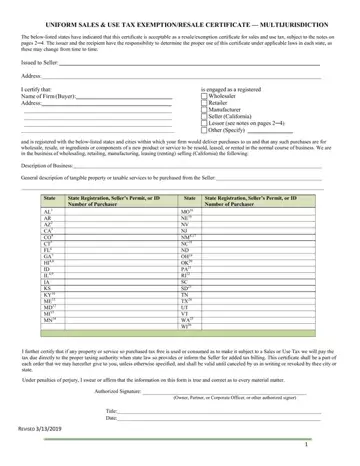
The Uniform Sales and Use Tax Exemption/Resale Certificate - Multijurisdiction allows qualifying businesses to purchase tangible personal property tax-free when goods are intended for resale. Rather than paying sales tax at the point of purchase, the buyer presents this certificate to the seller, shifting the tax obligation to the final sale to end customers. This arrangement helps businesses manage cash flow and prevents double taxation across the supply chain.
Any business purchasing inventory for resale in California should hold a seller's permit from the California Department of Tax and Fee Administration (CDTFA) before using this exemption certificate. Retailers, wholesalers, distributors, and manufacturers all require this document when buying inventory or raw materials designated for resale or further processing. Service providers, contractors, and individual consumers generally do not qualify for the resale exemption.
To complete the certificate, the buyer must supply the business name and address, the type of business, a description of goods to be purchased tax-free, and the state where the certificate applies. All details provided must be accurate, complete, and current. Submitting false or misleading information can result in substantial tax penalties. If a buyer's business information changes, the certificate should be updated promptly to reflect the new details.
The Multijurisdiction design makes this certificate accepted across many states, a practical choice for businesses that operate across multiple locations or maintain supply relationships with vendors in different states. Each state has its own rules on how long a certificate remains accepted, what types of property qualify for exemption, and how sellers must verify buyer credentials. Businesses active in several jurisdictions should review the requirements for each state where the certificate will be used.
When a business issue or accepts this certificate, both the buyer and seller take on specific tax responsibilities. If goods purchased under the exemption are later used for personal purposes rather than resale, sales tax becomes due on those purchases. Sellers who accept the certificate in good faith are generally not responsible for uncollected tax, but they must maintain records of all instances where the certificate is accepted. Gaps in recordkeeping can expose a business to audits and back-tax assessments, along with potential interest and penalties.
A resale certificate remains accepted as long as the information provided by the buyer stays accurate and the buyer continues to meet the requirements of the issuing state. California does not set a fixed expiration date for resale certificates, but sellers have the right to request a new certificate if circumstances change or if the existing one appears outdated. Businesses should periodically review their exemption certificates to ensure all information stays current and compliant with any updates to state tax laws.
| Question | Answer |
|---|---|
| Form Name | California Sales Tax Certificate |
| Form Length | 7 pages |
| Fillable? | No |
| Fillable fields | 0 |
| Avg. time to fill out | 5 min |
| Other names | Uniform Sales and Use Tax Exemption Certificate |