
Form T776 at a glance
What it is: T776 Statement of Real Estate Rentals.
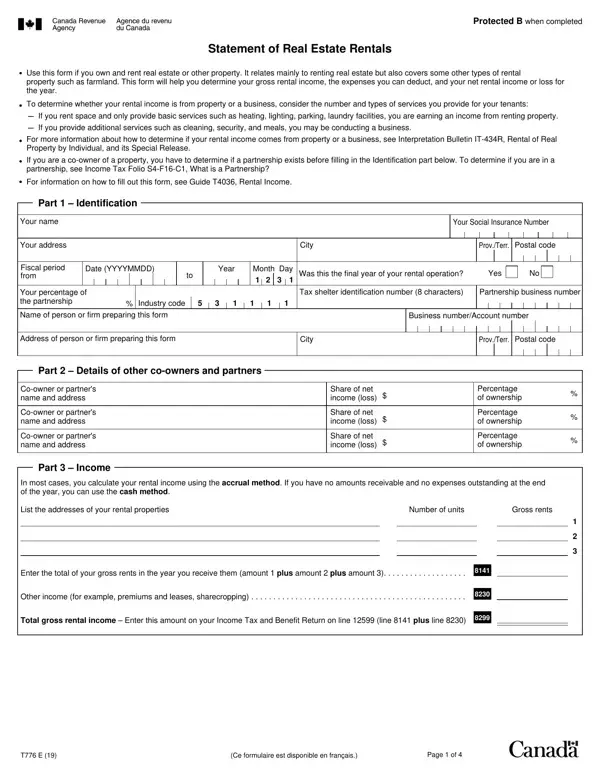
• Use this form if you own and rent out real estate or other property including residential property that is a short-term rental. It relates mainly to renting real estate but also covers some other types of rental property such as farmland. This form will help you determine your gross rental income, the expenses you can deduct, and your net rental income or loss for the year. • To determine whether your rental income is from property or a business, consider the number and types of services you provide for your tenants: - If you rent space and only provide basic services such as heating, lighting, parking, and laundry facilities, you are earning an income from renting property. - If you provide additional services such as cleaning, security, and meals, you may be conducting a business. • For more information about how to determine if your rental income comes from property or a business, see Interpretation Bulletin IT-434, Rental of Real Property by Individual, and its Special Release. • If you are a co-owner of a property, you have to determine if a partnership exists before filling in Part 1 below. To determine if you are in a partnership, see Income Tax Folio S4-F16-C1, What is a Partnership? • For information on how to fill out this form, see Guide T4036, Rental Income.
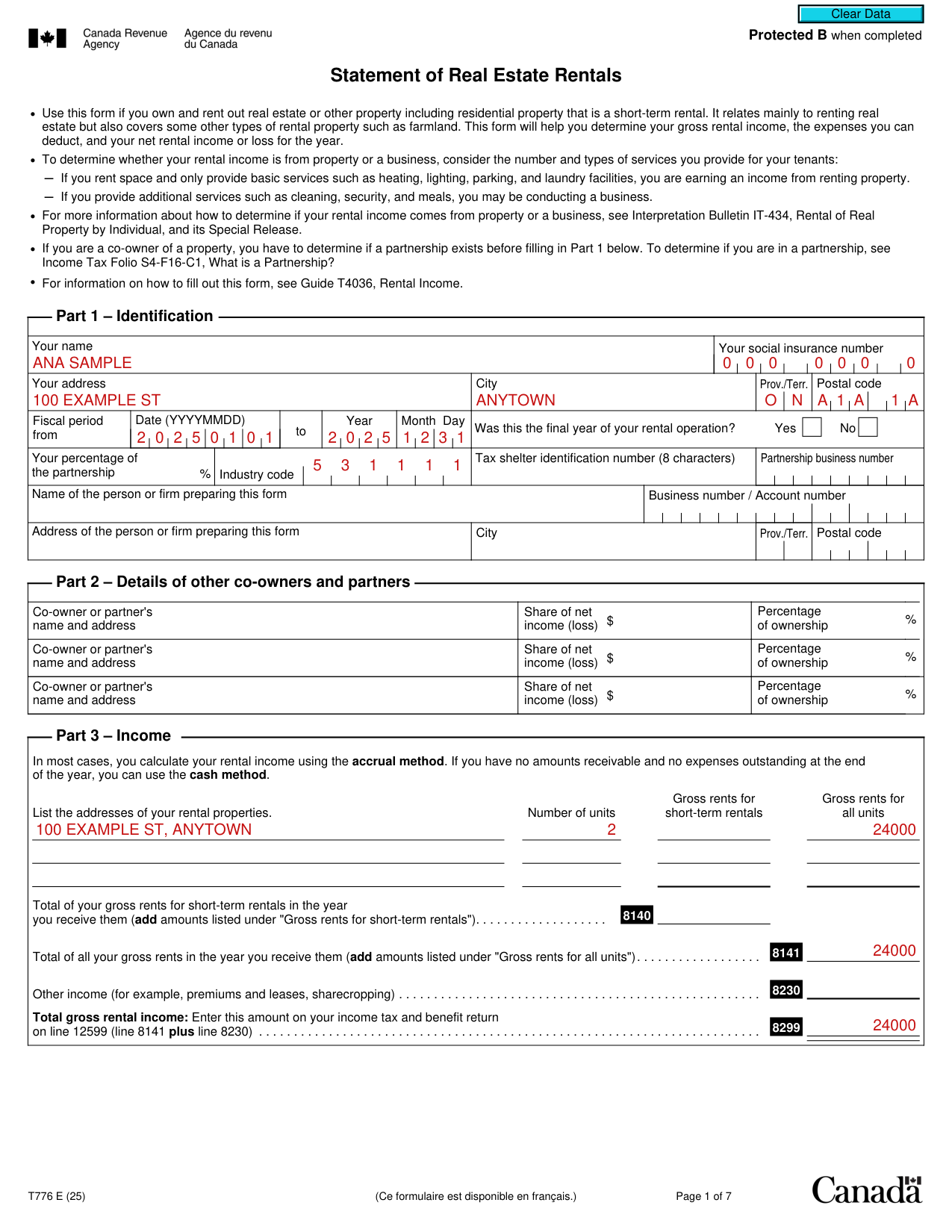
A filled-in Form T776 example: an owner reports rent from one duplex
How to fill out Form T776, box by box
Part 1 - Identification
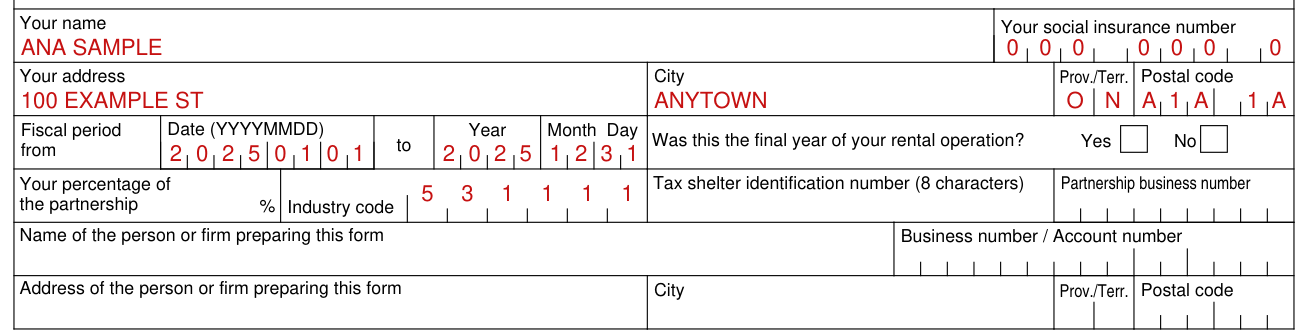
Part 1 - Identification: enter your name, your social insurance number, and your address, city, Prov./Terr., and postal code.
Under Fiscal period from, enter the Date (YYYYMMDD); after to, enter the Year, Month, and Day.
Check Yes or No: Was this the final year of your rental operation?
Enter the Industry code. If you are in a partnership, enter your percentage of the partnership and the Partnership business number; if you have a tax shelter, enter the Tax shelter identification number (8 characters).
Enter the name, Business number / Account number, and address, City, Prov./Terr., and postal code of the person or firm preparing this form.
Part 2 - Details of other co-owners and partners

Part 2 - Details of other co-owners and partners: enter each co-owner or partner's name and address, Share of net income (loss) $, and Percentage of ownership %.
Part 3 - Income
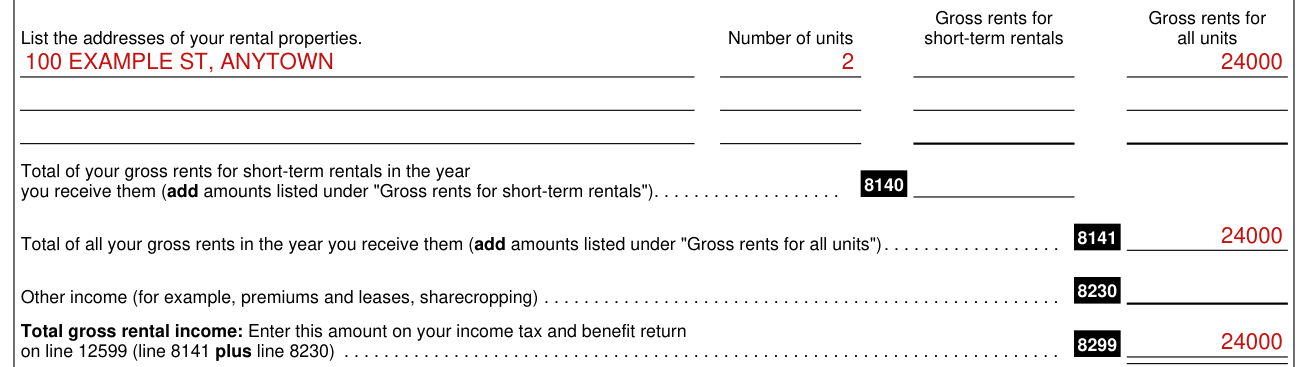
Part 3 - Income: in most cases, you calculate your rental income using the accrual method. If you have no amounts receivable and no expenses outstanding at the end of the year, you can use the cash method.
List the addresses of your rental properties and the Number of units, with Gross rents for short-term rentals and Gross rents for all units.
8140 Total of your gross rents for short-term rentals in the year you receive them (add amounts listed under "Gross rents for short-term rentals").
8141 Total of all your gross rents in the year you receive them (add amounts listed under "Gross rents for all units").
8230 Other income (for example, premiums and leases, sharecropping).
8299 Total gross rental income: Enter this amount on your income tax and benefit return on line 12599 (line 8141 plus line 8230).
Part 4 - Expenses
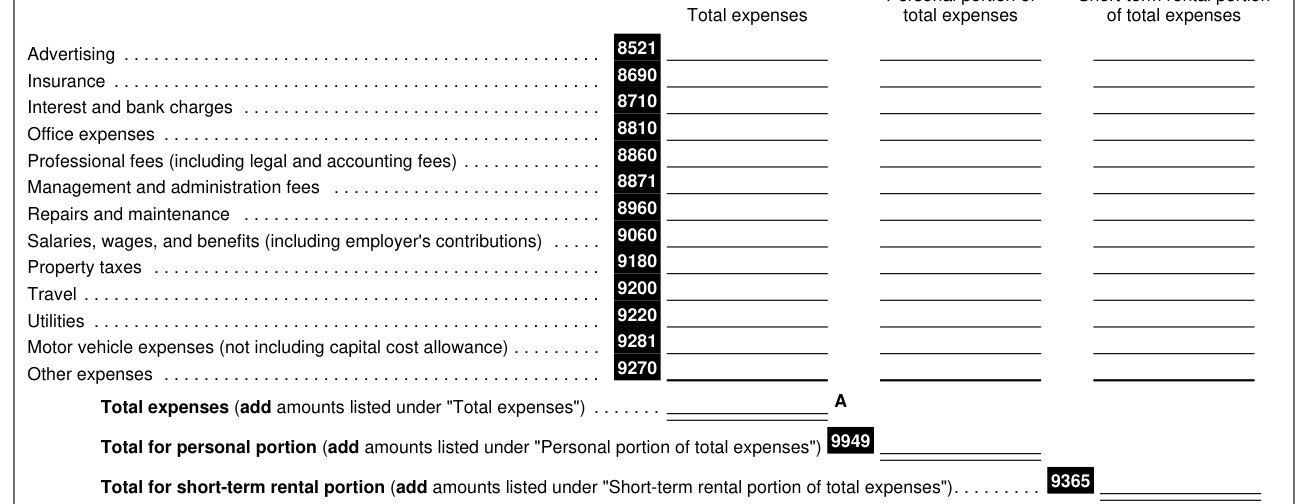
Part 4 - Expenses: enter each expense under Personal portion of total expenses, Short-term rental portion of total expenses, and Total expenses.
Expense lines: 8521 Advertising, 8690 Insurance, 8710 Interest and bank charges, 8810 Office expenses, 8860 Professional fees (including legal and accounting fees), 8871 Management and administration fees, 8960 Repairs and maintenance, 9060 Salaries, wages, and benefits (including employer's contributions), 9180 Property taxes, 9200 Travel, 9220 Utilities, 9281 Motor vehicle expenses (not including capital cost allowance), 9270 Other expenses.
A Total expenses (add amounts listed under "Total expenses").
9949 Total for personal portion (add amounts listed under "Personal portion of total expenses").
9365 Total for short-term rental portion (add amounts listed under "Short-term rental portion of total expenses").
9366 Non-compliant amount for short-term rentals (amount B from Chart A).
Deductible expenses (amount A minus line 9949 minus line 9366).
Net income (loss)
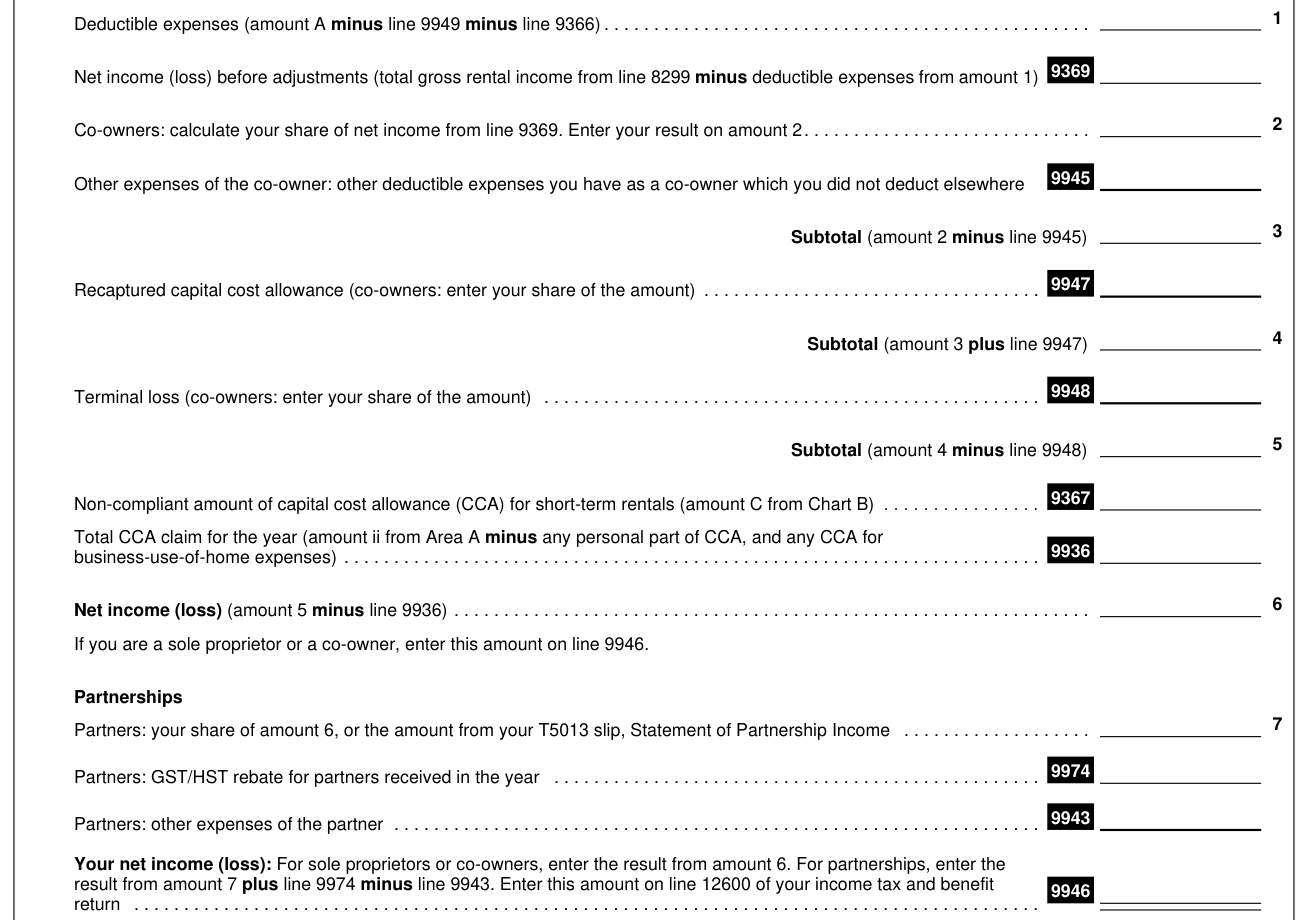
9369 Net income (loss) before adjustments (total gross rental income from line 8299 minus deductible expenses from amount 1).
Co-owners: calculate your share of net income from line 9369. Enter your result on amount 2.
9945 Other expenses of the co-owner: other deductible expenses you have as a co-owner which you did not deduct elsewhere; 3 Subtotal (amount 2 minus line 9945).
9947 Recaptured capital cost allowance (co-owners: enter your share of the amount); 4 Subtotal (amount 3 plus line 9947).
9948 Terminal loss (co-owners: enter your share of the amount); 5 Subtotal (amount 4 minus line 9948).
9367 Non-compliant amount of capital cost allowance (CCA) for short-term rentals (amount C from Chart B); 9936 Total CCA claim for the year (amount ii from Area A minus any personal part of CCA, and any CCA for business-use-of-home expenses); 6 Net income (loss) (amount 5 minus line 9936).
If you are a sole proprietor or a co-owner, enter this amount on line 9946.
Partnerships: 7 Partners: your share of amount 6, or the amount from your T5013 slip, Statement of Partnership Income; 9974 Partners: GST/HST rebate for partners received in the year; 9943 Partners: other expenses of the partner.
Your net income (loss): For sole proprietors or co-owners, enter the result from amount 6. For partnerships, enter the result from amount 7 plus line 9974 minus line 9943. Enter this amount on line 12600 of your income tax and benefit return.
If your situation is different
Some of your rental units were used for short-term rentals
Chart A - Non-compliant amount of expenses for short-term rentals: If you incurred an expense to earn rental income from a rental property with multiple rental units, where some rental units were used for short-term rentals, long-term rentals, or both short-term and long-term rentals (mixed rentals), exclude the portion of the expense which is related to long-term rentals.
You must divide expenses, on a reasonable basis, between each short-term rental or mixed rental. Enter each short-term rental or mixed rental property on a separate row. If your rental property has several units which include long-term, short-term, and mixed rentals, enter each short-term rental or mixed rental on a separate row instead of the rental property they are part of.
For more information on short-term rentals, see Guide T4036. Columns: 1 Rental property address, 2 Unit number, 3 Related portion of the total from line 9365 of Part 4, 4 Number of days the residential property was a non-compliant short-term rental, 5 Number of days the residential property was a short-term rental, 6 Non-compliant amount (col. 3 multiplied by col. 4 divided by col. 5). B Total non-compliant amount of expenses for short-term rentals: Total of column 6 (enter on line 9366 of Part 4).
You have land additions or dispositions in the year
Area F - Land additions and dispositions in the year: Note: You cannot claim capital cost allowance on land. For more information, see Chapter 4 of Guide T4036.
Sources
[1] Form T776 (25), Statement of Real Estate Rentals, Canada Revenue Agency.