

Form A-02 at a glance
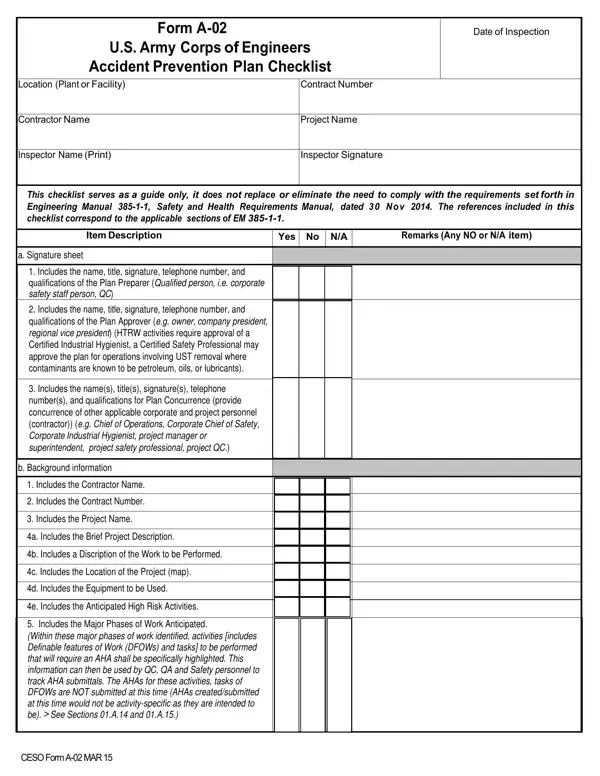
What it is: Form A-02 is the U.S. Army Corps of Engineers Accident Prevention Plan Checklist.
Who signs: Enter the Inspector Name (Print) and sign the Inspector Signature.
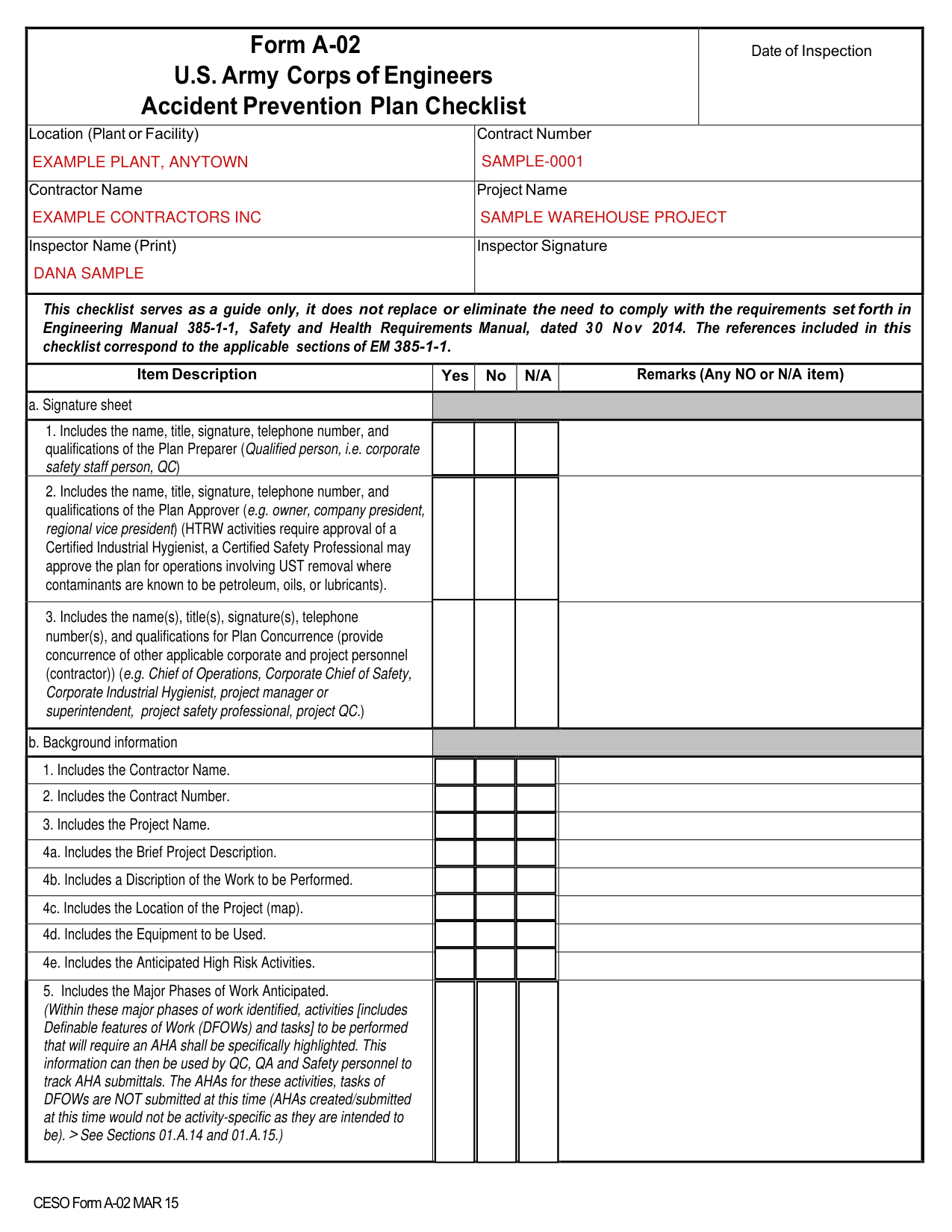
A filled-in Form A-02 example: an inspector fills in the checklist header
How to fill out Form A-02, box by box
Location, Contract Number, Contractor Name, Project Name and Inspector
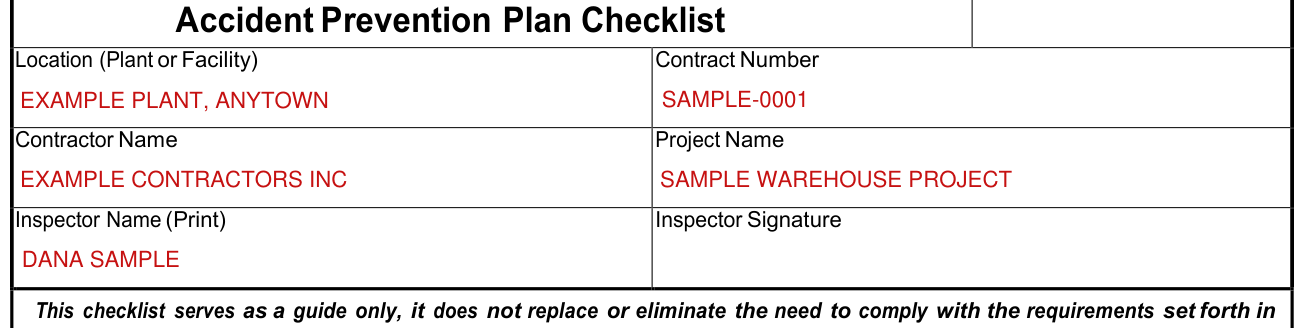
Enter the Location (Plant or Facility), Contract Number, Contractor Name and Project Name.
Enter the Inspector Name (Print) and sign the Inspector Signature.
Yes, No, N/A and Remarks (Any NO or N/A item)

Mark Yes, No or N/A for each item, with Remarks for any NO or N/A item.
If your situation is different
a. Signature sheet
Include the name, title, signature, telephone number, and qualifications of the Plan Preparer (Qualified person, i.e. corporate safety staff person, QC).
Include the name, title, signature, telephone number, and qualifications of the Plan Approver (e.g. owner, company president, regional vice president). HTRW activities require approval of a Certified Industrial Hygienist; a Certified Safety Professional may approve the plan for operations involving UST removal where contaminants are known to be petroleum, oils, or lubricants.
Include the name(s), title(s), signature(s), telephone number(s), and qualifications for Plan Concurrence (provide concurrence of other applicable corporate and project personnel (contractor)) (e.g. Chief of Operations, Corporate Chief of Safety, Corporate Industrial Hygienist, project manager or superintendent, project safety professional, project QC.)
b. Background information
Include the Contractor Name, the Contract Number and the Project Name.
4a. Include the Brief Project Description. 4b. Include a Discription of the Work to be Performed. 4c. Include the Location of the Project (map). 4d. Include the Equipment to be Used. 4e. Include the Anticipated High Risk Activities.
Include the Major Phases of Work Anticipated. Within these major phases of work identified, activities [includes Definable features of Work (DFOWs) and tasks] to be performed that will require an AHA shall be specifically highlighted. The AHAs for these activities, tasks of DFOWs are NOT submitted at this time. See Sections 01.A.14 and 01.A.15.
c. Statement of Safety and Health Policy
Provide a copy of current corporate/company Safety and Health Policy Statement, detailing commitment to providing a safe and healthful workplace for all employees.
Include Contractor's written safety program goals and objectives.
Include the Contractor Accident Experience (Copy of OSHA 300 Forms, or equivalent documentation).
e. Subcontractors and Suppliers
1. Include the list of subcontractors and suppliers. Include safety responsibilities of subcontractors and suppliers.
f. Training
Include requirements for new hire SOH orientation training at the time of initial hire of each new employee.
Include requirements for mandatory training and certifications that are applicable to this project (e.g., explosive actuated tools, confined space entry, crane operator, diver, vehicle operator, HAZWOPER training and certification, PPE) and any requirements for periodic retraining / recertification.
Include procedures for periodic safety and health training for supervisors and employees.
Include the requirements for emergency response training.
g. Safety and Health Inspections
Include specific assignment of responsibilities for a minimum daily jobsite SOH inspection during periods of work activity.
1a. Include the name(s) of individual(s) responsible for conducting safety inspections. (e.g., PM, safety professional, QC, supervisors, employees) 1b. Include proof of inspector's training / qualifications.
Indicate when inspections will be conducted.
Indicate procedures for documentation. (Furnished sample forms upon which inspections will be recorded.)
Indicate deficiency tracking system and follow-up procedures.
h. Mishap Reporting and Investigation
The plan identifies how, when, and who shall complete the Exposure data (man-hours worked).
The plan identifies how, when, and who shall complete mishap investigations, reports, and logs. (The contractor shall report, thoroughly investigate, and analyze all mishaps occurring incidentally to an operation, project or facility for which this manual is applicable.)
The plan identifies how, when, and who shall make immediate notification of major mishaps. (Mishaps shall be reported as soon as possible but not more than 24 hours afterwards to the KO/COR.)
Include how, when, and who will provide notice to the KO/COR when corrective actions are completed. (Implement corrective actions as soon as reasonably possible.)
i. Plans (Programs, Procedures, Assessments, and Evaluations) required by the Safety Manual
Based on a risk assessment of contracted activities and on mandatory OSHA compliance programs, the Contractor shall address all applicable safety and occupational health risks and associated compliance plans. Using the EM 385-1-1 as a guide, plans, programs, procedures (assessments and evaluations), may include but not be limited to:
(1) Include a project-specific compliance plan, as applicable to the work being performed. The plans shall incorporate project-wide procedures to control hazards to which the employees of all project employers may be exposed.
(2) These procedures shall be coordinated with all project employers and shall include project-specific, project-wide emergency response and evacuation procedures, PPE requirements, recordkeeping and reporting requirements, and training requirements.
(3) The plans shall be prepared prior to the start of any work activities on the job site (as much as the information can be known at that point in time). The plans shall be updated throughout the life of the project to include changes in personnel, equipment, conditions, etc. Additional revisions shall be incorporated as necessary to reflect changing site conditions, construction methods, personnel roles and responsibilities and construction schedules.
(4) No activity (DFOW) shall be started on site until the APP is revised and submitted to the GDA for acceptance, with the site-specific plans, programs and procedures required to complete the project.
Emergency Plans (01.E): (a) Procedures & Test (01.E.01), (b) Spill Plans (01.E.01, 06.A.02), (c) Fire Fighting Plan (01.E.01; 19.A), (d) Posting of Emergency Telephone Numbers (01.E.05), (e) Man overboard/abandon ship (19.A.04), (f) Plan for prevention of alcohol and drug abuse (01.C.02 & Specs).
Outline on-site medical support and off-site medical arrangements including rescue and medical duties for those employees who are to perform them, and the name(s) of on-site Contractor personnel trained in first aid and CPR. A minimum of two employees shall be certified in CPR and first-aid per shift/site (03.A.01, 03.A.03)
j. Risk Management Processes (AHAs)
Detailed project-specific hazards and controls shall be provided by Activity Hazard Analysis for each activity (DFOW). No work will begin on an activity (DFOW) until the initial AHA has been accepted by the GDA addressing the project-specific hazards.
(01.A.14 & 01.A.15) Note: USACE uses the Activity Hazard Analysis (AHA) as part of a total risk management process. Contractors and other individual employer's may use the AHAs or their own version [Job Safety Analyses (JSAs), Job Hazard Analyses (JHAs), or similar Risk Management assessment tools]. These documents are considered equivalent to, and acceptable substitutes for, the USACE's AHA provided the data collected is the same as that required by the AHA.
Common questions about Form A-02
When is this form not the right one?
This checklist serves as a guide only, it does not replace or eliminate the need to comply with the requirements set forth in Engineering Manual 385-1-1, Safety and Health Requirements Manual, dated 30 Nov 2014. The references included in this checklist correspond to the applicable sections of EM 385-1-1.
Sources
[1] Form A-02 (MAR 15), Accident Prevention Plan Checklist, U.S. Army Corps of Engineers (the Official source link on this page).