
Form EJ-160 at a glance
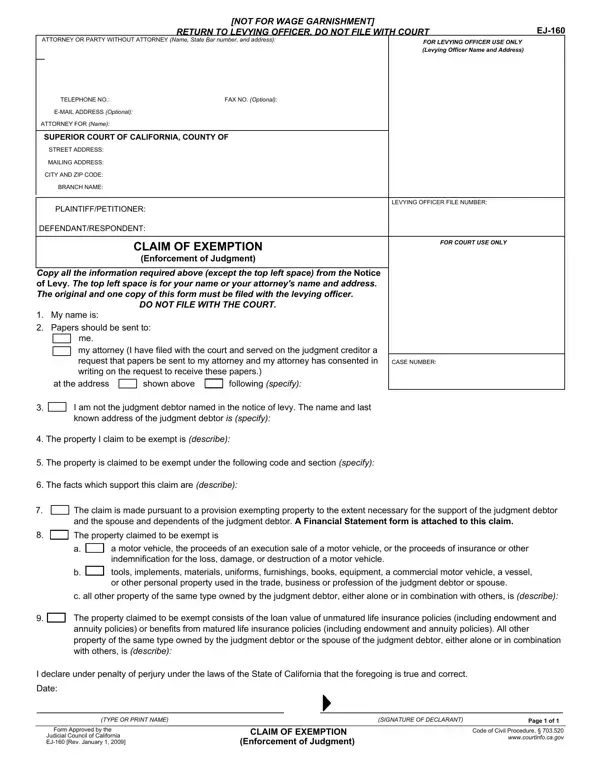
What it is: Claim of Exemption (Enforcement of Judgment), form EJ-160, is an optional Judicial Council of California form.
Who signs: Fill in the Date and the (TYPE OR PRINT NAME), and sign (SIGNATURE) under penalty of perjury.
What to bring and attach to Form EJ-160
Read Exemptions from the Enforcement of Judgments (form EJ-155) and Current Dollar Amounts of Exemptions from Enforcement of Judgments (form EJ-156) to help you figure out whether your property is exempt.
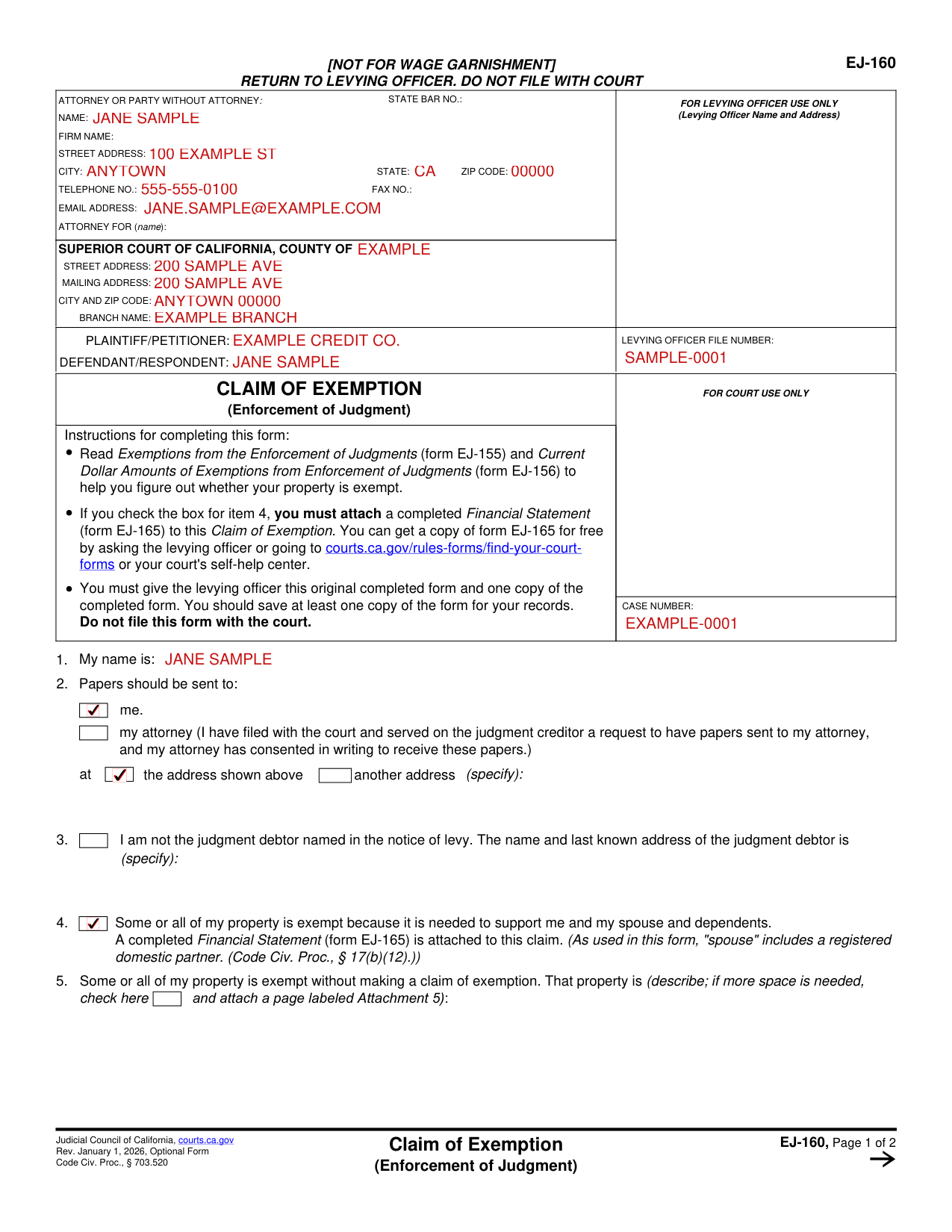
A filled-in Form EJ-160 example: a judgment debtor claims her bank account is exempt
How to fill out Form EJ-160, box by box
Attorney or party without attorney
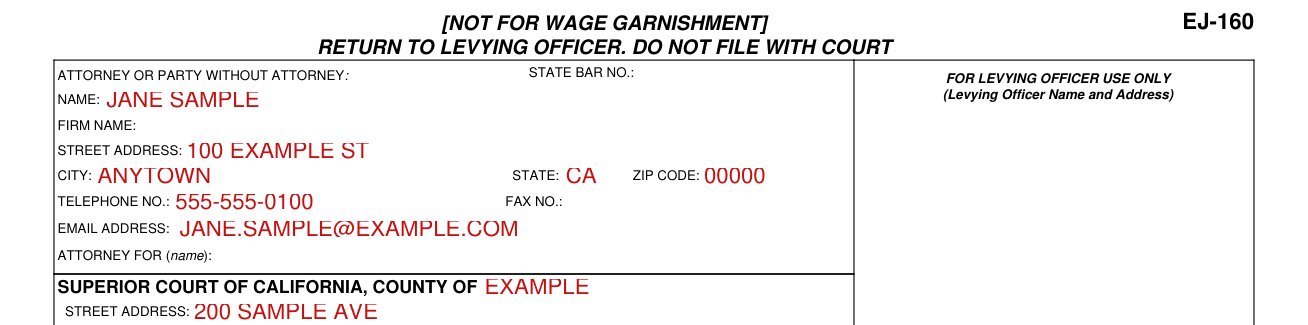
Under Attorney or party without attorney, fill in State bar no., Name, Firm name, Street address, City, State, Zip code, Telephone no., Fax no., Email address and Attorney for (name).
Superior court, plaintiff/petitioner, defendant/respondent and levying officer file number
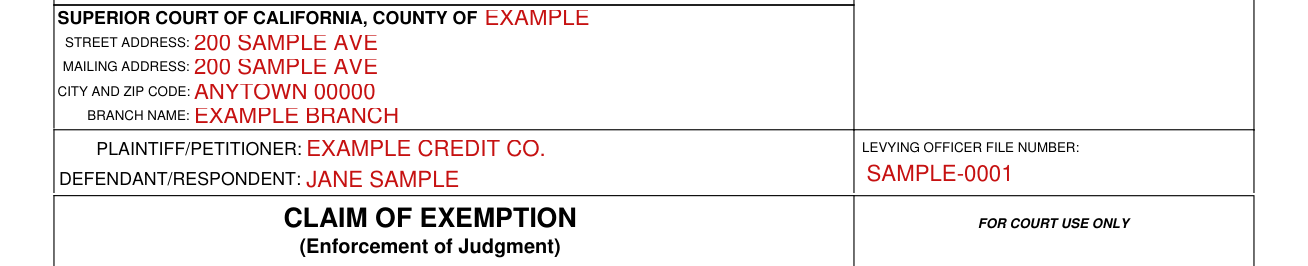
Under Superior Court of California, County of, name the county and fill in Street address, Mailing address, City and zip code and Branch name.
Fill in PLAINTIFF/PETITIONER and DEFENDANT/RESPONDENT.
Fill in LEVYING OFFICER FILE NUMBER.
Case number and 1. My name is

Fill in CASE NUMBER.
Next to 1. My name is:, write your name.
2. Papers should be sent to
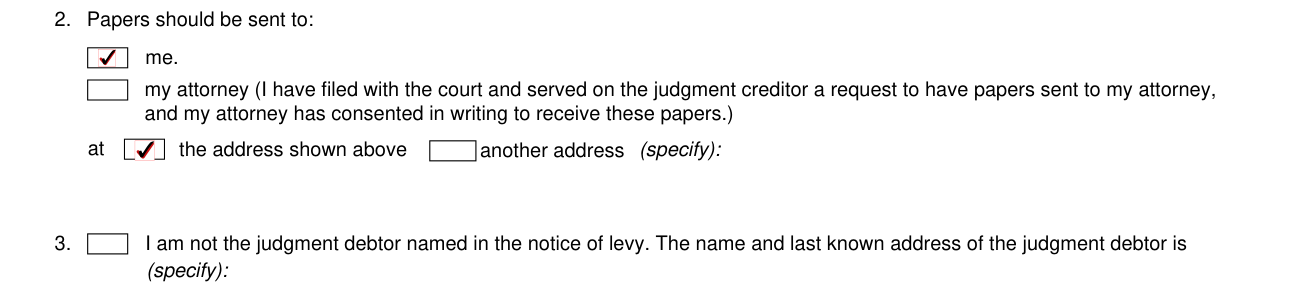
Under 2. Papers should be sent to:, check me or my attorney. Check my attorney if you have filed with the court and served on the judgment creditor a request to have papers sent to your attorney, and your attorney has consented in writing to receive these papers.
3. I am not the judgment debtor

Check 3 if you are not the judgment debtor named in the notice of levy, and specify the name and last known address of the judgment debtor.
4. Some or all of my property is exempt because it is needed to support me and my spouse and dependents

Check 4 if some or all of your property is exempt because it is needed to support you and your spouse and dependents. A completed Financial Statement (form EJ-165) is attached to this claim. As used in this form, "spouse" includes a registered domestic partner (Code Civ. Proc., § 17(b)(12)).
If you check the box for item 4, you must attach a completed Financial Statement (form EJ-165) to the Claim of Exemption. You can get a copy of form EJ-165 for free by asking the levying officer or at your court's self-help center.
5. Some or all of my property is exempt without making a claim of exemption

Check 5 if some or all of your property is exempt without making a claim of exemption, and describe that property; if more space is needed, check the box and attach a page labeled Attachment 5.
Short title, levying officer file no. and court case no.

On page 2, fill in SHORT TITLE, LEVYING OFFICER FILE NO. and COURT CASE NO.
6. The property I claim to be exempt
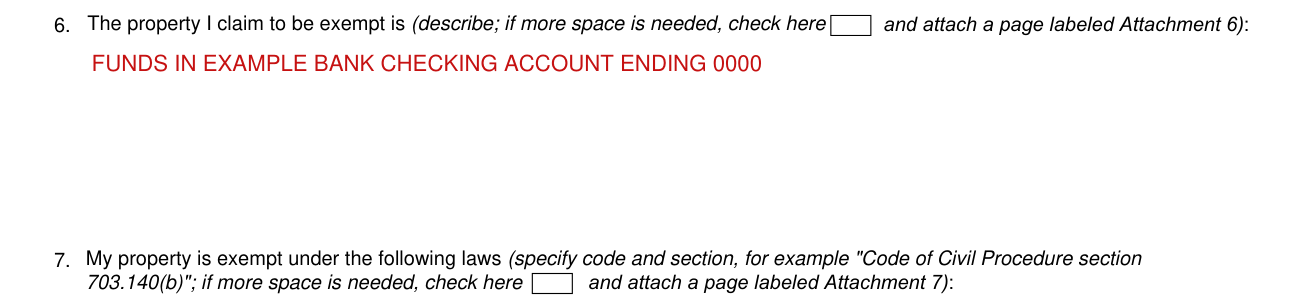
Next to 6, describe the property you claim to be exempt; if more space is needed, check the box and attach a page labeled Attachment 6.
7. My property is exempt under the following laws

Next to 7, specify the code and section under which your property is exempt, for example "Code of Civil Procedure section 703.140(b)"; if more space is needed, check the box and attach a page labeled Attachment 7.
8. The facts supporting my claim of exemption
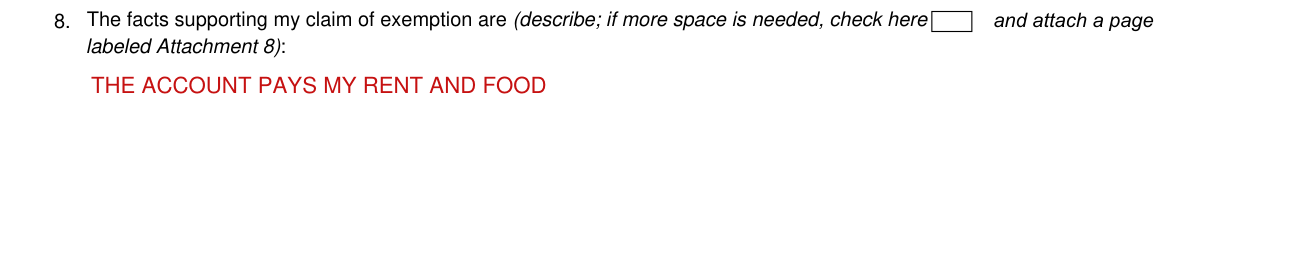
Next to 8, describe the facts supporting your claim of exemption; if more space is needed, check the box and attach a page labeled Attachment 8.
9. The property I claim to be exempt: a, b and c
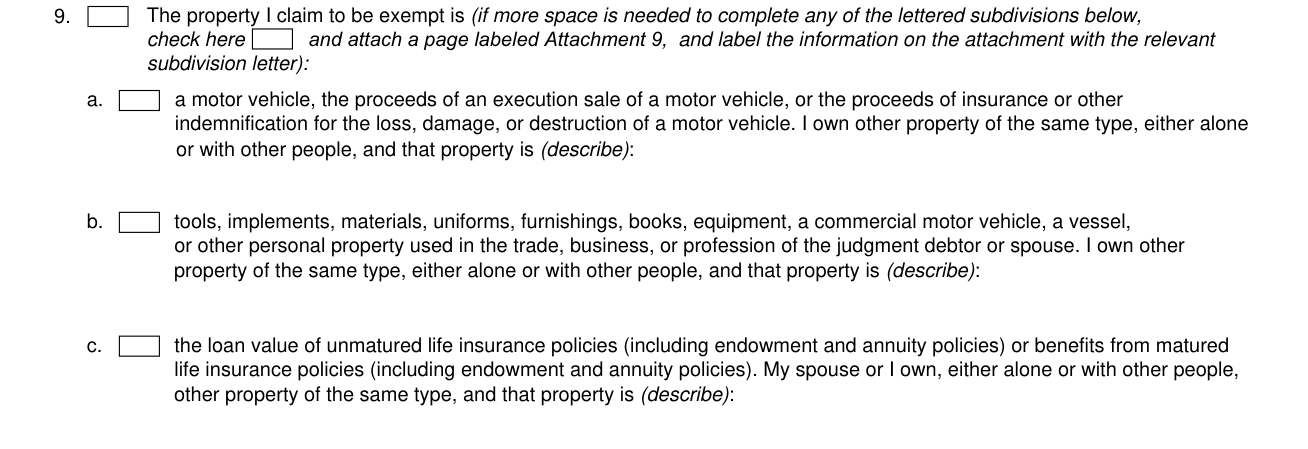
Next to 9, check the property you claim to be exempt. If more space is needed to complete any of the lettered subdivisions, check the box, attach a page labeled Attachment 9 and label the information on the attachment with the relevant subdivision letter.
Under a., check a motor vehicle, the proceeds of an execution sale of a motor vehicle, or the proceeds of insurance or other indemnification for the loss, damage, or destruction of a motor vehicle.
Under b., check tools, implements, materials, uniforms, furnishings, books, equipment, a commercial motor vehicle, a vessel, or other personal property used in the trade, business, or profession of the judgment debtor or spouse.
Under c., check the loan value of unmatured life insurance policies (including endowment and annuity policies) or benefits from matured life insurance policies (including endowment and annuity policies).
Under a. and b., if you own other property of the same type, either alone or with other people, describe that property. Under c., if you or your spouse own other property of the same type, either alone or with other people, describe that property.
Date, name and signature under penalty of perjury

Fill in the Date and the (TYPE OR PRINT NAME), and sign (SIGNATURE) under penalty of perjury.
Common questions about Form EJ-160
Where do I file it?
Give the levying officer the original completed form and one copy of the completed form. Save at least one copy of the form for your records. Do not file the form with the court.
When is this form not the right one?
The form is marked: NOT FOR WAGE GARNISHMENT.
Sources
[1] Form EJ-160 (Rev. January 1, 2026), Claim of Exemption (Enforcement of Judgment), Judicial Council of California (the Official source link on this page).