
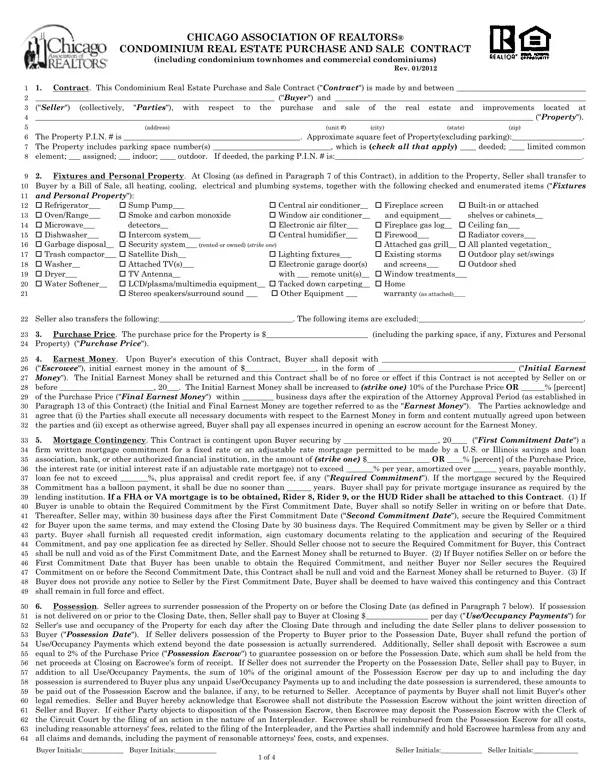
Buying or selling a condominium involves a series of carefully negotiated steps, and the Chicago Association of REALTORS® Condominium Real Estate Purchase and Sale Contract (revised January 2012) provides the legal framework for completing that process. This contract applies to condominium townhomes and commercial condominiums in addition to standard condo units. Below is a detailed look at what this agreement covers and what both parties need to understand before signing.
The contract begins by identifying the property, including its address, unit number, and any parking space assignment. It then establishes the agreed purchase price along with the amount of earnest money the buyer will deposit to demonstrate a serious intent to purchase. The earnest money is held in escrow until closing and is credited toward the final purchase price.
The mortgage contingency section is one of the most important clauses for buyers. It specifies a deadline by which the buyer must secure financing. If the buyer cannot obtain a mortgage commitment within that period, the contract can be terminated and the earnest money returned. The contingency amount and interest rate terms are negotiated between buyer and seller at the time of signing.
Fixtures and personal property included in the sale are listed explicitly. This prevents disputes later about items such as appliances, light fixtures, or storage units that are part of the deal.
The buyer has the right to conduct a property inspection within a defined number of business days after the contract is accepted. If defects are discovered, the buyer may request repairs, a price reduction, or cancellation depending on what the inspection reveals. The inspection clause protects buyers from purchasing a unit with hidden problems.
The buyer is also responsible for meeting all mortgage approval conditions on time and for making sure sufficient funds are available for the down payment and closing costs. Failure to meet these obligations can result in forfeiture of the earnest money.
The seller agrees to deliver possession of the unit on a specified date, typically the date of closing. Before that date, the seller must complete any agreed repairs and must provide all legally required disclosures about the condition of the property.
Real estate taxes, homeowner association fees, and utility charges are prorated as of the closing date so that each party pays only for the period they own the property. The seller is responsible for delivering a clear title and executing the deed at closing.
Homeowner association (HOA) disclosures are particularly important in condo transactions. The seller must provide the buyer with current HOA financial statements, rules, and any pending special assessments. Buyers who are unaware of significant assessments can face unexpected costs after closing.
At closing, the seller delivers the deed and all keys, and the buyer pays the remaining purchase price. Both parties sign the necessary transfer documents, and the deed is recorded with the county. The contract specifies the location and date of closing, and both parties must appear in person or through a legal representative.
The contract also includes an attorney modification period, typically five business days after acceptance, during which either party's attorney may propose changes to protect their client's interests. This period allows for legal review without invalidating the agreement as a whole.
When a single real estate agent or brokerage represents both buyer and seller, a dual agency situation exists. The contract requires both parties to confirm in writing that they understand and consent to this arrangement. Dual agency is legal in Illinois but requires full disclosure and written consent.
For buyers and sellers in Illinois, the Chicago Association of REALTORS® condominium contract is one of the most widely used forms in the Chicago metropolitan area. If you are working on a real estate transaction outside Illinois or need a different version, you may also find the real estate purchase agreement templates useful for your situation.
| Contract Term | What It Covers |
|---|---|
| Purchase Price | The total agreed amount the buyer will pay for the condo unit |
| Earnest Money | A good-faith deposit held in escrow until closing |
| Mortgage Contingency | A clause allowing the buyer to exit if financing cannot be secured |
| Inspection Period | The number of days the buyer has to inspect the property |
| Possession Date | The date the seller transfers the unit to the buyer |
| Attorney Modification | A review window in which attorneys may propose contract changes |
| HOA Disclosure | Documentation of association fees, rules, and pending assessments |
| Proration Date | The date used to split taxes and HOA fees between buyer and seller |
| Question | Answer |
|---|---|
| Form Name | Condominium Sale Contract Form |
| Form Length | 4 pages |
| Fillable? | No |
| Fillable fields | 0 |
| Avg. time to fill out | 1 min |
| Other names | chicago real association form, realtors purchase made search, contract realtors sale, chicago association condominium |
Condominium Sale Contract Form isn’t the one you’re looking for?