Please rate Contingency Plan For Vaccine Storage

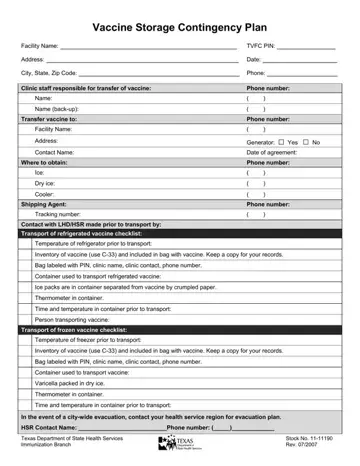
In the realm of healthcare and vaccine distribution, protecting vaccine integrity is a top priority for clinics, hospitals, and public health programs. The Contingency Plan for Vaccine Storage form provides a structured framework that healthcare facilities use to prepare for unexpected equipment failures or emergencies. This document captures every critical element of an emergency response plan, from staff contacts and backup facility agreements to temperature monitoring checklists and transportation protocols for both refrigerated and frozen vaccines.
Any healthcare provider or immunization program that stores vaccines must maintain a current contingency plan. This requirement applies to private physician offices, public health clinics, pharmacies, school health programs, and federally qualified health centers. Facilities enrolled in the Texas Vaccines for Children (TVFC) program are specifically required by the Texas Department of State Health Services to keep a completed and signed contingency plan on file at all times. The plan must be reviewed and updated annually, or whenever there are changes to staff roles, backup facility contacts, or storage equipment.
A thorough vaccine storage contingency plan must address every phase of an emergency response. The form captures the following essential information:
Maintaining the cold chain during vaccine transfer is critical for preserving vaccine efficacy. All refrigerated vaccines, including influenza, MMR, hepatitis A, hepatitis B, and tetanus-containing vaccines, must be kept at temperatures between 35 degrees F and 46 degrees F (2 degrees C to 8 degrees C) throughout the transport process. Frozen vaccines, including varicella (chickenpox) and MMRV (measles, mumps, rubella, varicella), must be maintained at temperatures between -58 degrees F and 5 degrees F (-50 degrees C to -15 degrees C) and require dry ice for transport.
The contingency plan form includes a detailed transport checklist for both refrigerated and frozen vaccines. The checklist covers container labeling with the facility PIN and clinic name, thermometer placement, time and temperature logging at departure and arrival, proper inventory documentation using the TVFC Vaccine Inventory form (C-21), and confirmation that ice packs or dry ice are properly positioned and not in direct contact with vaccine vials.
A written vaccine contingency plan is most effective when all relevant clinic staff are trained on the emergency procedures before any incident occurs. Staff should know where backup supplies are stored, how to reach the backup facility, and what steps to take immediately when a storage alarm triggers or power is lost. Conducting an annual review of the plan and a practice drill at least once per year ensures your team is prepared to act quickly and minimize vaccine loss during a real emergency.
The Texas Vaccines for Children (TVFC) program requires all enrolled providers to maintain a contingency plan that meets state standards. The plan must include a completed backup facility agreement signed by the backup facility and must be available for inspection during TVFC site visits. Providers who fail to maintain a current plan may face compliance warnings or loss of program participation. Keeping the vaccine storage contingency plan updated and on file is one of the simplest steps a clinic can take to remain in good standing with the TVFC program and protect its patients' access to free vaccines.
| Question | Answer |
|---|---|
| Form Name | Contingency Plan For Vaccine Storage |
| Form Length | 1 pages |
| Fillable? | No |
| Fillable fields | 0 |
| Avg. time to fill out | 15 sec |
| Other names | vaccine storage contingency plan form, Immunization, C-33, contingency plan for vaccine storage |
Contingency Plan For Vaccine Storage isn’t the one you’re looking for?
Please rate Contingency Plan For Vaccine Storage