
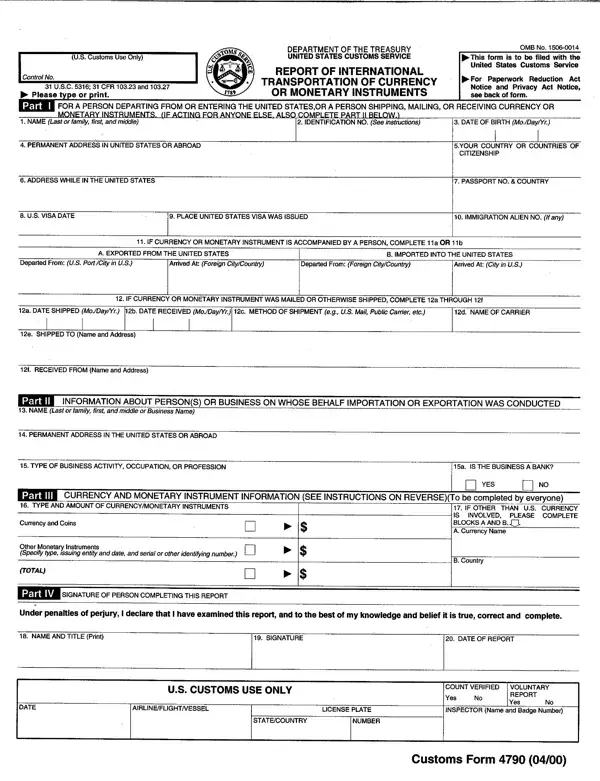
Customs Form 4790, officially titled the Report of International Transportation of Currency or Monetary Instruments (CMIR), is a federal requirement for anyone transporting $10,000 or more in currency or negotiable monetary instruments across U.S. borders. The form is administered by U.S. Customs and Border Protection and must be completed at the time of border crossing, whether entering or leaving the United States.
The requirement applies to a broad range of monetary instruments, including U.S. and foreign currency, traveler's checks, money orders, and bearer bonds. Both individual travelers and financial institutions are covered. Failing to file or providing inaccurate information may result in seizure of the funds and civil or criminal penalties under federal law. The form is available at ports of entry and can be completed in advance to save time at the border.
| Question | Answer |
|---|---|
| Form Name | Customs Form 4790 |
| Form Length | 2 pages |
| Fillable? | No |
| Fillable fields | 0 |
| Avg. time to fill out | 30 sec |
| Other names | f4790 customs form 4790 1995 |
Customs Form 4790 isn’t the one you’re looking for?