
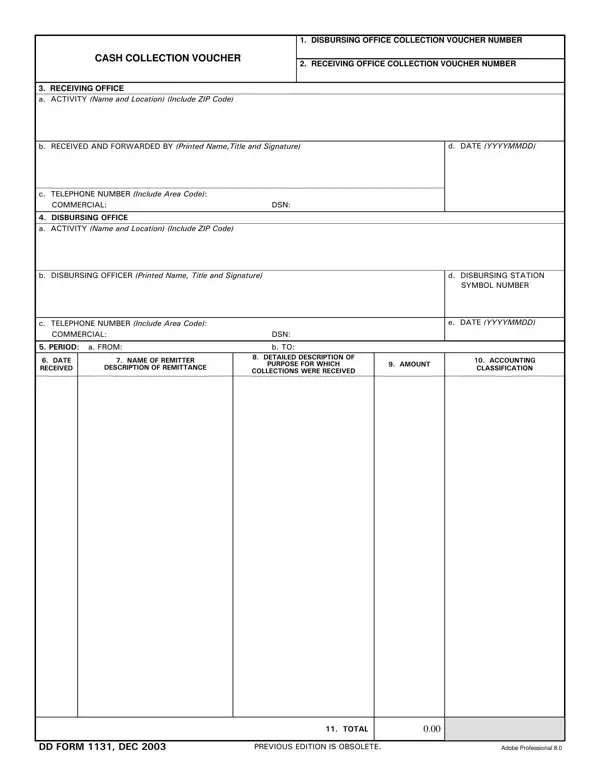

DD Form 1131 at a glance
What it is: This form is the Cash Collection Voucher.
Who signs: Enter the printed name, title, and signature of the designated receiving official in Box 3b, Received and Forwarded By. Enter the printed name, title, and signature of DO in Box 4b, Disbursing Officer, in the applicable blocks.
A filled-in DD Form 1131 example: a receiving official records one cash collection
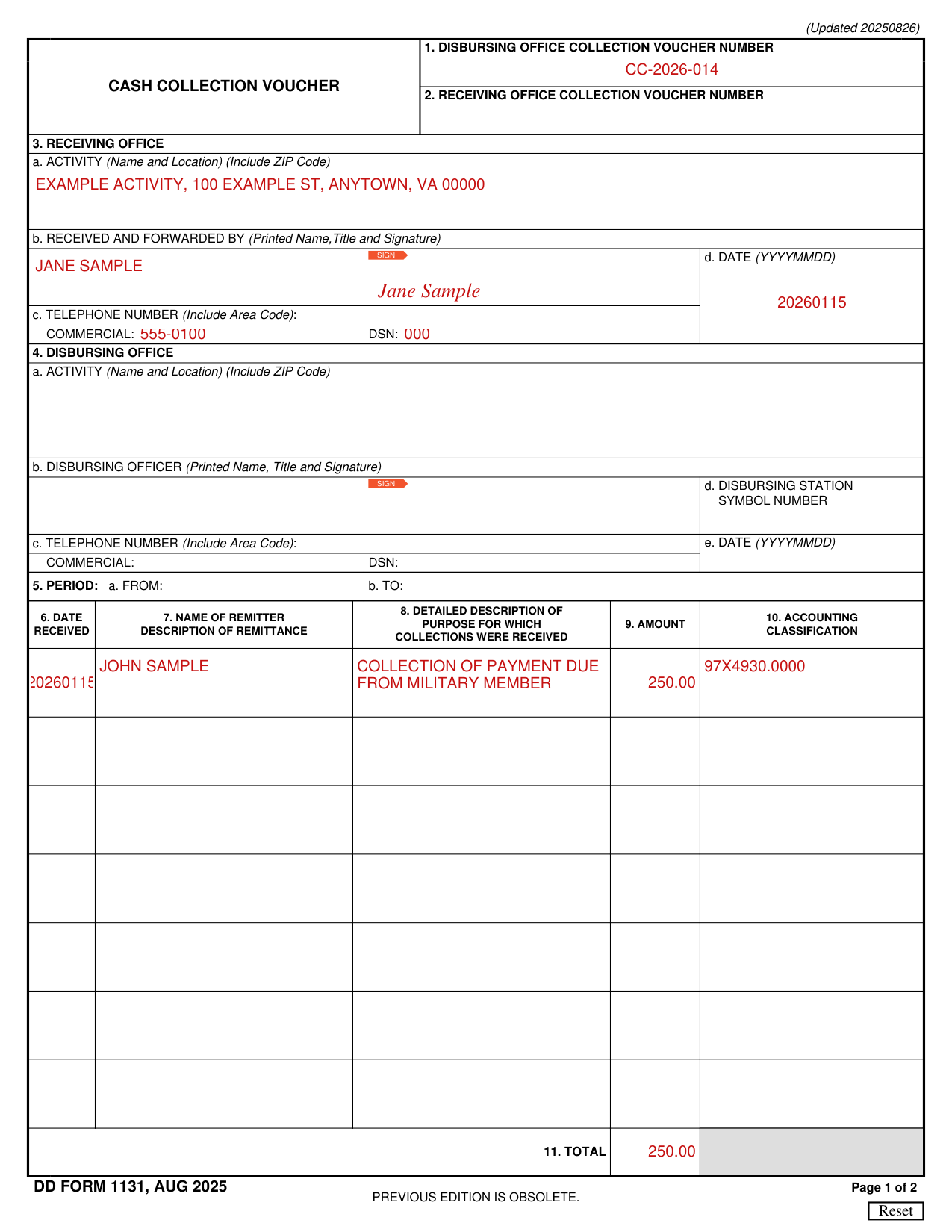
How to fill out DD Form 1131, box by box
Tap a group of boxes to open it, and a picture to see it full size.
Collection voucher numbers

The applicable functional area shall enter the voucher number in Box 1, Disbursing Office Collection Voucher Number.
Use of Box 2, Receiving Office Collection Voucher Number, is optional.
If the receiving official controls collections by locally assigned number, the receiving official shall enter the number in this block.
Receiving office (Box 3)
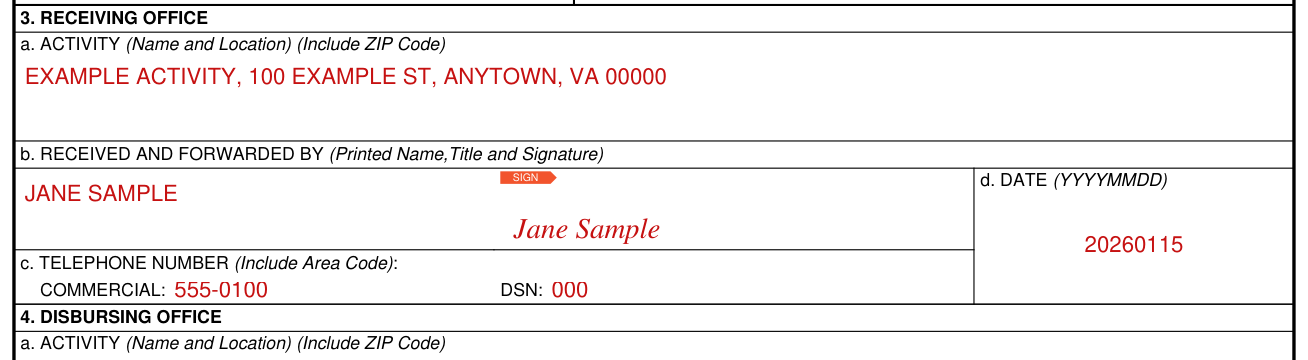
When collections are made by someone other than the disbursing office cashier, the receiving official shall enter the name and location of such activity in Box 3a, Activity.
Leave blank when collections are made by the disbursing office cashier.
Enter the printed name, title, and signature of the designated receiving official in Box 3b, Received and Forwarded By.
If a debtor turns in the remittance to the DO or cashier personally and the Receiving Office block is completed for reference, no signature is required.
Normally, this block is left blank when collections are made by the disbursing office cashier.
In Box 3d, Date, enter the date of the last collection shown on the DD Form 1131 or the date the DD Form 1131 is prepared by the collection official.
Disbursing office (Box 4)
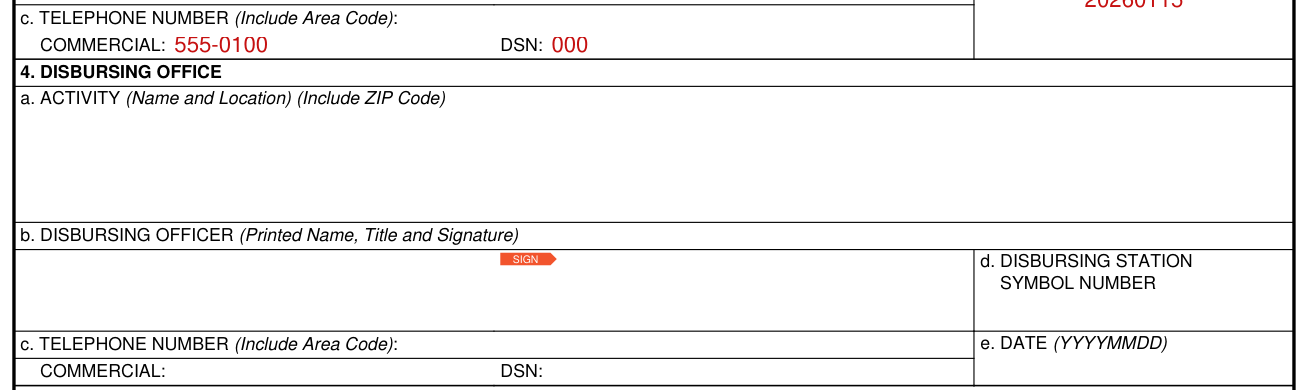
Enter the name and location of the disbursing activity in Box 4a, Activity.
Enter the printed name, title, and signature of DO in Box 4b, Disbursing Officer, in the applicable blocks.
Signature is not required when the DD Form 1131 is validated by a cash control machine.
Enter the four-digit DSSN in Box 4d, Disbursing Station Symbol Number.
In Box 4e, Date, enter the primary voucher date assigned by the functional area; it is the DO or agent accountability date.
Period (Box 5)

In Box 5, Period, enter the specific period encompassing collections reported on the form; the date of the first collection on the voucher is the "From" date, and the date of the last collection on the voucher is the "To" date.
If all collections on the voucher are applicable to a specifically designated period, such as an accounting month, enter inclusive dates (1 Mar XX to 31 Mar XX, for example).
If all collections are made on a single date or no specifically designated period is applicable, leave the "From-- To" blocks blank.
Collections (Boxes 6 to 11)
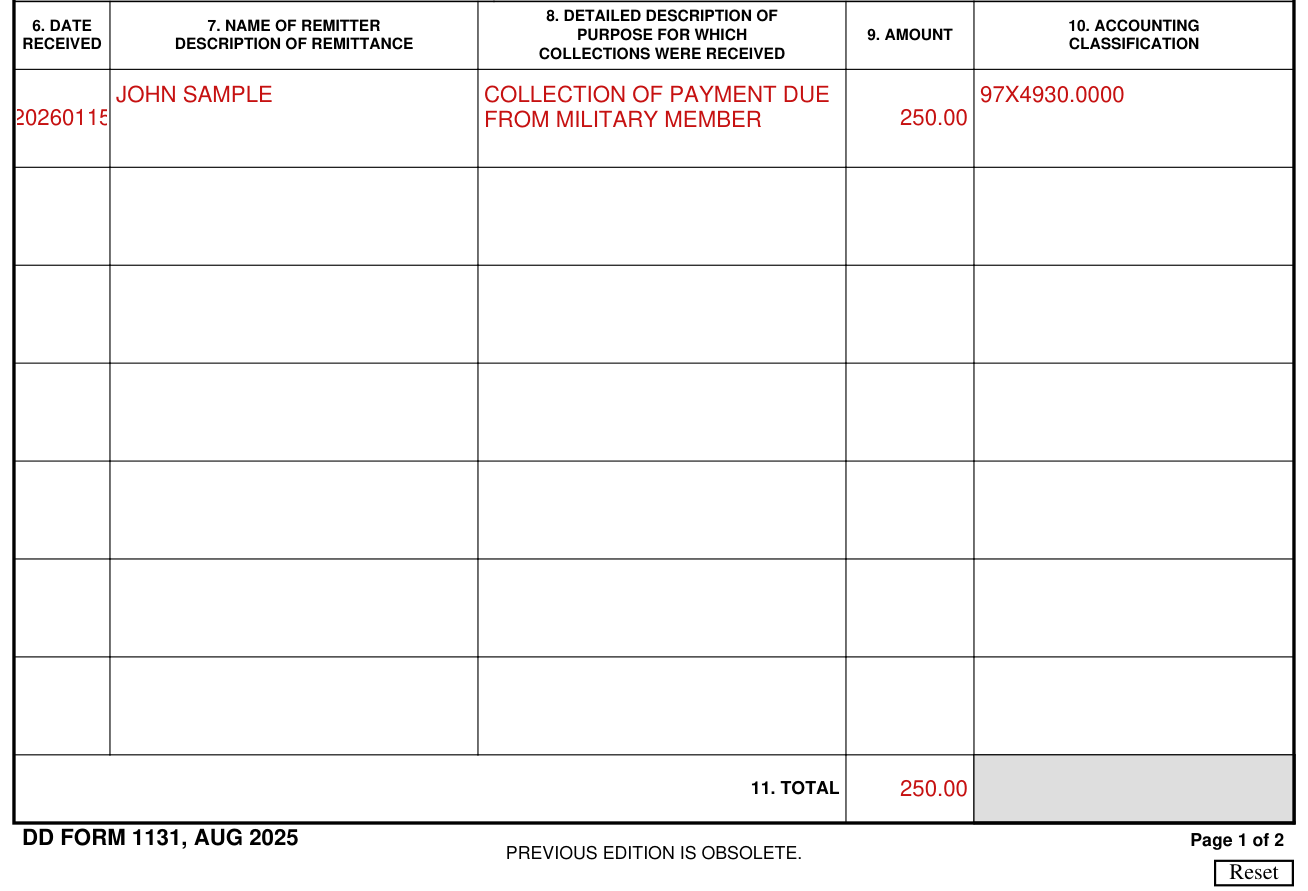
Box 9 is Amount and Box 10 is Accounting Classification.
In Box 6, Date Received, enter the date cash (or negotiable instruments) is received from a remitter, or other date of incident (for example, date money found on base).
If the DD Form 1131 is being used as a cover voucher and not all collections were made on the same day, enter "various."
In Box 7, Name of Remitter Description of Remittance, enter the name of the individual remitter or company.
Except for collections from over-the-counter sales (i.e., commissaries) and locally billed items (telephone service, housing, etc.), show each remitter's name and SSN if collection is received from a military member or civilian employee.
If a name is not applicable (for example, money found on base), enter a description of the remittance.
If the DD Form 1131 is being used as a cover voucher, enter "See Attached" and attach a copy of each DD Form 634 to the original and duplicate of the DD Form 1131.
In Box 8, Detailed Description of Purpose for Which Collections Were Received, enter the purpose for collection.
If information entered in the name of remitter and description of remittance block satisfactorily describes the purpose of the collection, leave blank.
In Box 9, Amount, enter the individual amounts collected from each remitter or each incident by accounting classification.
When the DD Form 1131 is used as a cover voucher, enter overall totals by accounting classification.
In Box 10, Accounting Classification, enter the complete accounting classification for the amount of each collection.
If the DD Form 1131 is being used as a cover voucher, enter the accounting classification for each amount included.
More rules for DD Form 1131
Dates may be entered by the receiving official or disbursing office, as applicable.
Sources
[1] DD Form 1131 (AUG 2025), Cash Collection Voucher (the Official source link on this page).