
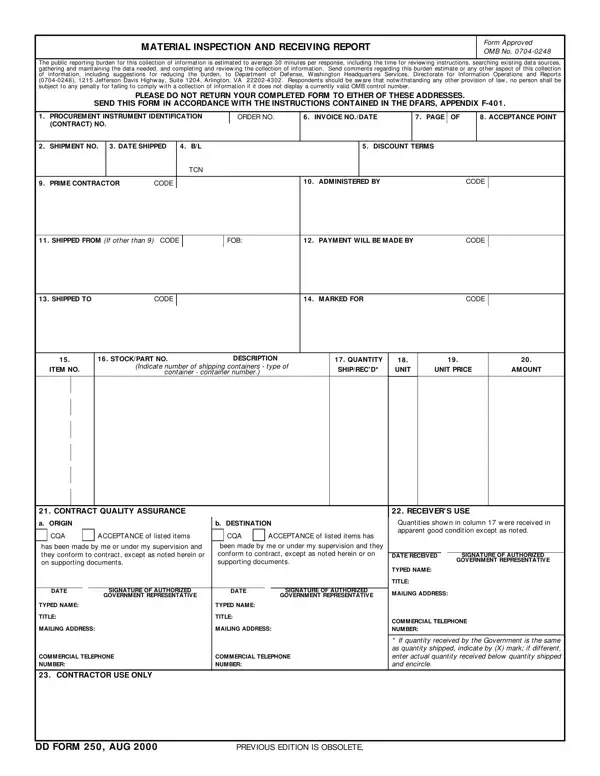
The Material Inspection and Receiving Report is the official government document used across Department of Defense procurement operations to record the delivery, inspection, and acceptance of materials and services supplied under federal contracts. Required under DFARS Part 4, this document creates an auditable record that protects both the contractor and the government by establishing precisely what was delivered, in what quantity, and whether the items met contract specifications.
Government contracting agencies rely on this form to capture all relevant shipment and inspection data in one place. The first block identifies the contract number, delivery order number, and shipment number. The line item section lists each item delivered with its description, unit of measure, quantity shipped, and quantity accepted. A Contract Quality Assurance (CQA) representative must sign and date the inspection block to confirm the goods were verified at either the origin or destination as specified in the contract. A second authorized government official signs the acceptance block, confirming the items have been received and accepted for government use.
The inspection and receiving workflow differs by contract type. For destination acceptance, a government inspector at the delivery site reviews the items upon arrival and completes the acceptance block on site. For origin acceptance, a government representative visits the contractor facility before shipment to certify that items meet quality standards before they leave the production floor. Both approaches require a fully completed receiving report to trigger the contractor payment process, so missing or incorrect data can delay invoice processing.
Receiving reports serve several important functions in supply chain management. They verify that materials arrived in the required condition and match contract specifications. They provide documentation for property accountability, helping the government track the physical location of procured assets. They feed directly into contract closeout procedures, supporting the contracting officer in determining that all deliveries have been made and accepted. In the event of a discrepancy between what was ordered and what was received, the report is the starting point for a formal discrepancy submission or contract modification.
Contractors frequently prepare multiple copies for distribution: one retained internally for billing records, one provided to the receiving official, and one forwarded to the contracting officer. While the standard template remains a single-page document, digital versions are now widely used to reduce manual errors and speed up processing. Timely submission after acceptance is important, as government payment terms under the Prompt Payment Act begin running from the date of acceptance or the date of a valid invoice, whichever is later.
| Question | Answer |
|---|---|
| Form Name | DD Form 250 |
| Form Length | 1 pages |
| Fillable? | No |
| Fillable fields | 0 |
| Avg. time to fill out | 15 sec |
| Other names | inspection receiving, how to form dd 250, dd 250, dd250 form pdf |
| Issuing Agency | Department of Defense (DoD) |
| Category | Procurement Documentation |
| OMB Control Number | 0704-0248 |
DD Form 250 isn’t the one you’re looking for?