
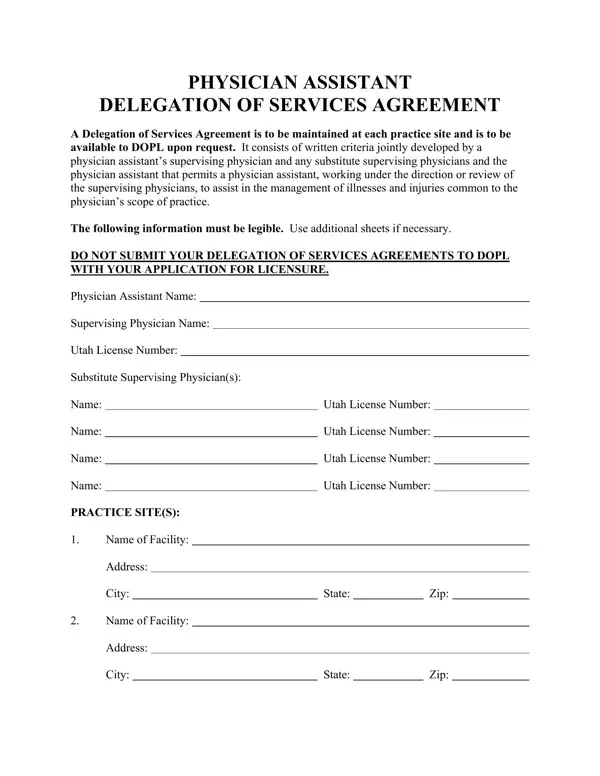
What Is a Delegation of Services Agreement?
A Delegation of Services Agreement is a formal written contract that defines the professional relationship between a physician assistant and a supervising physician. The document specifies the medical services the PA is authorized to provide, the supervision requirements that apply, and the steps to take in situations that exceed the PA's authorized clinical role. State medical boards across the United States require this agreement before a physician assistant can begin independent clinical practice at any facility.
Without a valid, signed agreement on file, a PA may not legally see patients in most states. The document protects patients by establishing clear care standards, protects the supervising physician by defining responsibility limits, and protects the PA by clearly documenting what services are authorized.
Who Needs This Agreement?
This agreement is required whenever a physician assistant provides patient care under physician supervision. The following parties are directly involved:
- Physician assistants licensed to practice in any clinical specialty
- Supervising physicians who oversee PA clinical activities at any location
- Healthcare facilities that employ or credential physician assistants
- Group practices where multiple physicians may serve as alternating supervisors
- Urgent care centers, hospitals, outpatient clinics, and private offices
Some states also require the practice administrator or medical director to countersign the agreement. Check with your state medical board for exact requirements.
Key Components of the Agreement
A complete supervisory agreement typically includes the following sections. Each must be filled out accurately to ensure the document is legally valid:
Party Identification
Full legal names, professional titles, and current license numbers for both the supervising physician and the PA. If multiple supervising physicians rotate coverage, each must be listed.
Authorized Practice Locations
Every site where the PA provides services must be named, including hospital departments, satellite offices, and any community or temporary clinic locations. Adding a new practice site usually requires an amendment to the existing agreement.
Scope of Services
A specific list of the clinical services the PA is authorized to perform. This may include conducting physical exams, ordering and interpreting diagnostic tests, prescribing medications, performing minor surgical procedures, and managing chronic conditions.
Supervision Requirements
The method of supervision must be stated: on-site, electronic, or telephonic. The agreement must also describe how often the supervising physician reviews the PA's patient charts. Many states require review of at least 10 percent of charts on a regular schedule.
Consultation Protocols
Clear procedures for the PA to reach the supervising physician in urgent or complex situations. This includes emergency contact methods, expected response times, and backup physician contact details when the primary supervisor is unavailable.
Prescribing Authority
The drug classes the PA is authorized to prescribe, including any restrictions on controlled substances. State prescribing laws vary considerably, and the agreement must match current state regulations.
Chart Review and Quality Oversight
The frequency of chart review, the process used, and how reviews are documented. Most state boards want to see a clear review schedule, not a general commitment to periodic review.
Emergency and Backup Procedures
Plans for patient care situations that fall outside the PA's scope, or when the supervising physician is unavailable. This section ensures continuity of care and protects patients in every situation.
How to Fill Out the Agreement
Follow these steps to complete the physician assistant supervisory agreement correctly and avoid common compliance issues:
- Collect required information. Gather the full legal names, license numbers, and NPI numbers of both the PA and all supervising physicians before starting the document.
- List every practice location. Write down each site where the PA will provide care, including the full address and facility name. Do not omit temporary or part-time locations.
- Define scope of services clearly. Be specific about what the PA is and is not authorized to do. Vague descriptions of scope often create compliance problems during state audits.
- Specify supervision type and frequency. State whether supervision will be on-site, electronic, or telephonic, and describe availability requirements for the supervising physician.
- Detail prescribing authority. List the drug classes the PA may prescribe, along with any restrictions on controlled substances or specific medication categories.
- Set the chart review schedule. Define how often the physician will review the PA's patient charts and how that review will be documented and tracked.
- Add backup procedures. Name an alternate supervising physician and describe the steps for emergencies, after-hours situations, or when the primary supervisor cannot be reached.
- Review and sign. Both the supervising physician and the PA must sign and date the agreement. Some states require notarization or a witness signature in addition to the primary parties.
- Distribute and store copies. Keep a signed copy at each practice site, submit to the state licensing board if required, and store a secure backup in a separate location.
State-Specific Requirements
Requirements for physician assistant supervisory agreements vary by state. Key examples include:
- California requires a written supervisory agreement reviewed and renewed every two years, with copies available at each practice site
- Utah requires the agreement to be filed with the Division of Occupational and Professional Licensing and kept on-site at each practice location
- Texas requires the supervising physician to review at least 10 percent of the PA's medical charts on a regular schedule
- Florida requires the supervising physician to file a physician profile with the state board before the PA begins practice at any facility
- New York requires a practice agreement that includes specific terms for supervisory physician availability and chart review procedures
State regulations change frequently. Always confirm current requirements with your state medical licensing board. Practicing without a valid current agreement can result in fines, suspension, or revocation of the PA's license.
Common Mistakes to Avoid
Healthcare providers often make the following errors when preparing or maintaining a physician assistant supervisory agreement:
- Not updating the agreement when scope changes. Adding a new service or procedure requires a formal amendment. An outdated agreement may not cover services the PA is currently providing.
- Failing to list all practice locations. If a PA works at multiple sites, each must be named in the agreement. Providing care at an unlisted site is a regulatory violation.
- Missing the annual renewal deadline. Most states require the agreement to be reviewed and re-signed at least once per year. A lapsed agreement puts both the PA and the supervising physician at risk of disciplinary action.
- Vague prescribing authority language. The agreement must specify which drug classes the PA may prescribe. Ambiguity around controlled substances is one of the most common issues flagged during state audits.
- Not keeping copies on-site. A signed copy of the current agreement must be kept at each practice location. State regulators expect to see the document during routine inspections.
- Using an outdated template. State regulations evolve. A template that was compliant three years ago may now be missing required provisions or contain superseded language.
Frequently Asked Questions
Is a Delegation of Services Agreement required in every state?
The vast majority of states require some form of written supervisory or collaborative agreement for physician assistants. Requirements differ by state. Some use the term 'collaborative practice agreement' or 'practice protocol,' but the core requirements are similar. As of 2024, more than 40 states have adopted laws that expand PA practice authority, but most still require a written agreement on file. Check with your state board for current rules.
How often must the agreement be renewed?
Most states require annual renewal. Some states require immediate updates whenever the PA changes practice sites, adds clinical services, or changes supervising physicians. The updated agreement must be signed before the PA begins work under the new terms.
What happens if the supervising physician leaves?
If the primary supervising physician is no longer available, the PA must enter into a new agreement with a qualified supervising physician before continuing clinical practice. Most facilities require this transition to happen within 30 to 90 days, depending on state law.
Can the same agreement cover multiple practice locations?
Yes, as long as all locations are named in the agreement. Some states require a separate agreement for each facility, while others allow one document to cover multiple sites. Each location must be listed by name and address for the agreement to be valid at that site.
For related forms used in healthcare professional arrangements, see the PA Medical Command Authorization Form and the Business Associate Agreement (HIPAA). Healthcare employers may also need an Independent Contractor Agreement for contract PA staffing arrangements or a Subcontractor Agreement for temporary clinical staffing situations.
