

Food Allergy Action Plan at a glance
What it is: This form is provided courtesy of Food Allergy Research & Education (FARE). Do not depend on antihistamines or inhalers (bronchodilators) to treat a severe reaction. USE EPINEPHRINE.
Who signs: The patient or parent/guardian and the physician/HCP sign.
A filled-in Food Allergy Action Plan example: a child with a peanut allergy
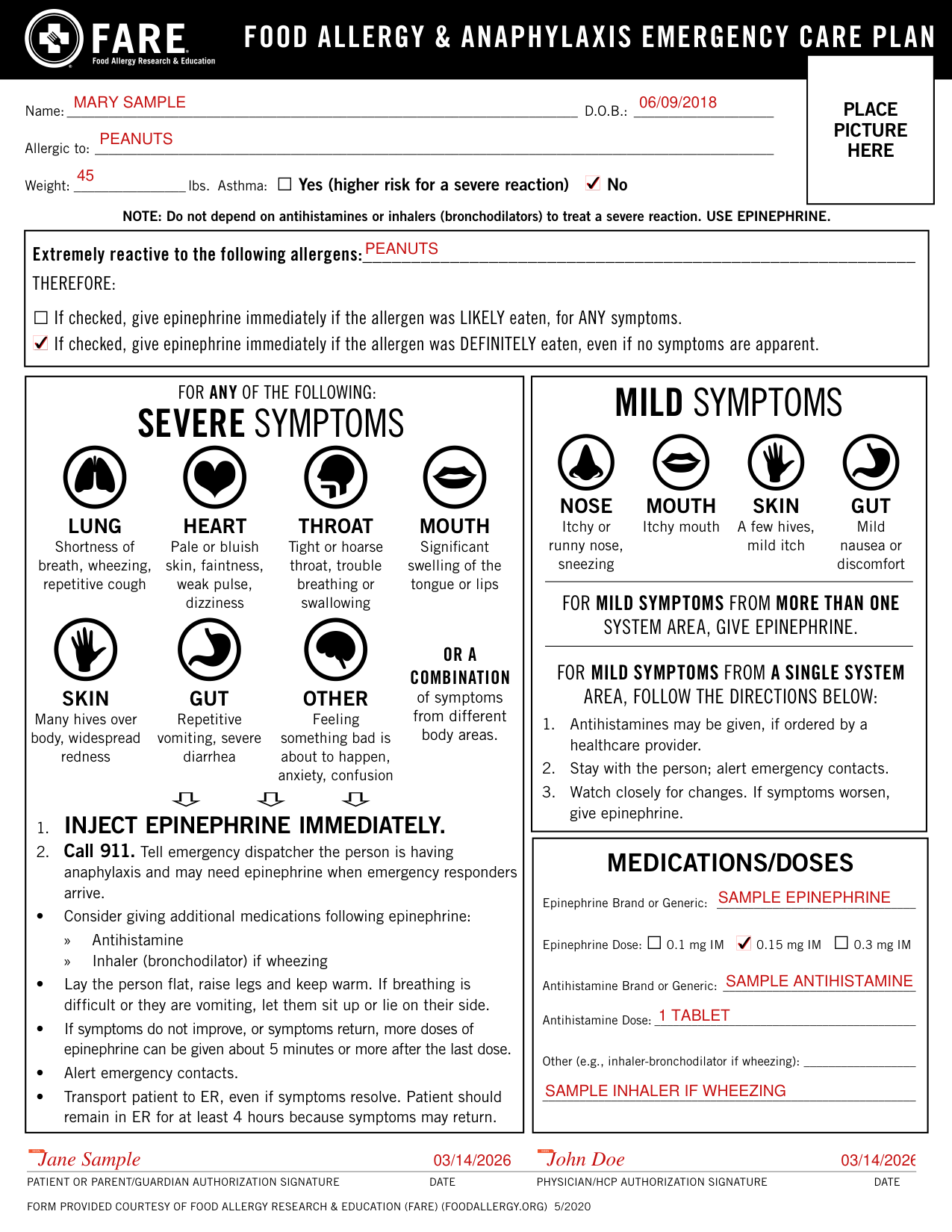
How to fill out Food Allergy Action Plan, box by box
Name, allergy, weight and asthma

Enter the Name, D.O.B., Allergic to and Weight in lbs.
For Asthma, check Yes (higher risk for a severe reaction) or No.
Extremely reactive allergens

Under Extremely reactive to the following allergens, enter the allergens.
THEREFORE: check the first box to give epinephrine immediately if the allergen was LIKELY eaten, for ANY symptoms, or the second box to give epinephrine immediately if the allergen was DEFINITELY eaten, even if no symptoms are apparent.
Epinephrine dose

Enter the Epinephrine Brand or Generic, and check the Epinephrine Dose: 0.1 mg IM, 0.15 mg IM or 0.3 mg IM.
Antihistamine and other

Antihistamines may be given, if ordered by a healthcare provider. Enter the Antihistamine Brand or Generic, the Antihistamine Dose and Other.
Signatures

Parent or Guardian Signature: the patient or parent/guardian signs the authorization and enters the date. Physician Signature: the physician/HCP signs the authorization and enters the date.
Other directions

Under OTHER DIRECTIONS/INFORMATION, enter directions such as may self-carry epinephrine or may self-administer epinephrine.
Emergency contacts

Treat the person before calling emergency contacts. The first signs of a reaction can be mild, but symptoms can worsen quickly. Under EMERGENCY CONTACTS - CALL 911, enter the RESCUE SQUAD.
Enter the DOCTOR and PARENT/GUARDIAN, each with a PHONE number.
Under OTHER EMERGENCY CONTACTS, enter up to three NAME/RELATIONSHIP lines, each with a PHONE number.
If your situation is different
For mild symptoms from a single system area
For mild symptoms from a single system area, follow the directions: stay with the person and alert emergency contacts, and watch closely for changes. If symptoms worsen, give epinephrine.
For mild symptoms from more than one system area
For mild symptoms from more than one system area, give epinephrine.
For severe symptoms
FOR ANY OF THE FOLLOWING: SEVERE SYMPTOMS or A COMBINATION of symptoms from different body areas. Inject epinephrine immediately, then call 911 and tell the emergency dispatcher the person is having anaphylaxis and may need epinephrine when emergency responders arrive.
Consider giving additional medications following epinephrine: Antihistamine, Inhaler (bronchodilator) if wheezing. Lay the person flat, raise legs and keep warm. If breathing is difficult or they are vomiting, let them sit up or lie on their side. If symptoms do not improve, or symptoms return, more doses of epinephrine can be given about 5 minutes or more after the last dose. Alert emergency contacts. Transport patient to ER, even if symptoms resolve. Patient should remain in ER for at least 4 hours because symptoms may return.
You use an auto-injector
For all auto-injectors: do not put your thumb, fingers or hand over the tip of the auto-injector or inject into any body part other than mid-outer thigh. In case of accidental injection, go immediately to the nearest emergency room. If administering to a young child, hold their leg firmly in place before and during injection to prevent injuries. Epinephrine can be injected through clothing if needed. Call 911 immediately after injection.
Sources
[1] Food Allergy Action Plan (the served file, provided courtesy of Food Allergy Research & Education (FARE); no issuer file found) (the Official source link on this page).
