

Form 103 - Short at a glance
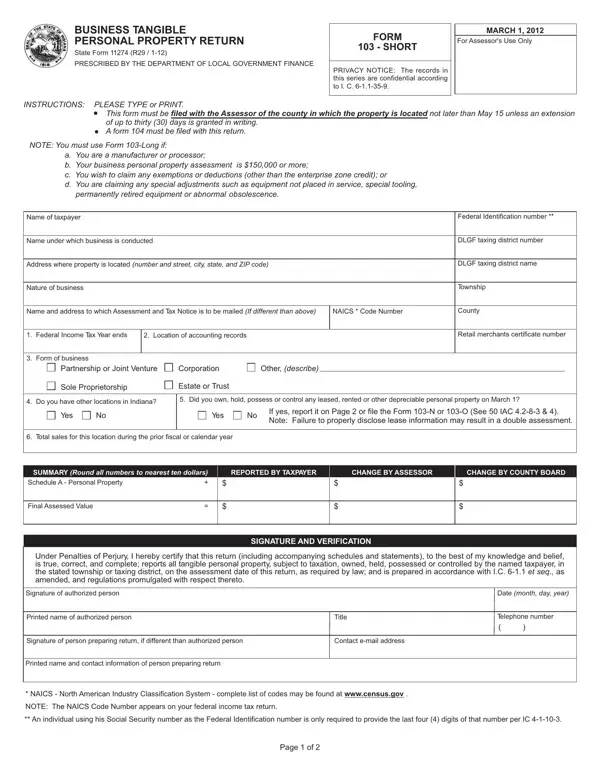
What it is: Form 103 - Short, State Form 11274 (R46 / 11-25), is the Business Tangible Personal Property Return, prescribed by the Department of Local Government Finance.
Who signs: The Authorized Person signs, with the Printed Name of Authorized Person and the Date (month, day, year).
Indiana's personal property tax system is a self-assessment system, so it is the taxpayer's responsibility to file this form in a timely manner.
What to bring and attach to Form 103 - Short
Form 104 must be filed with this return.
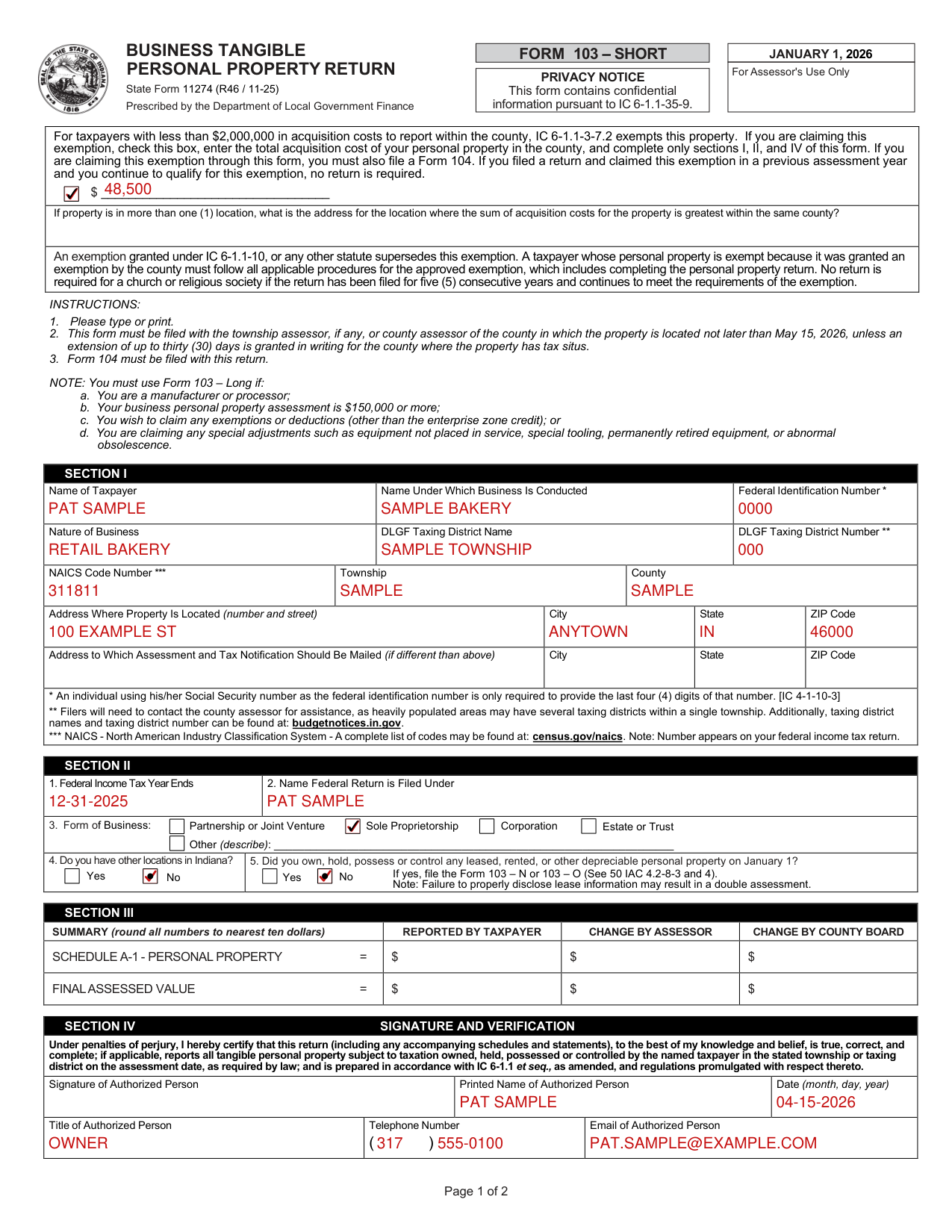
A filled-in Form 103 - Short example: a sole proprietor claiming this exemption
How to fill out Form 103 - Short, box by box
Claiming this exemption: total acquisition cost

For taxpayers with less than $2,000,000 in acquisition costs to report within the county, IC 6-1.1-3-7.2 exempts this property (checked November 11, 2026).
If you are claiming this exemption, check this box, enter the total acquisition cost of your personal property in the county, and complete only sections I, II, and IV of this form.
If you are claiming this exemption through this form, you must also file a Form 104.
If you filed a return and claimed this exemption in a previous assessment year and you continue to qualify for this exemption, no return is required.
If property is in more than one (1) location, enter the address for the location where the sum of acquisition costs for the property is greatest within the same county.
To establish an exemption in a new county, new or existing businesses must file a personal property return during their first year in that new county.
Section I: Name of Taxpayer
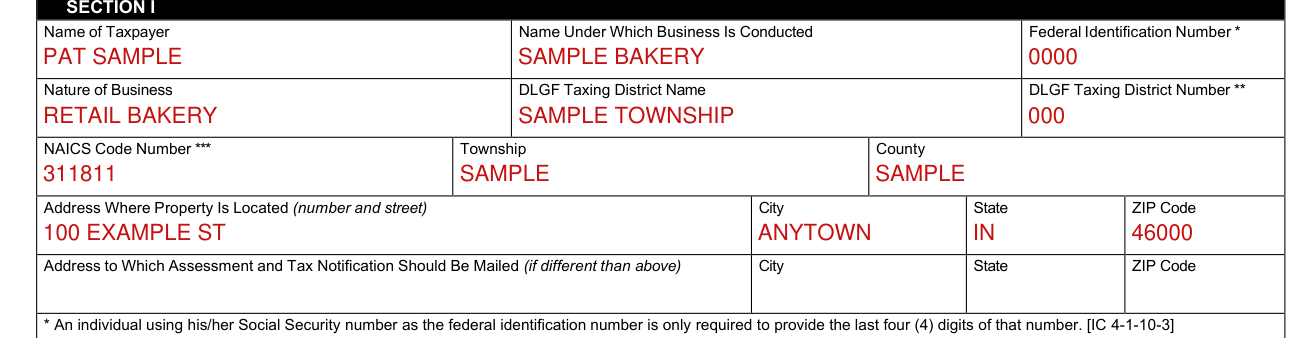
In SECTION I, enter the Name of Taxpayer, the Name Under Which Business Is Conducted and the Federal Identification Number *. * An individual using his/her Social Security number as the federal identification number is only required to provide the last four (4) digits of that number [IC 4-1-10-3].
Enter the Nature of Business, the DLGF Taxing District Name and the DLGF Taxing District Number **. ** Filers will need to contact the county assessor for assistance, as heavily populated areas may have several taxing districts within a single township. Taxing district names and taxing district number can be found at: budgetnotices.in.gov.
Enter the NAICS Code Number ***, the Township and the County. *** A complete list of codes may be found at: census.gov/naics. Note: Number appears on your federal income tax return.
Enter the Address Where Property Is Located (number and street), City, State and ZIP Code.
Enter the "Address to Which Assessment and Tax Notification Should Be Mailed (if different than above)", City, State and ZIP Code, if different than the Address Where Property Is Located.
Section II: Form of Business
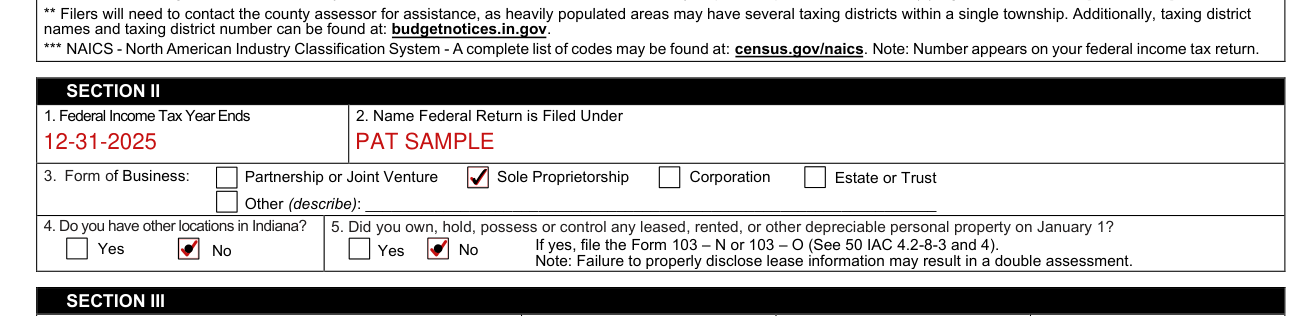
In SECTION II, enter 1. Federal Income Tax Year Ends and 2. Name Federal Return is Filed Under.
In 3. Form of Business, check Partnership or Joint Venture, Sole Proprietorship, Corporation, Estate or Trust, or Other (describe).
In 4, check Yes or No: Do you have other locations in Indiana?
In 5, check Yes or No: Did you own, hold, possess or control any leased, rented, or other depreciable personal property on January 1? If yes, file the Form 103 - N or 103 - O (See 50 IAC 4.2-8-3 and 4).
Common mistake: Note: Failure to properly disclose lease information may result in a double assessment.
Section III: Summary

In SECTION III, SUMMARY, round all numbers to nearest ten dollars. Under REPORTED BY TAXPAYER, enter SCHEDULE A-1 - PERSONAL PROPERTY and the FINAL ASSESSED VALUE. The SUMMARY also has CHANGE BY ASSESSOR and CHANGE BY COUNTY BOARD.
Section IV: Signature and Verification

In SECTION IV, SIGNATURE AND VERIFICATION, the Authorized Person certifies under penalties of perjury that this return (including any accompanying schedules and statements), to the best of their knowledge and belief, is true, correct, and complete; if applicable, reports all tangible personal property subject to taxation owned, held, possessed or controlled by the named taxpayer in the stated township or taxing district on the assessment date, as required by law; and is prepared in accordance with IC 6-1.1 et seq.
Sign at Signature of Authorized Person. Enter the Printed Name of Authorized Person, the Date (month, day, year), the Title of Authorized Person, the Telephone Number and the Email of Authorized Person.
Schedule A-1: Total Cost and True Tax Value
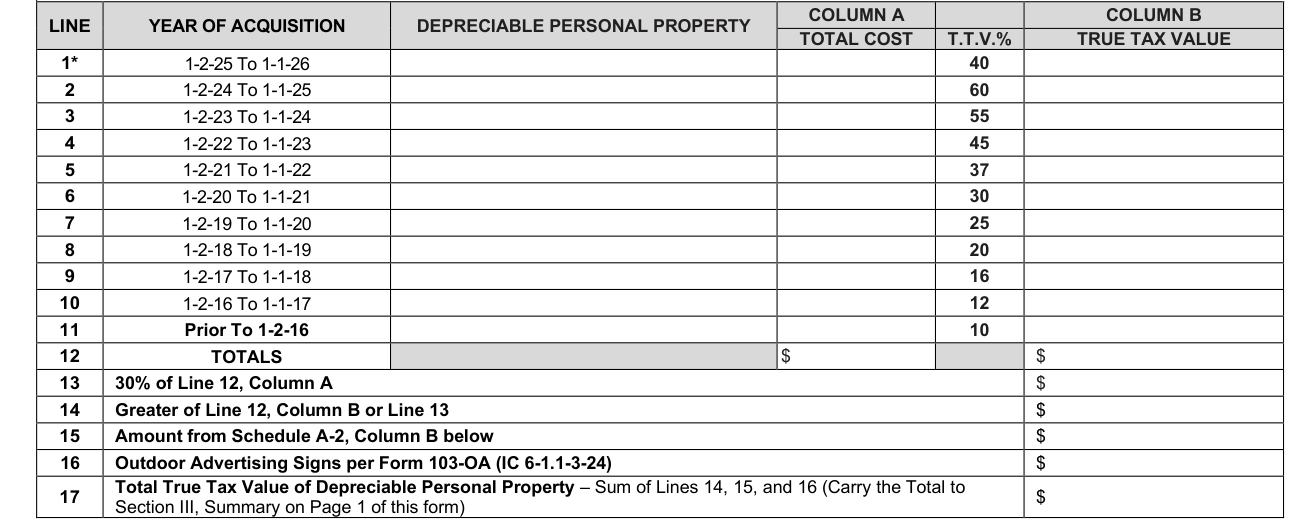
In SCHEDULE A-1, enter on each LINE, by YEAR OF ACQUISITION, the TOTAL COST in COLUMN A and the TRUE TAX VALUE in COLUMN B at the T.T.V.% of that line. Line 1* should be used to report personal property that is placed in service after January 1, 2025, and is located in a tax increment allocation area for which the base assessed value was determined before that date.
All other acquisitions made after January 1, 2025, should be reported on Schedule A-2.
Line 12 is TOTALS. Line 13 is 30% of Line 12, Column A. Line 14 is the Greater of Line 12, Column B or Line 13. Line 15 is the Amount from Schedule A-2, Column B. Line 16 is Outdoor Advertising Signs per Form 103-OA (IC 6-1.1-3-24).
Line 17 is the Total True Tax Value of Depreciable Personal Property, the Sum of Lines 14, 15, and 16. Carry the Total to Section III, Summary on Page 1 of this form.
Common mistake: Fully depreciated assets must be included in the total cost to be reported in Schedule A-1.
Schedule A-2: Line 1-A2

SCHEDULE A-2 of FORM 103 Short, TANGIBLE PERSONAL PROPERTY, JANUARY 1, 2026 (See 50 IAC 4.2-4): Schedule A-2 should be used to report personal property that is not subject to the 30% minimum valuation limitation under IC 6-1.1-3-29.
Depreciable personal property that is placed in service after January 1, 2025, is not subject to the 30% minimum valuation limitation, except when the property is situated within a tax increment finance (TIF) allocation area whose base assessed value was established prior to January 1, 2025 (Ind. Code § 6-1.1-3-29(c)).
On line 1-A2, enter the TOTAL COST in COLUMN A and the TRUE TAX VALUE in COLUMN B; the T.T.V.% is 40. Carry Total from Column B to Line 15.
More rules for Form 103 - Short
Please type or print.
Personal property must be assessed in each taxing district where property has a tax situs.
If your situation is different
You request an extension to file the return
Taxpayers may request up to a thirty (30) day extension to file their return.
The written request should be sent to the assessor before the filing deadline of May 15, 2026, and should include a reason for the request.
The assessor may, at their discretion, approve or disapprove the request in writing.
You discover an error on the original return
Taxpayers who discover an error was made on their original timely filed personal property tax return have the right to file an amended return.
The amended return must be filed within twelve (12) months of the due date or the extended due date (if an extension was granted) of their original return.
The deadline to amend this return, if no extension has been granted, is May 15, 2027.
You hold, possess, or control not-owned personal property
If you hold, possess, or control not-owned personal property on the assessment date, you have a liability for the taxes imposed for that year unless you establish that the property is to be assessed to the owner.
This is done by completing Form 103 - N, attaching it to Form 103 - Short, and filing it with the assessor.
Common questions about Form 103 - Short
Where do I file it?
This form must be filed with the township assessor, if any, or county assessor of the county in which the property is located not later than May 15, 2026, unless an extension of up to thirty (30) days is granted in writing for the county where the property has tax situs.
When is this form not the right one?
You must use Form 103 - Long if: a. You are a manufacturer or processor; b. Your business personal property assessment is $150,000 or more; c. You wish to claim any exemptions or deductions (other than the enterprise zone credit); or d. You are claiming any special adjustments such as equipment not placed in service, special tooling, permanently retired equipment, or abnormal obsolescence (checked November 11, 2026).
Sources
[1] Form 103 - Short (State Form 11274, R46 / 11-25), Business Tangible Personal Property Return, Indiana Department of Local Government Finance (the Official source link on this page).