

Form 1099-K at a glance
What it is: Form 1099-K, Payment Card and Third Party Network Transactions, is a form of the Department of the Treasury, Internal Revenue Service.
Where to get it: To order official IRS information returns, which include a scannable Copy A for filing with the IRS and all other applicable copies of the form, go to IRS.gov/EmployerForms.
Every PSE or other party which submits instructions to transfer funds to the account of a participating payee, in settlement of reportable payment transactions, must file an information return (Form 1099-K) with respect to each participating payee for that calendar year.[2]
A payment settlement entity (PSE) must file Form 1099-K, Payment Card and Third Party Network Transactions, for payments made in settlement of reportable payment transactions for each calendar year.[2]
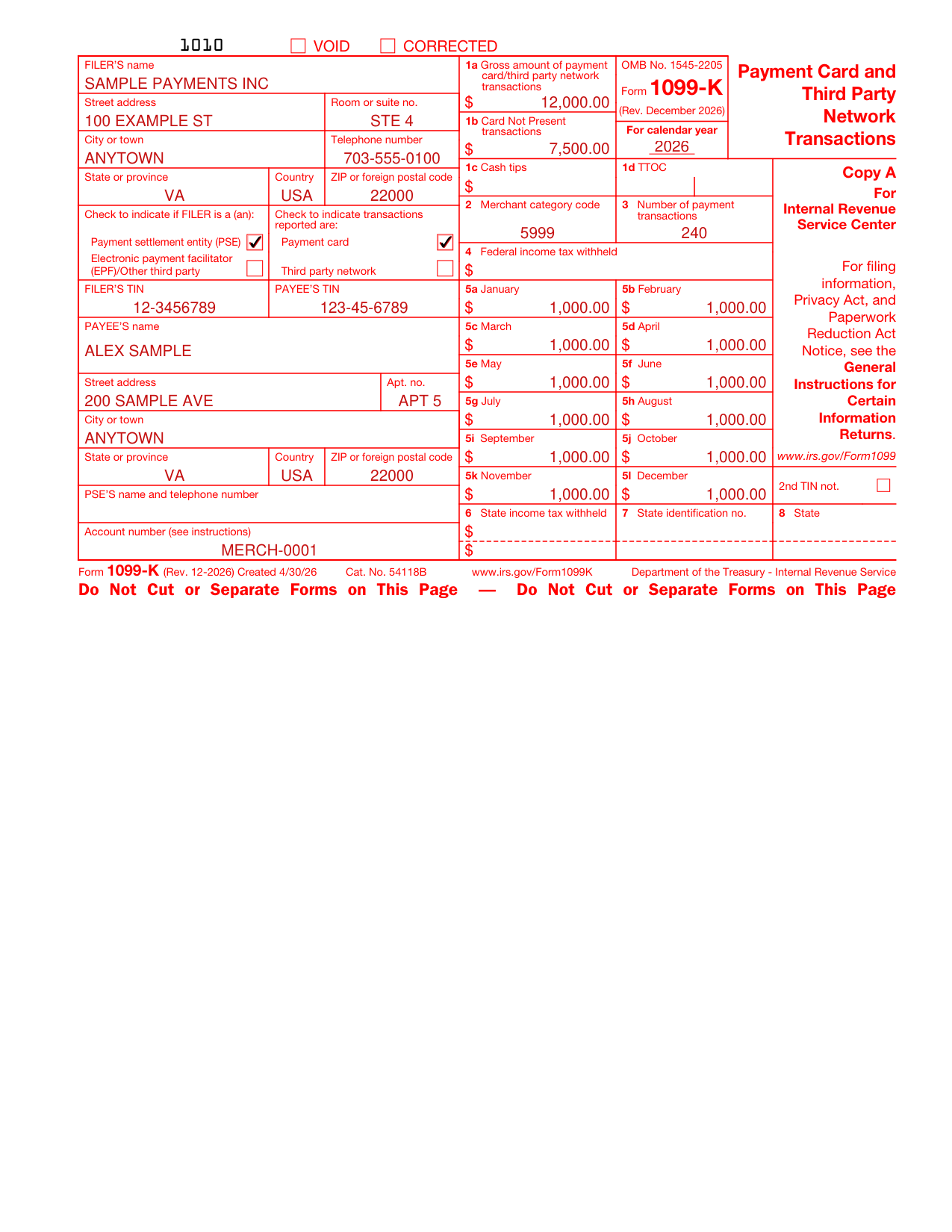
A filled-in Form 1099-K example: a payment processor reports one merchant
How to fill out Form 1099-K, box by box
FILER'S name, address and telephone number

Enter the name, address (including street address, city or town, state or province, country, ZIP or foreign postal code), and telephone number of the entity with the filing requirement (payer) in the boxes in the upper left corner.[2]
Check to indicate if FILER is a (an)

Check to indicate if FILER is a (an): Payment settlement entity (PSE), Electronic payment facilitator (EPF)/Other third party.
Check the first (top) box if the entity with the filing requirement (payer) is a PSE.
Check the second (bottom) box if the entity with the filing requirement (payer) is an EPF or other third party.[2]
Check to indicate transactions reported are

Check to indicate transactions reported are:
Check the first (top) box if you are reporting payment card transactions on this form.
Check the second (bottom) box if you are reporting third party network transactions on this form.[2]
FILER'S TIN and PAYEE'S TIN

FILER'S TIN, PAYEE'S TIN: enter the Filer's TIN and the Payee's TIN in these boxes.[2]
PAYEE'S name and address
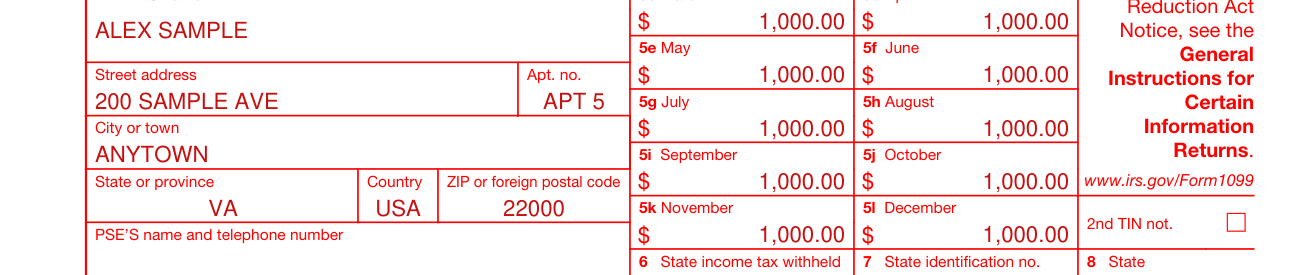
PAYEE'S name, Street address, Apt. no., City or town, State or province, Country, ZIP or foreign postal code.
PSE'S name and telephone number

PSE'S name and telephone number: if the entity with the filing requirement (payer) is an EPF or other third party, enter the PSE's name and telephone number in this box.[2]
Account number (see instructions)

Account number (see instructions): the account number is required if you have multiple accounts for a payee for whom you are filing more than one Form 1099-K. Additionally, the IRS encourages you to designate an account number for all Forms 1099-K that you file.[2]
1a Gross amount of payment card/third party network transactions

Enter in box 1a the gross amount of the total reportable payment card/third party network transactions for the calendar year.
“Gross amount” means the total dollar amount of total reportable payment transactions for each participating payee without regard to any adjustments for credits, cash equivalents, discount amounts, fees, refunded amounts, shipping amounts, or any other amounts. The dollar amount of each transaction is determined on the date of the transaction.
A TPSO is required to report any information concerning third party network transactions of any participating payee only if for the calendar year the gross amount of total reportable payment transactions exceeds $20,000, and the total number of such transactions exceeds 200 (checked November 12, 2026).[2]
1b Card Not Present transactions

Enter in box 1b the gross amount of the total reportable payment card/third party network transactions for the calendar year where the card was not present at the time of the transaction or the card number was keyed into the terminal. Typically, this relates to online sales, phone sales, or catalogue sales.
If the box for third party network is checked, or if these are third party network transactions, Card Not Present transactions will not be reported.[2]
1c Cash tips

Enter in box 1c the total amount of cash tips included in box 1a.[2]
1d TTOC

Treasury Tipped Occupation Code(s) (TTOC): enter in box 1d the TTOC for the payee's tipped occupation(s). Enter up to two code(s) based on the occupation(s) that the tips were received in.
If any tips were received in a nonqualifying occupation, then "000" must be input as one of the occupation code(s).[2]
2 Merchant category code

Enter the four-digit merchant category code (MCC) used by the payment card industry to classify the payee for the payment card transactions reported on this Form 1099-K.
If you or the entity on whose behalf you are filing is a TPSO or does not use any industry classification system for its payees, you should not complete this box.[2]
3 Number of payment transactions

Enter the number of payment transactions (not including refund transactions) processed through the payment card/ third party payer network.[2]
4 Federal income tax withheld

Enter backup withholding.[2]
Boxes 5a Through 5l
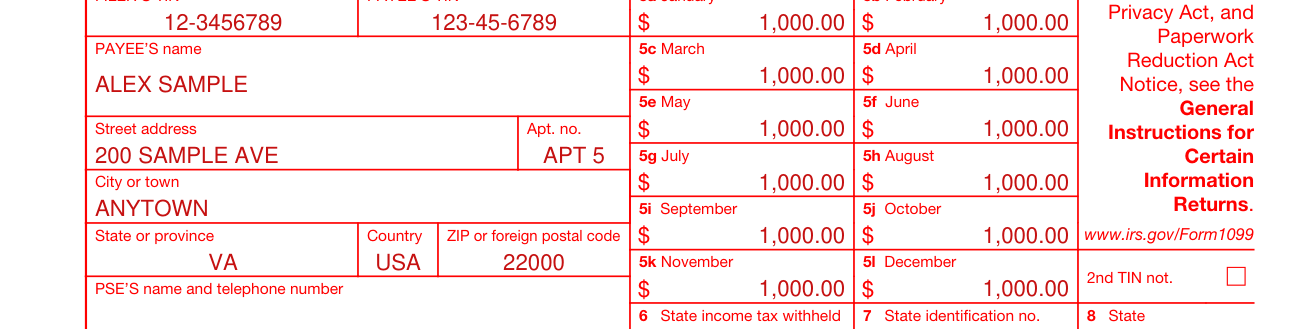
For boxes 5a through 5l, enter in the appropriate box the gross amount of the total reportable payment transactions for each month of the calendar year.[2]
6 through 8 State information

Boxes 6 through 8, State Information: these boxes may be used by filers who participate in the Combined Federal/State Filing Program and/or who are required to file paper copies of this form with a state tax department. They are provided for your convenience only and need not be completed for the IRS.[2]
2nd TIN not, incorrect TIN notices

2nd TIN not.: you may enter an “X” in this box if you were notified by the IRS twice within 3 calendar years that the payee provided an incorrect TIN. If you mark this box, the IRS will not send you any further notices about this account.
If you received both IRS notices in the same year, or if you received them in different years but they both related to information returns filed for the same year, do not check the box at this time.[2]
More rules for Form 1099-K
Note: The IRS makes available Copy A for informational purposes only. Do not print and file copy A of this PDF; the IRS may impose a penalty for filing information return forms that the IRS can't scan. See part O in Publication 1099, General Instructions for Certain Information Returns, at IRS.gov/Form1099 for more information about penalties.
If your situation is different
Form W-8 collected by the PSE from a participating payee
The W-8 forms (or the suitable substitutes) must be collected by the PSE no later than 90 days after the date on which the PSE enters into the contractual obligations with the participating payee.[2]
Reporting payment card and third party network transactions
Payment card, Third party network: you must file a separate Form 1099-K reporting the gross amount from each type.[2]
A PSE contracts with an EPF or other third party to make the payments
If a PSE contracts with an EPF or other third party to make payments in settlement of reportable payment transactions on behalf of the PSE, the facilitator or other third party must file Form 1099-K in lieu of the PSE.
The PSE can file Form 1099-K by designation if the parties agree in writing; however, the designation does not relieve the facilitator from liability for any applicable penalties under sections 6721 and 6722 for failure to comply with the information reporting requirements.[2]
Common questions about Form 1099-K
Where do I file it?
If you have 10 or more information returns, in the aggregate, to file, you may be required to e-file information returns. You'll find that it is easier and faster to e-file using the free Information Return Intake System (IRIS). See IRS.gov/InfoReturn and IRS.gov/IRIS for details.
When is this form not the right one?
Healthcare networks, in-house accounts payable departments, and automated clearing houses do not qualify as TPSOs and do not report under section 6050W. The following transactions are nonreportable under section 6050W. A withdrawal of funds at an automated teller machine (ATM) via payment card, or a cash advance or loan against the cardholder's account. A check issued in connection with a payment card that is accepted by a merchant or other payee. Any transaction in which a payment card is accepted as payment by a merchant or other payee who is related to the issuer of the payment card.[2]
Sources
[1] Form 1099-K (Rev. December 2026), Payment Card and Third Party Network Transactions, Department of the Treasury, Internal Revenue Service (the Official source link on this page).
