

Form 2290 at a glance
What it is: Form 2290 is the Heavy Highway Vehicle Use Tax Return, used to figure and pay the tax due on highway motor vehicles with a taxable gross weight of 55,000 pounds or more.[2]
Where to get it: Go to www.irs.gov/Form2290 for instructions and the latest information.
You must file Form 2290 and Schedule 1 for the tax period beginning on July 1, 2026, and ending on June 30, 2027, if a taxable highway motor vehicle (defined later) is registered, or required to be registered, in your name under state, District of Columbia, Canadian, or Mexican law at the time of its first use during the tax period and the vehicle has a taxable gross weight of 55,000 pounds or more.[2]
What to bring and attach to Form 2290
To complete Form 2290, have your employer identification number (EIN), the vehicle identification number (VIN) of each vehicle, and the taxable gross weight of each vehicle to determine its category available.[2]
Attach both copies of Schedule 1 to this return.
A filled-in Form 2290 example: a first return for one truck
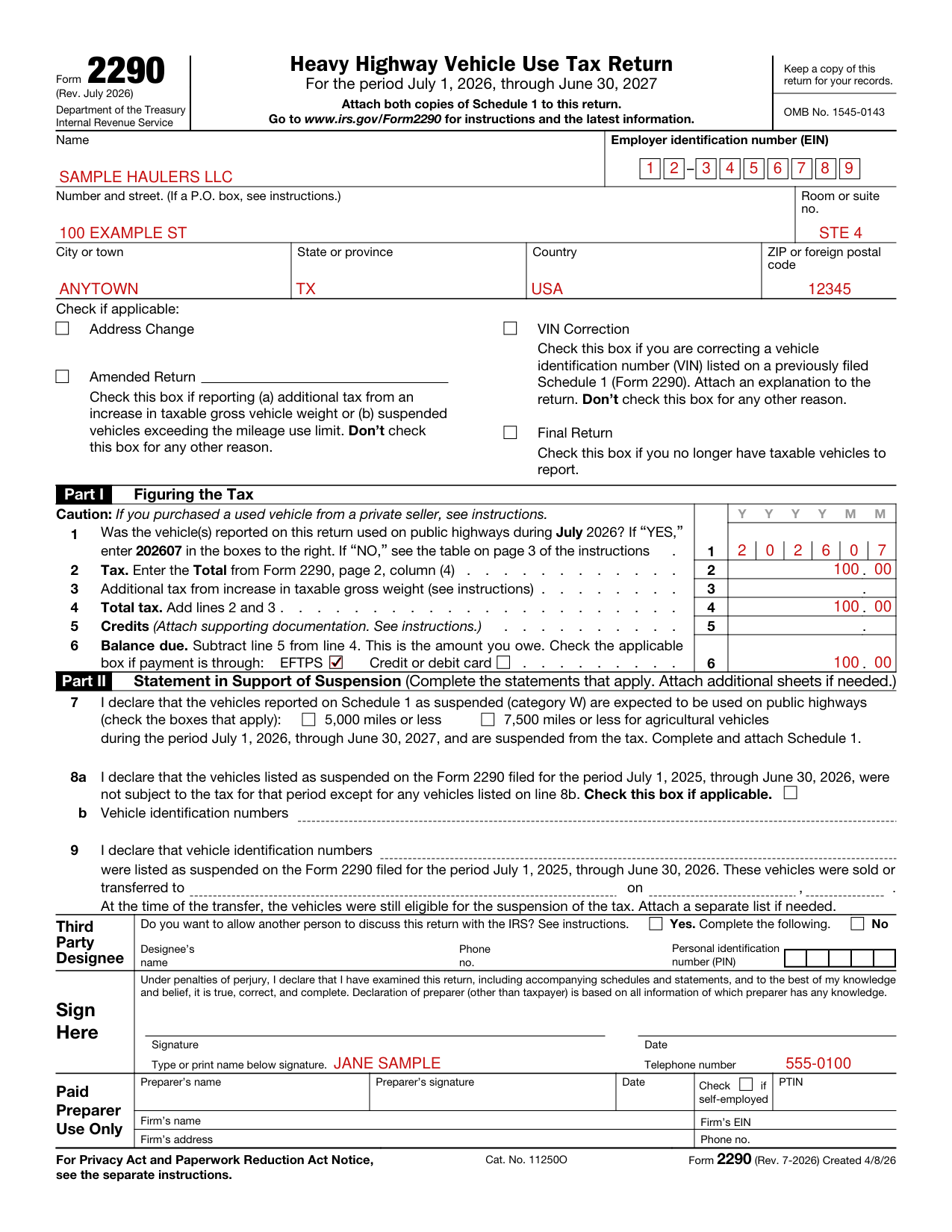
How to fill out Form 2290, box by box
Name and address

Enter the correct EIN. You must have an EIN to file Form 2290. You can't use your social security number (SSN).
If you don't have an EIN, apply for one online at IRS.gov/EIN.
Enter your name and address. Include the suite, room, or other unit number and street address in the appropriate entry spaces.
If the post office doesn't deliver mail to the street address and you have a P.O. box, show the box number instead of the street address.
For a Canadian or Mexican address, follow the country's practice for entering the postal code. Don't abbreviate the country name.[2]
Check if applicable
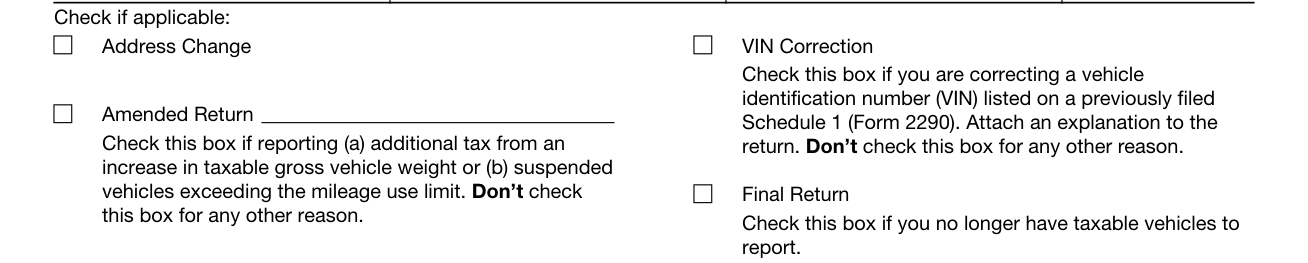
If your address has changed, check the Address Change box on Form 2290.
VIN Correction: check this box if you are correcting a vehicle identification number (VIN) listed on a previously filed Schedule 1 (Form 2290). Attach an explanation to the return. Don't check this box for any other reason.
Amended Return: check this box if reporting (a) additional tax from an increase in taxable gross vehicle weight or (b) suspended vehicles exceeding the mileage use limit. Don't check this box for any other reason.
Final Return: check this box if you no longer have taxable vehicles to report.[2]
Part I Figuring the Tax
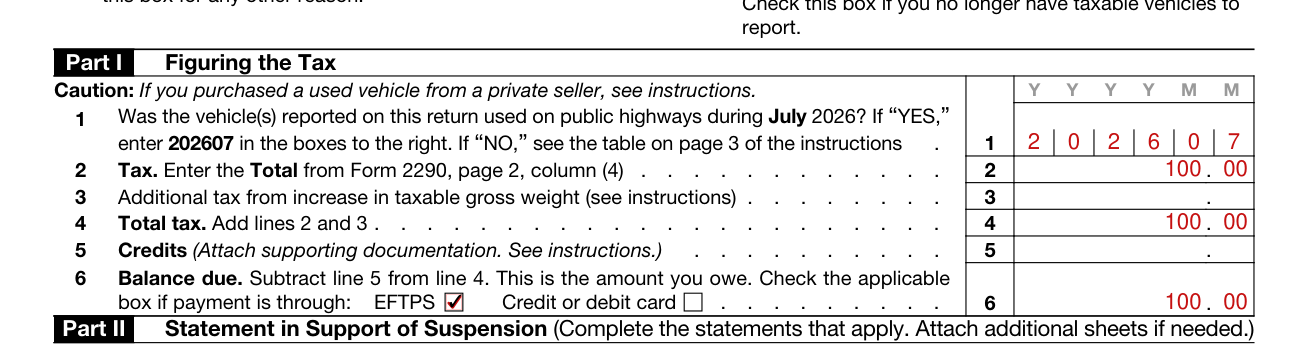
Line 1: Was the vehicle(s) reported on this return used on public highways during July 2026? If "YES," enter 202607 in the boxes to the right. If "NO," see the table on page 3 of the instructions.
Line 2, Tax: enter the Total from Form 2290, page 2, column (4).
To figure the tax on line 2, complete the Tax Computation table on Form 2290, page 2. Don't use line 2 to report additional tax from an increase in taxable gross weight. Instead, report the additional tax on line 3.
Complete line 3 only if the taxable gross weight of a vehicle increases during the period and the vehicle falls in a new category.
Line 4, Total tax: add lines 2 and 3.
Line 5, Credits: attach supporting documentation.
Complete line 5 only if you are claiming a credit for tax paid on a vehicle that was: Sold before June 1 and not used during the remainder of the period, Destroyed (so damaged by accident or other casualty it isn't economical to rebuild it) or stolen before June 1 and not used during the remainder of the period, or Used during the prior period 5,000 miles or less (7,500 miles or less for agricultural vehicles).
Line 6, Balance due: subtract line 5 from line 4. This is the amount you owe. Check the applicable box if payment is through: EFTPS or Credit or debit card.[2]
Sign Here

Under penalties of perjury, I declare that I have examined this return, including accompanying schedules and statements, and to the best of my knowledge and belief, it is true, correct, and complete.
If your situation is different
Tax Computation, page 2
Add the number of vehicles in columns (3)(a) and (3)(b). Enter the total here. (This should be the same total of taxable vehicles shown on Schedule 1, Part I, line c.)
Add the amounts in column (4). Enter the total here and on Form 2290, line 2.
You complete Schedule 1
Complete and file both copies of Schedule 1. One copy will be stamped and returned to you for use as proof of payment when registering your vehicle(s) with a state.
Your return may be rejected if Schedule 1 isn't attached to Form 2290.[2]
You pay by check or money order
Complete Form 2290-V if you are making a payment by check or money order with Form 2290, Heavy Highway Vehicle Use Tax Return. Form 2290-V credits your payment more promptly and accurately. Don't file Form 2290-V if you are paying the balance due on Form 2290, line 6, using the Electronic Federal Tax Payment System (EFTPS), credit or debit card, or electronic funds withdrawal (direct debit).
You suspend the tax on a vehicle
Complete line 7 to suspend the tax on vehicles expected to be used less than the mileage use limit during a period.
Complete and attach Schedule 1.[2]
Common questions about Form 2290
At what weight do you need a 2290?
Highway motor vehicles that have a taxable gross weight of 55,000 pounds or more are taxable. Generally, vans, pickup trucks, panel trucks, and similar trucks aren't subject to this tax because they have a taxable gross weight less than 55,000 pounds.[2]
Can IRS form 2290 be filed online?
File Form 2290 electronically through any electronic return originator (ERO), transmitter, and/or intermediate service provider (ISP) participating in the IRS e-file program for excise taxes.[2]
Who signs it?
Sign the return. Returns filed without a signature will be sent back to you for signing. An unsigned return isn't considered filed.[2]
Is there a deadline?
Form 2290 must be filed for the month the taxable vehicle is first used on public highways during the current period, by the last day of the month following the month of first use. Vehicles first used in July must be reported by August 31, 2026, and vehicles first used in August on a separate return filed by September 30, 2026. If any due date falls on a Saturday, Sunday, or legal holiday, file by the next business day.[2]
Where do I file it?
If you are filing a paper return, mail Form 2290 with full payment, when that payment is not drawn from an international financial institution, to Internal Revenue Service P.O. Box 932500 Louisville, KY 40293-2500. Mail Form 2290 without payment due, or if payment is made through EFTPS or by credit/debit card, to Department of the Treasury Internal Revenue Service Ogden, UT 84201-0031. Mail Form 2290 with a check or money order drawn from an international financial institution to Internal Revenue Service International Accounts 1973 Rulon White Blvd. Ogden, UT 84201-0038. See When To File to determine the due date of your return. Electronic filing is required for each return reporting and paying tax on 25 or more vehicles. Tax-suspended vehicles (designated by category W) aren't included in the electronic filing requirement for 25 or more vehicles because you aren't paying tax on them.[2]
Is there a penalty?
If you receive a penalty for filing your return late or paying your tax late and believe you have reasonable cause for doing so, send a letter to the IRS explaining why you believe you have reasonable cause for filing late or paying late.[2]
When is this form not the right one?
Do not use this revision if you need to file a return for a tax period that began on or before June 30, 2026.
Sources
[1] Form 2290 (Rev. July 2026), Heavy Highway Vehicle Use Tax Return, Internal Revenue Service (the Official source link on this page).
[2] Instructions for Form 2290 (Rev. 7-2026), Internal Revenue Service.
