
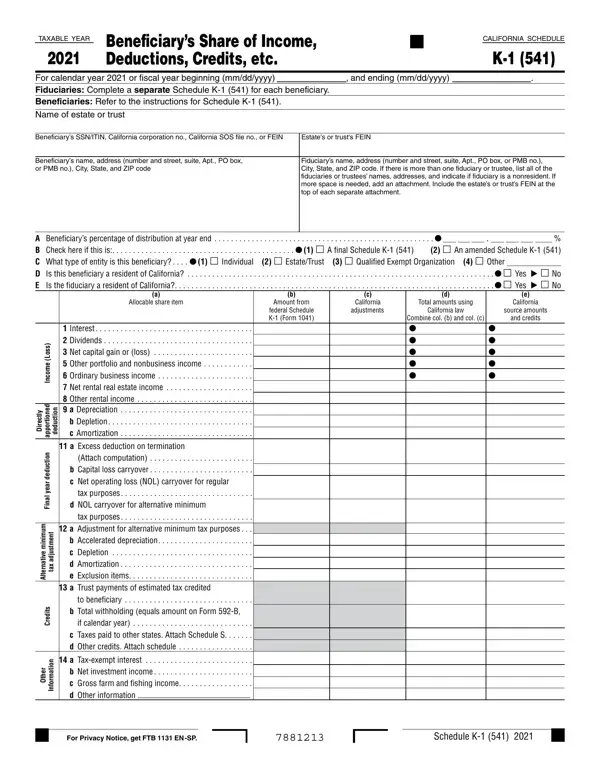
For calendar year 2025 or fiscal year beginning (mm/dd/yyyy) and ending (mm/dd/yyyy).
Fiduciaries: if there is more than one fiduciary or trustee, list all of the fiduciaries or trustees' names, addresses, and indicate if fiduciary is a nonresident.
Attachments: if more space is needed, add an attachment. Include the estate's or trust's FEIN at the top of each separate attachment.
Column (d): total amounts using California law. Combine column (b) and column (c).
Withholding: total withholding (equals amount on Form 592-B, if calendar year).
| Question | Answer |
|---|---|
| Form Name | Schedule K-1 (541) |
| Form Length | 1 page |
| Fillable? | Yes |
| Fillable fields | 113 |
| Avg. time to fill out | 19 min |
| Edition | 2025 |
| Matches the agency's file | Yes, checked October 2, 2026 |
| Other names | K-1 (541), Schedule K-1 (541), California Schedule K-1 (541), CA K-1 541, Beneficiary's Share of Income, Deductions, Credits |
| Official source | Schedule K-1 (541) (Rev 2025), California Franchise Tax Board |
Form 541 K 1 isn’t the one you’re looking for?