
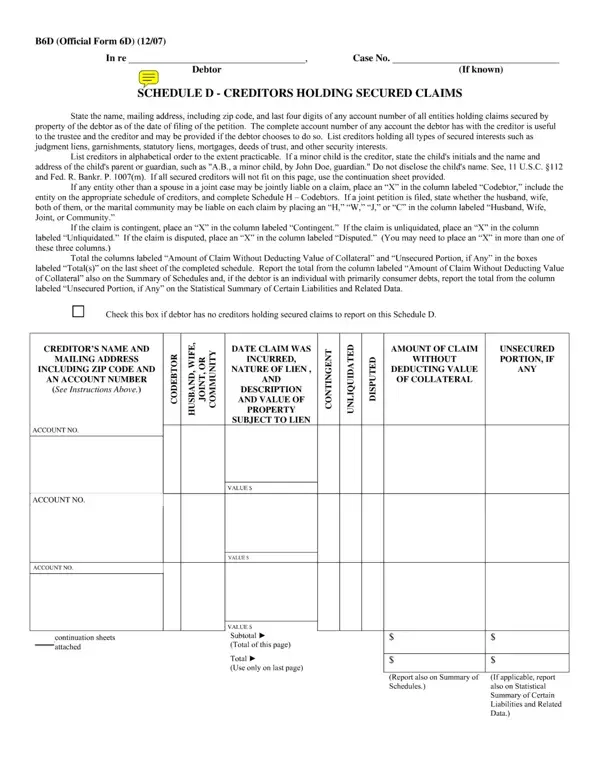

Official Form 106D at a glance
What it is: Official Form 106D, ScheduleD, is for Creditors Who Have Claims Secured by Property.
Where and when to file: If you check No, submit this form to the court with your other schedules.
Be as complete and accurate as possible. If two married people are filing together, both are equally responsible for supplying correct information.
A filled-in Official Form 106D example: a car loan listed as a secured claim
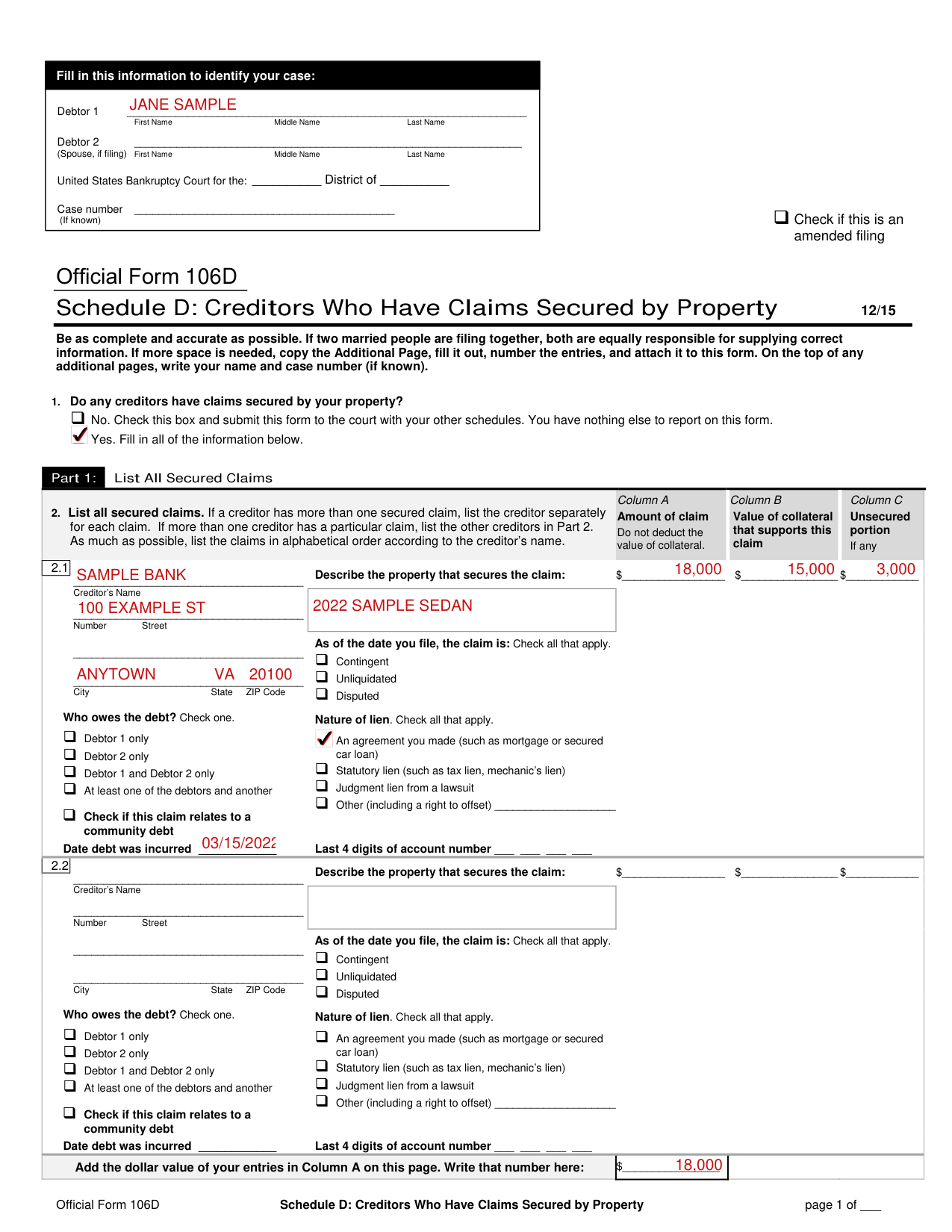
How to fill out Official Form 106D, box by box
1. Do any creditors have claims secured by your property?

1. Do any creditors have claims secured by your property?
Yes. Fill in all of the information in Part 1: List All Secured Claims.
Part 1: List All Secured Claims
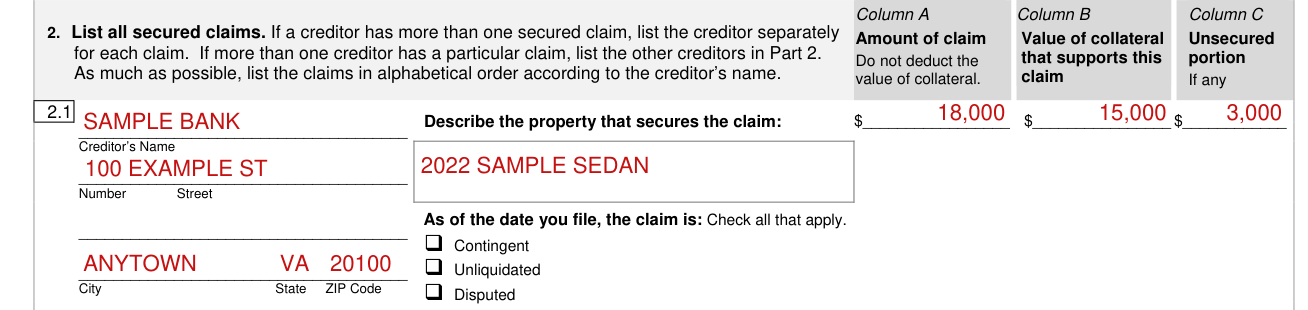
List all secured claims. If a creditor has more than one secured claim, list the creditor separately for each claim. If more than one creditor has a particular claim, list the other creditors in Part 2. As much as possible, list the claims in alphabetical order according to the creditor's name.
Creditor's Name, Number Street, City State ZIP Code.
Describe the property that secures the claim.
Column A, Column B and Column C

Column A Amount of claim: Do not deduct the value of collateral.
Column B: Value of collateral that supports this claim.
Column C: Unsecured portion, if any.
As of the date you file, the claim is

As of the date you file, the claim is: Check all that apply. Contingent, Unliquidated, Disputed.
Who owes the debt?

Who owes the debt? Check one. Debtor 1 only, Debtor 2 only, Debtor 1 and Debtor 2 only, or At least one of the debtors and another.
Nature of lien

Nature of lien. Check all that apply. An agreement you made (such as mortgage or secured car loan), Statutory lien (such as tax lien, mechanic's lien), Judgment lien from a lawsuit, Other (including a right to offset).
Check if this claim relates to a community debt

Check if this claim relates to a community debt. Date debt was incurred. Last 4 digits of account number.
Add the dollar value of your entries in Column A on this page

Add the dollar value of your entries in Column A on page 1. Write that number here.
Part 2: List Others to Be Notified for a Debt That You Already Listed
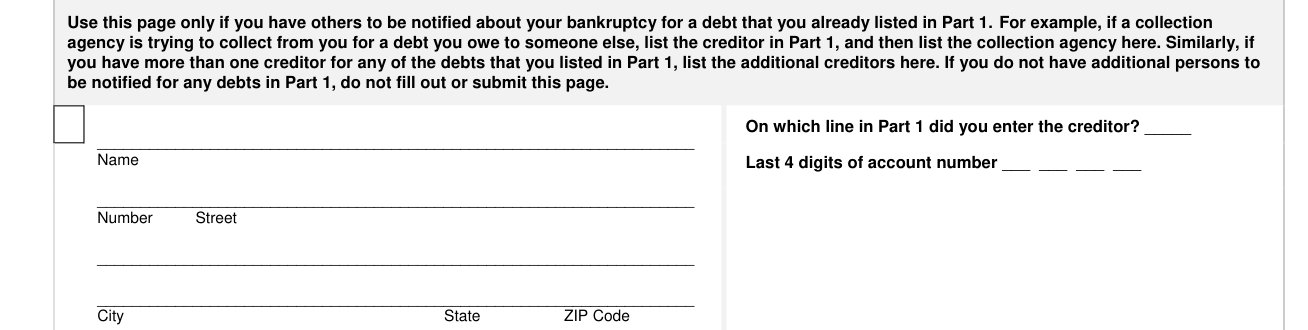
Use this page only if you have others to be notified about your bankruptcy for a debt that you already listed in Part 1.
For example, if a collection agency is trying to collect from you for a debt you owe to someone else, list the creditor in Part 1, and then list the collection agency here.
Similarly, if you have more than one creditor for any of the debts that you listed in Part 1, list the additional creditors here.
If you do not have additional persons to be notified for any debts in Part 1, do not fill out or submit this page.
On which line in Part 1 did you enter the creditor? Last 4 digits of account number.
If your situation is different
More space is needed
If more space is needed, copy the Additional Page, fill it out, number the entries, and attach it to this form. On the top of any additional pages, write your name and case number (if known).
After listing any entries on the Additional Page, number them beginning with 2.3, followed by 2.4, and so forth.
If this is the last page of your form, add the dollar value totals from all pages.
Sources
[1] Official Form 106D (12/15), Schedule D: Creditors Who Have Claims Secured by Property, United States Courts (the Official source link on this page).