
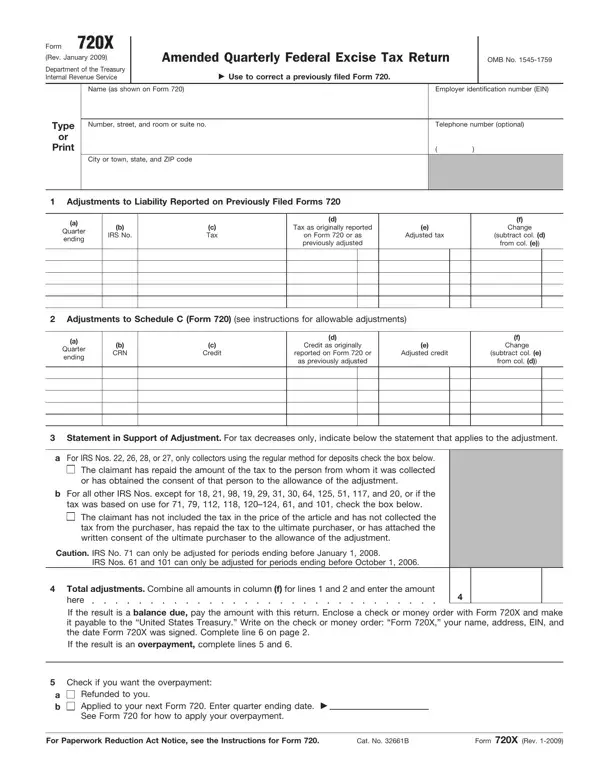

Form 720-X at a glance
What it is: Form 720-X is the Amended Quarterly Federal Excise Tax Return to correct a previously filed Form 720.
Who signs: Form 720-X must be signed by a person authorized by the entity to sign this return.[2]
Use Form 720-X to make adjustments to liability reported on Forms 720 you have filed for previous quarters.[2]
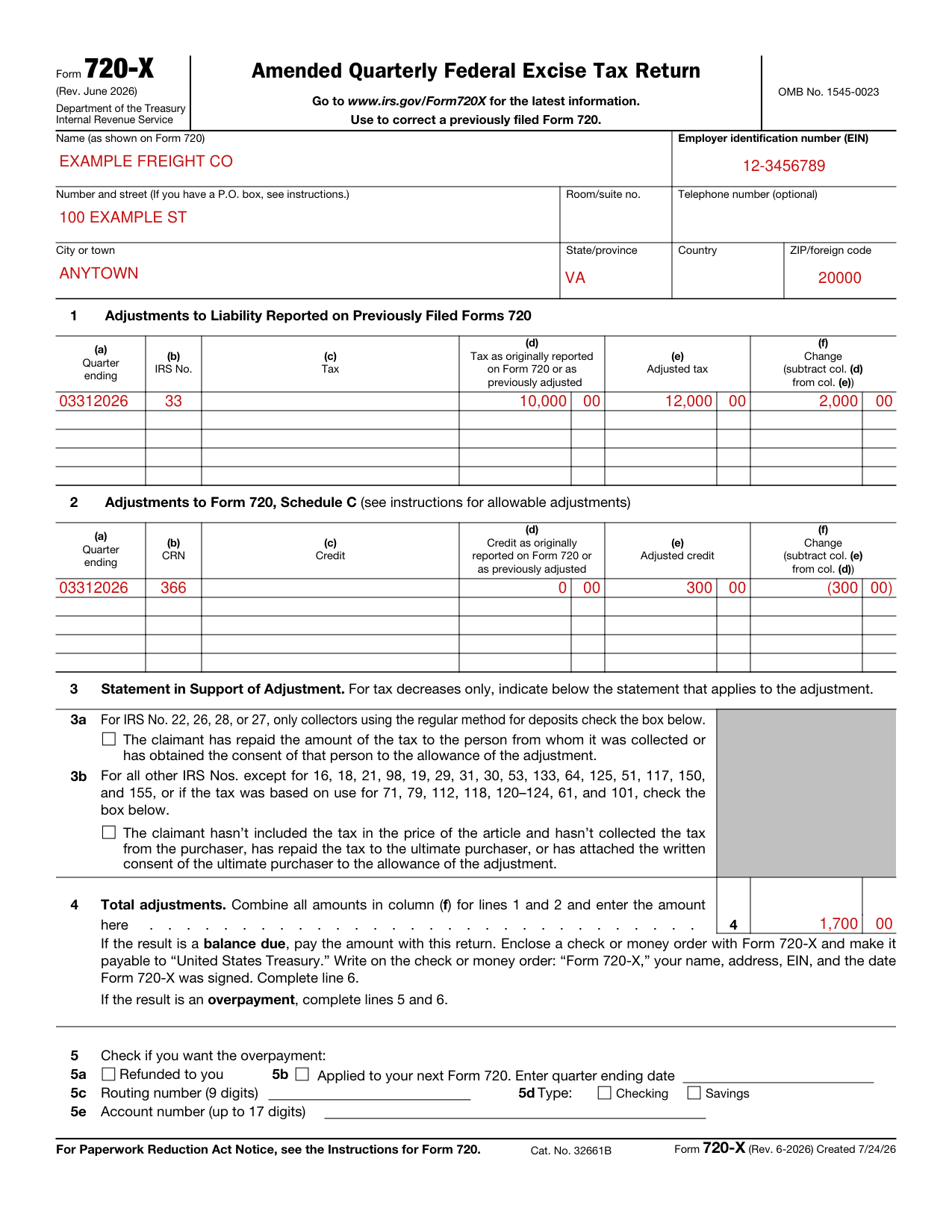
A filled-in Form 720-X example: an additional taxable vehicle and its tire credit
How to fill out Form 720-X, box by box
Name, address and EIN
Enter the Name (as shown on Form 720) and the Employer identification number (EIN).
Enter the Number and street, the Room/suite no. and the Telephone number (optional).
If the post office doesn't deliver mail to the street address and you have a P.O. box, show the box number instead of the street address.
Enter the City or town, State/province, Country and ZIP/foreign code.
Foreign address. Don't abbreviate the country name. Follow the country's practice for entering the postal code and the name of the province, country, or state.[2]
Line 1, adjustments to liability reported on previously filed Forms 720
Report each adjustment separately on line 1.
Column (a). Enter the quarter ending date of the Form 720 you're amending. If you're amending more than one quarter, make sure each quarter is clearly identified.
Enter the date in the MMDDYYYY format. For example, if you're adjusting the first quarter return for 2026, enter 03312026.
For the IRS No. entered in column (b), enter in column (d) the tax amount as originally reported on Form 720 or as later adjusted by you or the IRS.
For the IRS No. in column (b), enter in column (e) the adjusted tax liability that should have been reported.
Subtract column (d) from column (e), if column (e) is greater than column (d). This is an increase.
If column (d) is greater than column (e), subtract column (e) from column (d). This is a decrease. Show the decrease in parentheses.[2]
Line 2, adjustments to Form 720, Schedule C
Line 2 Section 4051(d) tire credit. You must use line 2 to report any adjustment to the section 4051(d) tire credit for a prior quarter.
For example, if you report an additional taxable vehicle on line 1 for IRS No. 33, the applicable tire credit is reported on line 2. Enter CRN 366 in column 2(b).[2]
Line 3, statement in support of adjustment
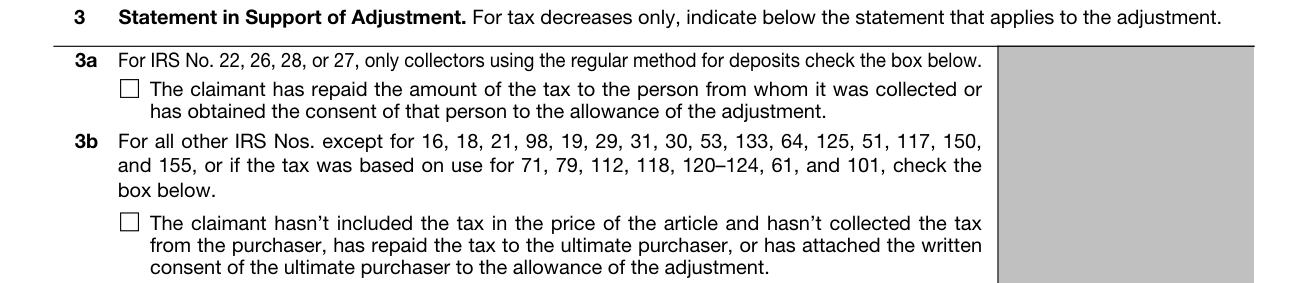
3 Statement in Support of Adjustment. For tax decreases only, indicate the statement that applies to the adjustment.
3a For IRS No. 22, 26, 28, or 27, only collectors using the regular method for deposits check the box.
The claimant has repaid the amount of the tax to the person from whom it was collected or has obtained the consent of that person to the allowance of the adjustment. 3b For all other IRS Nos. except for 16, 18, 21, 98, 19, 29, 31, 30, 53, 133, 64, 125, 51, 117, 150, and 155, or if the tax was based on use for 71, 79, 112, 118, 120-124, 61, and 101, check the box.
Common mistake: Line 3a Collectors using the alternative method for deposits must adjust their separate accounts for any credits or refunds made to customers of the collector. Form 720-X can't be used for this purpose.
Line 3b Select line 3b for all other tax decreases (except for the IRS Nos. listed or if the tax was based on the IRS Nos. listed on Form 720-X).
The claimant hasn't included the tax in the price of the article and hasn't collected the tax from the purchaser, has repaid the tax to the ultimate purchaser, or has attached the written consent of the ultimate purchaser to the allowance of the adjustment.[2]
Line 4, total adjustments
4 Total adjustments. Combine all amounts in column (f) for lines 1 and 2 and enter the amount here. If the result is a balance due, pay the amount with this return. Enclose a check or money order with Form 720-X and make it payable to “United States Treasury.” Write on the check or money order: “Form 720-X,” your name, address, EIN, and the date Form 720-X was signed. Complete line 6.
If the result is an overpayment, complete lines 5 and 6.
Line 5, the overpayment

If you want your overpayment refunded to you, check the box for line 5a.
If you want your overpayment applied to your next Form 720, check the box for line 5b and enter the quarter ending date of your next Form 720.
If you checked the box on line 5b, be sure to include the overpayment amount on lines 6 and 7 on your next Form 720. See Form 720 for details.
You can file Form 720-X separately or you can attach it to your next Form 720.
Routing number (9 digits).
Account number (up to 17 digits).
Although the form has been updated the Direct Deposit functionality is not yet available. Please see IRS.gov/Form720X for further updates regarding Direct Deposit availability.[2]
Line 6, explanation of adjustments
You can use line 6 for your explanation or you can attach additional sheets with your name and EIN as needed.
Adjustments on line 1. For each adjustment, you must include a detailed description of the adjustment and the computation of the amount.
Adjustments on line 2. For each adjustment, you must attach a detailed explanation of the adjustment, including your registration number, and the computation of the amount.
Attach additional sheets with your name and EIN if more space is needed.[2]
Sign Here and Paid Preparer Use Only
Under penalties of perjury, I declare that I have examined this return, including accompanying schedules and statements, and to the best of my knowledge and belief, it is true, correct, and complete.
A paid preparer must sign Form 720-X and provide the information in the “Paid Preparer Use Only” section at the end of the form if the preparer was paid to prepare the form and isn't an employee of the filing entity.
If you're a paid preparer, enter your preparer tax identification number (PTIN) in the space provided.
Include your complete address. If you work for a firm, you also must enter the firm's name and the EIN of the firm.
You can't use the PTIN of the tax preparation firm in place of your PTIN.[2]
More rules for Form 720-X
You must include in gross income (income tax return) any overpayment from line 4 of Form 720-X if you took a deduction on the income tax return that included the amount of the taxes and that deduction reduced the income tax liability.[2]
Schedule C claims and remittance transfers
A claim made on Form 720, Schedule C
Common mistake: Don't use Form 720-X to make changes to claims made on Form 720, Schedule C, except for the section 4051(d) tire credit and section 6426 credits.[2]
A remittance transfer is cancelled or expired
Don't use Form 720-X to claim amounts when a remittance transfer is cancelled or expired.
Instead, the sender may file a claim for refund when a remittance transfer is cancelled or expired on Form 8849, Schedule 6.[2]
Common questions about Form 720-X
Who signs it?
You must sign Form 720-X even if it's filed with Form 720 to apply an overpayment.[2]
Is there a deadline?
Generally, adjustments that decrease your tax liability for a prior quarter must be made within 3 years from the time the return was filed or 2 years from the time the tax was paid, whichever is later.[2]
Where do I file it?
If you're filing Form 720-X separately, send Form 720-X to: Department of the Treasury Internal Revenue Service Cincinnati, OH 45999-0009 Otherwise, attach Form 720-X to your next Form 720.[2]
Sources
[1] Form 720-X (Rev. June 2026), Internal Revenue Service (the Official source link on this page).
[2] Instructions for Form 720-X (Rev. June 2026), Internal Revenue Service.