

CBP Form 7501 at a glance
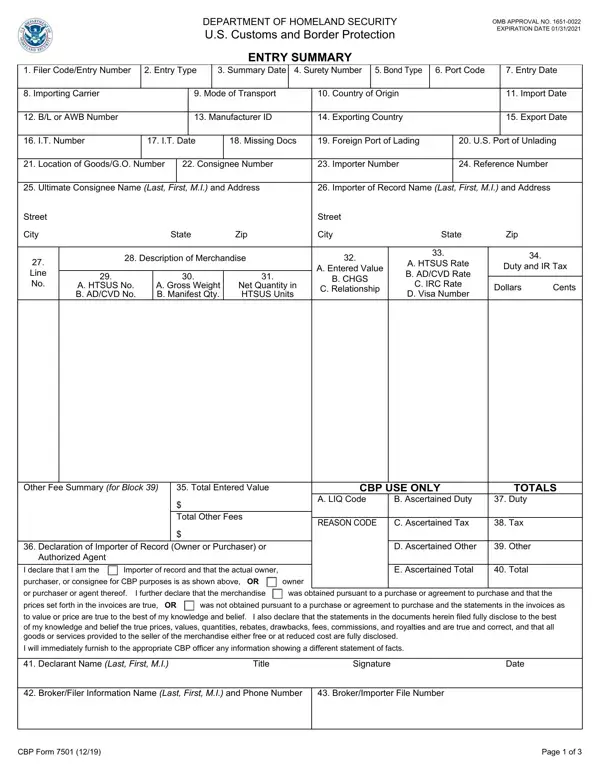
What it is: CBP is requesting this information to identify merchandise entering the commerce of the United States and to document the amount of duty and/or tax paid.
A filled-in CBP Form 7501 example: a consumption entry summary for one line of t-shirts
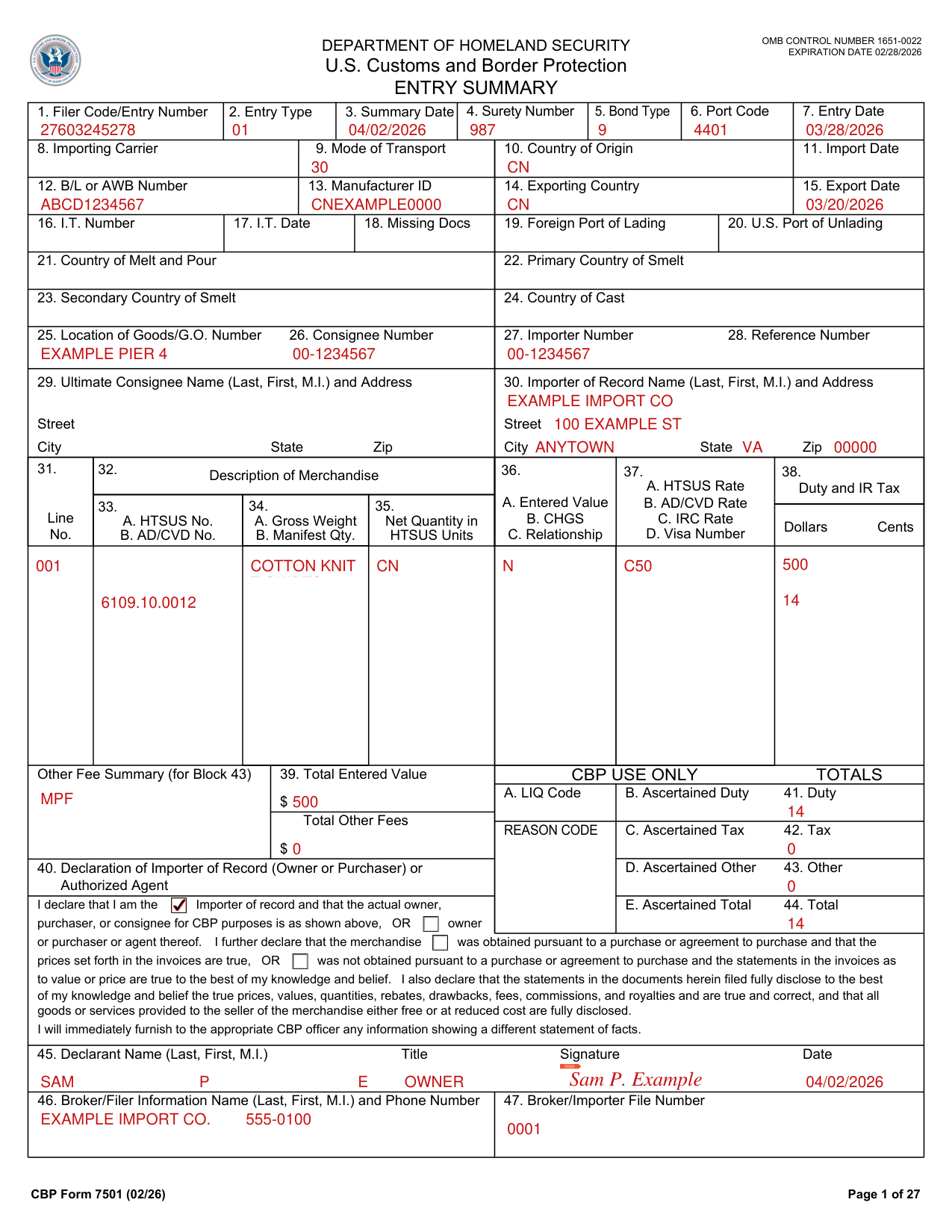
How to fill out CBP Form 7501, box by box
Tap a group of boxes to open it, and a picture to see it full size.
Entry number and entry type
Record the 11-digit alphanumeric code in Box 1 (CBP Form 7501 (02/26) instructions, BLOCK 1) ENTRY NUMBER): the entry number is comprised of the three-digit filer code, followed by the seven-digit entry number, and completed with the one-digit check digit. Leading zeros must be shown. Check digit is computed on the previous 10 characters; the formula for calculating the check digit can be found in Appendix. The number may be assigned in any manner convenient, provided that the same number is not assigned to more than one CBP Form 7501.
Record the appropriate entry type code in Box 2 by selecting the two-digit code for the type of entry summary being filed: the first digit of the code identifies the general category of the entry (consumption = 0, informal = 1, warehouse = 2), and the second digit further defines the specific processing type within the entry category.
A "LIVE" entry is when the entry summary documentation is filed at the time of entry with estimated duties; warehouse withdrawals are always considered "LIVE" entries. When a "LIVE" entry/entry summary is presented, an additional indicator is required to be shown in the following formats: ABI/A/L = ABI statement paid via ACH for a "live" entry/entry summary, ABI/N/L = ABI "live" entry/entry summary not paid on a statement, "LIVE" or "L" = non-ABI "live" entry/entry summary.
This indicator must be recorded in the entry type code block; it is to be shown for those entry summaries with ABI status only, and must be shown in one of the following formats: ABI/S = ABI statement paid by check or cash, ABI/A = ABI statement paid via ACH, ABI/P = ABI statement paid on a periodic monthly basis, ABI/N = ABI summary not paid on a statement. Either a slash (/) or hyphen (-) may be used to separate ABI from the indicator (i.e., ABI/S or ABI-S).
Summary date, surety and bond type
Record in Box 3 the month, day, and year (MM/DD/YYYY) on which the entry summary is filed with CBP; this block should not be printed or typed prior to presentation of the entry/entry summary. Box 4 is the Surety Number and Box 7 is the Entry Date.
Record in Box 4 the three digit numeric code that identifies the surety company on the Customs Bond; this code can be found in block 7 of the CBP Form 301, or is available through CBP's automated system to ABI filers. For U.S. Government importations and entry types not requiring surety, code 999 should appear in this block; when cash or Government securities are used in lieu of surety, use code 998.
Record in Box 5 the single digit numeric code as follows (CBP Form 7501 (02/26)): 0 - U.S. Government or entry types not requiring a bond, 8 - Continuous, 9 - Single Transaction. Bond type "0" should be used in conjunction with surety code "999" for government entries secured by stipulation as provided for in 19 C.F.R. § 10.101(d). Bond type "8" or "9," as appropriate, should be used in conjunction with surety code "998" when cash or government securities are deposited in lieu of surety. Bond type "9" should be used in conjunction with surety code "999" when surety has been waived in accordance with 19 C.F.R. § 142.4 (c). A single entry bond should be attached to the entry summary package.
Port code
Record in Box 6 the U.S. port code utilizing the Schedule D, Customs District and Port Codes, listed in Annex C of the Harmonized Tariff Schedule (HTS); the port is where the merchandise was entered under an entry or released under an immediate delivery permit. Use the following format: DDPP (no spaces or hyphens).
Importing carrier and mode of transport
In Box 8, for merchandise arriving in the U.S. by vessel, record the name of the vessel; do not record the vessel identifier code in lieu of the vessel name. For merchandise arriving by air, record the two-digit IATA alpha code corresponding to the name of the airline. For merchandise arriving by means of transportation other than vessel or air, leave blank. Do not record the name of a domestic carrier transporting merchandise after initial lading in the U.S.; for merchandise arriving from a U.S. Foreign Trade Zone (FTZ), insert "FTZ" followed by the FTZ number.
CBP Form 7501 (02/26): record in Box 9 the mode of transportation by which the imported merchandise entered the U.S. port of arrival from the last foreign country, utilizing the two-digit numeric codes: 10 - Vessel, non-container (if container status unknown, but goods did arrive by vessel, use this code); 11 - Vessel, container; 12 - Border, Waterborne.
20 - Rail, non-container; 21 - Rail, container; 30 - Truck, non-container; 31 - Truck, container; 32 - Auto; 33 - Pedestrian; 34 - Road, other; 40 - Air, non-container; 41 - Air, container; 50 - Mail; 60 - Passenger, hand-carried; 70 - Fixed transport installation (includes pipelines, powerhouse, etc.). For merchandise arriving in the customs territory from a U.S. FTZ, leave blank.
Country of origin and import date
Record in Box 10 the country of origin utilizing the International Organization for Standardization (ISO) country code located in Annex B of the HTS; the country of origin is the country of manufacture, production, or growth of any article. When merchandise is invoiced in or exported from a country other than that in which it originated, the actual country of origin shall be specified rather than the country of invoice or exportation. When an entry summary covers merchandise from more than one country of origin, record the word "MULTI"; in column 31, directly below the line number, prefixed with the letter "O," indicate the ISO code corresponding to each line item.
Record in Box 11 the import date: for merchandise arriving in the U.S. by vessel, the month, day, and year (MM/DD/YYYY) on which the importing vessel transporting the merchandise from the foreign country arrived within the limits of the U.S. port with the intent to unlade; for merchandise arriving in the U.S. other than by vessel, the month, day, and year (MM/DD/YYYY) in which the merchandise arrived within the U.S. port limits. Additional information related to reporting the correct ISO country code for goods of Canadian Origin can be found in CSMS# 97-000267 and 02-000071.
Bill of lading, manufacturer ID, exporting country and export date
Record in Box 12 the number assigned on the manifest by the international carrier delivering the goods to the U.S. Each B/L number for vessel or rail shipments must conform to a unique format comprised of 2 elements: the Standard Carrier Alpha Code (SCAC) of the bill's issuer, and a second element of any length up to a maximum 12 characters, alpha and/or numeric. Use the following format: ABCD1234567. If multiple bills are associated with an entry summary, list additional B/L or AWB numbers across the top of column 32 or on a separate attachment.
In Box 13, MANUFACTURER ID (MID), this block is provided to accommodate the manufacturer/shipper identification code; the code identifies the manufacturer/shipper of the merchandise by a constructed code, and the method for deriving the code can be found in Appendix 2. Use the name and address of the invoicing party whose invoice accompanies the CBP entry. The manufacturer/shipper identification code is required for all entry summaries and entry/entry summaries, including informal entries, filed on the CBP Form 7501. When an entry summary covers merchandise from more than one manufacturer, record the word "MULTI"; in column 32, indicate the MID Code corresponding to each line item, and if there is more than one vendor for a particular HTS number, separate line items will be required for each MID.
Record in Box 14 the exporting country utilizing the ISO country code located in Annex B of the HTS; the country of exportation is the country of which the merchandise was last part of the commerce and from which the merchandise was shipped to the U.S. without contingency of diversion. When an entry summary covers merchandise from more than one country of export, record the word "MULTI"; in column 31, directly below the line number, prefixed with the letter "E," indicate the ISO code corresponding to each line item.
Record in Box 15 the export date: for merchandise exported by vessel, the month, day, and year (MM/DD/YYYY) on which the carrier departed the last port in the exporting country; for merchandise exported by air, the date the aircraft departed the last airport in the exporting country. For goods entering the customs territory from a U.S. FTZ, leave blank. When an entry summary covers merchandise with more than one date of export, record the word "MULTI"; in column 31, directly below the line number, indicate the date corresponding to each line item. In the case where the merchandise is U.S. goods returned and the filer opts to pay the duty and report only the Chapter 1 - 97 HTS number, report the country of invoice or exportation. Country of export U.S. will not be acceptable when country of origin is U.S.
I.T. number and date, missing docs, ports of lading and unlading
In Box 16. I.T. Number 17. I.T. Date 18. Missing Docs 19. Foreign Port of Lading 20. U.S. Port of Unlading (CBP Form 7501 (02/26)), record the IT number obtained from the CBP Form 7512, AWB number from the Transit Air Cargo Manifest (TACM), or Automated Manifest System (AMS) master in-bond (MIB) movement number, and the IT date (MM/DD/YYYY), obtained from the CBP Form 7512, TACM, or AMS MIB record. When an entry summary covers merchandise with more than one IT, place additional IT numbers and associated IT dates across the top of column 32 or on a separate attachment. If merchandise moves on an IT into a U.S. FTZ, the IT number need not be recorded on the CBP Form 7501 when the merchandise is removed from the zone. Note: IT date cannot be prior to import date.
In Box 18, record the appropriate document code number(s) to indicate documents not available at the time of filing the entry summary; a maximum of two codes may be used. The bond charge should be made on the entry summary only for those documents required to be filed with the entry summary. If a document has been waived prior to entry summary filing or is not required at time of entry summary, it should not be recorded as a missing document.
In Box 19 (CBP Form 7501 (02/26)), for merchandise arriving in the U.S. by vessel, record the five digit numeric code listed in the "Schedule K" for the foreign port at which the merchandise was actually laden on the vessel that carried the merchandise to the U.S.; if the actual port name is not provided, use the code for "all other ports" for the country in which the merchandise was laden. When an entry summary covers merchandise with more than one foreign port of lading, record the word "MULTI"; in column 31, directly below the line number, indicate the code corresponding to each line item. When merchandise is transported by a mode of transportation other than vessel, leave blank; for merchandise entering from a U.S. FTZ, leave blank.
In Box 20, record the U.S. port code where the merchandise was unladen from the importing vessel, aircraft or train; do not show the name of the port instead of the numeric code. For merchandise arriving in the U.S. by means of transportation other than vessel, rail or air, leave blank; for merchandise arriving from a U.S. FTZ, leave blank.
Country of melt and pour, smelt and cast
Box 21 is required for the articles of steel subject to the Section 232 steel and steel derivatives measures; this information must be submitted regardless of whether the Section 232 duty treatment applies. Report the ISO country code of the original location where the raw steel is first produced in a steelmaking furnace in a liquid state and then poured into its first solid shape; for steel derivatives, report the ISO code where the steel was originally melted and poured or "OTH" (for other countries). When an entry summary covers merchandise from more than one country of melt and pour, record the word "MULTI"; in column 31, directly below the line number, prefixed with the letters "MP," indicate the ISO code corresponding to each line item.
Blocks 22, 23 and 24 are required for articles of aluminum subject to the Section 232 aluminum and aluminum derivatives remedies; this information must be submitted regardless of whether the Section 232 duty treatment applies. In Box 22, report the ISO country code where the largest volume of new aluminum metal is produced from alumina (or aluminum oxide) by the electrolytic Hall-Héroult process. Filers must report an ISO code for primary country of smelt; and/or secondary country of smelt, and may not report N/A for both. If the imported aluminum is manufactured only from recycled aluminum, then filers should report N/A, and see instructions under Block 23, secondary country of smelt.
In Box 23, report the ISO country code where the second largest volume of new aluminum metal is produced from alumina (or aluminum oxide) by the electrolytic Hall-Héroult process; if the imported aluminum is manufactured only from recycled aluminum, report the ISO code of the country reported as the country of origin of the imported article. When an entry summary covers merchandise from more than two countries of smelt, record the word "MULTI"; in column 31, directly below the line number, prefixed with the letter "S," indicate the ISO code corresponding to each line item.
In Box 24, report the ISO country code where the aluminum (with or without alloying elements) was last liquified by heat and cast into a solid state; the final solid state can take the form of either a semifinished product (slab, billets or ingots) or a finished aluminum product. When an entry summary covers merchandise from more than one country of cast, record the word "MULTI"; in column 31, directly below the line number, prefixed with the letter "C," indicate the ISO code corresponding to each line item.
Location of goods and consignee, importer and reference numbers
In Box 25 (CBP Form 7501 (02/26)), where the entry summary serves as entry/entry summary, record the pier or site where the goods are available for examination; for air shipments, record the flight number. Where the Facilities Information and Resources Management (FIRMS) codes are available, they must be used in lieu of pier/site. Where the entry summary is used for merchandise that has been placed in GO, record the number assigned by CBP; where it is used for merchandise placed in a bonded warehouse, record the name and the FIRMS code of the bonded warehouse where the goods will be delivered.
In Box 26, record the Internal Revenue Service (IRS) Employee Identification Number (EIN), Social Security Number (SSN), or CBP assigned number of the consignee; this number must reflect a valid identification number filed with CBP via the CBP Form 5106 or its electronic equivalent. Only the following formats shall be used: IRS EIN NN-NNNNNNN, IRS EIN with suffix NN-NNNNNNNXX, SSN NNN-NN-NNNN, CBP assigned number YYDDPP-NNNNN; for consolidated shipments, enter zeros in the IRS EIN format (00-0000000), and the reporting of zeros is limited to consolidated shipments and consolidated entry summaries.
In Box 27, record the IRS EIN, SSN, or CBP assigned number of the importer of record; proper format is listed under the instructions for Consignee Number.
In Box 28, record the IRS EIN, SSN, or CBP assigned number of the individual or firm to whom refunds, bills, or notices of extension or suspension of liquidation are to be sent (if other than the importer of record and only when a CBP Form 4811 is on file); proper format is listed under the instructions for Consignee Number. Do not use this block to record any other information.
Ultimate consignee and importer of record
In Box 29 (CBP Form 7501 (02/26)), at the time of Entry Summary, record the name and address of the individual or firm purchasing the merchandise or, if a consigned shipment, to whom the merchandise is consigned; if those parties are not known, indicate to whose premises the merchandise is being shipped. If this information is the same as the importer of record, leave blank.
In the space provided for indicating the state, report the ultimate state of destination of the imported merchandise, as known at the time of entry summary filing. If the contents of the shipment are destined to more than one state or if the entry summary represents a consolidated shipment, report the state of destination with the greatest aggregate value. If in either case this information is unknown, the state of the ultimate consignee, or the state where the entry is filed, in that order, should be reported. However, before either of these alternatives is used, a good faith effort should be made by the entry filer to ascertain the state where the imported merchandise will be delivered.
In Box 30, record the name and address, including the standard postal two-letter state or territory abbreviation, of the importer of record. The importer of record is defined as the owner or purchaser of the goods, or when designated by the owner, purchaser, or consignee, a licensed customs broker. The importer of record is the individual or firm liable for payment of all duties and meeting all statutory and regulatory requirements incurred as a result of importation, as described in 19 C.F.R. § 141.1(b). The importer of record shown on the invoice should be the same party on the CBP Form 7501, unless the CBP form reflects a licensed customs broker.
Line number
In column 31, record the appropriate line number, in sequence, beginning with the number 001; a "line number" refers to a commodity from one country, covered by a line which includes a net quantity, entered value, HTS number, charges, rate of duty and tax.
At the top of column 32, report a description of the articles in sufficient detail to permit the classification thereof under the proper statistical reporting number in the HTS; the standard definitions from the CBP HTS database are acceptable for this requirement.
In column 33, do not record the column heading letters, only the required data in the proper format. For A. HTS NUMBER, record the appropriate full 10-digit HTS item number, left justified, with decimals used exactly as they appear in the HTS; use the following format: 4012.11.4000. If more than one HTS number is required, follow the reporting instructions in the statistical head note in the appropriate HTS section or chapter.
Directly below the HTS number, indicate the appropriate AD/CVD case number(s), as assigned by the Department of Commerce, International Trade Administration.
Directly below the HTS number record the textile category for each separate line, as applicable. Use the following format: CAT NNN.
Directly below the pertinent line information, on the same line as the applicable rate in column 37, identify any other fee, charge or exaction that applies; examples include the beef fee, honey fee, pork fee, cotton fee, harbor maintenance fee (HMF), sugar fee, and merchandise processing fee (MPF). All fees, with the exception of the HMF, are to be reported at the line item level; the HMF may be shown either at the line item level or once at the bottom of column 33 on the first page of the summary.
In column 34, do not record the column heading letters, only the required data in the proper format. For A. GROSS WEIGHT, report gross shipping weight in kilograms for merchandise imported by ALL modes of transportation; the gross weight must be reported on the same line as the entered value. Gross weight information must be provided for each line item; if the gross weight is not available for each line item, the approximate shipping weight shall be estimated and reported.
Where the entry summary serves as entry/entry summary, indicate the manifest quantity reported on the B/L or AWB.
In column 35, NET QUANTITY IN HTS UNITS, when a unit of measure is specified in the HTS for an HTS number, report the net quantity in the specified unit of measure, and show the unit of measure after the net quantity figure. Fractions must be expressed as decimals. When an "X" appears in the column for units of quantity, no quantity is to be reported in column 35 (gross weight must still be reported in Column 34).
Record the U.S. dollar value as defined in 19 U.S.C. § 1401a for all merchandise; record the value for each line item on the same line as the HTS number. This information is required on all entry summaries. Dollar signs are omitted.
Record the aggregate cost in U.S. dollars of freight, insurance and all other charges, costs and expenses incurred while bringing the merchandise from alongside the carrier at the port of exportation in the country of exportation and placing it alongside the carrier at the first U.S. port of entry; do not include U.S. import duties. It is to be placed beneath the entered value and identified with the letter 'C' (e.g., C550); dollar signs are omitted. Charges are not required to be reported for merchandise entered by mode of transportation code 60 (passenger, hand-carried).
Record whether the transaction was between related parties, as defined in 19 C.F.R. § 152.102(g), by placing a "Y" in the column for related and an "N" for not related (the words "related" and "not related" may be used in lieu of "Y" or "N"). "Y" or "N" may be recorded once, at the top of column 36, when applicable to the entire entry summary or may be recorded with each line item below entered value and charges; "Y" or "N" must be recorded with each line item when the relationship differs for line items.
In column 37, do not record the column heading letters, only the required data in the proper format. For A. HTS RATE, record the rate(s) of duty for the classified item as designated in the HTS: free, ad valorem, specific, or compound.
Record the AD/CVD rate(s) as designated by the Department of Commerce, International Trade Administration, directly opposite the respective AD/CVD case number(s) shown in column 33.
Record the tax rate(s) for the classified item as designated in the HTS, or record the CBP approved metric conversion tax rate. If I.R. tax is deferred, precede I.R.C. rate with "DEF".
Record the letter “V” or “C” followed by the visa/certificate number associated with each line; visa/certificate numbers are generally nine alphanumeric characters in length.
BLOCK 38) DUTY AND I.R. TAX: record the estimated duty, AD/CVD, I.R. tax, and any other fees or charges calculated by applying the rate times the dutiable value or quantity; the amount shown in this column must be directly opposite the appropriate HTS rate(s), AD/CVD rate, I.R. rate and other fees or charges. Where bonding is accomplished, enclose the AD/CVD amounts in parentheses. Where I.R. tax is deferred under 26 U.S.C. § 5232(a), leave blank (see instructions for column 37). Dollar signs are omitted. Show the amount in column 38 and in block 42 but do not include in the "Total" in block 44.
Total entered value, declaration and signature
In the Other Fee Summary for Block 43, for entries subject to payment of AD/CVD and/or any of the various fees, each applicable fee must be indicated in this area, and the individual amount of each fee must be shown on the corresponding line. AD/CVD amounts are to be included in the summary only when they are actually deposited; bonded amounts should not be included. The Block 43 Summary must be on the first page if the entry summary consists of more than one page, and the applicable collection code must be indicated on the same line as the fee or other charge or exaction.
For the Merchandise Processing Fee (MPF) there is no de minimis collection; there is an established minimum and maximum due on each formal entry, release or withdrawal from warehouse for consumption. Report the actual MPF due unless the perspective amount due is less than the established minimum (record the minimum), or exceeds the established maximum (record the maximum). There is a de minimis on the HMF if it is the only payment due on the entry summary. Goods originating under a Free Trade Agreement (FTA) may be exempt from MPF; to obtain this exemption, the importer must indicate the appropriate SPI for each HTS number in Column 31.
In Box 40, Declaration of Importer of Record (Owner or Purchaser) or Authorized Agent, select the appropriate boxes as it relates to your circumstances as an importer or agent.
Check the box for owner, or purchaser, or agent. Write: "I declare that I am the Importer of record and that the actual owner, purchaser, or consignee for CBP purposes is as shown above." Declare that the merchandise was obtained pursuant to a purchase or agreement to purchase, OR was not obtained pursuant to a purchase or agreement to purchase and the statements in the invoices as to value or price are true to the best of my knowledge and belief. Declare that the statements in the documents herein filed fully disclose to the best of my knowledge and belief the true prices, values, quantities, rebates, drawbacks, fees, commissions, and royalties and are true and correct. Declare that all goods or services provided to the seller of the merchandise either free or at reduced cost are fully disclosed. Write: "I will immediately furnish to the appropriate CBP officer any information showing a different statement of facts."
In Block 41, Duty, record the total estimated duty paid (excluding AD/CVD).
In Block 42, Tax, record the total estimated tax paid, including any amount deferred (except tax deferred under 26 U.S.C. § 5232(a)).
In Block 43, Other, record the total estimated AD/CVD or other fees, charges or exactions paid; do not show AD/CVD amounts that were bonded. The amounts shown in block 43 of the summary should reflect the amounts actually being paid.
In Block 44, Total, record the sum of blocks 41, 42, and 43; do not include any I.R. deferred tax shown in column 38 and block 42, and do not include any AD/CVD that has been bonded. If no duty, tax, or other charges apply to the transaction, record "0" in this block. HMF is required to be paid on all warehouse entry summaries (type 21), but is not due on re-warehouse (type 22) entries.
In Block 45, record the name, job title, and signature of the owner, purchaser, or agent who signs the declaration, and the month, day, and year (MM/DD/YYYY) when the declaration is signed. When the entry summary consists of more than one page, the signature of the declarant, title, and date must be recorded on the first page.
Certification is the electronic equivalent of a signature for data transmitted through ABI; this electronic (facsimile) signature must be transmitted as part of the entry summary data.
Broker/filer information and file number
Block 46 is reserved for a broker or filer name, address and phone number; Block 47 is reserved for a broker or importer internal file or reference number.
More rules for CBP Form 7501
The filer must submit entry documents for both entry summaries and entry/entry summaries in an ordered manner: Check, Statistical copy (Non-ABI only), Collection copy (non-statement), Certification, Record Copy, CBP Form 3461 or Alt., Single entry bond when applicable, Invoice, Packing List, Other Agency Documents. All documents should be stapled together in the upper left-hand corner by the filer of the entry summary or entry/entry summary.
A minimum of two copies of a warehouse withdrawal for consumption, CBP Form 7501, will be presented (importer's copy and permit copy); if not paying via ACH, a cashier's copy is also required. Non-ABI submissions must include a fourth copy for statistical purposes; if deferred tax is involved, at least one extra copy of the CBP Form 7501 must be included.
A solid line, broken line, or a blank line to facilitate the processing of the entry summary must separate each line item on the CBP Form 7501 and continuation sheet.
This information is required from the importer, or the importer's agent, for each import transaction; failure to provide this information will prevent CBP from carrying out the regulatory requirements associated with import transaction documentation.
Filers of the CBP Form 7501 may, on their own initiative, provide additional or clarifying information on the form provided such additional information does not interfere with the reporting of those required data elements. Such additional or clarifying information may be placed in any location on the form solely at the discretion of the filer provided it does not interfere with any required data element. In such instances, CBP will not mandate what the additional information may be or where it is to be placed on the form.
Other situations
The following blocks are to be completed for informal entries where applicable
Informal entries may be made on the CBP Form 7501. The following blocks are to be completed for informal entries where applicable. The blocks are [1, 2, 6, 8, 10, 11, 12, 14, 16, 17, 21, 22, 23, 24, 27, 30, 31, 32, 33A, 34A, 34B, 35, 36A, 37A, 37C, 38, 39, 40, 41, 42, 43, 44, and 45]. For ABI transmissions, blocks 9, 15, and 20 are also required. When goods are released on a CBP Form 3461 and subsequently followed up by an informal entry summary (CBP Form 7501), the entry date (date of release) must be shown in block 7. Block 25, Location of Goods, will be filled in only if merchandise has been placed in a general order warehouse. No statistical copy of the CBP Form 7501 is required for an informal entry summary.
Provide the country where a shipment of diamonds has been mined or extracted
Country of Mining: provide the country where a shipment of diamonds has been mined or extracted; if the line item does not contain diamonds, as in certain articles of jewelry, then the disclaim is made on the line level. If country of mining does not apply, check no.
Country of Harvest: provide the country the product, including the country of harvest of any ingredient or component that was incorporated into the final product. If country of harvest does not apply, check box.
Vessel Flag: provide the country flag the vessel is registered in. Vessel Name: provide the vessel which harvested the product, including the name of the vessel that harvested any ingredient or component that was incorporated into the final product. Vessel International Maritime Organization (IMO) Number: provide the unique seven-digit vessel number issued to each vessel. Method of Harvest: the manner in which the product was gathered; this can include vessel, harvest capture fisheries, hatchery-based aquaculture, small vessel harvest.
Common questions about CBP Form 7501
What is the CBP form 7501 entry summary?
CBP is requesting this information to identify merchandise entering the commerce of the United States and to document the amount of duty and/or tax paid.
Sources
[1] CBP Form 7501 (02/26), Entry Summary, U.S. Customs and Border Protection (the Official source link on this page).