
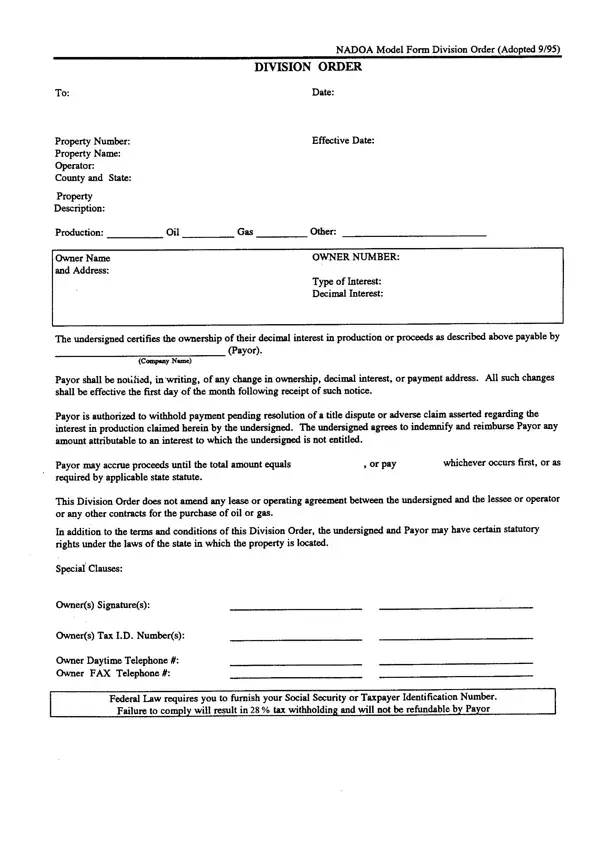
Navigating the landscape of oil and gas revenues can be a complex task for property owners and royalty recipients. At the heart of this financial interaction lies the Division Order form, a critical document that bridges the gap between energy producers and the beneficiaries of mineral resources. This form not only verifies a recipient's rightful share of production revenue but also sets forth the terms under which payments are made, ensuring accuracy in the distribution of funds. It acts as a binding agreement that details the fraction of production allocated to each party, based on their ownership in the mineral rights. Additionally, the Division Order provides essential information such as the property's legal description, the owner’s contact information, and the method by which payments are to be made, often serving as a cornerstone for the financial dealings between oil and gas companies and landowners. Understanding its nuances, from its structure to its implications, is pivotal for anyone involved in the realm of energy production and mineral rights.
| Question | Answer |
|---|---|
| Form Name | Form Division Order |
| Form Length | 1 pages |
| Fillable? | No |
| Fillable fields | 0 |
| Avg. time to fill out | 15 sec |
| Other names | which form division symbols, nadoa division order form, us wage and hour division forms, oil and gas division order form |
Form Division Order isn’t the one you’re looking for?