

Form FDA 2966 at a glance
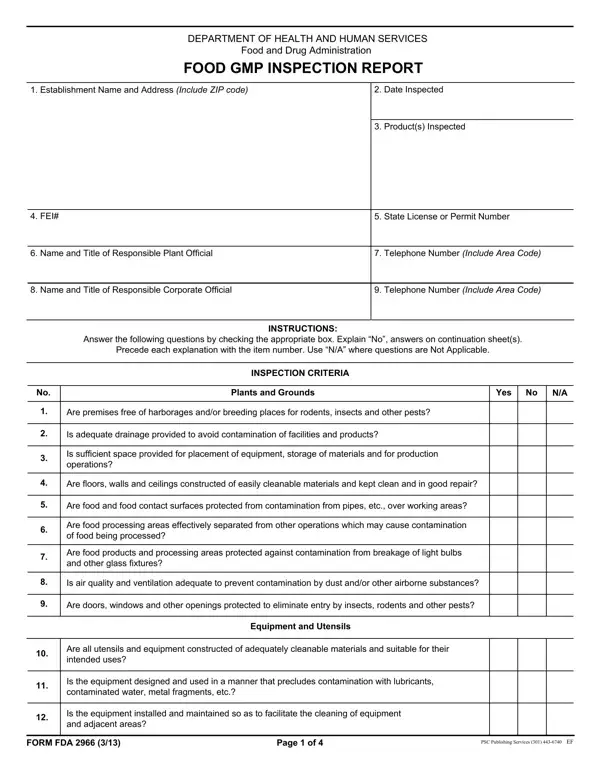
What it is: Form FDA 2966 is the FOOD GMP INSPECTION REPORT of the Food and Drug Administration, Department of Health and Human Services.
Who signs: The inspector signs on the Signature of Inspector line and enters the Date.
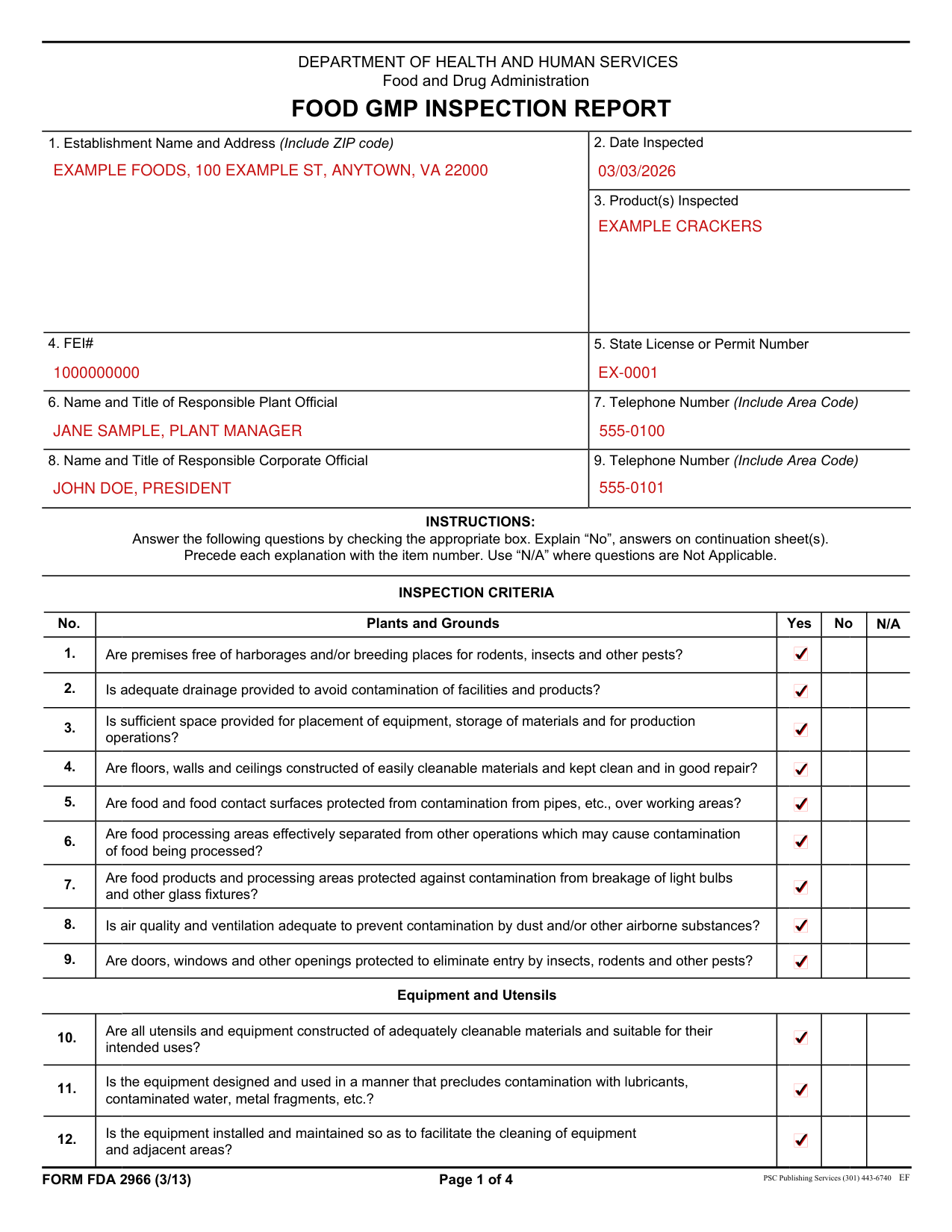
A filled-in Form FDA 2966 example: an inspector reports on a bakery
How to fill out Form FDA 2966, box by box
Plants and Grounds
1. Are premises free of harborages and/or breeding places for rodents, insects and other pests? Check Yes, No or N/A.
2. Is adequate drainage provided to avoid contamination of facilities and products? Check Yes, No or N/A.
3. Is sufficient space provided for placement of equipment, storage of materials and for production operations? Check Yes, No or N/A.
4. Are floors, walls and ceilings constructed of easily cleanable materials and kept clean and in good repair? Check Yes, No or N/A.
5. Are food and food contact surfaces protected from contamination from pipes, etc., over working areas? Check Yes, No or N/A.
6. Are food processing areas effectively separated from other operations which may cause contamination of food being processed? Check Yes, No or N/A.
7. Are food products and processing areas protected against contamination from breakage of light bulbs and other glass fixtures? Check Yes, No or N/A.
8. Is air quality and ventilation adequate to prevent contamination by dust and/or other airborne substances? Check Yes, No or N/A.
9. Are doors, windows and other openings protected to eliminate entry by insects, rodents and other pests? Check Yes, No or N/A.
Equipment and Utensils
10. Are all utensils and equipment constructed of adequately cleanable materials and suitable for their intended uses? Check Yes, No or N/A.
11. Is the equipment designed and used in a manner that precludes contamination with lubricants, contaminated water, metal fragments, etc.? Check Yes, No or N/A.
12. Is the equipment installed and maintained so as to facilitate the cleaning of equipment and adjacent areas? Check Yes, No or N/A.
Sanitary Facilities and Controls
13. Is the water supply adequate in quantity and quality for its intended uses? Check Yes, No or N/A.
14. Are the water temperatures and pressures maintained at suitable levels for its intended use? Check Yes, No or N/A.
15. Is the sewage disposal system adequate? Check Yes, No or N/A.
16. Is the plumbing adequately sized, designed, installed and maintained in a manner to prevent contamination? Check Yes, No or N/A.
17. Are adequate toilet rooms provided, equipped and maintained clean and in good repair? Check Yes, No or N/A.
18. Are adequate handwashing and/or sanitizing facilities provided where appropriate? Check Yes, No or N/A.
19. Is all refuse properly stored and protected where necessary from insects, rodents and other pests and disposed of in an adequate manner? Check Yes, No or N/A.
Sanitary Operations
20. Is the facility kept clean and in good physical repair? Check Yes, No or N/A.
21. Is cleaning of facilities and equipment conducted in such a manner as to avoid contamination of food products? Check Yes, No or N/A.
22. Are detergents, sanitizers, hazardous materials and other supplies used in a safe and effective manner? Check Yes, No or N/A.
23. Are cleaning compounds and hazardous materials kept in original containers, stored separate from raw materials? Check Yes, No or N/A.
24. Are the processing areas maintained free of insects, rodents and other pests? Check Yes, No or N/A.
25. Are insecticides and rodenticides used and stored so as to prevent contamination of food? Check Yes, No or N/A.
26. Are all utensils and equipment cleaned and sanitized at intervals frequently enough to avoid contamination of food products? Check Yes, No or N/A.
27. Are single service articles stored, handled, dispensed, used and disposed of in a manner that prevents contamination? Check Yes, No or N/A.
28. Are utensils and portable equipment stored so as to protect them from splash, dust and other contamination? Check Yes, No or N/A.
Processes and Controls
29. Is responsibility for overall plant sanitation specifically assigned to an individual? Check Yes, No or N/A.
30. Are raw materials and ingredients adequately inspected, processed as necessary and stored to assure that only clean, wholesome materials are used? Check Yes, No or N/A.
31. Is ice (where used) manufactured from potable water and stored and handled in a sanitary manner? Check Yes, No or N/A.
32. Is food processing conducted in a manner to prevent contamination and minimize harmful microbiological growth? Check Yes, No or N/A.
33. Are chemical, microbiological, or extraneous material testing procedures used where necessary to identify sanitation failures of food contamination? Check Yes, No or N/A.
34. Are packaging processes and materials adequate to prevent contamination? Check Yes, No or N/A.
35. Are only approved food and/or color additives used? Check Yes, No or N/A.
36. Are products coded to enable positive lot identification, and are records maintained in excess of expected shelf-life? Check Yes, No or N/A.
37. Are weighing and measuring practices adequate to ensure the declared quantity of contents? Check Yes, No or N/A.
38. Are labels of products covered during inspection in compliance? (submit violative labels as exhibits) Check Yes, No or N/A.
39. Are finished products stored and shipped under conditions which will avoid contamination and deterioration? Check Yes, No or N/A.
Details of Manufacturing Procedures and Controls
Provide brief description of manufacturing processes and controls for product(s) inspected.
Where appropriate, report times, temperatures, and other critical processing steps.
If microbiological or any other type of contamination is suspected or encountered, fully describe the relationship between the routes of contamination and the process.
Use flow charts where appropriate.
If more space is needed, use continuation sheet.
Personnel
40. Are personnel with illness, sores, infections, etc., restricted from handling food products? Check Yes, No or N/A.
41. Do employees wear clean outer garments, use adequate hair restraints and remove excess jewelry when handling food? Check Yes, No or N/A.
42. Do employees thoroughly wash and sanitize hands as necessary? Check Yes, No or N/A.
43. Do employees refrain from eating, drinking and smoking and observe good food handling techniques in processing areas? Check Yes, No or N/A.
Corrections and samples
If any corrections were made as a result of this inspection or made as a result of a previous inspection (including voluntary destructions, capital improvements, etc.), complete Voluntary Correction section of cover sheet Form FDA 481 (E) CG.
If any samples were collected, list sample numbers and briefly describe samples.
Discussions with management
Indicate individual with whom inspection was discussed.
Identify official (name and title) having authority to authorize corrections.
Record any recommendations/warnings given, and management's response.
Continuation sheet and signature
Use additional continuation sheets as appropriate.
The inspector signs on the Signature of Inspector line and enters the Date.
Sources
[1] Form FDA 2966 (3/13), Food GMP Inspection Report, Food and Drug Administration (the Official source link on this page).