

FS Form 1522 at a glance
What it is: FS Form 1522 is the Special Form of Request for Payment of United States Savings and Retirement Securities Where Use of a Detached Request Is Authorized.
Who signs: The person(s) requesting payment of the bonds must sign the form in ink, print his or her name, and provide his or her address, daytime telephone number, and if applicable, e-mail address.
This form may be completed by the owner, coowner, surviving beneficiary, or legal representative of the estate of a deceased or incompetent owner, persons entitled to the estate of a deceased registrant, or such other persons who may be entitled to payment under the regulations governing United States Savings Bonds.
A minor may sign this form if, in the opinion of the notary or certifying officer, he or she is of sufficient competency to understand the nature of the transaction.
An incompetent person may not sign this form.
What to bring and attach to FS Form 1522
If a form asks for legal evidence, such as a death certificate, be sure to include it. However, it won't be returned. A photocopy is fine if the stamp or seal is legible.[2]
A filled-in FS Form 1522 example: a savings bond paid by direct deposit
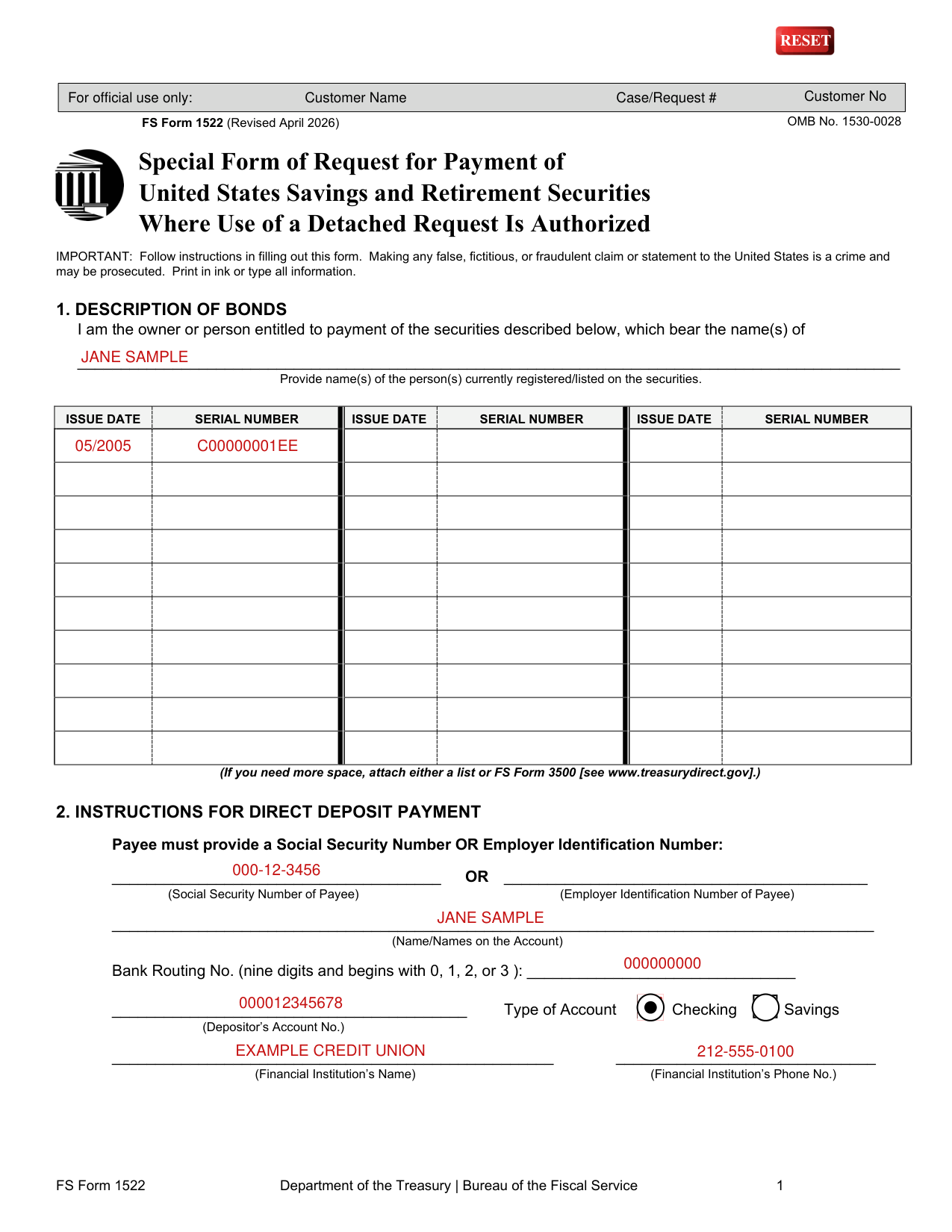
How to fill out FS Form 1522, box by box
Description of bonds
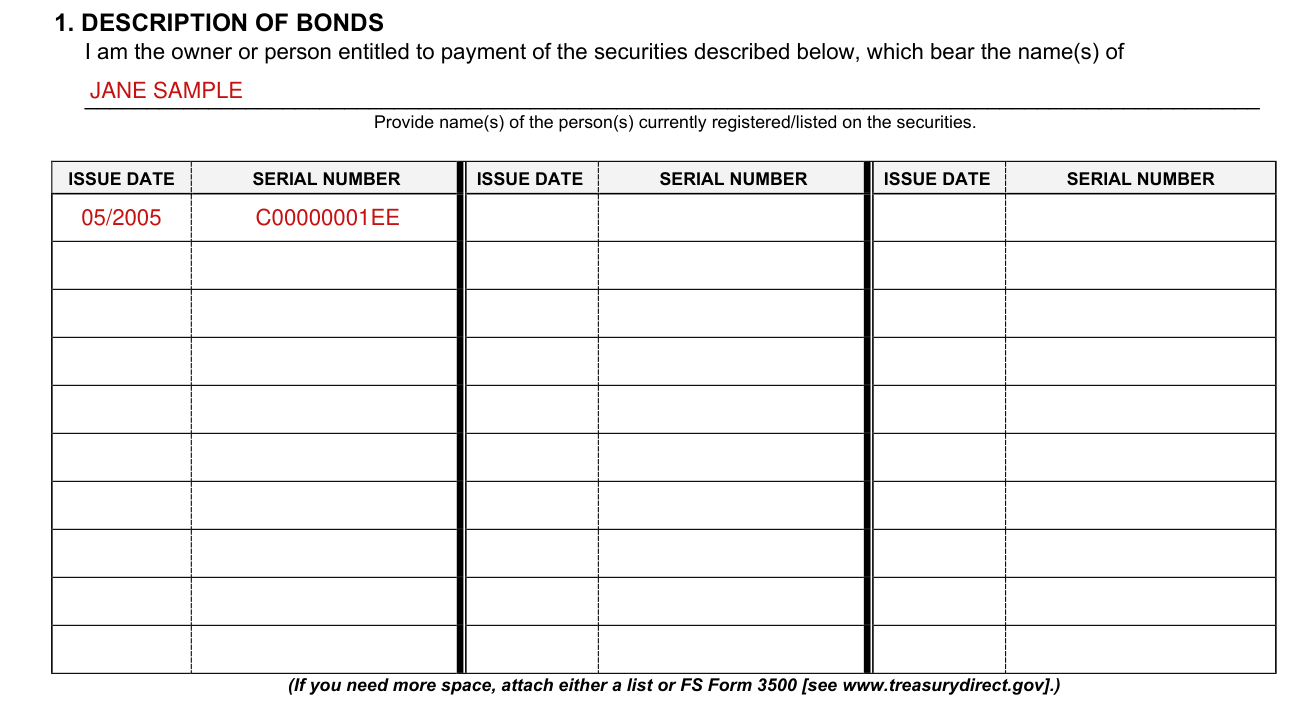
Provide the name(s) of the person(s) shown in the inscription of the bonds for which payment is requested.
Describe the bonds by issue date and serial number.
If you need more space, attach either a list or FS Form 3500 [see www.treasurydirect.gov].
Instructions for direct deposit payment
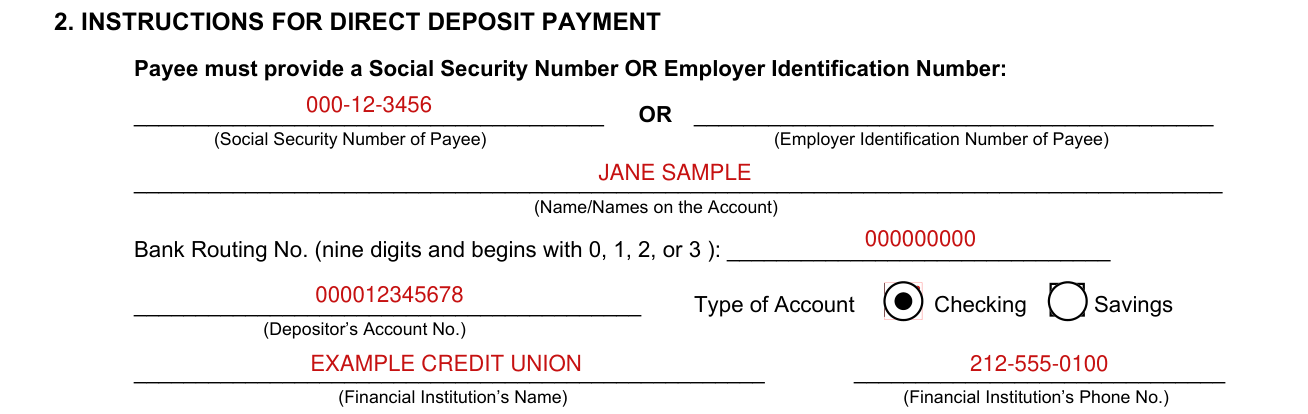
The payee's Taxpayer Identification Number must be provided.
Furnish the Social Security Number if the payee is an individual.
If an estate, trust, or other entity is involved and IRS has assigned an Employer Identification Number, provide that number.
Furnish the name(s) on the account, the account number, the type of account, and the financial institution's name, the routing/transit number which identifies the institution, and the institution's phone number.
Bank Routing No. is nine digits and begins with 0, 1, 2, or 3.
You may need to contact the financial institution to obtain the routing number.
Please verify account information for accuracy and legibility to avoid a delay in deposit.
Signature
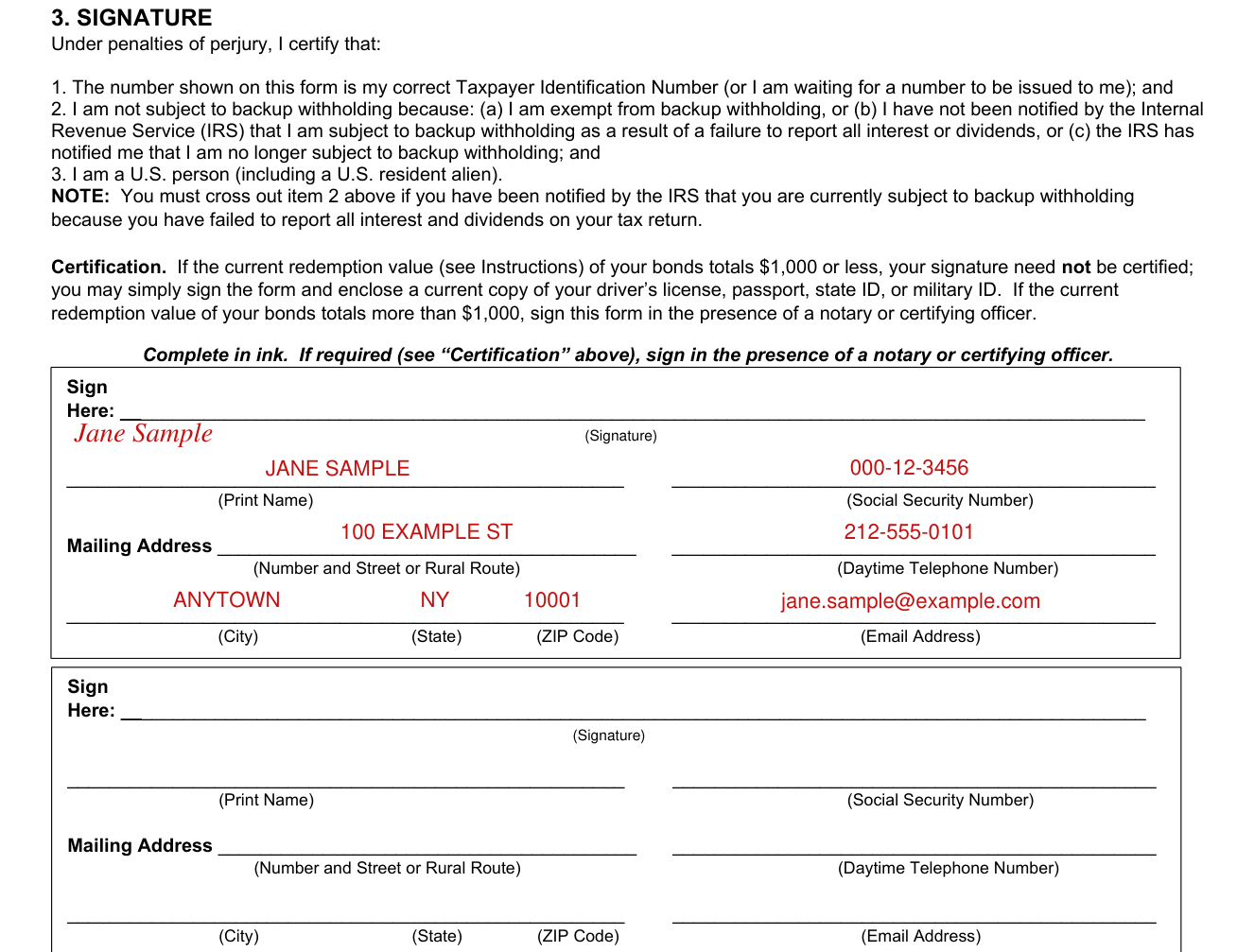
Complete in ink. If required (see "Certification"), sign in the presence of a notary or certifying officer.
If the name of a person requesting payment has been changed by marriage or in any other legal manner from the name in the inscription of the bonds, the signature to the request for payment must show both names and the manner in which the change was made; for example, "Miss Mary T. Jones now by marriage Mrs. Mary T. Smith."
If the current redemption value (see Instructions) of your bonds totals $1,000 or less, your signature need not be certified; you may simply sign the form and enclose a current copy of your driver's license, passport, state ID, or military ID. (checked October 20, 2026)
If the current redemption value of your bonds totals more than $1,000, sign this form in the presence of a notary or certifying officer. (checked October 20, 2026)
Some forms require a certified signature. If your form says you need that, wait to sign it until you are with the person who will certify your signature.
On page 4 of FS Form 1522, under CERTIFICATION: To find the current redemption value of savings bonds of Series EE, Series E, or Series I, or of savings notes, use the Savings Bond Calculator at TreasuryDirect.gov.
Under penalties of perjury, I certify that: 1. The number shown on this form is my correct Taxpayer Identification Number (or I am waiting for a number to be issued to me); and 2. I am not subject to backup withholding because: (a) I am exempt from backup withholding, or (b) I have not been notified by the Internal Revenue Service (IRS) that I am subject to backup withholding as a result of a failure to report all interest or dividends, or (c) the IRS has notified me that I am no longer subject to backup withholding; and 3. I am a U.S. person (including a U.S. resident alien).
You must cross out item 2 if you have been notified by the IRS that you are currently subject to backup withholding because you have failed to report all interest and dividends on your tax return.[2]
More rules for FS Form 1522
Making any false, fictitious, or fraudulent claim or statement to the United States is a crime and may be prosecuted.
Print clearly in ink or type all information requested.
If your situation is different
Instructions to Notary or Certifying Officer
Name(s) of the person(s) who appeared and date of appearance MUST be completed.
If a Medallion stamp is used, an original signature is required.
Person(s) must sign in your presence.
Authorized certifying officers are available at financial institutions, including credit unions, in the United States.
Common questions about FS Form 1522
What is an FS form 1522?
FS Form 1522 is the Special Form of Request for Payment of United States Savings and Retirement Securities Where Use of a Detached Request Is Authorized. On page 3 of FS Form 1522, under USE OF FORM: Use this form to request payment of United States Savings Bonds, Savings Notes, Retirement Plan Bonds, and Individual Retirement Bonds.
Where do I file it?
Unless otherwise instructed, send this form and the bonds, as well as any other appropriate forms, evidence, or identification records, to Treasury Retail Securities Services, P.O. Box 9150, Minneapolis, MN 55480-9150. If you are asking for payment for paper savings bonds, send the physical bonds (signed or unsigned) along with the form and mail them at the address shown on FS Form 1522.[2]
Sources
[1] FS Form 1522 (Revised April 2026), Special Form of Request for Payment of United States Savings and Retirement Securities, Bureau of the Fiscal Service (the Official source link on this page).
[2] treasurydirect.gov, certified_signature (treasurydirect.gov). Accessed October 20, 2026.
