

Form HA-1151-BK at a glance
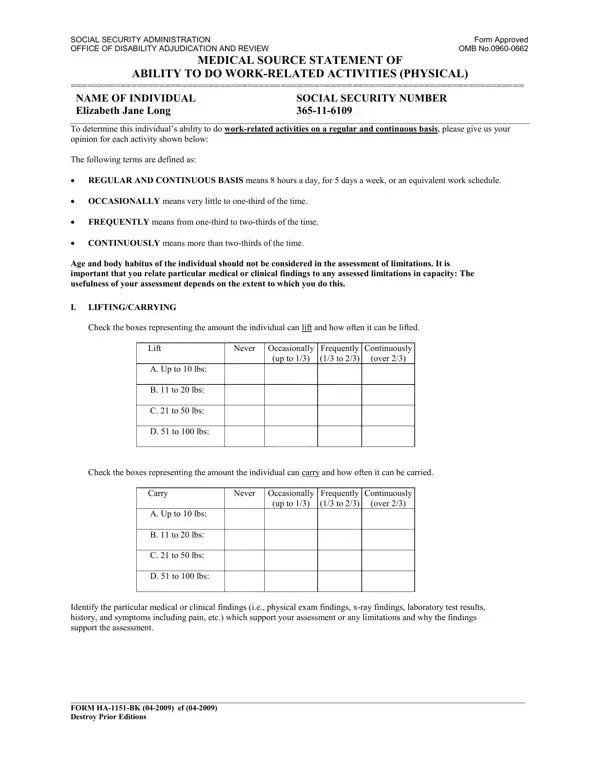
What it is: Form HA-1151-BK, the Medical Source Statement of Ability to Do Work-Related Activities (Physical), is a form of the Social Security Administration, Office of Disability Adjudication and Review.
Who signs: Enter the Date, sign on the Signature line, and Print Name, Title and Medical Specialty (Legibly Please).
Where and when to file: Send or bring the completed form to your local Social Security Office.
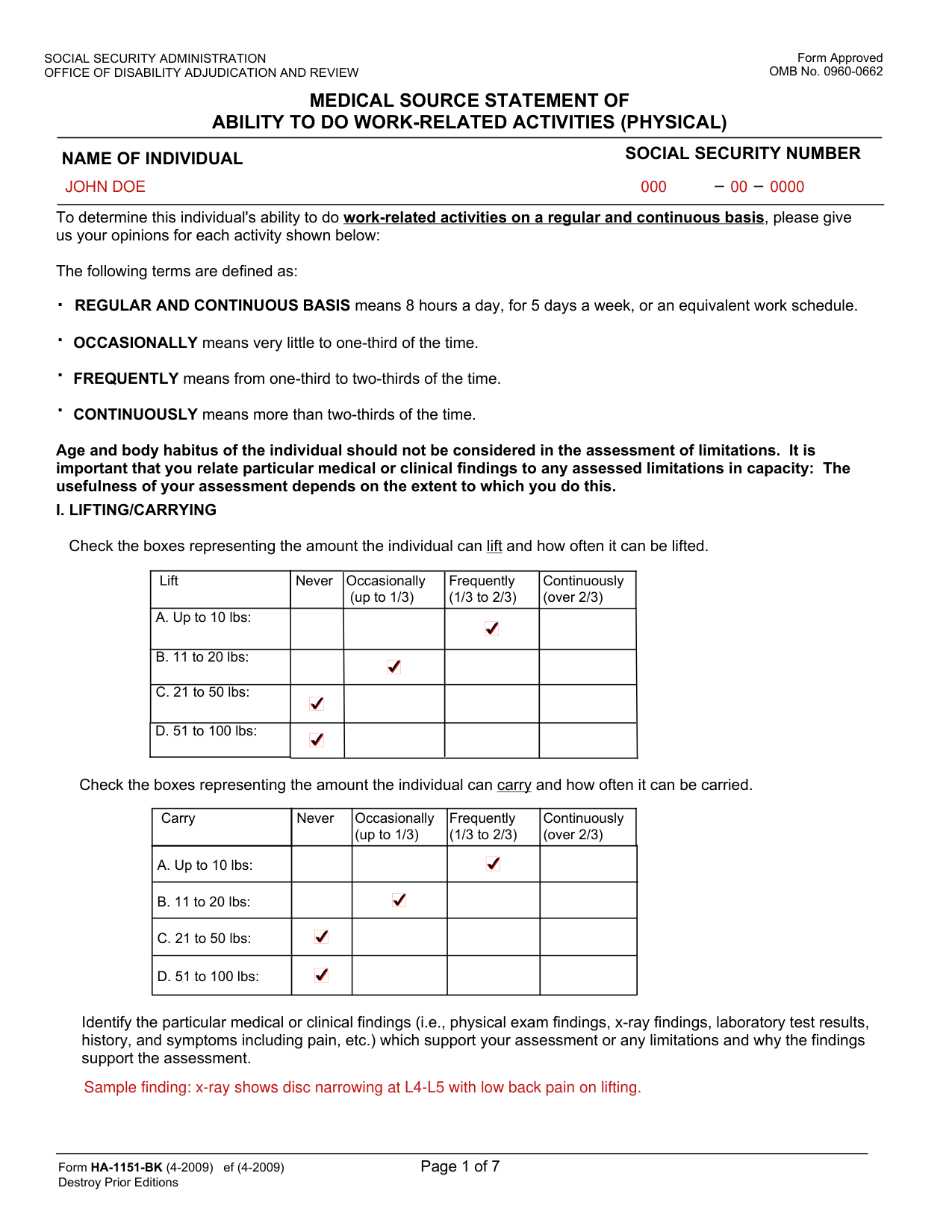
A filled-in Form HA-1151-BK example: a doctor rates lifting and carrying
How to fill out Form HA-1151-BK, box by box
Name of individual

Enter the Name of Individual and the Social Security Number.
To determine this individual's ability to do work-related activities on a regular and continuous basis, give your opinions for each activity shown.
Regular and continuous basis means 8 hours a day, for 5 days a week, or an equivalent work schedule.
Occasionally means very little to one-third of the time.
Frequently means from one-third to two-thirds of the time.
Continuously means more than two-thirds of the time.
Age and body habitus of the individual should not be considered in the assessment of limitations. Relate particular medical or clinical findings to any assessed limitations in capacity: the usefulness of your assessment depends on the extent to which you do this.
Lifting/Carrying
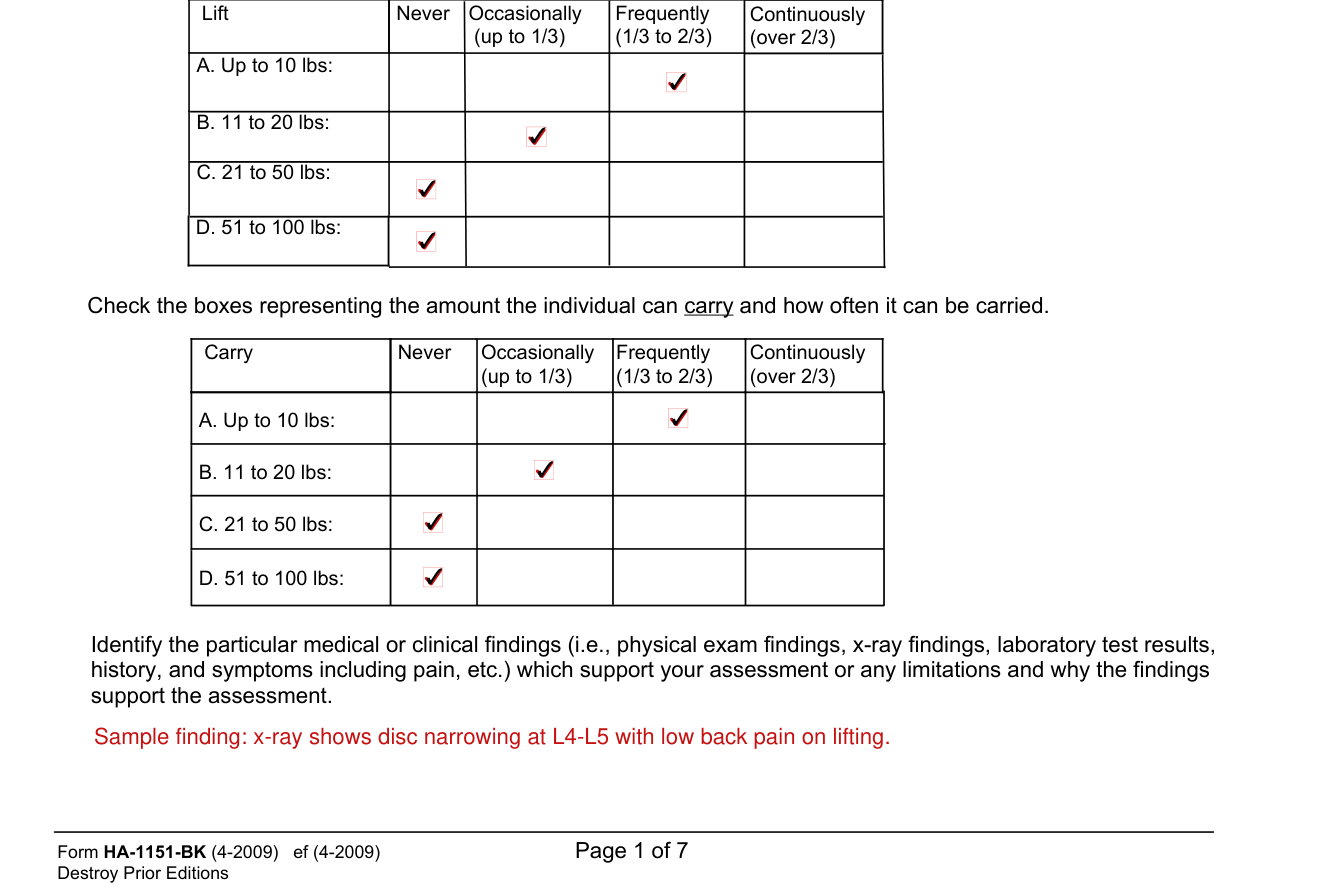
Under Lift, check the boxes representing the amount the individual can lift and how often it can be lifted, for A. Up to 10 lbs, B. 11 to 20 lbs, C. 21 to 50 lbs and D. 51 to 100 lbs, as Never, Occasionally (up to 1/3), Frequently (1/3 to 2/3) or Continuously (over 2/3).
Under Carry, check the boxes representing the amount the individual can carry and how often it can be carried, as Never, Occasionally (up to 1/3), Frequently (1/3 to 2/3) or Continuously (over 2/3), for A. Up to 10 lbs, B. 11 to 20 lbs, C. 21 to 50 lbs and D. 51 to 100 lbs.
Identify the particular medical or clinical findings (i.e., physical exam findings, x-ray findings, laboratory test results, history, and symptoms including pain, etc.) which support your assessment or any limitations and why the findings support the assessment.
Sitting/Standing/Walking
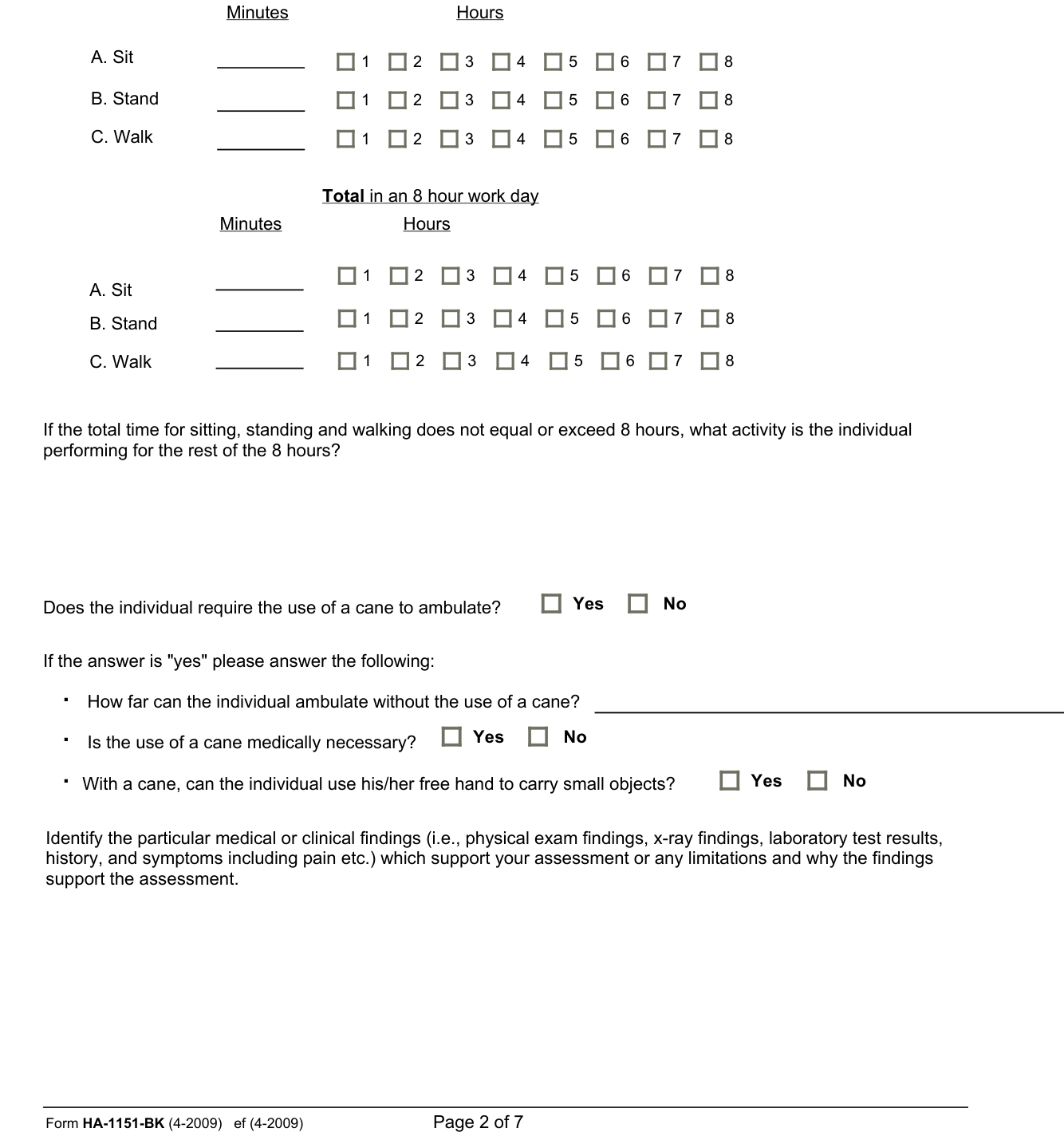
Under At One Time without Interruption, check how many hours the individual can (if less than one hour, how many minutes): A. Sit, B. Stand, C. Walk.
Under Total in an 8 hour work day, check how many hours the individual can (if less than one hour, how many minutes): A. Sit, B. Stand, C. Walk.
If the total time for sitting, standing and walking does not equal or exceed 8 hours, what activity is the individual performing for the rest of the 8 hours?
Does the individual require the use of a cane to ambulate? Check No or Yes.
If the answer is "yes", answer the following.
How far can the individual ambulate without the use of a cane? Is the use of a cane medically necessary? With a cane, can the individual use his/her free hand to carry small objects?
Use of hands
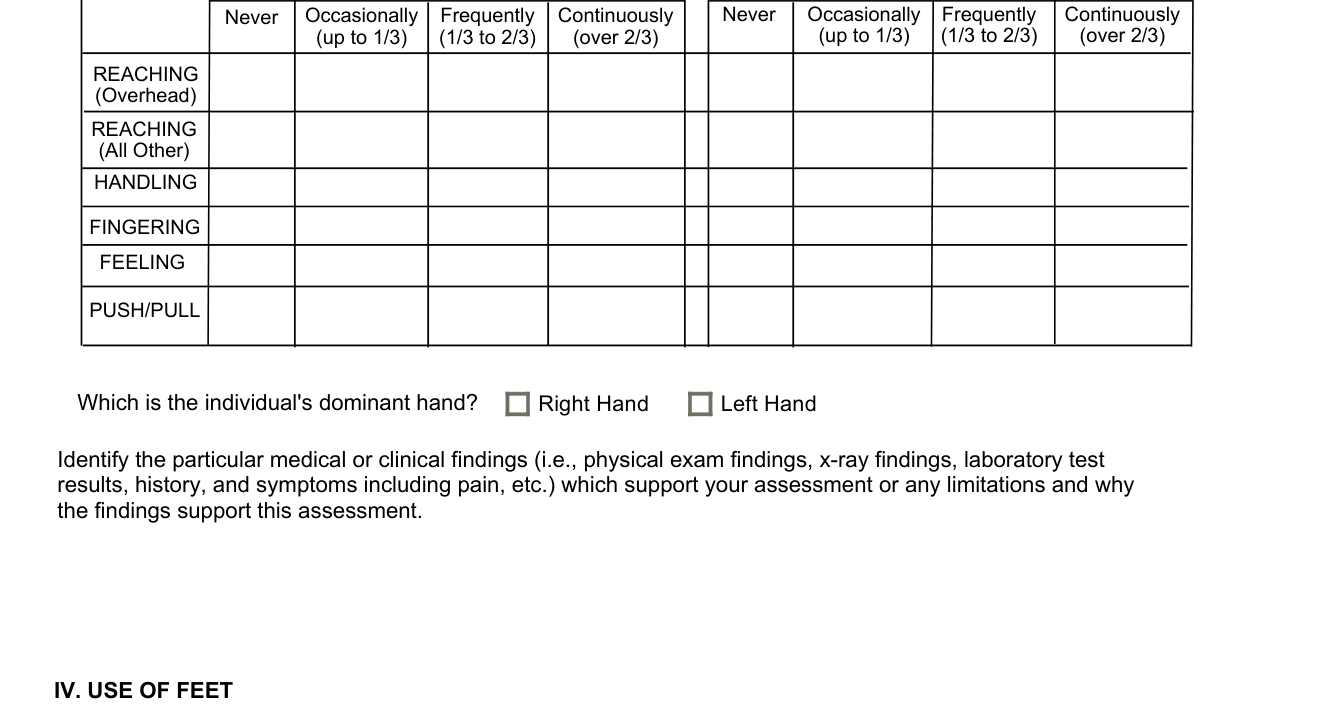
Indicate how often the individual can perform the following activities with the Right Hand and the Left Hand: REACHING (Overhead), REACHING (All Other), HANDLING, FINGERING, FEELING and PUSH/PULL, each as Never, Occasionally (up to 1/3), Frequently (1/3 to 2/3) or Continuously (over 2/3).
Check Left Hand or Right Hand as the individual's dominant hand.
Use of Feet
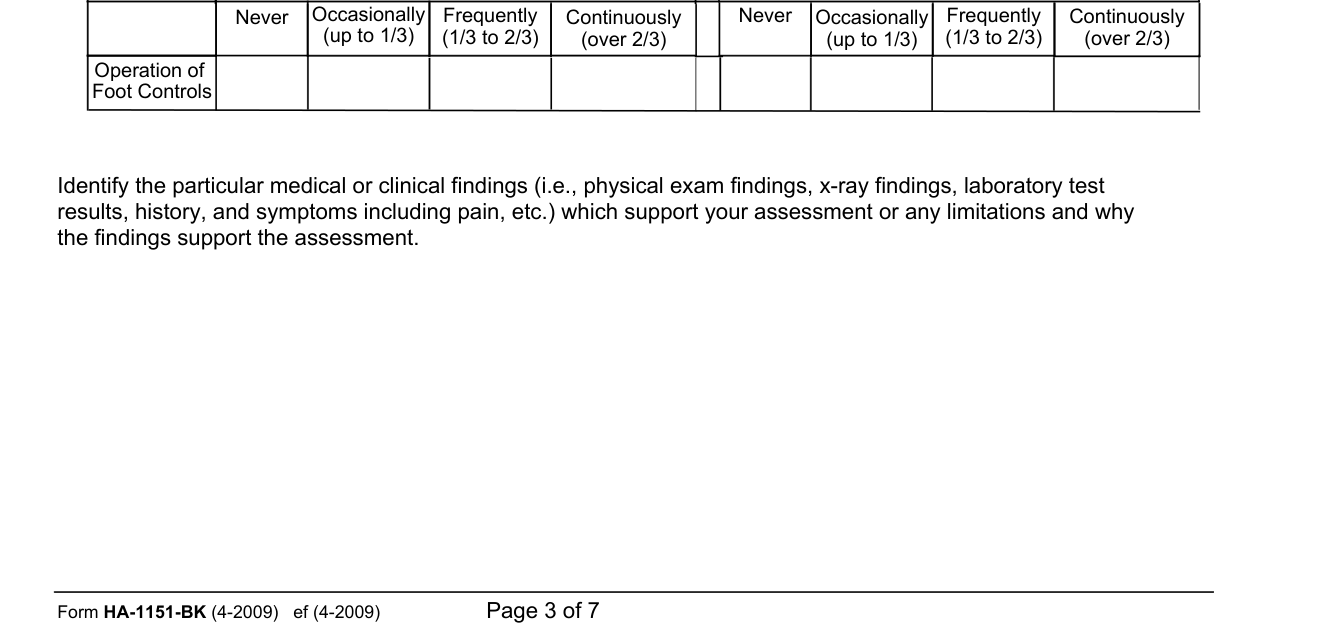
Indicate how often the individual can perform Operation of Foot Controls with the Right Foot and the Left Foot, as Never, Occasionally (up to 1/3), Frequently (1/3 to 2/3) or Continuously (over 2/3).
Postural Activities
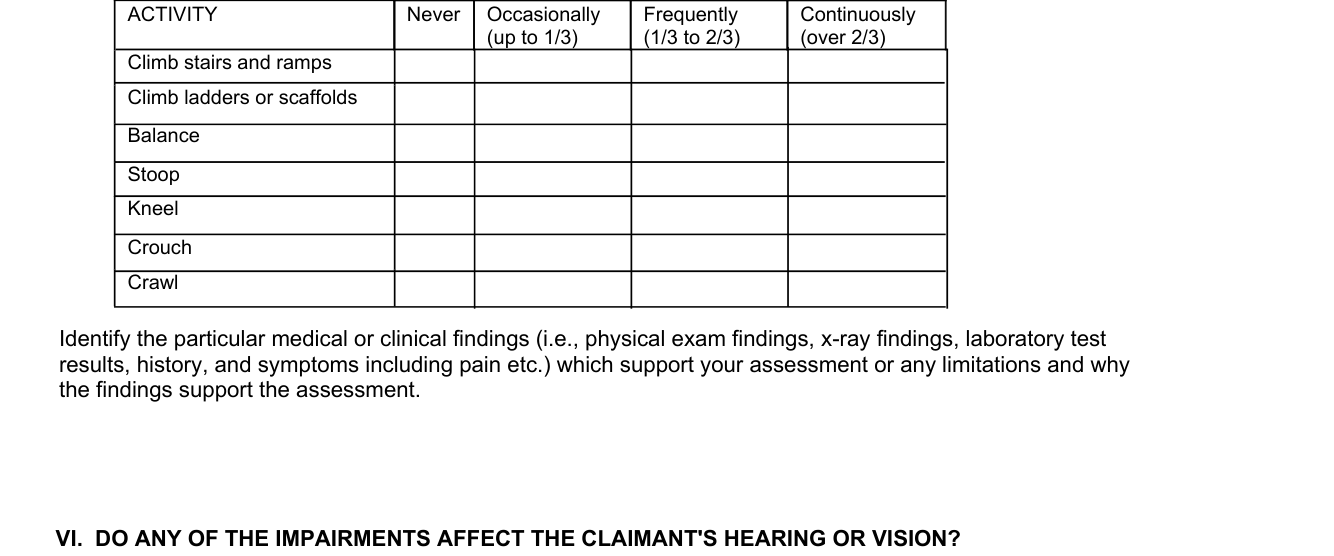
Check how often the individual can climb stairs and ramps, climb ladders or scaffolds, balance, stoop, kneel, crouch and crawl, each as Never, Occasionally (up to 1/3), Frequently (1/3 to 2/3) or Continuously (over 2/3).
Hearing or vision
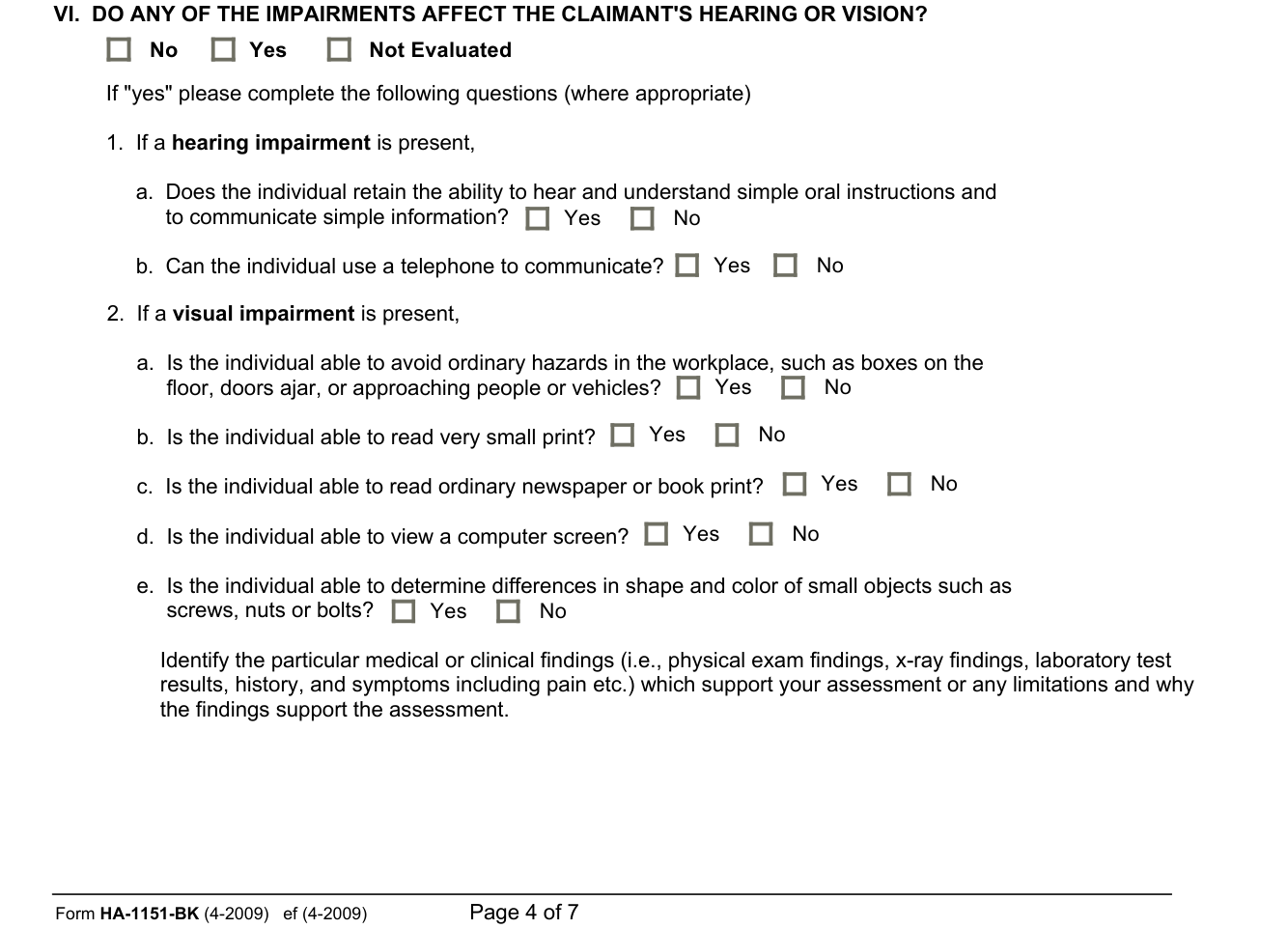
Do any of the impairments affect the claimant's hearing or vision? Check No, Yes or Not Evaluated. If "yes", complete the following questions (where appropriate).
If a hearing impairment is present, check Yes or No for each: a. Does the individual retain the ability to hear and understand simple oral instructions and to communicate simple information? b. Can the individual use a telephone to communicate?
If a visual impairment is present, check Yes or No for each: a. Is the individual able to avoid ordinary hazards in the workplace, such as boxes on the floor, doors ajar, or approaching people or vehicles? b. Is the individual able to read very small print? c. Is the individual able to read ordinary newspaper or book print? d. Is the individual able to view a computer screen? e. Is the individual able to determine differences in shape and color of small objects such as screws, nuts or bolts?
Environmental Limitations
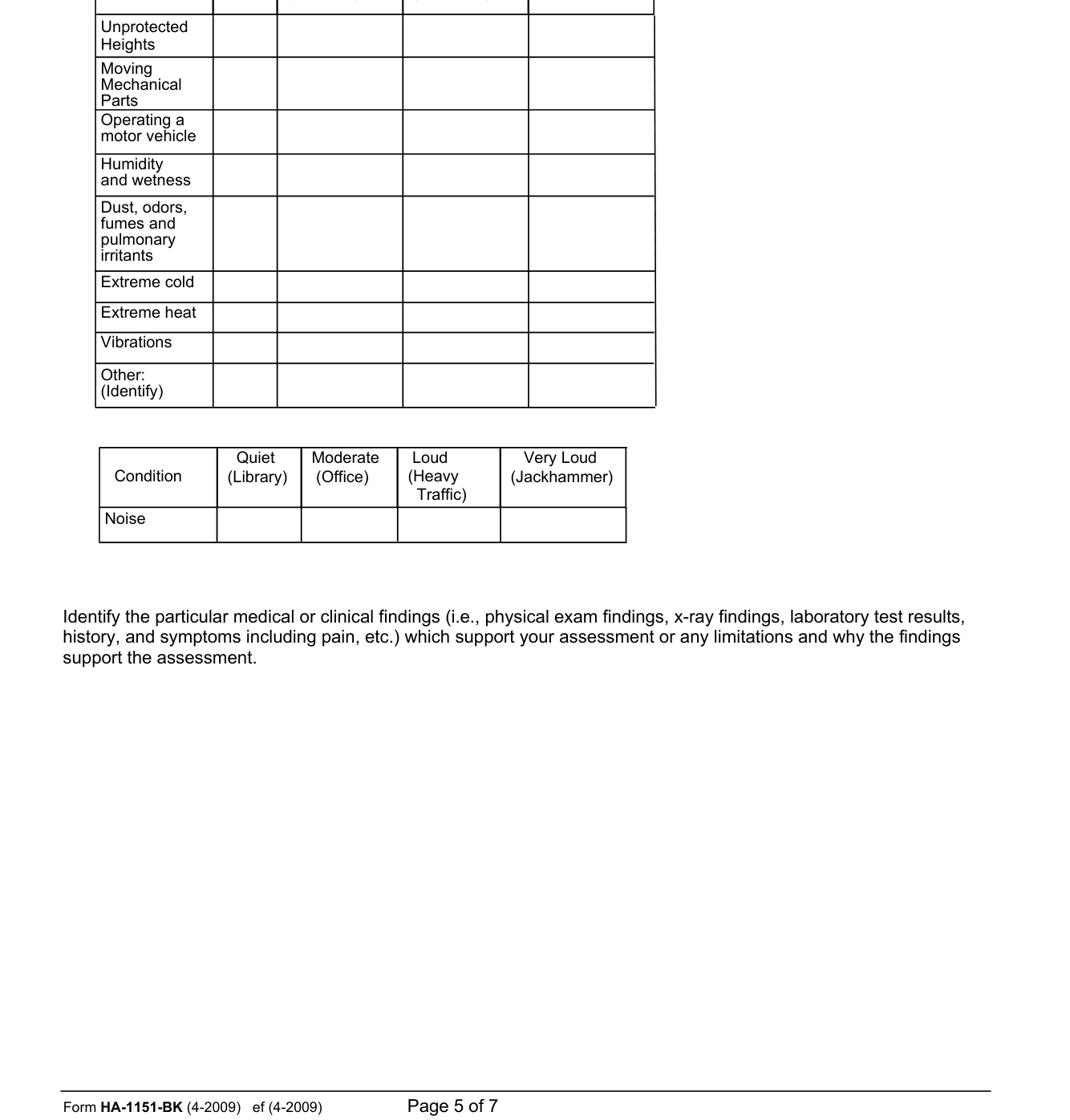
Under ENVIRONMENTAL LIMITATIONS, check how often the individual can tolerate exposure to the following conditions: Unprotected Heights, Moving Mechanical Parts, Operating a motor vehicle, Humidity and wetness, Dust, odors, fumes and pulmonary irritants, Extreme cold, Extreme heat, Vibrations and Other: (Identify), each as Never, Occasionally (up to 1/3), Frequently (1/3 to 2/3) or Continuously (over 2/3).
Under Noise, check Quiet (Library), Moderate (Office), Loud (Heavy Traffic) or Very Loud (Jackhammer).
Physical impairments and activities
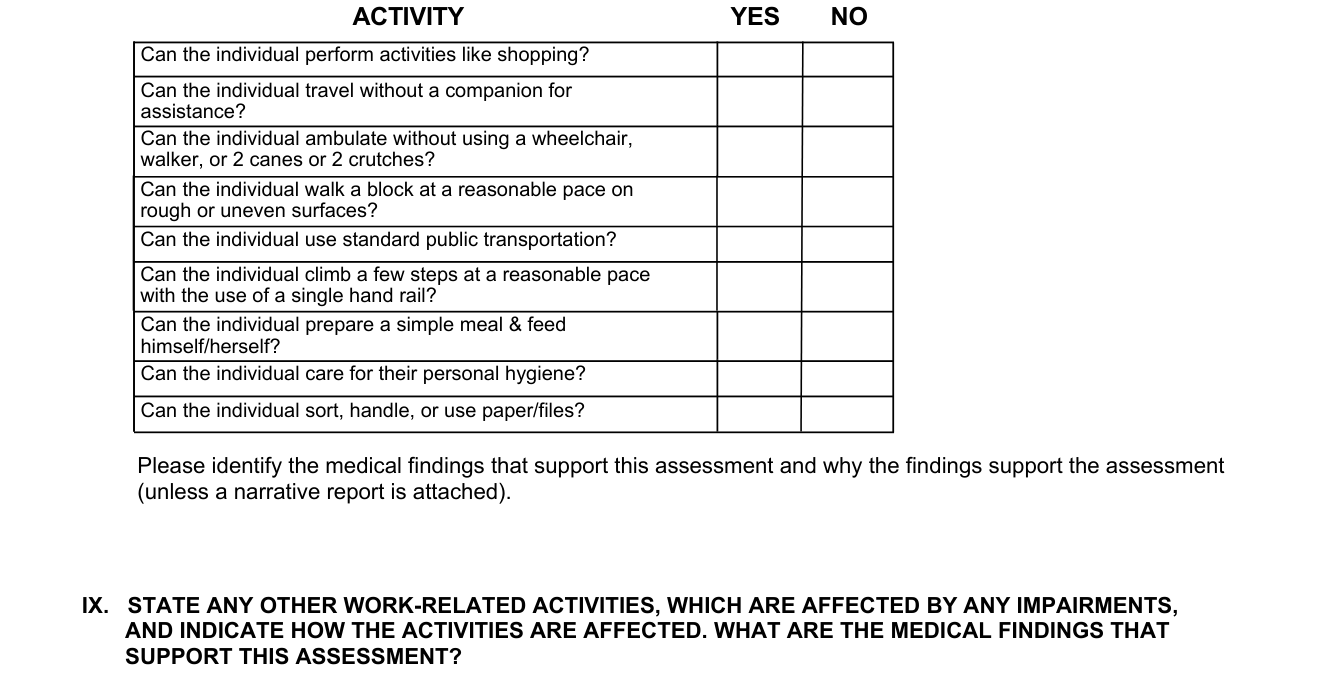
Place a check in the appropriate YES or NO box, based solely on the claimant's physical impairments, for each activity: Can the individual perform activities like shopping? Can the individual travel without a companion for assistance? Can the individual ambulate without using a wheelchair, walker, or 2 canes or 2 crutches? Can the individual walk a block at a reasonable pace on rough or uneven surfaces? Can the individual use standard public transportation? Can the individual climb a few steps at a reasonable pace with the use of a single hand rail? Can the individual prepare a simple meal & feed himself/herself? Can the individual care for their personal hygiene? Can the individual sort, handle, or use paper/files?
Identify the medical findings that support this assessment and why the findings support the assessment (unless a narrative report is attached).
Other work-related activities

State any other work-related activities, which are affected by any impairments, and indicate how the activities are affected. What are the medical findings that support this assessment?
Past limitations

The limitations are assumed to be your opinion regarding current limitations only. However, if you have sufficient information to form an opinion within a reasonable degree of medical probability as to past limitations, enter the date on which the limitations you found were first present.
Limitations lasting 12 consecutive months

Have the limitations you found lasted or will they last for 12 consecutive months? Check No or Yes.
Date, signature and print name

Enter the Date, sign on the Signature line, and Print Name, Title and Medical Specialty (Legibly Please).
Common questions about Form HA-1151-BK
Where do I file it?
Send or bring the completed form to your local Social Security Office.
Sources
[1] Form HA-1151-BK (4-2009), Medical Source Statement of Ability to Do Work-Related Activities (Physical), Social Security Administration (the Official source link on this page).