
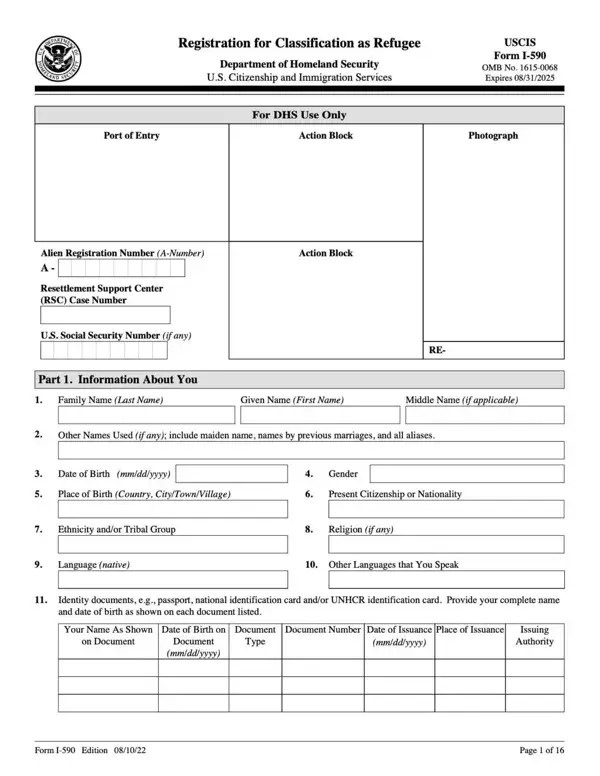
The Resettlement Support Center (RSC) with jurisdiction in the registrant's region shall assist the registrant in the completion and submission of Form I-590.
Biometrics: you may be required to provide fingerprints, photograph, and/or additional signature as requested; if you fail, USCIS may reject, close, or deny your form.
Translations: if a document with information in a foreign language is submitted, a full English translation must also be submitted.
Signatures: USCIS will not accept a stamped or typewritten name in place of a signature.
Photocopies: you may submit legible photocopies of documents requested, unless the Instructions specifically state that you must submit an original document.
Extra space: if extra space is needed to complete any item, use the space provided in Part 12.
| Question | Answer |
|---|---|
| Form Name | Form I-590 |
| Form Length | 16 pages |
| Fillable? | Yes |
| Fillable fields | 581 |
| Avg. time to fill out | 60+ min |
| Edition | 01/20/25 |
| Issuing agency | Department of Homeland Security, USCIS |
| Who signs | The registrant |
| Matches the agency's file | Yes, checked October 2, 2026 |
| Other names | I-590, I590, I 590, Form I-590, USCIS I-590, Registration for Classification as Refugee |
| Official source | Form I-590 (Rev 01/20/25), USCIS |
Form I 590 isn’t the one you’re looking for?