
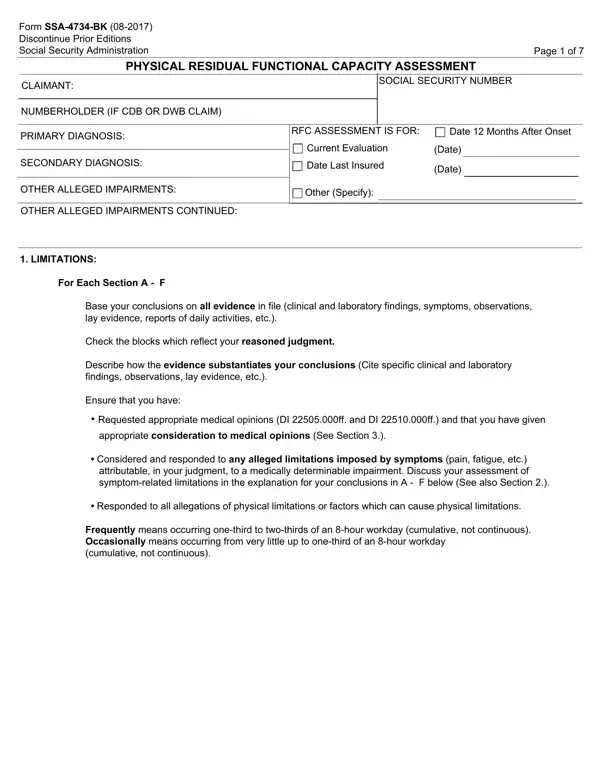
Form SSA-4734-BK at a glance
What it is: Form SSA-4734-BK is the Social Security Administration's Physical Residual Functional Capacity Assessment.
Who signs: The Signatory's Role is Medical Consultant (MC) or Single Decisionmaker (SDM).
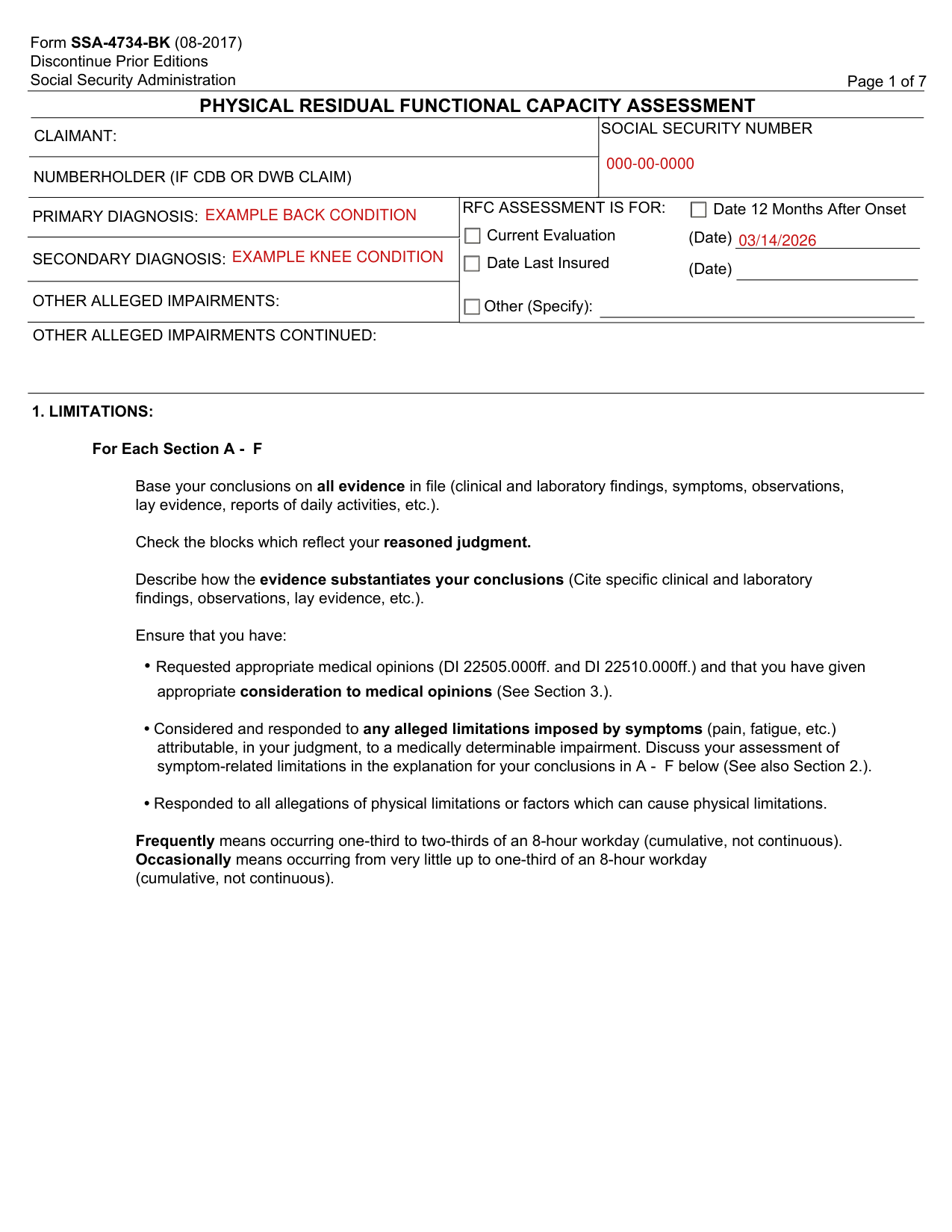
A filled-in Form SSA-4734-BK example: a medical consultant starts the assessment
How to fill out Form SSA-4734-BK, box by box
Claimant, social security number and diagnoses
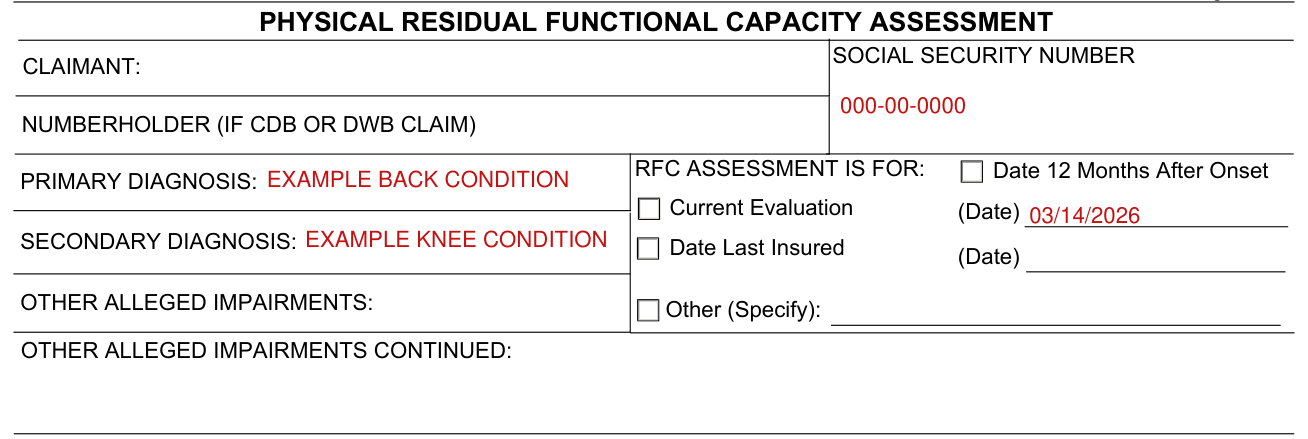
Enter the Claimant, the Social Security Number, the Numberholder (if CDB or DWB claim), the Primary Diagnosis, the Secondary Diagnosis, the Other Alleged Impairments and the Other Alleged Impairments Continued.
RFC assessment is for

RFC Assessment is for: Date 12 Months After Onset, Current Evaluation (Date), Date Last Insured (Date) or Other (Specify).
A. Exertional limitations
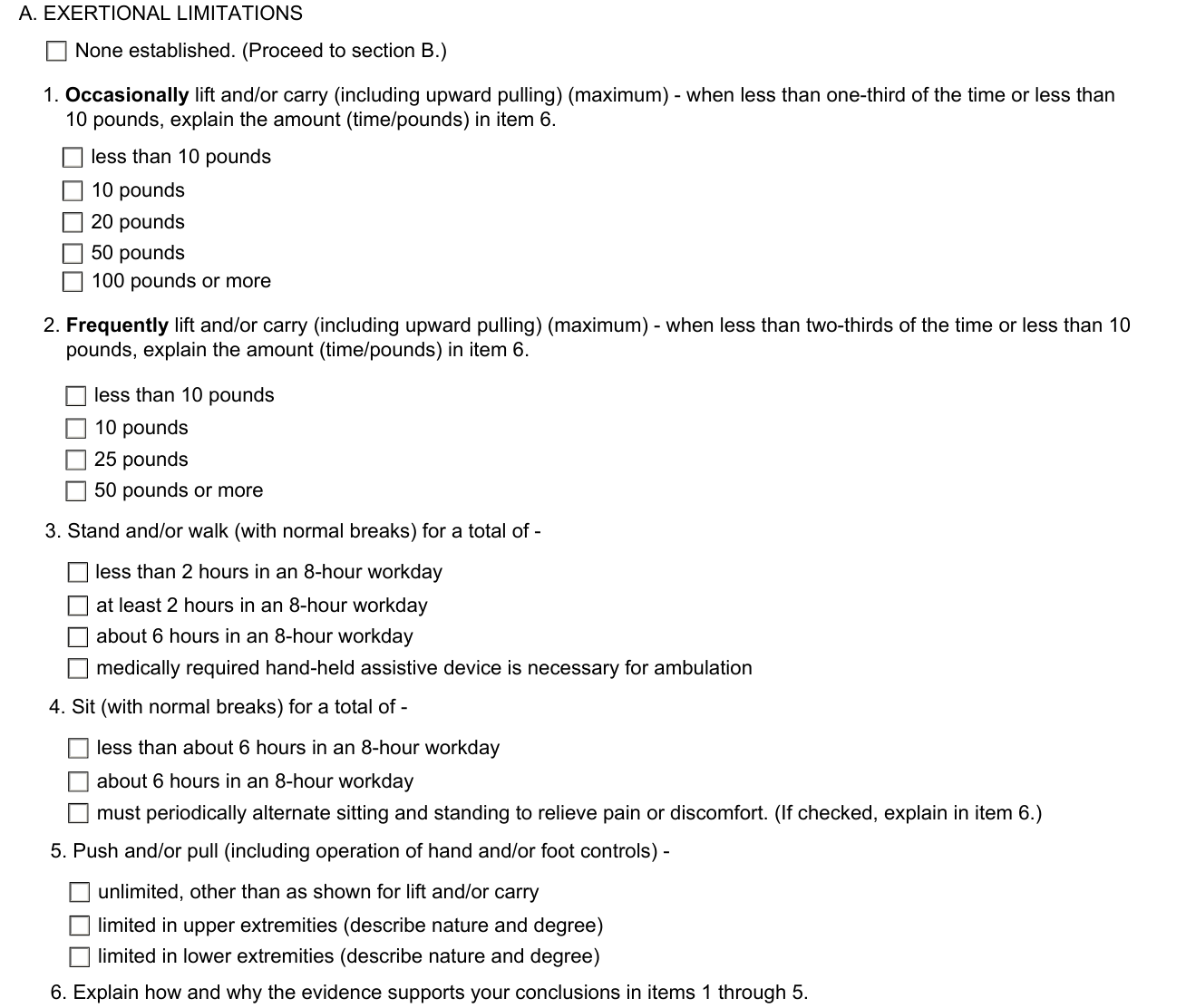
A. Exertional Limitations: None established. (Proceed to section B.)
1. Occasionally lift and/or carry (including upward pulling) (maximum): less than 10 pounds, 10 pounds, 20 pounds, 50 pounds or 100 pounds or more. When less than one-third of the time or less than 10 pounds, explain the amount (time/pounds) in item 6.
2. Frequently lift and/or carry (including upward pulling) (maximum): less than 10 pounds, 10 pounds, 25 pounds or 50 pounds or more. When less than two-thirds of the time or less than 10 pounds, explain the amount (time/pounds) in item 6.
3. Stand and/or walk (with normal breaks) for a total of: less than 2 hours in an 8-hour workday, at least 2 hours in an 8-hour workday, about 6 hours in an 8-hour workday or medically required hand-held assistive device is necessary for ambulation.
4. Sit (with normal breaks) for a total of: less than about 6 hours in an 8-hour workday or about 6 hours in an 8-hour workday. Check must periodically alternate sitting and standing to relieve pain or discomfort. (If checked, explain in item 6.)
5. Push and/or pull (including operation of hand and/or foot controls): unlimited, other than as shown for lift and/or carry; limited in upper extremities (describe nature and degree); or limited in lower extremities (describe nature and degree).
6. Explain how and why the evidence supports your conclusions in items 1 through 5. Cite the specific facts upon which your conclusions are based.
B. Postural limitations
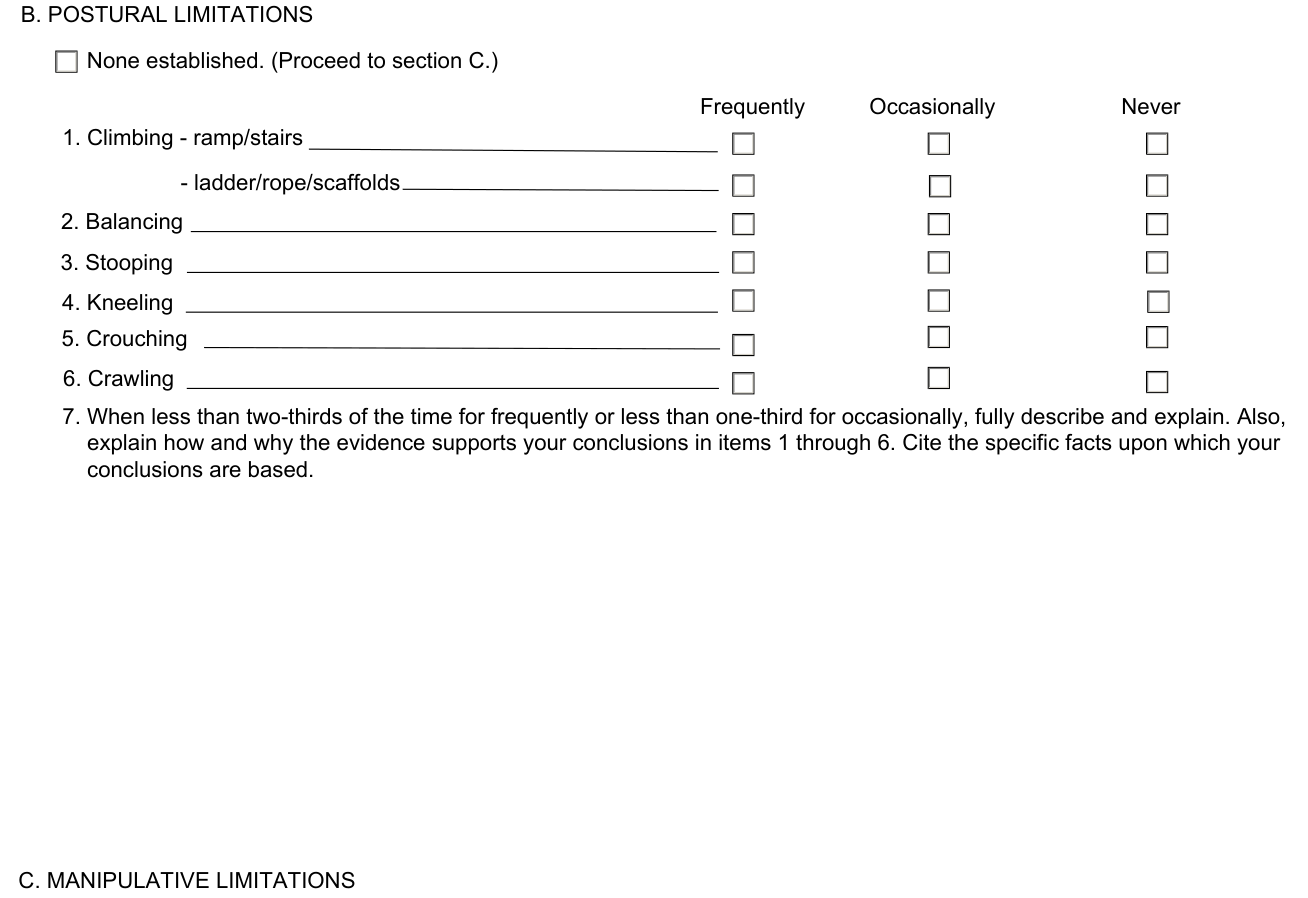
B. Postural Limitations: None established. (Proceed to section C.)
For each of 1. Climbing - ramp/stairs and ladder/rope/scaffolds, 2. Balancing, 3. Stooping, 4. Kneeling, 5. Crouching and 6. Crawling, check Frequently, Occasionally or Never.
7. When less than two-thirds of the time for frequently or less than one-third for occasionally, fully describe and explain. Also, explain how and why the evidence supports your conclusions in items 1 through 6.
C. Manipulative limitations
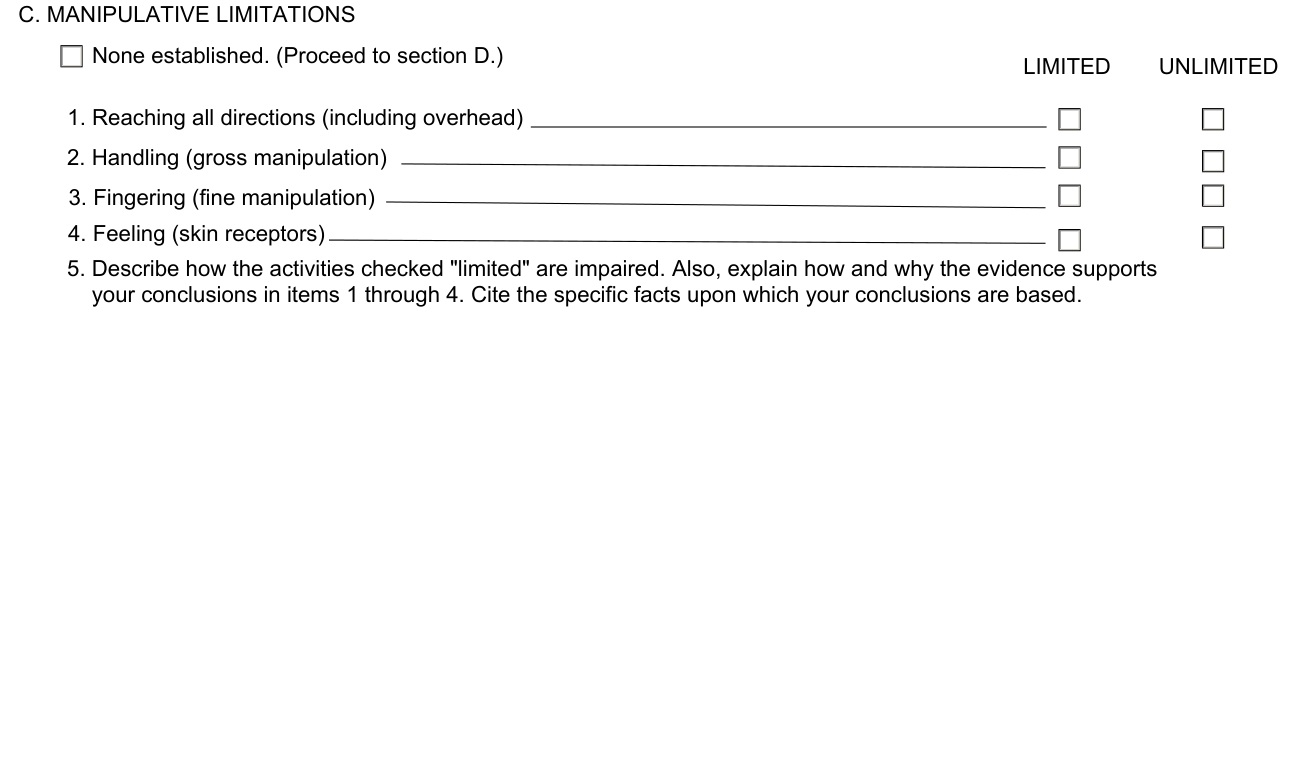
C. Manipulative Limitations: None established. (Proceed to section D.)
For each of 1. Reaching all directions (including overhead), 2. Handling (gross manipulation), 3. Fingering (fine manipulation) and 4. Feeling (skin receptors), check Limited or Unlimited.
5. Describe how the activities checked "limited" are impaired. Also, explain how and why the evidence supports your conclusions in items 1 through 4.
D. Visual limitations
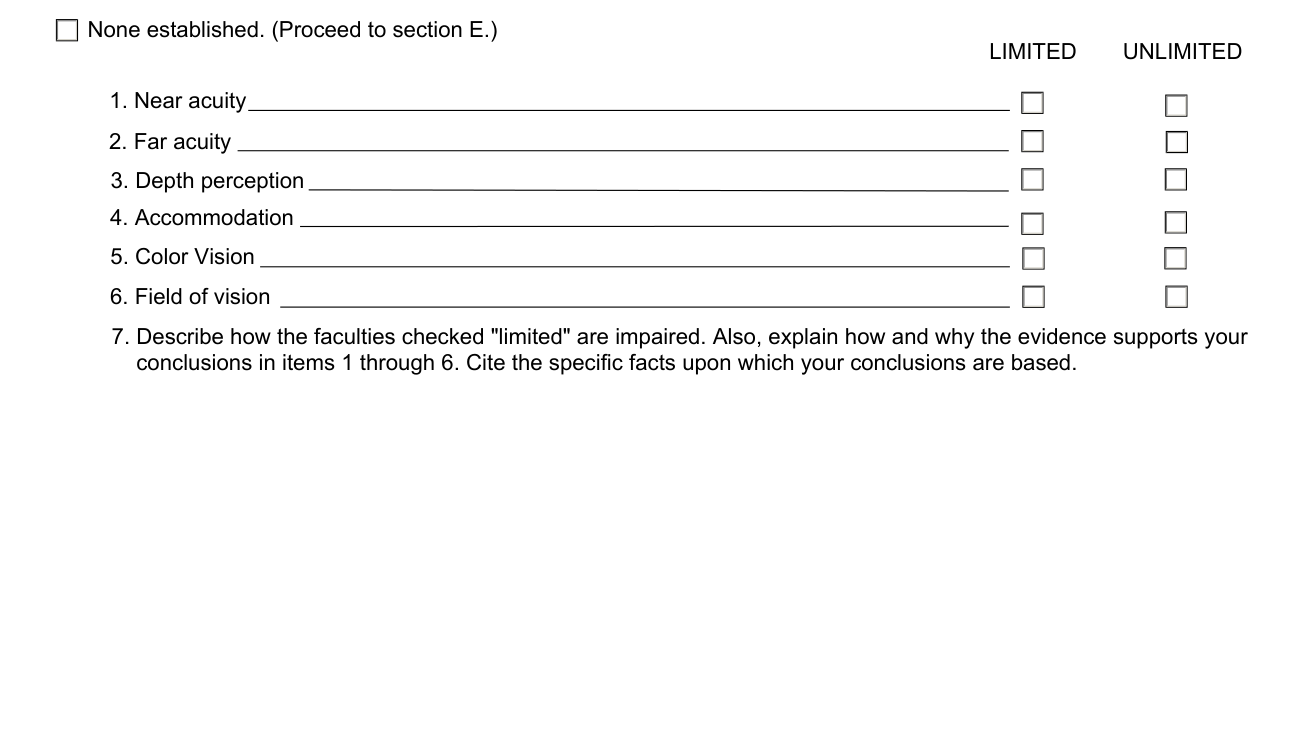
D. Visual Limitations: None established. (Proceed to section E.)
For each of 1. Near acuity, 2. Far acuity, 3. Depth perception, 4. Accommodation, 5. Color Vision and 6. Field of vision, check Limited or Unlimited.
7. Describe how the faculties checked "limited" are impaired.
E. Communicative limitations
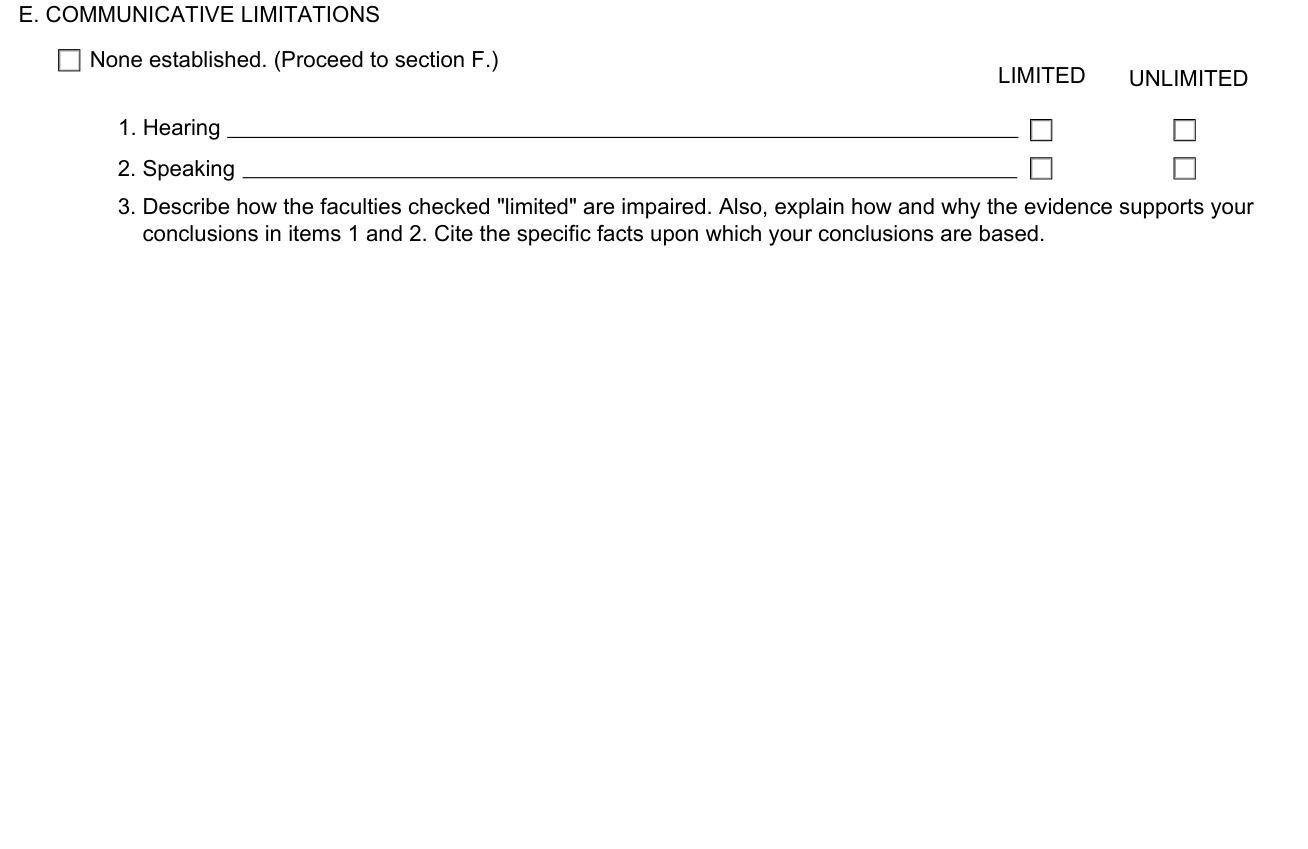
E. Communicative Limitations: None established. (Proceed to section F.)
For each of 1. Hearing and 2. Speaking, check Limited or Unlimited.
3. Describe how the faculties checked "limited" are impaired, and also explain how and why the evidence supports your conclusions in items 1 and 2.
F. Environmental limitations
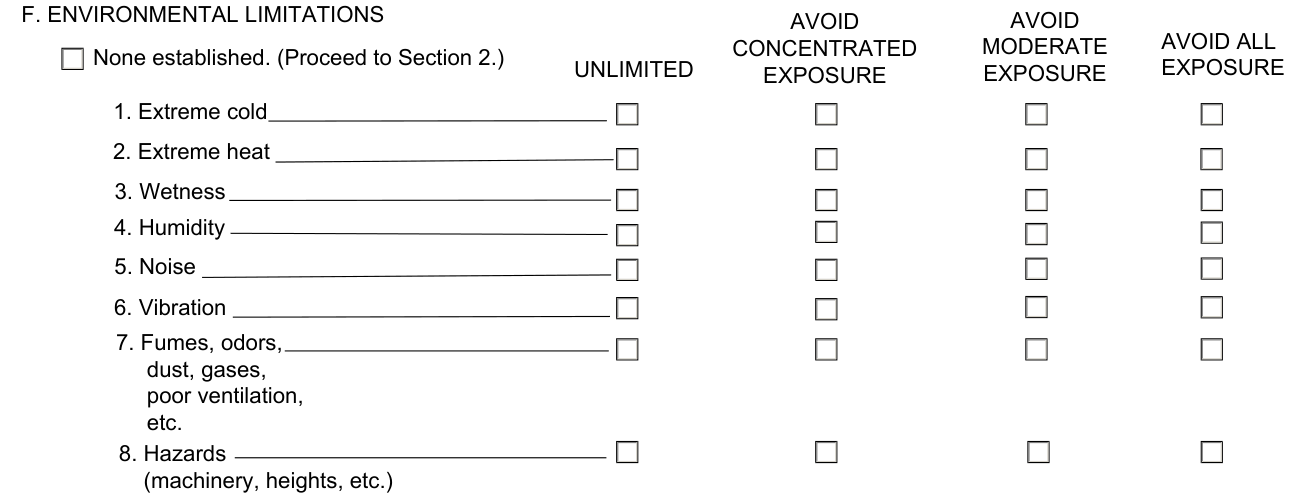
F. Environmental Limitations: None established. (Proceed to Section 2.)
For each of 1. Extreme cold, 2. Extreme heat, 3. Wetness, 4. Humidity, 5. Noise, 6. Vibration, 7. Fumes, odors, dust, gases, poor ventilation, etc. and 8. Hazards (machinery, heights, etc.), check Unlimited, Avoid Concentrated Exposure, Avoid Moderate Exposure or Avoid All Exposure.
9. Describe how these environmental factors impair activities and identify hazards to be avoided. Also, explain how and why the evidence supports your conclusions in items 1 through 8.
2. Symptoms
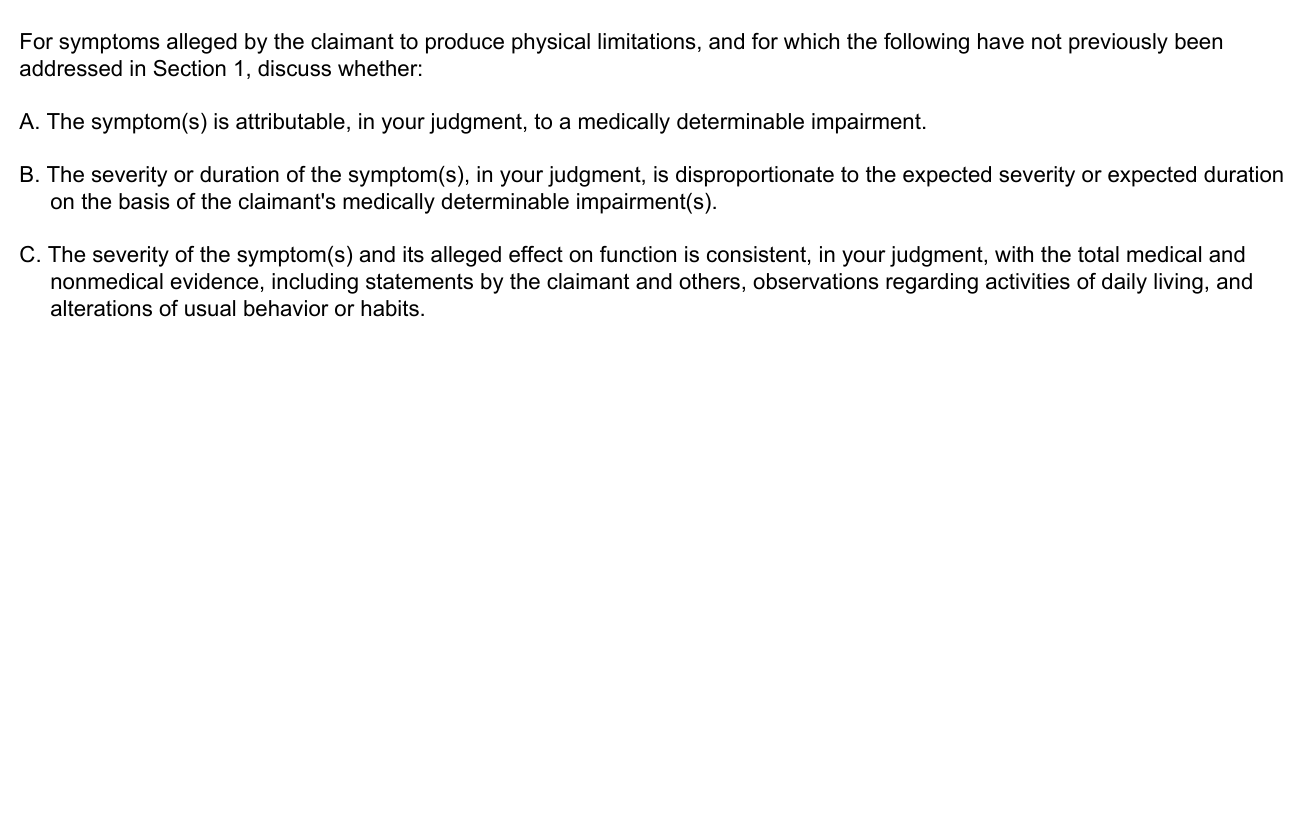
2. SYMPTOMS: For symptoms alleged by the claimant to produce physical limitations, and for which the following have not previously been addressed in Section 1, discuss whether: A. The symptom(s) is attributable, in your judgment, to a medically determinable impairment.
B. The severity or duration of the symptom(s), in your judgment, is disproportionate to the expected severity or expected duration on the basis of the claimant's medically determinable impairment(s). C. The severity of the symptom(s) and its alleged effect on function is consistent, in your judgment, with the total medical and nonmedical evidence, including statements by the claimant and others, observations regarding activities of daily living, and alterations of usual behavior or habits.
3. Medical opinion(s)
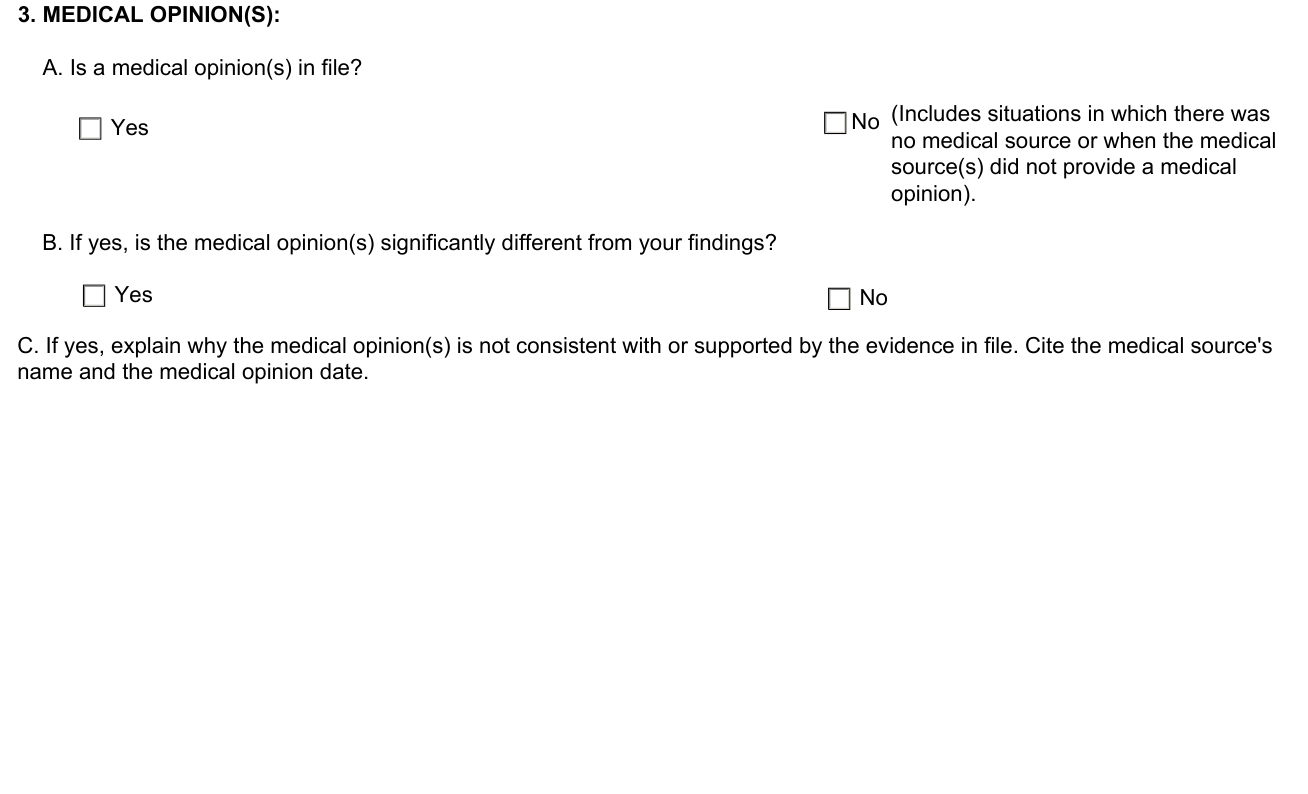
3. MEDICAL OPINION(S): A. Is a medical opinion(s) in file? Yes or No (Includes situations in which there was no medical source or when the medical source(s) did not provide a medical opinion).
B. If yes, is the medical opinion(s) significantly different from your findings? Yes or No.
C. If yes, explain why the medical opinion(s) is not consistent with or supported by the evidence in file. Cite the medical source's name and the medical opinion date.
5. Signature
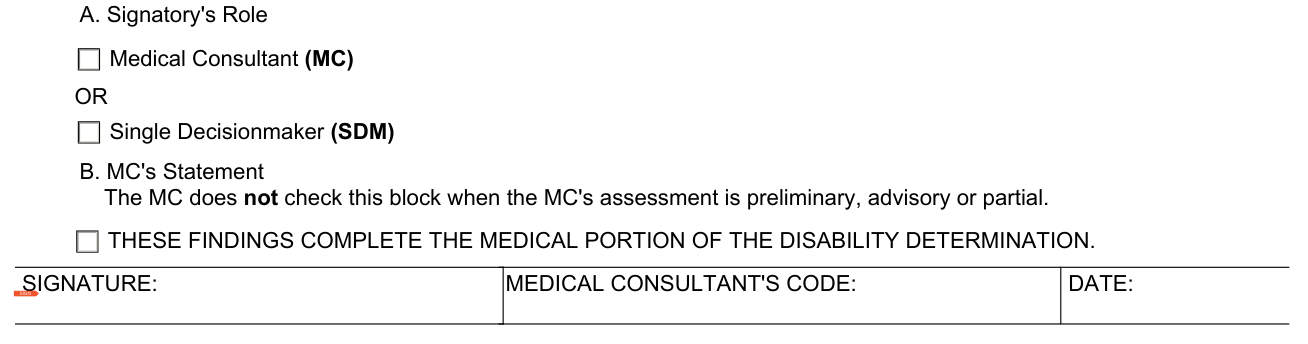
Under B, the MC's Statement: the MC does not check this block when the MC's assessment is preliminary, advisory or partial. These findings complete the medical portion of the disability determination.
Sign on the Signature line, then enter the Medical Consultant's Code and the Date.
More rules for Form SSA-4734-BK
For Each Section A - F base your conclusions on all evidence in file (clinical and laboratory findings, symptoms, observations, lay evidence, reports of daily activities, etc.). Check the blocks which reflect your reasoned judgment. Describe how the evidence substantiates your conclusions. Ensure that you have requested appropriate medical opinions (DI 22505.000ff. and DI 22510.000ff.) and that you have given appropriate consideration to medical opinions (See Section 3.). Ensure that you have considered and responded to any alleged limitations imposed by symptoms (pain, fatigue, etc.) attributable, in your judgment, to a medically determinable impairment, and responded to all allegations of physical limitations or factors which can cause physical limitations. Frequently means occurring one-third to two-thirds of an 8-hour workday (cumulative, not continuous). Occasionally means occurring from very little up to one-third of an 8-hour workday (cumulative, not continuous).
Sources
[1] Form SSA-4734-BK (08-2017), Physical Residual Functional Capacity Assessment (the served file; no issuer file found) (the Official source link on this page).