
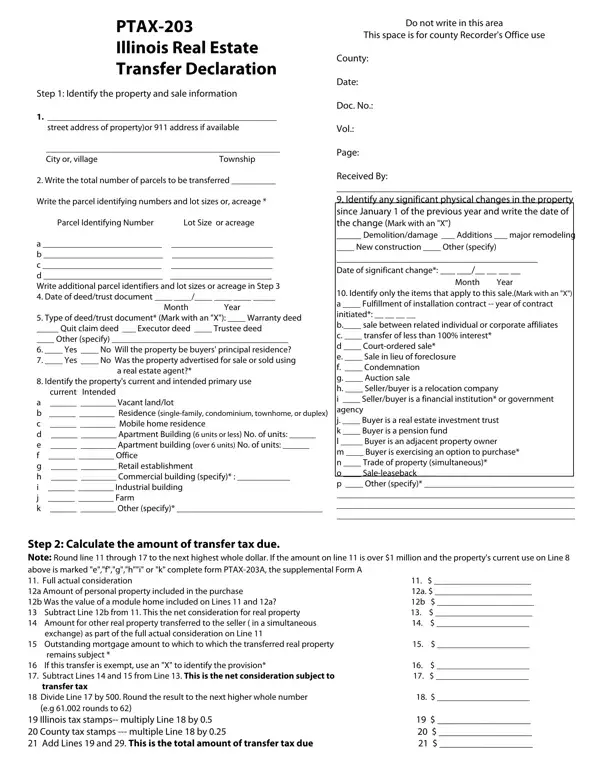
Form PTAX-203 at a glance
What it is: Form PTAX-203, the Illinois Real Estate Transfer Declaration, is used by county offices and the Illinois Department of Revenue to collect sales data.
Who signs: The seller and buyer (or their agents) and preparer must sign this form.
County offices and the Illinois Department of Revenue use this form to collect sales data and to determine if a sale can be used in assessment ratio studies.
File Form PTAX-203 for all real estate transfers except those qualifying for exempt status under (a), (c), (d), (e), (f), (g), (h), (i), (j), or (l).
A filled-in Form PTAX-203 example: a buyer fills out the declaration for a house
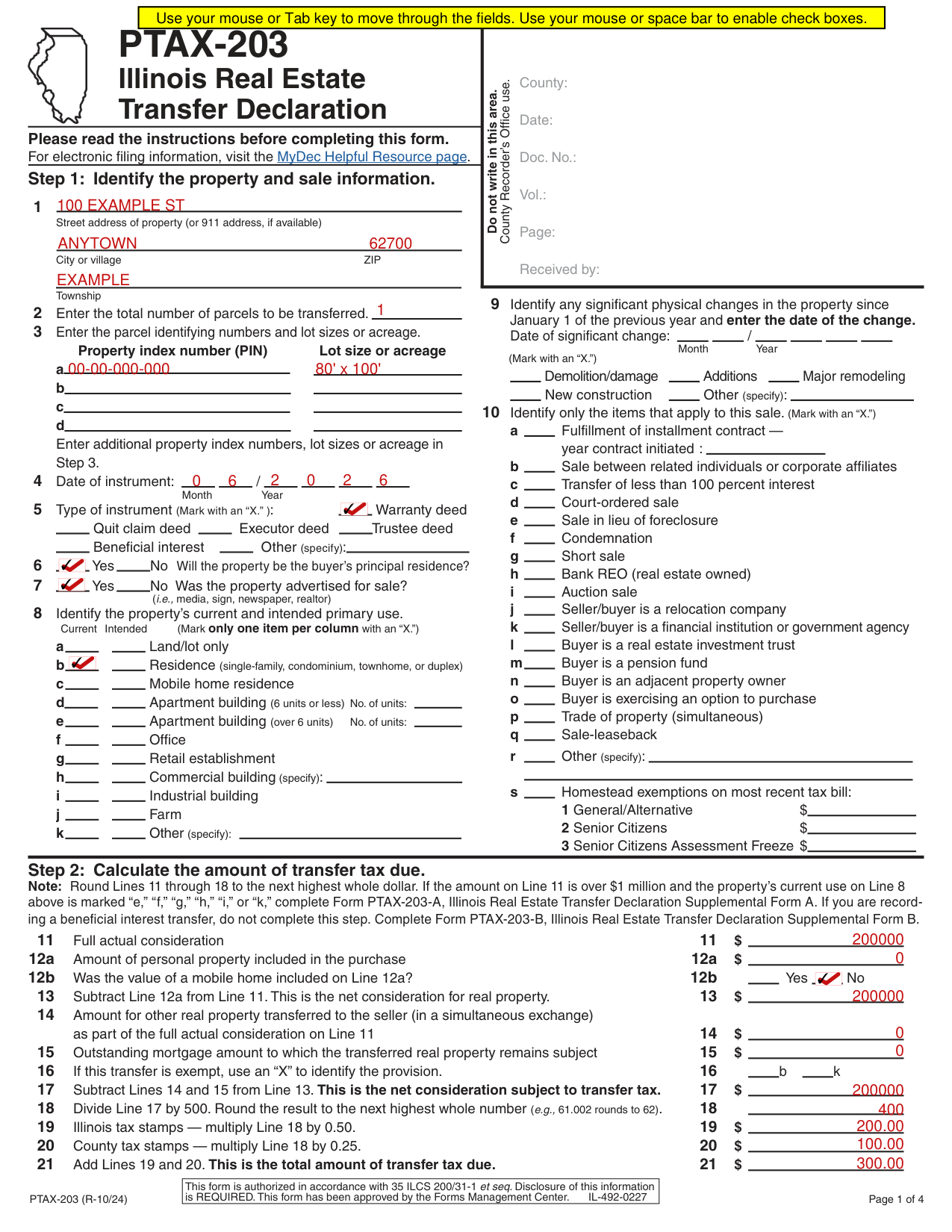
How to fill out Form PTAX-203, box by box
Lines 1 to 3: the property
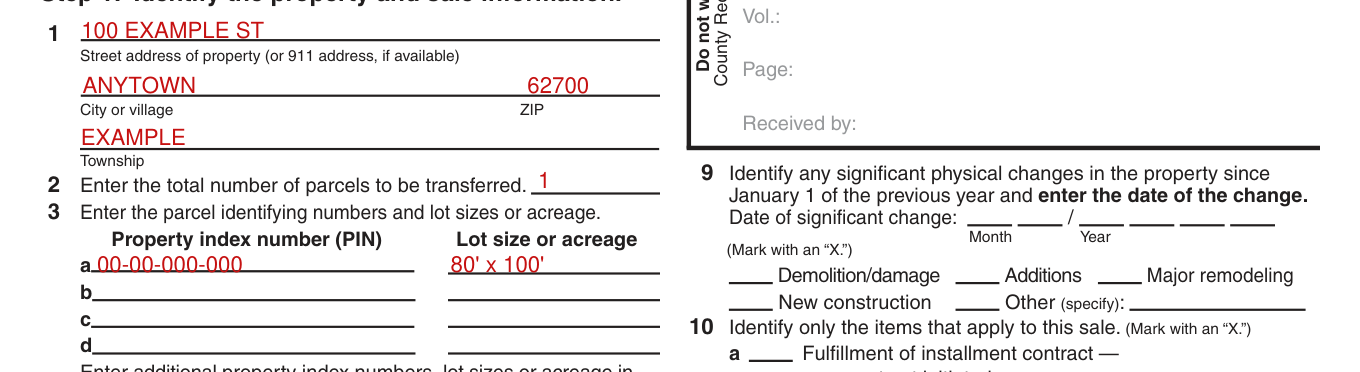
Line 1 - Enter the property's street address (or 911 address, if available), city or village, zip code, and township in which the property is located.
Line 3 - Enter all the parcel identifying numbers and the properties' lot sizes (e.g., 80' x 100') or acreage.
Lines 4 to 7: instrument and sale

Line 4 - Enter the month and year from the instrument.
Line 5 - Use an “X” to identify the type of instrument (i.e., deed, trust document, or facsimile) to be recorded with this form.
Line 6 - Select “Yes” if the property will be used as the buyer's principal dwelling place and legal residence.
Line 7 - Select “Yes” if the property was sold using a real estate agent or advertised for sale by newspaper, trade publication, radio/ electronic media, or sign.
Line 8: current and intended use
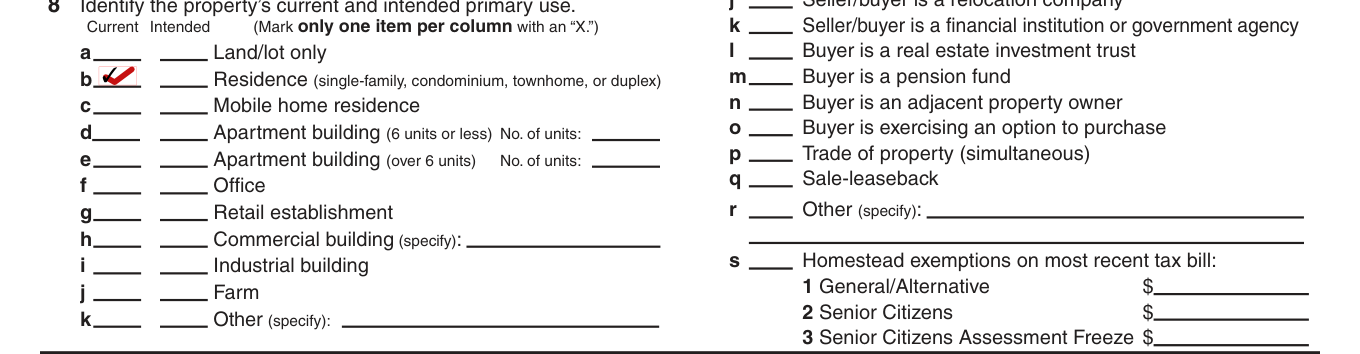
Line 8 - Use an “X” to select one item under each of the column headings “Current” and “Intended.”
If the property has more than one use, identify the primary use only.
Line 9: physical changes

Line 9 - Use an “X” to identify any significant physical changes in the property since January 1 of the previous year.
Enter the date the change was completed or the property was damaged.
Line 10: items that apply to the sale
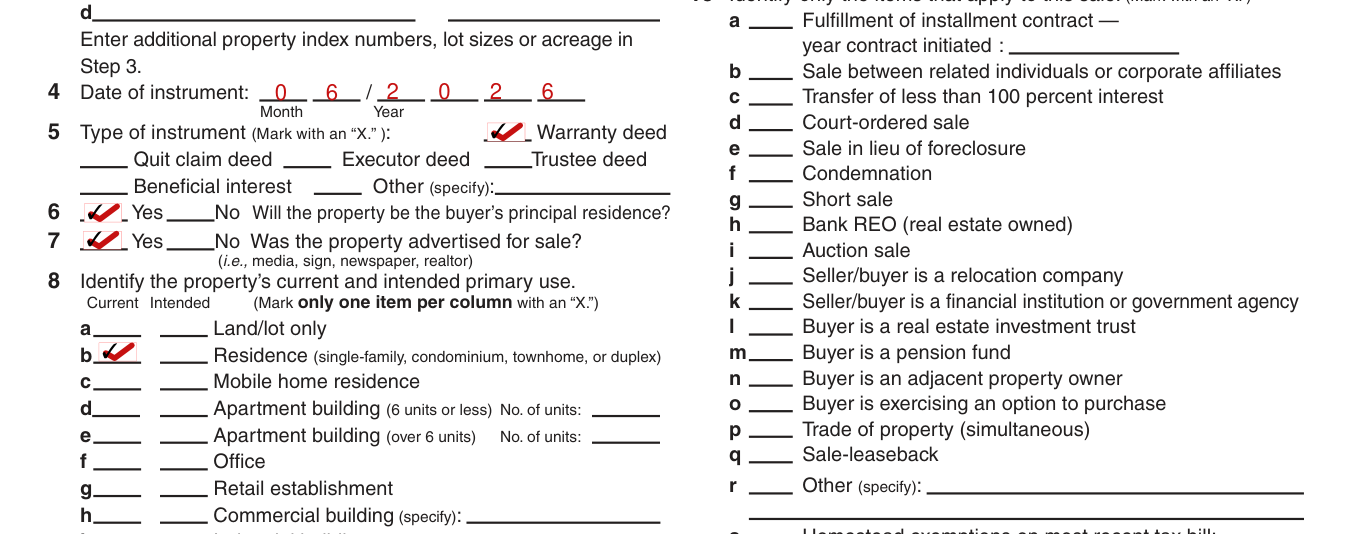
Line 10 - Select only the items that apply to this sale.
Line 11: full actual consideration

Round Lines 11 through 18 to the next highest whole dollar.
Line 11 - Enter the full actual consideration (sale price).
Full actual consideration is the amount actually paid, excluding any amount credited against the purchase price or refunded to the buyer for improvements or repairs to the property.
Also include the amount of outstanding mortgages to which the property remains subject at the time of the transfer.
Lines 12a and 12b: personal property

Line 12a - Enter the amount of personal property items included in the sale price on Line 11.
On 81/2” x 11” paper, submit an itemized list of personal property (include values) transferred from the seller to the buyer if this sale meets either of the following conditions:
residential property - if the amount of personal property (not including the value of a mobile home) on Line 12a is greater than 5 percent of the sale price on Line 11, or
non-residential property - if the amount of personal property on Line 12a is greater than 25 percent of the sale price on Line 11.
Lines 13 to 15: other real estate and the mortgage

On Line 13, subtract Line 12a from Line 11. This is the net consideration for real property.
Line 14 - Enter the amount of other real estate transferred from the buyer to the seller that was included in the sale price on Line 11.
Line 15 - Enter an amount only if the deed or trust document states that the transferred property remains subject to a mortgage at the time of the transfer.
Line 16: exempt transfers

Line 16 - Use an “X” to identify the letter of the provision for the exemption from the transfer tax (i.e., (b) or (k)) that applies to this transfer.
The following transactions are exempt from the transfer tax under 35 ILCS 200/31-45.
(a) Deeds representing real estate transfers made before January 1, 1968, but recorded after that date and trust documents executed before January 1, 1986, but recorded after that date.
(b) Deeds to or trust documents relating to (1) property acquired by any governmental body or from any governmental body, (2) property or interests transferred between governmental bodies, or (3) property acquired by or from any corporation, society, association, foundation or institution organized and operated exclusively for charitable, religious or educational purposes. However, deeds or trust documents, other than those in which the Administrator of Veterans' Affairs of the United States is the grantee pursuant to a foreclosure proceeding, shall not be exempt from filing the declaration.
(c) Deeds or trust documents that secure debt or other obligation.
(d) Deeds or trust documents that, without additional consideration, confirm, correct, modify, or supplement a deed or trust document previously recorded.
(e) Deeds or trust documents where the actual consideration is less than $100. (checked November 12, 2026)
(f) Tax deeds.
(g) Deeds or trust documents that release property that is security for a debt or other obligation.
(h) Deeds of partition.
(i) Deeds or trust documents made pursuant to mergers, consolidations or transfers or sales of substantially all of the assets of corporations under plans of reorganization under the Federal Internal Revenue Code (26 USC 368) or Title 11 of the Federal Bankruptcy Act.
(j) Deeds or trust documents made by a subsidiary corporation to its parent corporation for no consideration other than the cancellation or surrender of the subsidiary's stock.
(k) Deeds when there is an actual exchange of real estate and trust documents when there is an actual exchange of beneficial interests, except that that money difference or money's worth paid from one to the other is not exempt from the tax. These deeds or trust documents, however, shall not be exempt from filing the declaration.
(l) Deeds issued to a holder of a mortgage, as defined in Section 15-103 (now Section 15-1207) of the Code of Civil Procedure, pursuant to a mortgage foreclosure proceeding or pursuant to a transfer in lieu of foreclosure.
Lines 17 to 21: tax due

On Line 17, subtract Lines 14 and 15 from Line 13. This is the net consideration subject to transfer tax. On Line 18, divide Line 17 by 500. Round the result to the next highest whole number (e.g., 61.002 rounds to 62). On Line 19, Illinois tax stamps - multiply Line 18 by 0.50. On Line 20, County tax stamps - multiply Line 18 by 0.25. On Line 21, add Lines 19 and 20. This is the total amount of transfer tax due.
The legal description from the deed
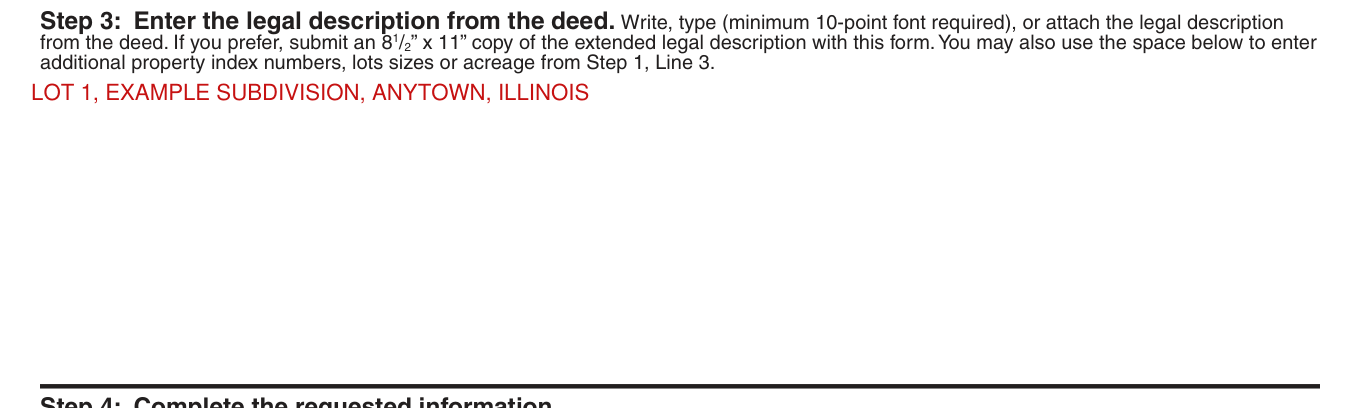
Write, type (minimum 10-point font required), or attach the legal description from the deed.
If the legal description will not fit in the space provided, submit an 81/2” x 11” copy of the extended legal description from the deed with this form.
Seller, buyer and preparer information
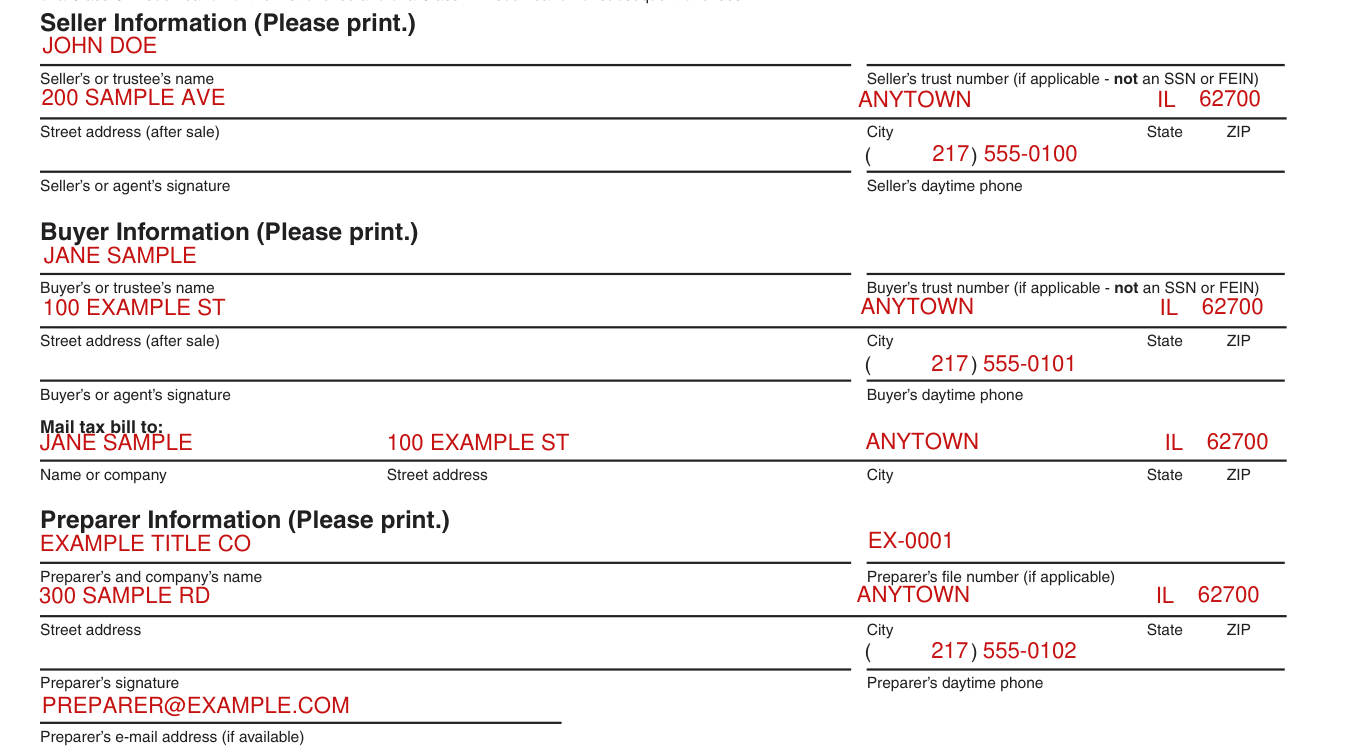
Enter the requested information for the seller, buyer, and preparer.
Enter the addresses and daytime phone numbers where the seller and buyer can be contacted after the sale.
The buyer and seller (or their agents) hereby verify that to the best of their knowledge and belief, the full actual consideration and facts stated in this declaration are true and correct.
Required documents

Use an “X” to identify any required documents submitted with this form.
(Mark with an “X.”) Extended legal description Form PTAX-203-A Itemized list of personal property Form PTAX-203-B
Common questions about Form PTAX-203
Where do I file it?
You must file either (1) Form PTAX-203 and any required documents with the deed or trust document or (2) an exemption notation on the original deed or trust document at the County Recorder's office within the county where the property is located.
Is there a penalty?
Anyone who willfully falsifies or omits any required information on Form PTAX-203 is guilty of a Class B misdemeanor for the first offense and a Class A misdemeanor for subsequent offenses. Anyone who knowingly submits a false statement concerning the identity of a grantee of property in Cook County is guilty of a Class C misdemeanor for the first offense and a Class A misdemeanor for subsequent offenses.
Sources
[1] Form PTAX-203 (R-10/24), Illinois Real Estate Transfer Declaration, Illinois Department of Revenue (the Official source link on this page).