

Form TP-584 at a glance
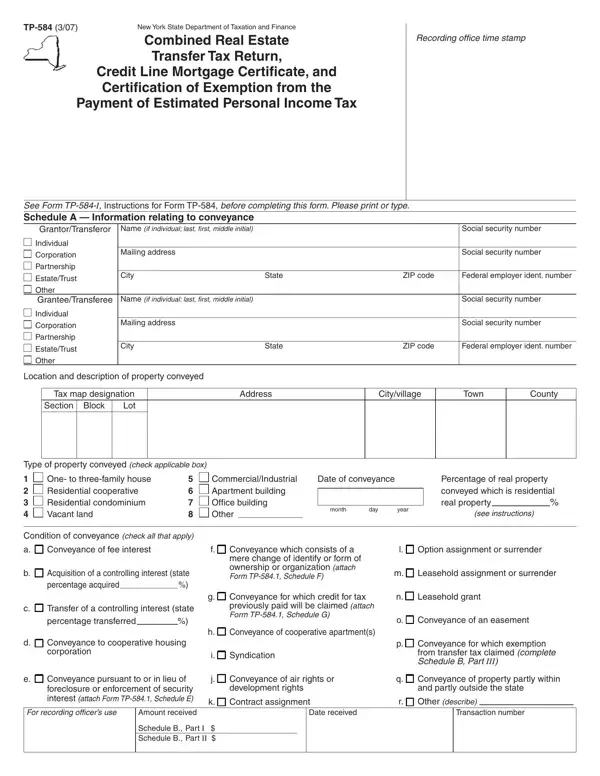
What it is: Form TP-584 is the Combined Real Estate Transfer Tax Return, Credit Line Mortgage Certificate, and Certification of Exemption from the Payment of Estimated Personal Income Tax of the Department of Taxation and Finance.
Who signs: Both the grantors and the grantees must sign Form TP-584 on page 3.[2]
What to bring and attach to Form TP-584
Make check(s) payable to the county clerk where the recording is to take place.
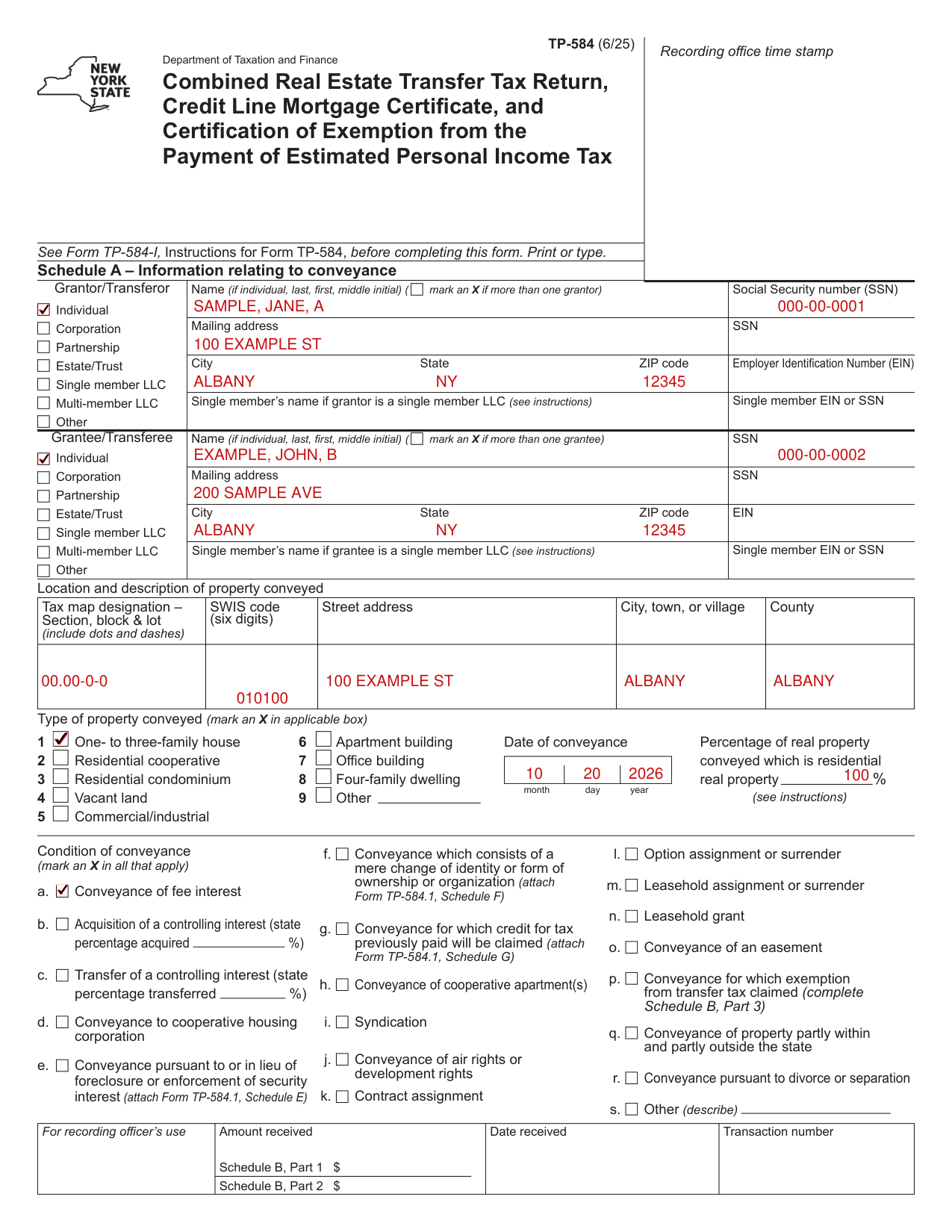
A filled-in Form TP-584 example: a home sale with no exemption
How to fill out Form TP-584, box by box
Grantor and grantee: name, address, SSN or EIN
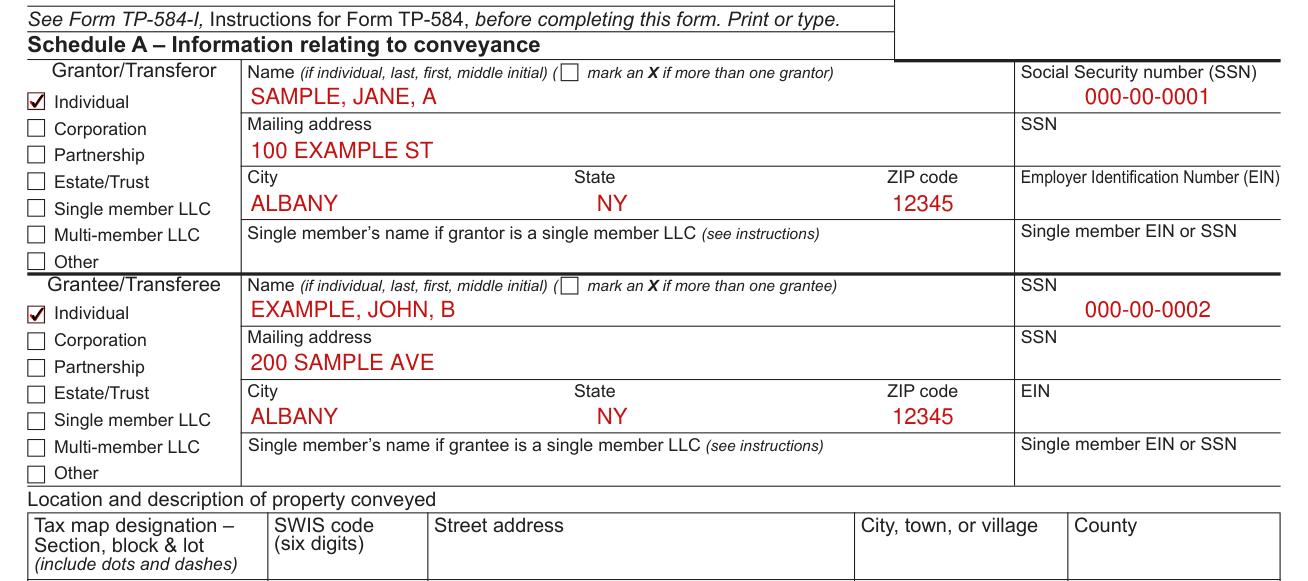
Print or type the name, address, and Social Security number (SSN) or employer identification number (EIN) of the grantor and grantee as they appear in your deed, lease, or other instrument that conveys the interest in real property.
If the grantor or grantee is a single member limited liability company (LLC), enter the name and identification number (SSN or EIN or both) for both the LLC and the single member (also see Single and multi-member LLC).[2]
Location and description of property conveyed

Provide the location and description of the interest in real property being conveyed by entering the tax map designation, the Statewide Information System Code (SWIS Code), and address as they appear in your deed, lease, or other instrument that conveys the interest in real property.
You may also obtain the SWIS Code from your tax bill or by contacting the assessor’s office where the property is located.
Also include the name of the city or village, town, and county where the property conveyed is located.[2]
Type of property conveyed, date of conveyance and percentage of residential real property

Type of property conveyed Indicate the type of property being conveyed by marking an X in the appropriate box.
Date of conveyance Enter the date the instrument effecting the conveyance was delivered from the grantor to the grantee.
Percentage of real property conveyed which is residential real property Enter the percentage of the entire real property conveyed that is residential real property (see Imposition of additional tax, for a definition of residential real property).[2]
Condition of conveyance
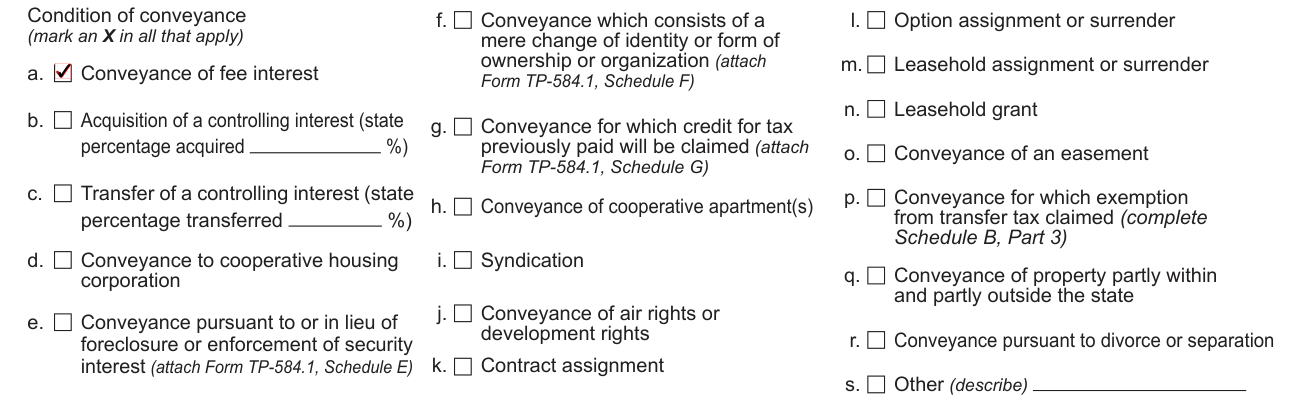
Under Condition of conveyance, mark an X in all that apply.
If items e, f, or g are checked, Form TP-584.1, Real Estate Transfer Tax Return Supplemental Schedules, must be attached to Form TP-584 with the appropriate schedule completed.[2]
Schedule B, Part 1 - Computation of tax due

Enter amount of consideration for the conveyance (if you are claiming a total exemption from tax, mark an X in the Exemption claimed box, enter consideration and proceed to Part 3).
Enter the continuing lien deduction (see instructions if property is taken subject to mortgage or lien).
Taxable consideration (subtract line 2 from line 1).
Tax: $2 for each $500, or fractional part thereof, of consideration on line 3 (checked November 2, 2026).
Amount of credit claimed for tax previously paid (see instructions and attach Form TP-584.1, Schedule G).
Total tax due (subtract line 5 from line 4).
Schedule B, Part 2 - Computation of additional tax due

Part 2 is the computation of additional tax due on the conveyance of residential real property for $1 million or more (checked November 2, 2026).
If you are claiming an exemption from additional tax, enter 0 on line 1, mark an X in the Exemption claimed box and the item l box in Part 3.
Taxable consideration (multiply line 1 by the percentage of the premises which is residential real property, as shown in Schedule A).
Total additional transfer tax due (multiply line 2 by 1% (.01)).[2]
Part 3 - Explanation of exemption claimed
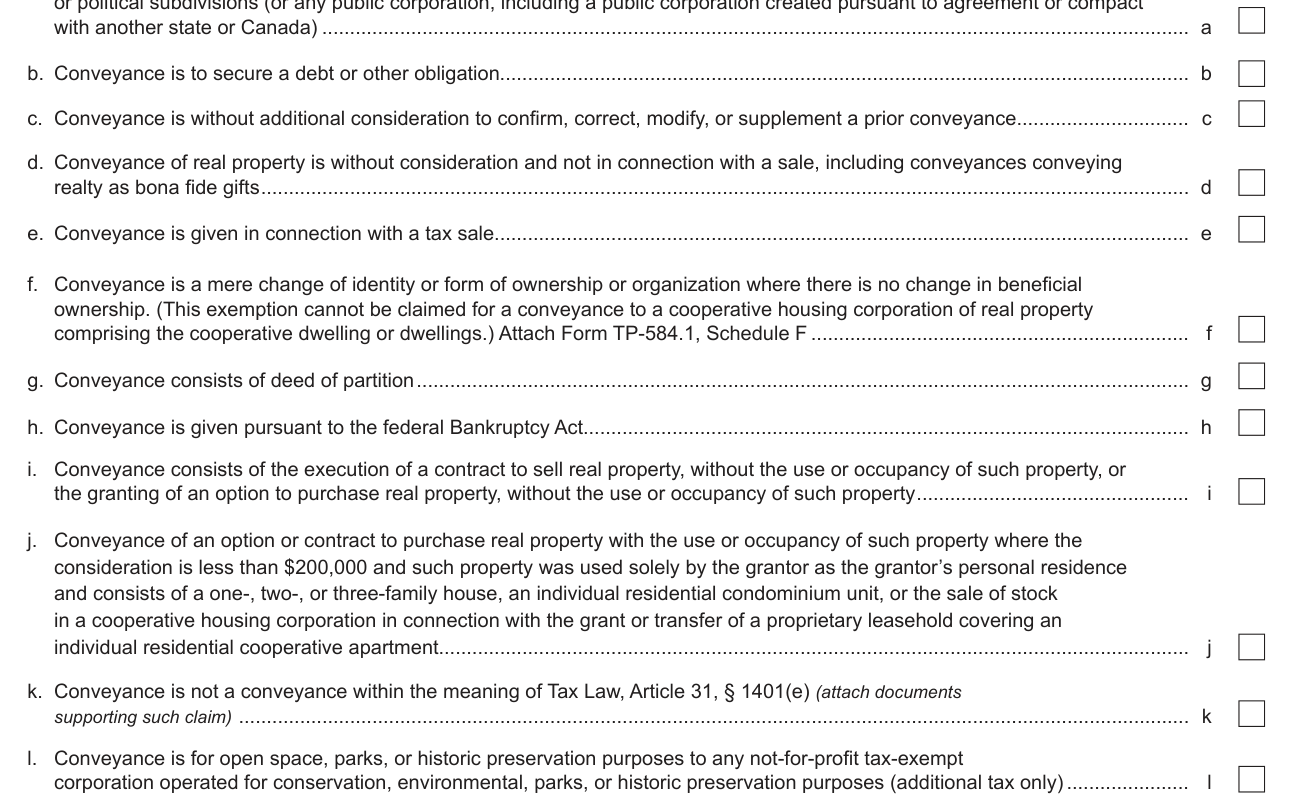
Part 3 - Explanation of exemption claimed: mark an X in all boxes that apply.
Schedule C - Credit Line Mortgage Certificate
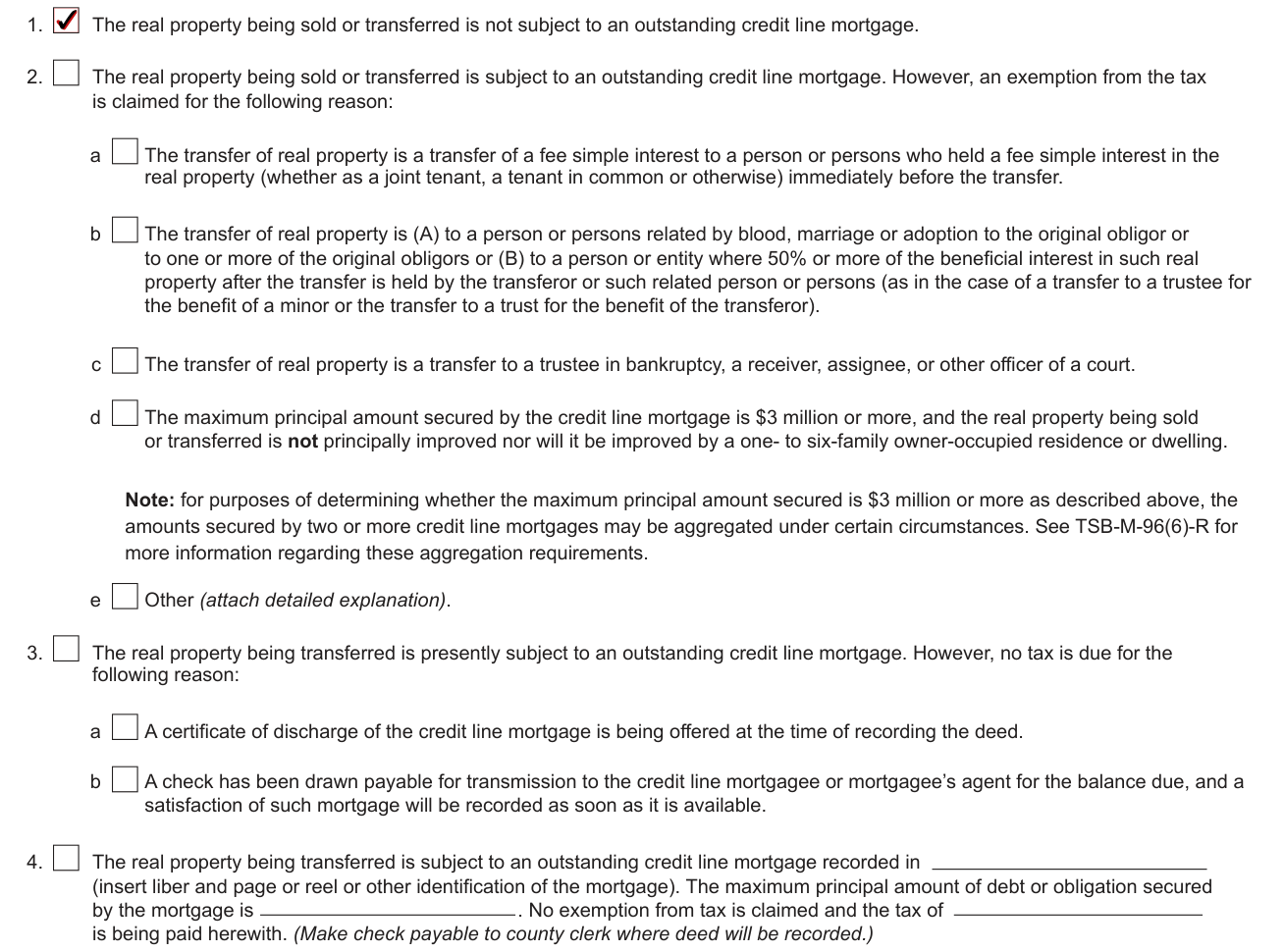
Complete the following only if the interest being transferred is a fee simple interest. Mark an X in the appropriate box.
1. The real property being sold or transferred is not subject to an outstanding credit line mortgage.
2. The real property being sold or transferred is subject to an outstanding credit line mortgage. However, an exemption from the tax is claimed.
3. The real property being transferred is presently subject to an outstanding credit line mortgage. However, no tax is due.
4. The real property being transferred is subject to an outstanding credit line mortgage. No exemption from tax is claimed and the tax is being paid herewith. (Make check payable to county clerk where deed will be recorded.)
Signature and certification

The undersigned certify that the information contained in Schedules A, B, and C, including any return, certification, schedule, or attachment, is to the best of their knowledge, true and complete, and authorize the person(s) submitting such form on their behalf to receive a copy for purposes of recording the deed or other instrument effecting the conveyance.
Schedule D, Part 1 - New York State residents

Complete the following only if a fee simple interest or a cooperative unit is being transferred by an individual or estate or trust.
If you are a New York State resident transferor/seller listed in Form TP‑584, Schedule A (or an attachment to Form TP‑584), you must sign the certification.
Schedule D, Part 2 - Nonresidents of New York State
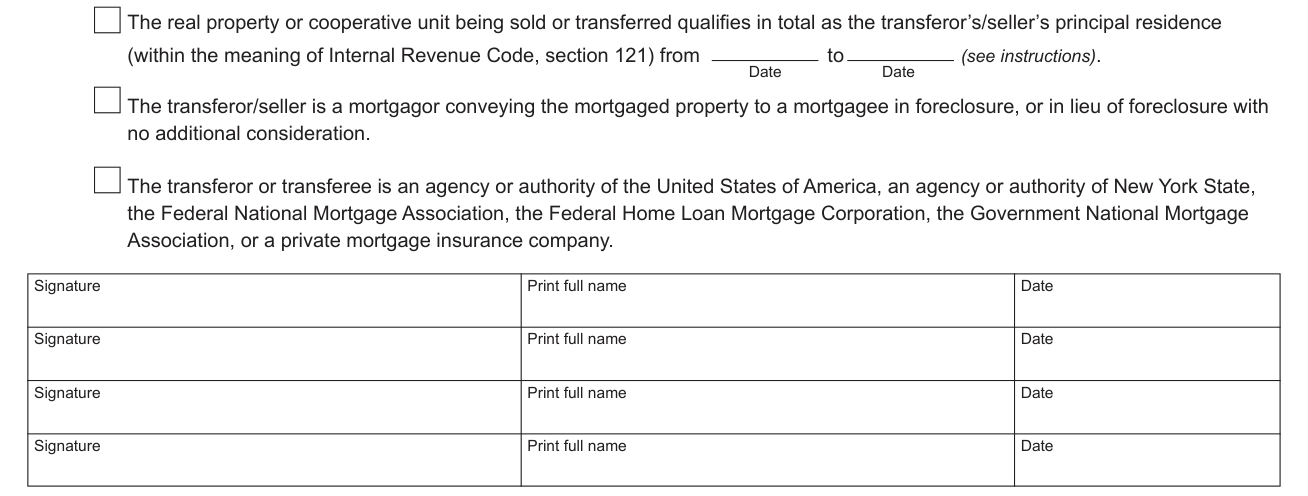
If you are a nonresident of New York State listed as a transferor/seller in Form TP-584, Schedule A (or an attachment to Form TP-584) but are not required to pay estimated personal income tax because one of the exemptions applies under Tax Law § 663(c), mark an X in the box of the appropriate exemption.
The real property or cooperative unit being sold or transferred qualifies in total as the transferor's/seller's principal residence (within the meaning of Internal Revenue Code, section 121) from Date to Date (see instructions).
The transferor/seller is a mortgagor conveying the mortgaged property to a mortgagee in foreclosure, or in lieu of foreclosure with no additional consideration.
The transferor or transferee is an agency or authority of the United States of America, an agency or authority of New York State, the Federal National Mortgage Association, the Federal Home Loan Mortgage Corporation, the Government National Mortgage Association, or a private mortgage insurance company.
If none of these exemption statements apply, you must complete Form IT‑2663, Nonresident Real Property Estimated Income Tax Payment Form, or Form IT-2664, Nonresident Cooperative Unit Estimated Income Tax Payment Form.
Common questions about Form TP-584
What is NYS form TP 584?
Form TP-584 is the Combined Real Estate Transfer Tax Return, Credit Line Mortgage Certificate, and Certification of Exemption from the Payment of Estimated Personal Income Tax of the Department of Taxation and Finance. Form TP-584 must be filed for each conveyance of real property from a grantor/transferor to a grantee/transferee.[2]
Who signs it?
Both the grantors and the grantees must sign Form TP-584 on page 3.[2]
Is there a deadline?
* The total tax (from Part 1, line 6 and Part 2, line 3 above) is due within 15 days from the date of conveyance.
Where do I file it?
File Form TP-584 with the recording officer of the county where the real property being conveyed is located, no later than the fifteenth day after the delivery of the instrument effecting the conveyance. However, if the instrument effecting the conveyance will not be recorded, or will be recorded later than the time required to file Form TP-584 and to pay any real estate transfer tax, file Form TP-584 and pay any real estate transfer tax due no later than the fifteenth day after the delivery of the instrument effecting the conveyance, directly with: NYS Tax Department, RETT Return Processing, PO Box 5045, Albany NY 12205-0045[2]
When is this form not the right one?
For conveyances of real property within New York City, use Form TP-584-NYC.
Sources
[1] Form TP-584 (6/25), New York State Department of Taxation and Finance (the Official source link on this page).
[2] tax.ny.gov, Form TP-584-I, Instructions for Form TP-584. Accessed November 2, 2026.