
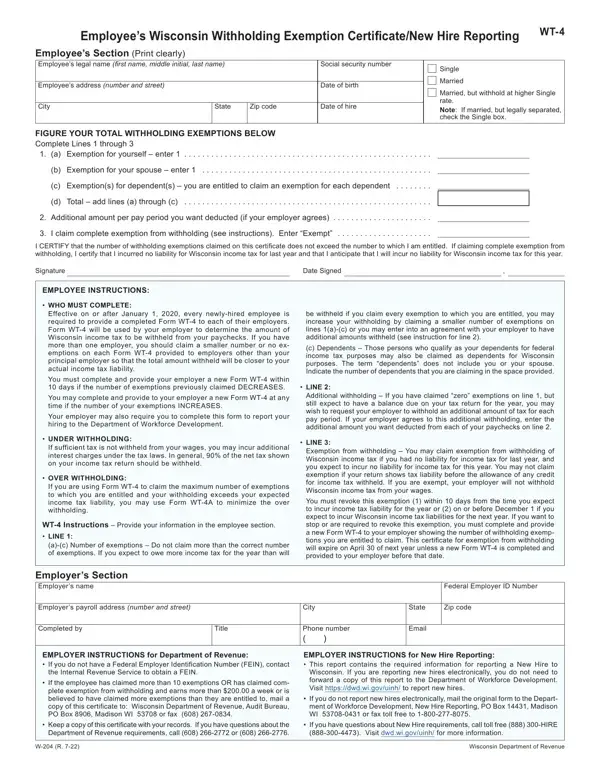

Form WT-4 at a glance
What it is: Form WT-4, the Employee's Wisconsin Withholding Exemption Certificate/New Hire Reporting, is a form of the Wisconsin Department of Revenue.
Who signs: Add your Signature and the Date Signed.
WHO MUST COMPLETE: Effective on or after January 1, 2020, every newly-hired employee is required to provide a completed Form WT-4 to each of their employers. Form WT-4 will be used by your employer to determine the amount of Wisconsin income tax to be withheld from your paychecks. If you have more than one employer, you should claim a smaller number or no exemptions on each Form WT-4 provided to employers other than your principal employer so that the total amount withheld will be closer to your actual income tax liability.
A filled-in Form WT-4 example: a married new hire claims a dependent
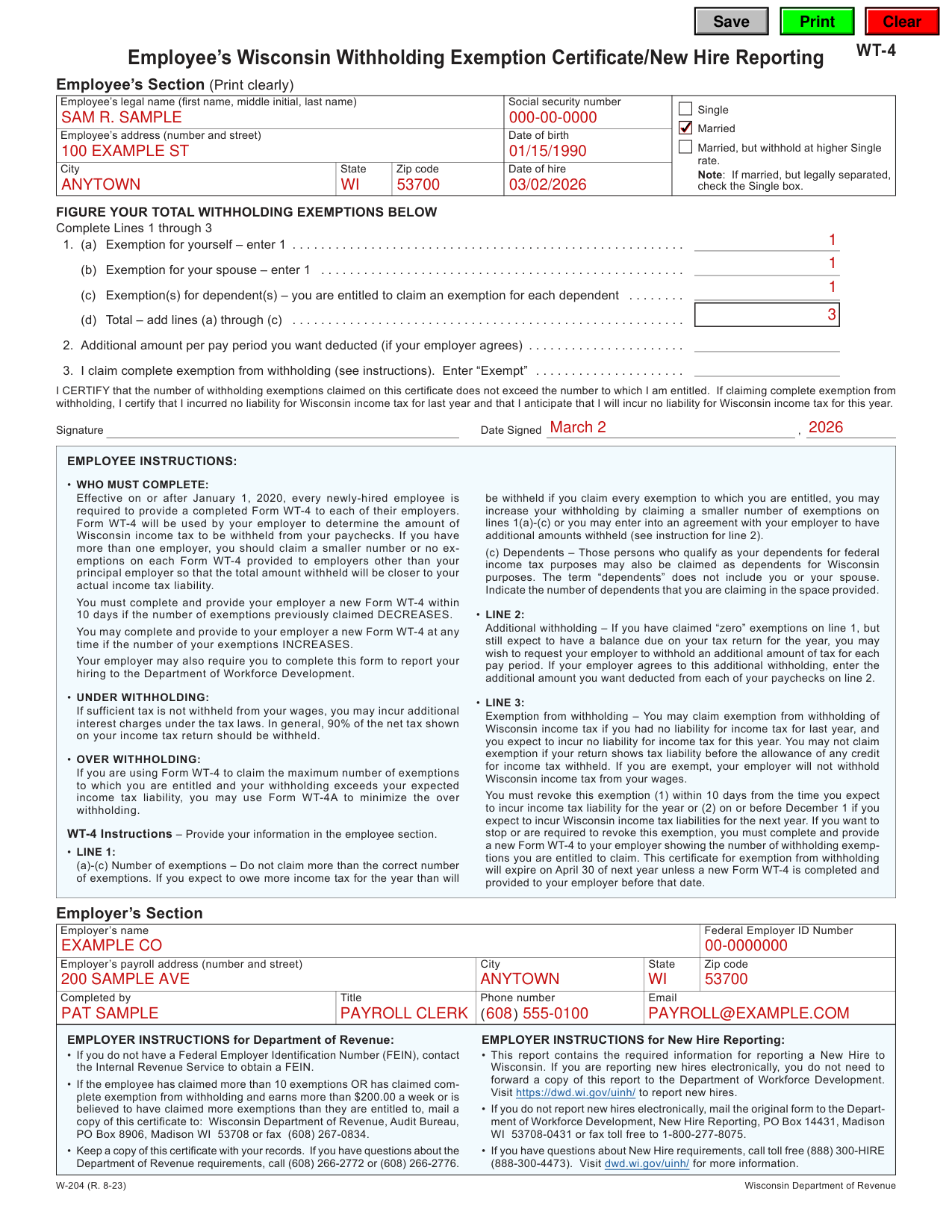
How to fill out Form WT-4, box by box
Employee's Section: name, address and dates

WT-4 Instructions: Provide your information in the Employee's Section (Print clearly).
Enter the Employee's legal name (first name, middle initial, last name) and the Social security number.
Enter the Employee's address (number and street), City, State, Zip code, Date of birth and Date of hire.
Single, Married, or Married, but withhold at higher Single rate

Check Single, Married, or Married, but withhold at higher Single rate. If married, but legally separated, check the Single box.
Lines 1 and 2: exemptions and additional amount

Figure your total withholding exemptions: Complete Lines 1 through 3.
On Line 1(a), exemption for yourself, enter 1.
On Line 1(b), exemption for your spouse, enter 1.
In (c), you are entitled to claim an exemption for each dependent. Those persons who qualify as your dependents for federal income tax purposes may also be claimed as dependents for Wisconsin purposes. The term "dependents" does not include you or your spouse. Indicate the number of dependents that you are claiming in the space provided.
Add lines (a) through (c) for the Total in (d).
Do not claim more than the correct number of exemptions. If you expect to owe more income tax for the year than will be withheld if you claim every exemption to which you are entitled, you may increase your withholding by claiming a smaller number of exemptions on lines 1(a)-(c) or you may enter into an agreement with your employer to have additional amounts withheld (see instruction for line 2).
On Line 2, enter the additional amount per pay period you want deducted (if your employer agrees). If you have claimed "zero" exemptions on line 1, but still expect to have a balance due on your tax return for the year, you may wish to request your employer to withhold an additional amount of tax for each pay period. If your employer agrees to this additional withholding, enter the additional amount you want deducted from each of your paychecks on line 2.
Line 3: complete exemption from withholding

To claim complete exemption from withholding, enter "Exempt" on Line 3. You may claim exemption from withholding of Wisconsin income tax if you had no liability for income tax for last year, and you expect to incur no liability for income tax for this year. You may not claim exemption if your return shows tax liability before the allowance of any credit for income tax withheld. If you are exempt, your employer will not withhold Wisconsin income tax from your wages.
You must revoke this exemption (1) within 10 days from the time you expect to incur income tax liability for the year or (2) on or before December 1 if you expect to incur Wisconsin income tax liabilities for the next year. If you want to stop or are required to revoke this exemption, you must complete and provide a new Form WT-4 to your employer showing the number of withholding exemptions you are entitled to claim. This certificate for exemption from withholding will expire on April 30 of next year unless a new Form WT-4 is completed and provided to your employer before that date.
Certification, Signature and Date Signed

I CERTIFY that the number of withholding exemptions claimed on this certificate does not exceed the number to which I am entitled. If claiming complete exemption from withholding, I certify that I incurred no liability for Wisconsin income tax for last year and that I anticipate that I will incur no liability for Wisconsin income tax for this year.
Add your Signature and the Date Signed.
Employer's Section

In the Employer's Section, enter the Employer's name, Federal Employer ID Number, Employer's payroll address (number and street), City, State, Zip code, Completed by, Title, Phone number and Email.
EMPLOYER INSTRUCTIONS for Department of Revenue: If you do not have a Federal Employer Identification Number (FEIN), contact the Internal Revenue Service to obtain a FEIN.
More rules for Form WT-4
You may complete and provide to your employer a new Form WT-4 at any time if the number of your exemptions INCREASES.
Your employer may also require you to complete this form to report your hiring to the Department of Workforce Development.
If sufficient tax is not withheld from your wages, you may incur additional interest charges under the tax laws. In general, 90% of the net tax shown on your income tax return should be withheld.
If you have questions about the Department of Revenue requirements, call (608) 266-2772 or (608) 266-2776.
Common questions about Form WT-4
Is there a deadline?
You must complete and provide your employer a new Form WT-4 within 10 days if the number of exemptions previously claimed DECREASES.
When is this form not the right one?
If you are using Form WT-4 to claim the maximum number of exemptions to which you are entitled and your withholding exceeds your expected income tax liability, you may use Form WT-4A to minimize the over withholding.
Sources
[1] Form WT-4 (W-204, R. 8-23), Employee's Wisconsin Withholding Exemption Certificate/New Hire Reporting, Wisconsin Department of Revenue (the Official source link on this page).