
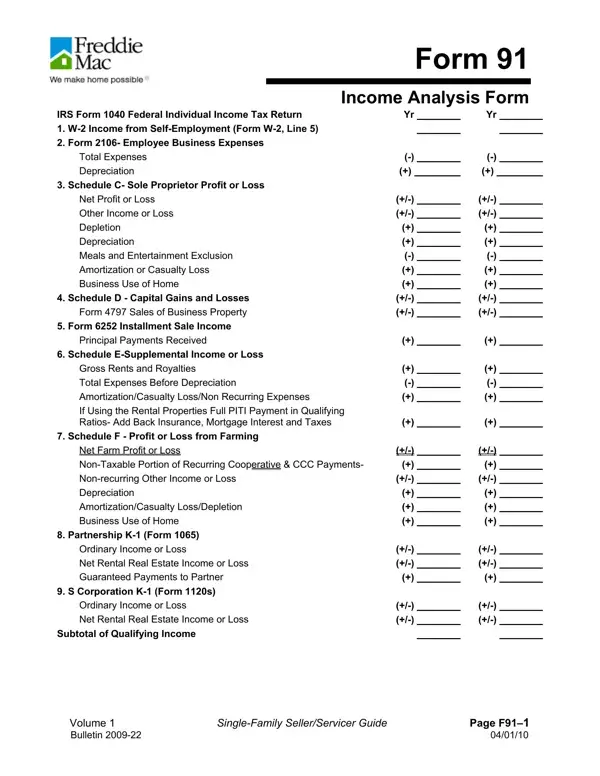
Navigating the complexities of income verification for loan applications, particularly for individuals with diverse or self-employed income sources, can be daunting. The Freddie Mac 91 form plays a critical role in this process, designed to assist in the accurate analysis of a borrower's income. This form, structured to evaluate various forms of income detailed in the Federal Individual Income Tax Return (Form 1040), encapsulates a wide array of income types including W-2 income from self-employment, sole proprietor profits or losses (Schedule C), capital gains and losses (Schedule D), and more specialized income sources such as rental income (Schedule E), farming income (Schedule F), and income from partnerships and S corporations. It carefully outlines the process for adding back certain expenses and deductions such as depreciation, amortization, or casualty loss, while subtracting non-recurring items or expenses not reflective of ongoing income. This meticulous approach ensures a comprehensive understanding and evaluation of a borrower's financial standing, facilitating more informed lending decisions. Designed not only for self-employed individuals but also for those earning commission income, or owning investment properties, the Freddie Mac 91 form embodies an indispensable tool for lenders aiming to navigate the intricate landscape of income verification.
| Question | Answer |
|---|---|
| Form Name | Freddie Mac Form 91 |
| Form Length | 3 pages |
| Fillable? | No |
| Fillable fields | 0 |
| Avg. time to fill out | 45 sec |
| Other names | form 91, freddie form 91, 91 income freddie, form 91 freddie |
Freddie Mac Form 91 isn’t the one you’re looking for?