

Form C1 at a glance
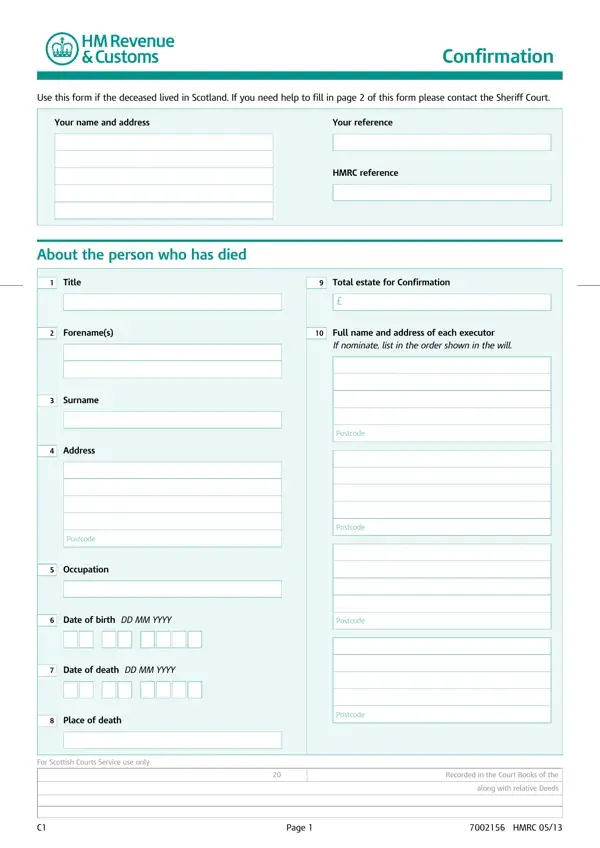
What it is: HMRC form C1 (2022), Confirmation, is for applying for confirmation in Scotland when the deceased died on or after 1 January 2022.
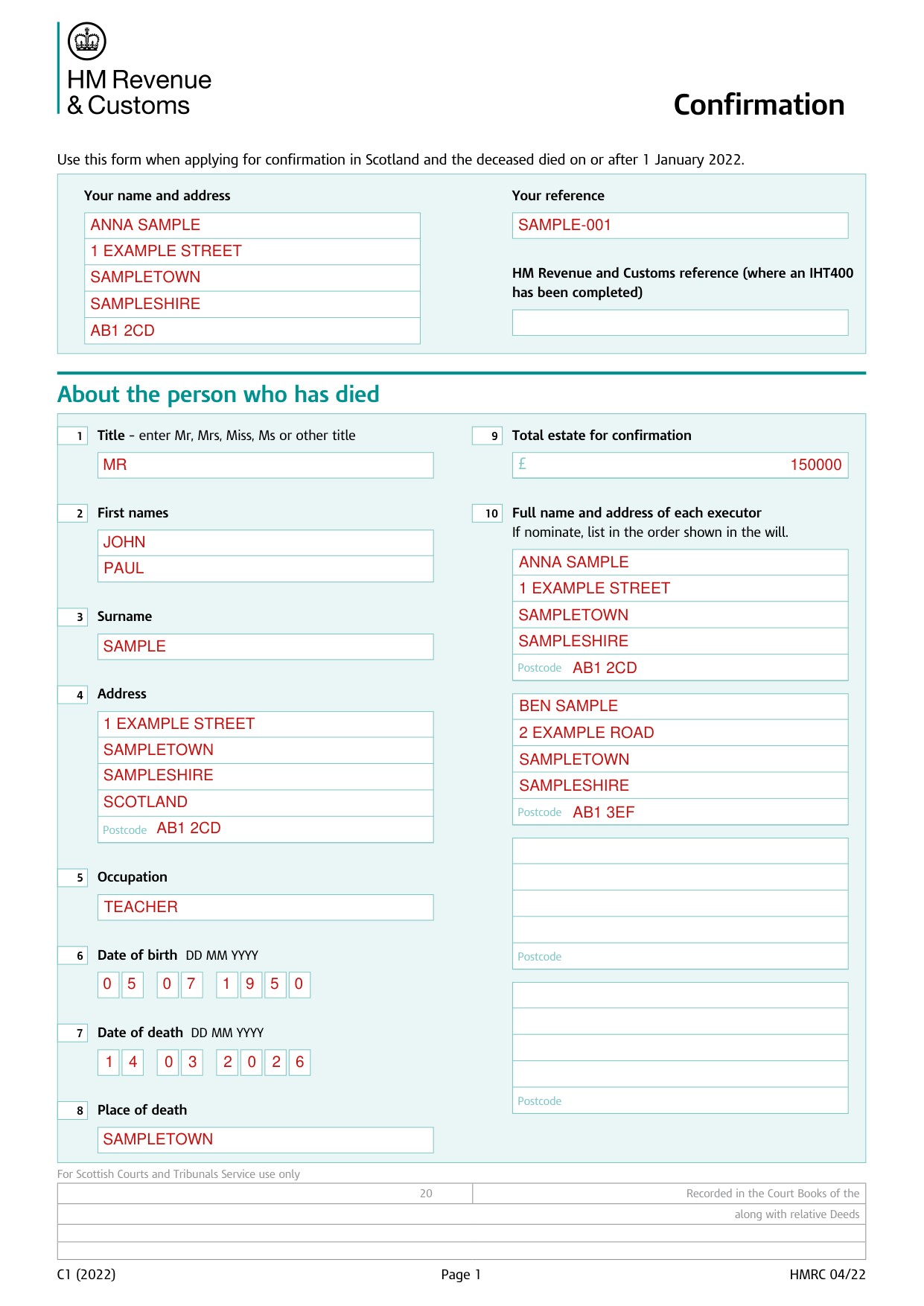
A filled-in Form C1 example: an executor fills in page 1 of the confirmation form
How to fill out Form C1, box by box
Your name and address and your reference

Enter your name and address and your reference. Enter the HM Revenue and Customs reference (where an IHT400 has been completed).
About the person who has died
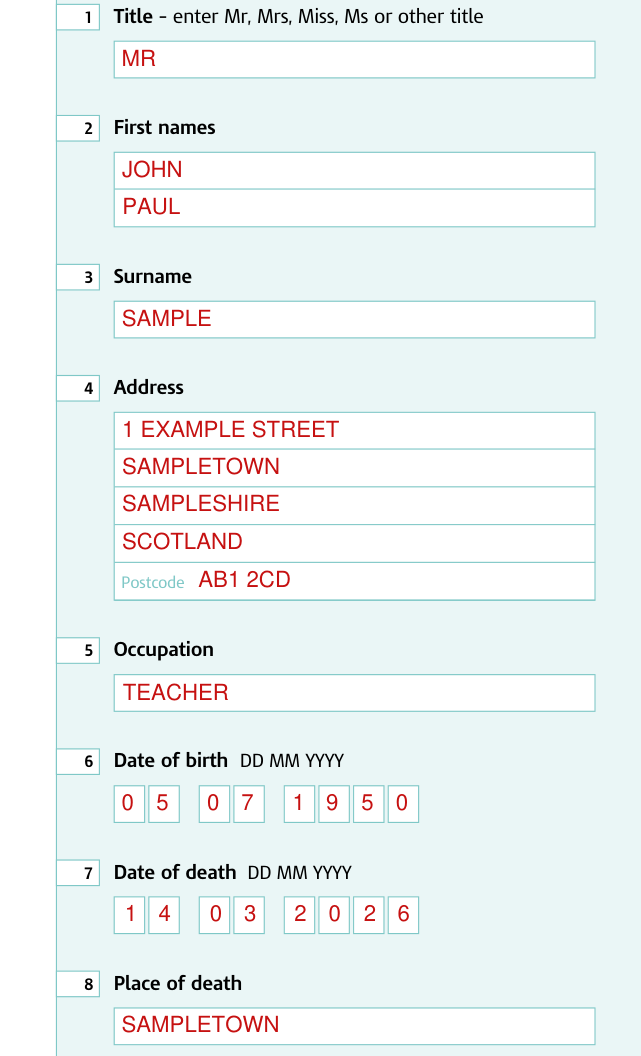
Under About the person who has died, enter the title (Mr, Mrs, Miss, Ms or other title), the first names and the surname.
Enter the address and the occupation.
Enter the date of birth and the date of death as DD MM YYYY. Enter the place of death.
Total estate and each executor
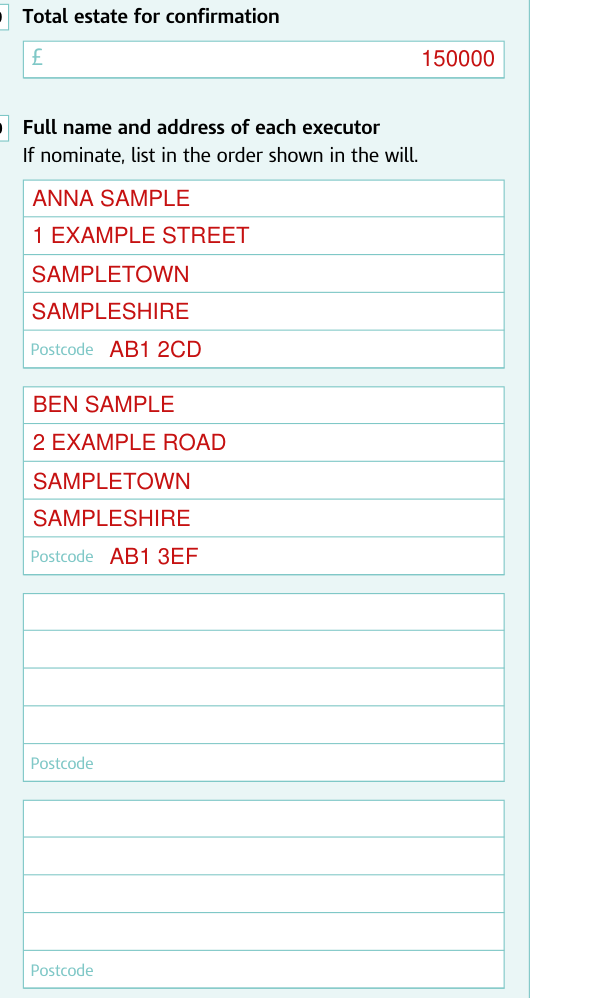
Enter the total estate for confirmation.
In box 10, enter the full name and address of each executor. If nominate, list in the order shown in the will.
More rules for Form C1
That confirmation of the estate in Scotland, England and Wales and Northern Ireland amounting in value to the amount you enter is required.
That I do not know of any testamentary settlement or writing relating to the disposal of the deceased's estate or any part of the deceased's estate other than that mentioned in paragraph 2.
To the best of my knowledge and belief the information I have given in this form is correct and complete. Sign on the Signature line and enter the Date as DD MM YYYY.
List the estate under these headings and in this order: Estate in Scotland (heritable property first), Estate in England and Wales, Estate in Northern Ireland, Estate elsewhere (say in which country).
Include property, other than settled property, over which the deceased had and exercised an absolute power of disposal.
Enter the Gross value of estate in box 11. Enter the funeral expenses in box 12, the standard security or mortgage in box 13 and the other debts and liabilities in box 14. Box 15, the Net value of estate, is box 11 minus box 12 minus box 13 minus box 14.
Have you filled in form IHT400 Inheritance Tax account? If Yes, go to question 26. If No, go to question 17.
Which of the following applied to the deceased at the time of death? Tick only one box: Married or in a civil partnership, Single, Divorced or former civil partner, Widowed or surviving civil partner.
If the deceased had surviving relatives, tick the appropriate box(es): Spouse or civil partner, Parent, Brothers or sisters.
Enter the number of children and/or grandchildren who survived the deceased.
Enter the Unique Taxpayer reference (UTR) and the National Insurance number for the deceased.
For Inheritance Tax, is the estate an excepted estate? No or Yes.
Claim against this estate the unused proportion of the Inheritance Tax nil rate band of a pre-deceased spouse or civil partner of the deceased: No or Yes.
Enter the Gross value of estate for Inheritance Tax (see page 14 of the notes C3(2006) (2022)), the Net value of estate for Inheritance Tax and the Net qualifying value of estate.
If you've confirmed that this is an excepted or exempt estate, you've finished completing this form.
Enter the total tax and interest now being paid. Copy amount from either form: IHT400, box 119, IHT400 Calculation, box 64, IHT430, box 28 as appropriate. If there's no tax to pay, please enter '0'.
Common questions about Form C1
Is there a penalty?
You may be liable to penalties or prosecution if you fail to make full enquiries and to include all property on which Inheritance Tax is payable.
Sources
[1] Form C1 (2022), Confirmation, HM Revenue and Customs (the Official source link on this page).