
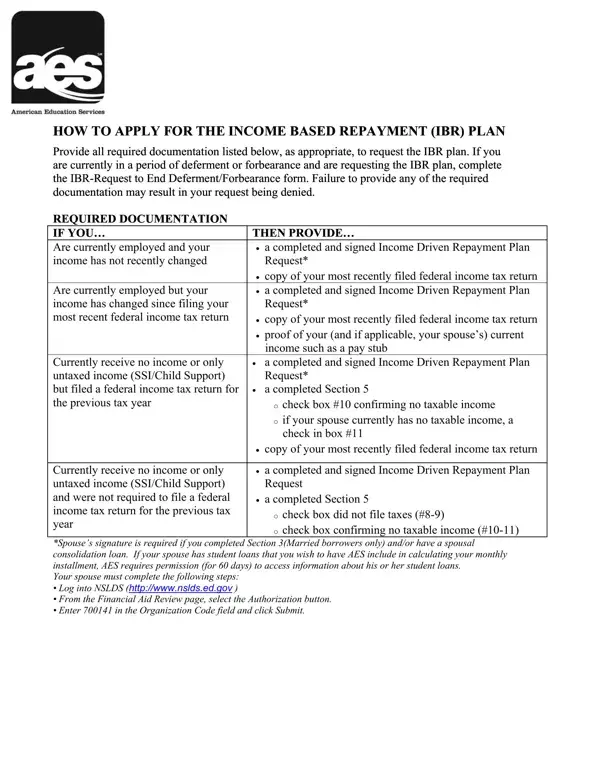
Understanding the process of applying for an Income-Based Repayment (IBR) plan is essential for borrowers seeking relief based on their income and financial situation, reflecting the plan's intent to adjust monthly payment amounts based on income and family size. The IBR application form guides borrowers through the documentation required to establish eligibility, whether they are newly applying or reassessing their monthly payment due to a change in circumstances. Key aspects include providing proof of income—or lack thereof—for both the borrower and, if applicable, their spouse. This can include recent tax returns, employment pay stubs, or confirmation of non-taxable income sources like Supplemental Security Income or child support. For married borrowers, additional stipulations require involvement from the spouse, such as signatures on the application form and in some cases, documentation of the spouse's student loans if affecting the applicant's payment calculation. The form also delineates scenarios requiring different documentation, affirming the program's flexibility and responsiveness to diverse borrower situations. As part of the Federal Direct Loan and Federal Family Education Loan (FFEL) Programs, applicants are alerted to the potential implications of their repayment choice, ranging from elongated repayment periods to the possibility of increased loan costs due to accrued interest. Additionally, it explicitly warns about the legal ramifications of providing false information, illustrating the form's dual purpose as both an application and a contractual agreement between the borrower and the loan service provider.
| Question | Answer |
|---|---|
| Form Name | Ibr Online Application Form |
| Form Length | 7 pages |
| Fillable? | No |
| Fillable fields | 0 |
| Avg. time to fill out | 1 min 45 sec |
| Other names | ibr renewal form, current ibr application, ibr application 2019, navient ibr form 2019 |