
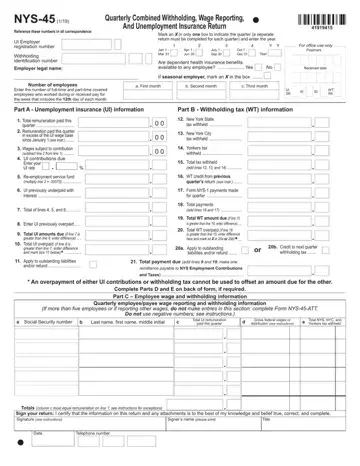
- Form NYS-45 at a glance
- A filled-in Form NYS-45 example: a first quarter return for a small employer
- How to fill out Form NYS-45, box by box
- More rules for Form NYS-45
- Amended returns, seasonal employers, no payroll and other situations
- Common questions about Form NYS-45
- Where to get help with Form NYS-45
- Sources
Form NYS-45 at a glance
What it is: Form NYS-45 is the Quarterly Combined Withholding, Wage Reporting, and Unemployment Insurance Return.[1]
Who signs: This return must be signed by the individual if the employer is an individual owner; the president, treasurer, or other principal officer if the employer is a corporation; a responsible and duly authorized member having knowledge of a firm's affairs if the employer is a partnership or other unincorporated organization; or a responsible and duly authorized governmental official, where appropriate.[2]
Where and when to file: Form NYS-45 is due the last day of the month following the end of the quarter: April 30 for January 1 through March 31, July 31 for April 1 through June 30, October 31 for July 1 through September 30, and January 31 for October 1 through December 31; when the due date falls on a Saturday, Sunday, or legal holiday, you are permitted to file on the next business day. You must electronically file your quarterly returns and pay any balance due. The Tax Department offers three methods for electronically filing withholding tax returns: 1) Web File, 2) Web Upload, or 3) Federal/State Employment Taxes (FSET) compatible software.[2]
A filled-in Form NYS-45 example: a first quarter return for a small employer
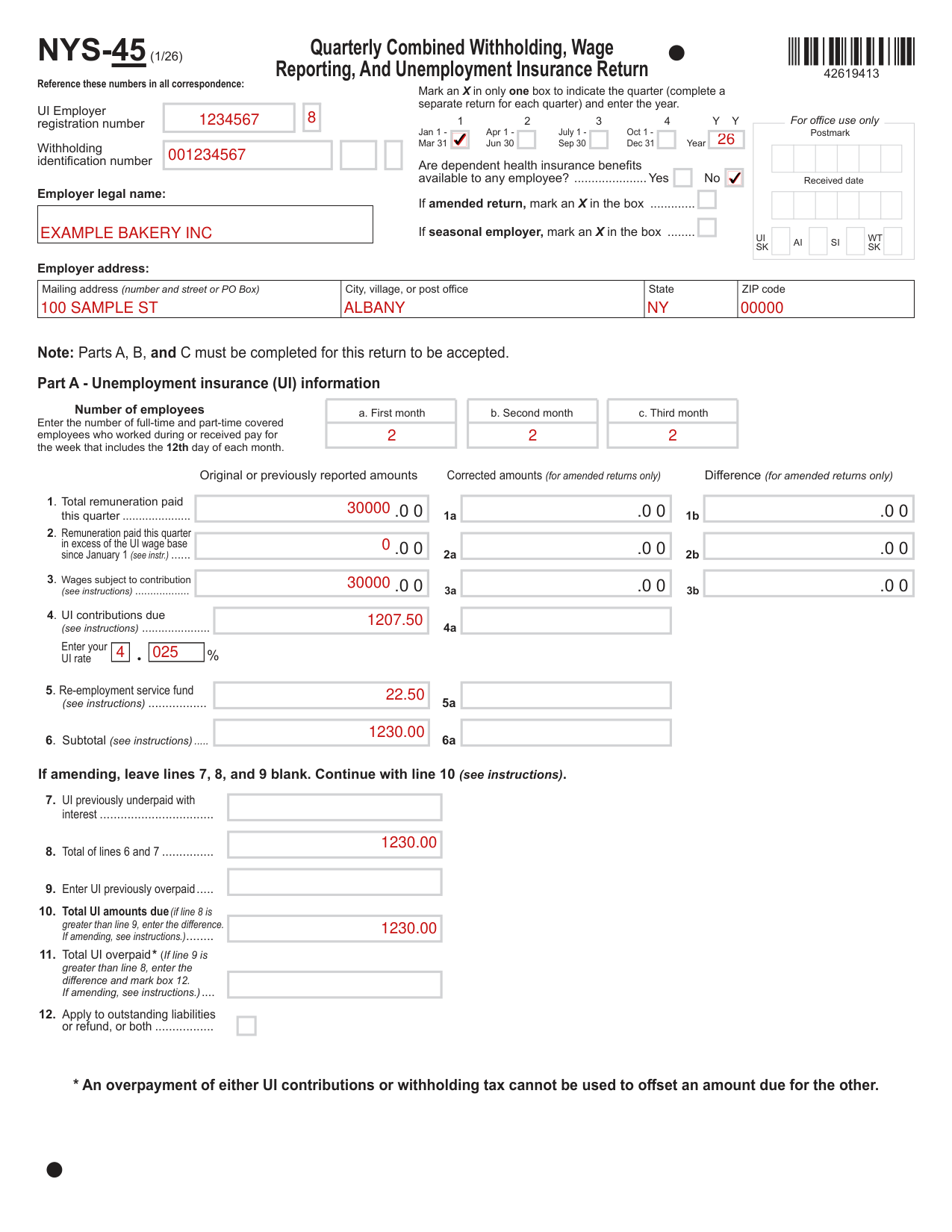
How to fill out Form NYS-45, box by box
Tap a group of boxes to open it, and a picture to see it full size.
The quarter, the year and the employer
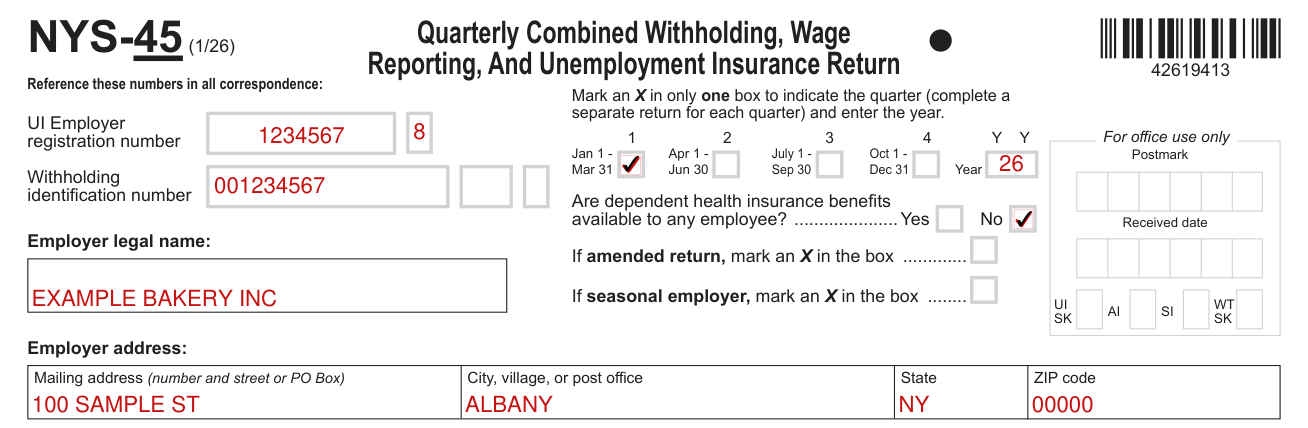
Common mistake: Mark an X in only one box to indicate the quarter (complete a separate return for each quarter) and enter the year.
Enter the last two digits of the year of the period for which you are filing. For Web application filing only, a return can be filed even if no UI employer registration number is available, and the web application will then show a default number of 00-00000 0.
If applicable, enter your 7-digit UI employer registration number in the first box and your check digit in the second box.
If you do not know your UI registration number, contact the New York State Department of Labor, Unemployment Insurance Division (see Need help?). You must provide complete wage information (Part C, boxes a through e and g through j), each calendar quarter, for all employees.
A UI employer registration number is created when a business registers and is determined to be liable under the New York State Unemployment Insurance Law.
Enter your 9-digit federal employer identification number (EIN) in the first box of the withholding identification number; in the second box, your 2-digit NYS suffix, if any; and in the third box, your assigned check digit, if known.
Enter your legal name in the space provided.
Mark an X in the Yes or No box to indicate whether or not dependent health insurance benefits were available to any employee during the reporting period.
Employer address: enter the address to which you want your withholding tax and UI notices sent.
Regardless of your method of filing (Tax Department Web File, Tax Department Web Upload, FSET, or paper), the address entered in this section will replace the mailing address on record for all withholding tax and UI notices sent to you.[1][2]
Number of employees

For each of the three months of the calendar quarter being reported, enter the number of full-time and part-time workers in covered employment who worked during or received pay for the pay period that includes the 12th day of the month.
Unless specifically excluded, all employment performed for a liable employer is covered, with employee wages subject to UI contributions.
Common mistake: The employment entries should not reflect the number of paychecks issued, nor should the entries be a cumulative sum of all workers employed during the month.
If there is no employment in the payroll period, enter 0.[2]
Part A, lines 1 to 3: remuneration and wages subject to contribution

Part A is used to report quarterly UI information and UI contribution amounts due.
Line 1, enter the total of all remuneration paid to all employees during this quarter (full or part-time, permanent, or casual), including amounts in excess of the UI wage base per year.
Remuneration includes salaries, cash wages, tips, commissions, bonuses, and the reasonable value of board, rent, housing, lodging or similar advantage.
Payments to corporate officers for services rendered are remuneration regardless of their stock ownership and regardless of how the payments are treated under subchapter S of the Internal Revenue Code (IRC) or any other tax law.
Remuneration is considered paid on the date the payment is made.
Of the total amount of remuneration paid to each employee by each employer during the calendar year, the UI wage base is the portion of that total which is subject to contributions.
Line 2, for each employee who received remuneration of more than the UI wage base from the beginning of the year through the end of the quarter being reported, determine the amount of excess remuneration paid during this quarter.
Common mistake: Add all the excess amounts and enter the total here; in no case may the figure exceed the amount entered on line 1.
If you acquired a business, you should consider remuneration paid to employees by the predecessor in arriving at the excess amount.
Also consider in the excess remuneration paid to an employee that was reported to another state (concerning an employee transfer into New York from another state).
Line 3, subtract line 2 from line 1 and enter the difference.[2]
Payments excluded from remuneration
The following payments are excluded from remuneration: (1) payments made by a sole proprietorship to the sole proprietor, to their spouse or minor (under 21) child, and payments made by a partnership to the partners; (*2) any payment made under a plan or system providing for retirement, sickness or accident disability, or medical or hospital expenses for an employee or an employee's dependents, including amounts paid for insurance, annuities, or into a fund to provide for the payments.
(3) Payments made by an employer, without payroll deductions, of taxes required from employees under the Social Security Act.
(4) Insurance or annuity payments to an employee for retirement.
(5) Payments made to an employee on account of sickness or accident disability after six complete calendar months following the month in which the employee last worked.
(6) Payments from or to a trust described in IRC § 401(a) that is exempt from tax under IRC § 501(a).
(7) Payments made to an employee, except vacation or sick pay, beginning with the month following the employee's 65th birthday, for any period in which the employee did not actually work; (*8) dismissal payments (does not apply to earned vacation payments); (*9) compensation paid to daytime students in elementary and secondary schools who work for other than nonprofit organizations or governmental or Native American tribal entities, including payments for working during vacation periods and holidays.
(10) For household employers, payments to babysitters under 18 years of age.
(11) Payments made by certain organized camps for services of a student who is enrolled full-time in an educational institution. *Note: some payments listed above as exclusions are subject to the Federal Unemployment Tax Act (FUTA) and must be reported to New York if you are subject to FUTA.[2]
The line 2 worksheet
To calculate the amount of excess wages for each individual employee, use the following worksheet; line A is the UI wage base (see the chart on page 2 of the instructions, Form NYS-45-I).
Line B, enter total wages paid to the employee in prior quarter or quarters of this same calendar year; if this is the first quarter of the year or if the employee never received wages in prior quarter or quarters, enter 0.
Line C, subtract line B from line A and enter the difference; if the difference is zero or less, all wages paid to this employee this quarter are excess wages and must be included in the total excess wages entered on Form NYS-45, line 2; if the difference is greater than zero, continue to line D of this worksheet.
Line D, enter wages paid to the employee this quarter.
Line E, subtract line C from line D and enter the difference; if the difference is zero or less, no wages paid to this employee this quarter are excess wages and none should be included in the total excess wages entered on Form NYS-45, line 2; if the difference is greater than zero, include the difference in that total; ensure that the differences for all employees are included in the total on Form NYS-45, line 2.[2]
Lines 4 to 6: UI contributions and the re-employment service fund

Line 4, enter the correct UI rate for the quarter being reported.
The UI rate is the combination of the normal and subsidiary rate, as shown on your UI rate notice.
For example, a normal rate of 3.4% and subsidiary rate of 0.625% would equal a UI rate of 4.025%.
Multiply the wages on line 3 by your UI rate to calculate UI contributions due.
Common mistake: No part of the UI contributions reported was or is to be deducted from an employee's remuneration.
If you do not know your UI rate, you can get it online at dol.ny.gov by following the links to the UI Online Services or by calling the UI Employer Hotline at 1-888-899-8810.
Have your eight-digit UI employer registration number available when calling; if you are filing using the Web application and your account does not have a UI rate on record for this period, your rate will populate by default to 9.825% for the UI rate and 0.075% for the re-employment service fund rate, for a total of 9.9%.
If you are paper filing and your account does not have a UI rate on record, you should use a default rate of 9.825% for the UI rate and 0.075% for the re-employment service fund rate, totaling 9.9%.
Once calculated, if your assigned rate is lower than the default rate, any excess payments you made will be credited to your account.
You may enter a lower rate, but if your assigned rate is higher than the rate you enter, your account will be underpaid.
Any underpayments remaining on your account will be billed to you with interest at the rate of 12% per year from the due date of the return to the date paid.
Line 5, multiply the wages on line 3 by 0.075% to calculate the re-employment service fund contributions due and enter the resulting amount.
Each employer liable for UI contributions must also make a quarterly contribution to this fund.
The re-employment service fund is a New York State fund, and amounts paid into it cannot be used as a credit for the Federal Unemployment Tax Act (FUTA).
Line 6, add lines 4 and 5.[2]
Lines 7 to 12: the UI amount due or overpaid
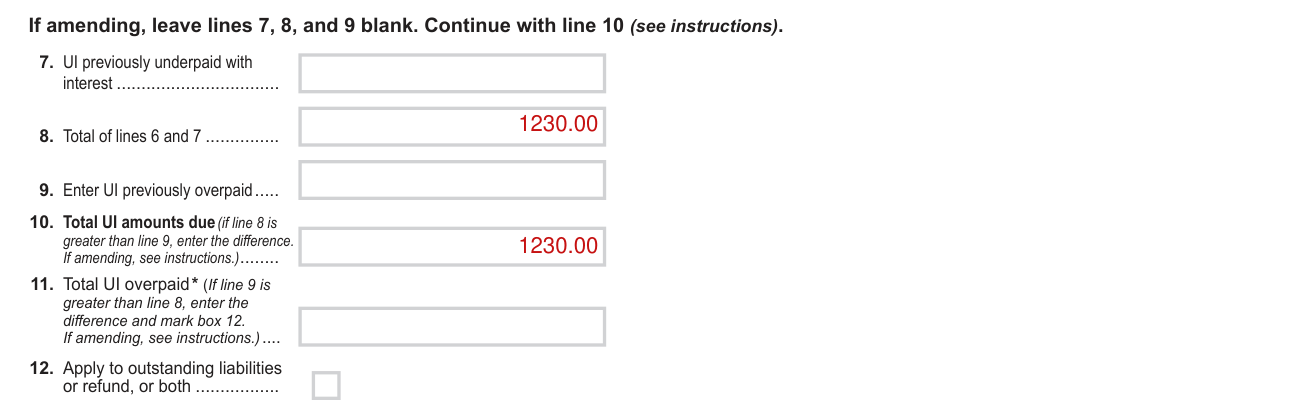
Line 7 (for original returns only), if you have previously underpaid your UI, enter the amount underpaid.
Your underpaid balance, including interest, may be obtained online at dol.ny.gov by following the links to the UI Online Services or by calling the UI Employer Hotline at 1-888-899-8810.
Line 8 is the total of lines 6 and 7.
Line 9 (for original returns only), if you have previously overpaid your UI, enter the amount overpaid.
Line 10, if line 8 is greater than line 9, enter the difference on line 10; this is the balance due for UI.
Line 11, if line 9 is greater than line 8, enter the difference on line 11; this is the balance of your UI overpayment, which will be applied first to any outstanding UI liabilities.
Mark an X in box 12 to obtain a refund of any remaining overpaid balance.[1][2]
Part B, lines 13 to 22: withholding tax
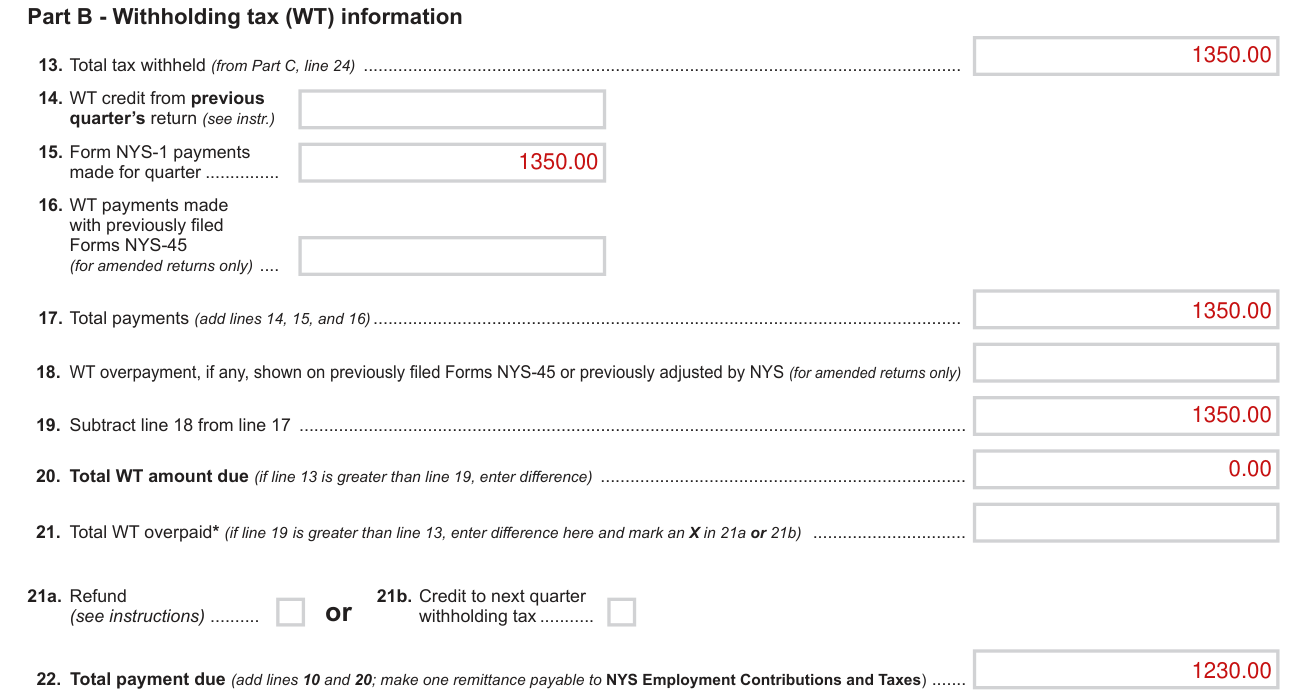
Line 13, enter the total New York State, New York City, and Yonkers tax withheld for the entire quarter (total tax withheld, from Part C, line 24).
Line 14, if in the previous calendar quarter you had a withholding overpayment and you marked box 20b (for quarters beginning prior to March 1, 2025) or box 21b (for quarters beginning on or after March 1, 2025) on last quarter's Form NYS-45, enter the overpayment amount here.
Line 15, enter the sum of all payments remitted with Web File, Web Upload, PrompTax, or paper Forms NYS-1, Return of Tax Withheld, for payrolls during the quarter.
Line 17, total payments: add lines 14, 15, and 16.
Line 19, subtract line 18 from line 17.
Line 20, if line 13 is more than line 19, enter the difference on line 20; this is the total withholding tax amount due for this quarter.
Line 21, if line 19 is greater than line 13, enter the difference here and mark an X in box 21a or 21b; this is the total withholding tax overpaid for this quarter.
To request a refund of this overpayment, mark an X in box 21a (if you have outstanding liabilities, amounts to be refunded will first be applied to these liabilities and any balance refunded to you).
To request a credit to next quarter's withholding tax, mark an X in box 21b.
Common mistake: An overpayment of either UI contributions or withholding tax cannot be used to offset an amount due for the other.
Line 22, add lines 10 and 20 to calculate your total payment due; complete lines 10 and 20 to ensure proper credit of payment.
Make one remittance (check or money order) payable in U.S. funds to NYS Employment Contributions and Taxes for the total payment due.
Write your withholding ID number on your remittance.[1][2]
Change of business information
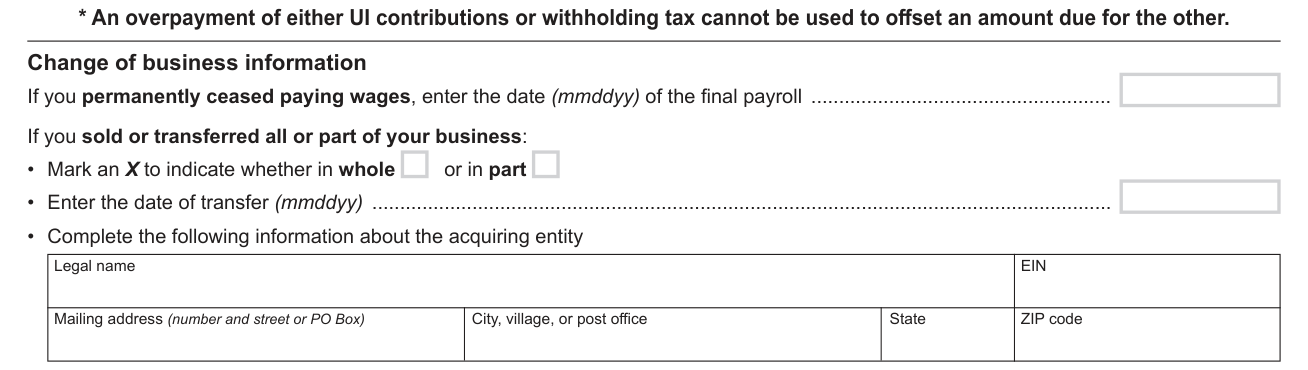
If you have permanently ceased paying wages, you must indicate that this is the final return by entering the date (mmddyy) of the final payroll.
A final Form NYS-45 must be filed within 30 days of the date on which you permanently ceased paying wages.
If applicable, you must also complete the sold or transferred all or part of your business section: if you sold or transferred all or part of your business, mark an X to indicate whether in whole or in part, enter the date of transfer (mmddyy), and complete the following information about the acquiring entity: legal name, EIN, mailing address (number and street or PO Box), city, village, or post office, state, and ZIP code.[1][2]
Part C, boxes a to e: each employee

Part C is used to report quarterly employee wage reporting and withholding information.
Every employer liable for New York State UI contributions or for payments in lieu of these contributions (reimbursement of benefits paid to former employees) must report the total UI remuneration (as defined in the UI law) paid to each employee each quarter.
If you are reporting more than five employees in Part C, report the first five employees on page 3, print additional copies of page 3 to report additional employees, and if additional pages are attached, enter the number of pages utilized in the section above line 23 titled Page __ of __ Totals from this page only.
Box a, enter the number shown on the employee's or payee's Social Security card: the nine numerals without any dashes or slash marks.
Boxes b, c, and d, enter the name of each employee or payee, listing the last name in box b, the first name in box c, and the middle initial in box d.
Common mistake: Box e, if you are reporting regular wages, you must enter R in box e; if you are reporting other wages, you must write O in box e.
Other wages include earnings such as dismissal or severance payments and the first six months of sick pay benefits.
Other wages also include pension and annuity distributions (reported on federal Form 1099-R) and gambling winnings if you withheld New York State, New York City, or Yonkers income tax.[2]
Part C, boxes f to j: the amounts

Box f, enter the total UI remuneration paid to each employee this quarter.
Include all wages paid this quarter prior to any deductions and without regard to the UI wage base.
You may report dollars and cents or round to whole dollars; however, you must be consistent for all employees.
Calculate and enter the total on line 23, box f; the total must equal Part A, line 1, Total remuneration paid this quarter (except IA7/IA7A annual report filers).
All employers that pay wages to daytime students in elementary and secondary schools should report the wage payments as regular gross wages on Form NYS-45.
You are required to report, each calendar quarter, federal gross wages subject to withholding and the total amount of New York State, New York City, and Yonkers tax withheld for every employee paid during the calendar quarter you are reporting, on Form NYS-45, Part C, boxes g, h, i, and j.
The total amount for all employees in boxes h, i, and j should equal the amount reported on Form NYS-45, Part B, line 13 and Part C, line 24 for the same quarter.
Box g, enter the total of federal gross wages or other payments subject to withholding, prior to any allocation, paid to every individual employed at any time during the calendar quarter.
For governmental employees, also include in box g any taxable 414(h) retirement contributions and any IRC § 125 amounts from a New York City flexible benefits program.
Box h, enter the total amount of New York State tax withheld for every individual employed at any time during the quarter.
Box i, enter the total amount of New York City tax withheld for every individual employed at any time during the quarter.
Box j, enter the total amount of Yonkers tax withheld for every individual employed at any time during the quarter.[2]
Page totals and lines 23 and 24
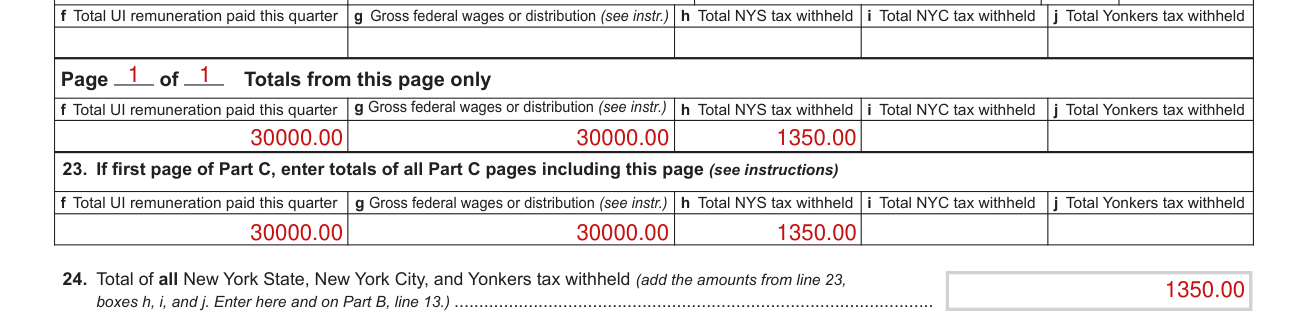
Page totals (each page), add each of box f (Total UI remuneration paid this quarter), box g (Gross federal wages or distribution), box h (Total NYS tax withheld), box i (Total NYC tax withheld) and box j (Total Yonkers tax withheld) reported on that page, and enter each total in the same box of the Page Totals line.
Line 23 (first page only), if this is the first page of Part C, add the totals of all pages for each of box f (Total UI remuneration paid this quarter), box g (Gross federal wages or distribution, see the instructions), box h (Total NYS tax withheld), box i (Total NYC tax withheld) and box j (Total Yonkers tax withheld), and enter each total in its box of line 23.
Line 24 (first page only) is the total of all New York State, New York City, and Yonkers tax withheld: add the amounts from line 23, boxes h, i, and j, and enter the amount here and on Part B, line 13.[1][2]
The signature

After your Form NYS-45 return has been completed, you must sign in the area provided on the bottom of page 3.
This return must be signed by the individual if the employer is an individual owner; the president, treasurer, or other principal officer if the employer is a corporation; a responsible and duly authorized member having knowledge of a firm's affairs if the employer is a partnership or other unincorporated organization; or a responsible and duly authorized governmental official, where appropriate.
The signature certifies that the information contained in this return is true and correct, and that the remuneration reported represents all remuneration paid during this calendar quarter for employment covered by the law.
Sign your return: you certify that the information on this return and any attachments is to the best of your knowledge and belief true, correct, and complete.
Write your telephone number in the boxes below your signature.[1][2]
More rules for Form NYS-45
Parts A, B, and C must be completed for this return to be accepted.[1][2]
Form NYS-45 (this return) is designed to be read by information processing equipment.[2]
Common mistake: To assist, be sure to send original forms (not photocopies).[2]
When entering information, print with a black pen or type in the numbers 0-9 or letters A-Z.[2]
Common mistake: Do not use negative (credit) amounts on Form NYS-45, and do not enter dollar signs, commas, minus signs, parentheses, or any other punctuation or symbols in boxes f, g, h, i, and j or on any part of Form NYS-45, except for decimal points used in currency fields.[2]
File the return and keep a copy for your records.[1]
Amended returns, seasonal employers, no payroll and other situations
You are amending a return
To amend a previously Web- or paper-filed Form NYS-45, complete an amended Form NYS-45: mark an X in the Amended return box, indicate the quarter and tax year of the period, and complete the form in its entirety.
If any of the amounts entered on lines 1 through 3 of Form NYS-45 must be corrected, complete an amended Form NYS-45 and complete all parts of Form NYS-45 in its entirety.
To amend wage or withholding information for a previous quarter you must file an amended Form NYS-45 and complete the form in its entirety.
If you determine an error was made in the employee wage and withholding information reported on a previously filed Form NYS-45, Form NYS-45-X, or Form NYS-45-ATT, correct that information on an amended Form NYS-45.
If you are amending Other wages information, report these corrections on an amended Form NYS-45.
If your corrections to employee wage and withholding information result in changes to UI information or withholding tax information, or both, reported on the Form NYS-45 or a previously filed Form NYS-45-X for the quarter, also amend this information on an amended Form NYS-45.
For amended returns only, in the Original or previously reported box, on lines 1 through 5, enter the amounts as reported previously on the most recent return filed for the quarter being amended (that is, the original Form NYS-45 or the most recent Form NYS-45).
If the only errors on the previously filed return were incorrect amounts due for UI contributions (Form NYS-45, line 4) or Re-employment service fund (Form NYS-45, line 5), because of an incorrect UI rate used, you do not need to file an amended return; your account will automatically be adjusted.
In the Corrected amounts box, enter the amounts you now determine to be correct; amounts that were previously reported correctly should be entered unchanged in both Original or previously reported amounts and Corrected amounts boxes.
For lines 1b through 3b, determine the difference between the amounts entered in the Original or previously reported amounts and Corrected amounts box and enter the difference in the Difference box.
Line 1a and 1b (for amended returns only), if amending, enter the correct total of all remuneration paid this quarter on line 1a; subtract line 1 from line 1a, and enter the difference on line 1b.
Line 2a and 2b (for amended returns only), if amending, enter the correct total of remuneration paid in excess of the UI wage base on line 2a; subtract line 2 from line 2a, and enter the difference on line 2b.
Line 3a and 3b (for amended returns only), if amending, subtract line 2a from line 1a and enter the difference on line 3a; subtract line 3 from line 3a, and enter the difference on line 3b.
Line 4a (for amended returns only), if amending, multiply the wages on line 3a by your UI rate to calculate UI contributions due.
Line 5a (for amended returns only), multiply line 3a, Corrected amounts box, by 0.075% to recalculate the re-employment service fund contribution due and enter the resulting amount.
Line 6a (for amended returns only), add lines 4a and 5a; if amending, skip lines 7, 8, and 9 (leave them blank) and continue with line 10.
If line 6 is less than line 6a, enter the amount due on line 10; if line 6 is greater than line 6a, enter the overpayment amount on line 11, which will first be applied to any outstanding liabilities and any balance refunded to you.
Line 16 (for amended returns only), enter the sum of all payments remitted with previously filed Forms NYS-45.
Line 18 (for amended returns only), enter the sum of all overpayments reported on previously filed Forms NYS-45 or previously adjusted by NYS.
To correct errors made in Part C on a previously filed Form NYS-45-ATT, replace the erroneous values in the existing employee record and fill in the other boxes with the original values.
The entire corrected return must be filed together, including Parts A and B and all wage records in Part C, including those that do not have changes.[1][2]
You are a seasonal employer
If, due to the seasonal nature of your business, there is at least one quarter of the calendar year in which you do not make any wage payments subject to income tax withholding and UI contributions, you are eligible for seasonal employer status.
To obtain seasonal employer status, you must file a Form NYS-45 and mark an X in the seasonal employer box.
Thereafter, you are not required to file Form NYS-45 for subsequent quarters during the calendar year in which you paid no wages subject to UI and withholding.
However, you must mark an X in the box on every return you are required to file, or you will lose your seasonal status and be subject to penalties for not filing a return for a subsequent quarter in the same calendar year.
A seasonal employer must file at least one quarterly return for each calendar year to maintain seasonal status.[2]
You have no payroll for the quarter
Employers with no payroll for the quarter must complete Parts A and B, and enter 0 in Part C, line 24.
If no remuneration was paid this quarter, enter 0 on line 1 and in Part C, box f.
If you did not withhold any New York State, New York City, or Yonkers tax, or did not make payments for the quarter, enter 0 on lines 13 and 15, whichever apply.[2]
You pay gambling winnings or other payments
Payments of gambling winnings, other than NYS Lottery winnings, are reported as if the payments are other wages paid by an employer to an employee for any period of time where a withholding agreement is in place.
Payers of gambling winnings must complete Form NYS-45, Part B, to report the withholding, and Part C, boxes a through e and g through j (the amount of gambling winnings is reported in box g and the amount withheld in boxes h, i, and j).
Payers of gambling winnings must enter zeros in UI fields that do not apply.
Payers of other payments who withheld New York State, New York City, or Yonkers income tax must also complete boxes a through e and g through j in the calendar quarter that the other payments were made and tax was withheld.
In the case of an annuity, enter the total gross distribution for the quarter in box g.
In the case of other payments, enter in boxes h, i, and j the total amount of New York State, New York City, and Yonkers tax withheld from the distribution or payment made in that quarter.[2]
You elected the reimbursement option (nonprofit, governmental and Native American tribe employers)
Nonprofit, governmental, and Native American tribe employers who have elected the option of reimbursement of benefits paid to former employees, rather than paying quarterly UI contributions, must complete Form NYS-45 to include these items: number of employees; Part A, line 1; Parts B and C; and signature.
Leave Part A, lines 2, 3, 4, 5, and 6 blank, and do not enter 0; these lines are used by employers who pay quarterly UI contributions.
If you have questions about the reimbursement option, call 518-457-2635.[2]
You are liable under FUTA
Employers liable under FUTA are required to report to New York student wages, dismissal payments, and the first six months of sick or accident payments (excluding occupationally related payments made under a State's Workers' Compensation Law).
These payments to employees may be reported by employers, other than nonprofit organizations, governmental entities, and Native American tribes, and UI based on them may be paid either quarterly on Form NYS-45, Part A, or annually on Form IA7 or IA7A, Annual Supplementary Contributions Report.
Form IA7 is used by employers with a total rate of 5.4% or less, and Form IA7A is used by employers with a total rate of more than 5.4%.
Due to the provisions of FUTA, special rules apply to certain types of payments; employers who are liable under FUTA must include payments of severance pay and the first six months of sick pay and identify them by entering O in Part C, box e.
Nonprofit organizations, governmental entities, Native American tribes, and other employers not liable under FUTA are not required to report severance pay and the first six months of sick pay.
Nonprofit organizations and governmental and Native American tribal entities are not subject to FUTA and are not required to file Form IA7 or IA7A; however, they must include student wages on the quarterly Form NYS-45 in Part A.[2]
You have federal audit changes to report
If the Internal Revenue Service makes a change to an amount an employer is required to report as wages or deduct and withhold from wages for federal income tax purposes, the employer must report this change to the New York State Tax Department within 90 days after the final federal determination of the change.
If you have federal audit changes to report and you did not previously file a Form NYS-45 for the period or periods covered by the federal audit, report the federal audit changes on Form NYS-45.
If you are reporting federal audit changes to correct withholding tax or wage reporting information previously reported on Form NYS-45, report the federal audit changes on an amended Form NYS-45.
You must attach a copy of the final federal determination to your Form NYS-45.[2]
A payroll service or paid preparer completes the return
If you use a payroll service or a paid preparer, the section on the bottom of the return must be completed by the payroll service or preparer.
When preparing an employer's New York State Quarterly Combined Withholding, Wage Reporting, and Unemployment Insurance Return, paid preparers must enter their New York tax preparer registration identification number (NYTPRIN) if they are required to have one.
A preparer who is not required to have a NYTPRIN enters in the NYTPRIN excl. code box one of these 2-digit codes that indicates why the preparer is exempt from the registration requirement: 01 Attorney, 02 Employee of attorney, 03 CPA, 04 Employee of CPA, 05 PA (Public Accountant), 06 Employee of PA, 07 Enrolled agent, 08 Employee of enrolled agent, 09 Volunteer tax preparer, 10 Employee of business preparing that business' return; the preparer must enter a NYTPRIN or an exclusion code.
The preparer must also enter their federal preparer tax identification number (PTIN), if they have one; a preparer who does not have a PTIN must use their Social Security number.[2]
Your address or business information changed
If you need to update your physical address for withholding tax, UI (if applicable), and MCTMT (if applicable), you can do so online: visit www.tax.ny.gov and select the option to change your address.
You may also use Form DTF-96, Report of Address Change for Business Tax Accounts, to update your mailing address, physical address, or designated preparer or filing service address.
To report changes that affect your UI account, submit Form IA 15, Change of Business Information for the Unemployment Insurance Program.
If there have been changes to other business information (for example, business name, identification number, telephone number, and so on), visit the website and select the option to update your business tax account; you may also submit changes using Form DTF-95, Business Tax Account Update.[2]
Common questions about Form NYS-45
Who is required to file NYS 45?
Employers who are subject to both UI contributions and withholding tax must file Form NYS-45, completing Parts A, B, and C (boxes a through j) each quarter. Employers subject only to UI contributions must complete Part A and Part C (boxes a, b, c, d, e, and f) and enter zeros in withholding tax fields that do not apply. Employers subject only to withholding tax must complete Part B and Part C (boxes a through e and g through j) for each quarter and enter zeros in UI fields that do not apply.[2]
How to file NYS-45 electronically?
The Tax Department offers three methods for electronically filing withholding tax returns: 1) Web File, 2) Web Upload, or 3) Federal/State Employment Taxes (FSET) compatible software. With Tax Department Web File, employers can electronically file Form NYS-45, Quarterly Combined Withholding, Wage Reporting, and Unemployment Insurance Return, as well as submit payment via ACH debit on the website. NYS-45 Web File accepts wage reporting data for up to 1,000 employees via manual entry or .csv upload or for an uncapped number of employees via flat file upload. With Tax Department Web Upload, upload options are available to employers, tax preparers, and payroll services for bulk filing Form NYS-45, Parts A, B, and C (see Publication 72.5, Electronic Reporting of Form NYS-45 Information). Some commercially available software allows you to use the FSET program to file withholding returns and report wage and unemployment insurance (UI) information; for a list of approved vendors, visit the website.[2]
What is the difference between form NYS-1 and form NYS-45?
Is NYS-45 ATT discontinued?
Form NYS-45-ATT, the Quarterly Combined Withholding, Wage Reporting, and Unemployment Insurance Return Attachment, has been discontinued.[3]
Does it need a notary?
No notary is named anywhere on Form NYS-45 or its instructions.
Is there a deadline?
Form NYS-45 is due the last day of the month following the end of the quarter: April 30 for January 1 through March 31, July 31 for April 1 through June 30, October 31 for July 1 through September 30, and January 31 for October 1 through December 31; when the due date falls on a Saturday, Sunday, or legal holiday, you are permitted to file on the next business day.[2]
Where do I file it?
You must electronically file your quarterly returns and pay any balance due. If you file a paper withholding tax return, you may be subject to penalties. Mail your return to NYS Employment Contributions and Taxes, PO Box 4119, Binghamton NY 13902-4119; if not using U.S. Mail, see Publication 55, Designated Private Delivery Services.[2]
Are there fees?
The form does not say.
Is there a penalty for filing late?
Returns filed and withholding tax and UI contributions paid after the due date are subject to interest and penalties. UI contributions received more than 60 days after the quarterly due date cannot be credited to your account for experience rating purposes. In future years, this may adversely affect both your UI contribution rate and credit you may be entitled to on federal Form 940. Failure to file or late filing of all required parts of Form NYS-45 may subject you to a penalty which can increase the later the return is filed.[2]
Where to get help with Form NYS-45
For information on UI rates or registration, call the UI Employer Hotline at 1-888-899-8810.[2]
New York State Department of Labor, Unemployment Insurance (UI) Division telephone assistance is available 8:00 A.M. to 5:00 P.M. (eastern time), Monday through Friday.[2]
To confidentially report employer fraud, call the 24 hour toll-free Fraud Hotline at 1-866-435-1499.[2]
For additional UI phone and fax numbers and addresses, see Publication NYS-50, Section 6, Need help? or visit the Labor Department's website at dol.ny.gov.[2]
For more information, visit dol.ny.gov and see Unemployment Insurance Information for Employers and select Business Employer Registration for Unemployment Insurance, Withholding, and Wage Reporting (NYS 100).[2]
Visit the New York State Department of Taxation and Finance website at www.tax.ny.gov to get information and manage your taxes online.[2]
Check for new online services and features; the Withholding Tax Information Center is 518-485-6654, to order forms and publications, 518-457-5431, and Text Telephone (TTY) or TDD equipment users dial 7-1-1 for the New York Relay Service. New York State Unemployment Insurance Law § 537 provides that UI information is confidential and cannot be disclosed except under limited circumstances.[2]
See Need help? on Form NYS-45-I if you need forms or assistance.[1]
Sources
[1] Form NYS-45 (1/26), New York State Department of Taxation and Finance (the Official source link on this page).
[3] New York State Department of Taxation and Finance, Withholding tax forms, current period (tax.ny.gov). Accessed October 1, 2026.