
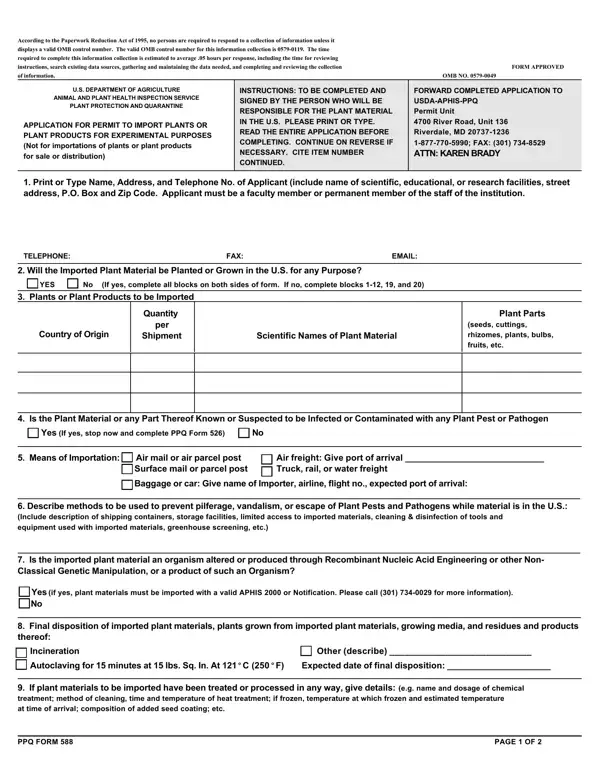

PPQ Form 588 at a glance
What it is: PPQ Form 588 is the Application for Controlled Import Permit (CIP) to Import Restricted or Not Authorized Plant Material.
Who signs: The person who will be responsible for the plant material in the U.S. completes and signs the application. Print or type it, and read the entire application before completing it. Continue on reverse if necessary and cite the item number continued.
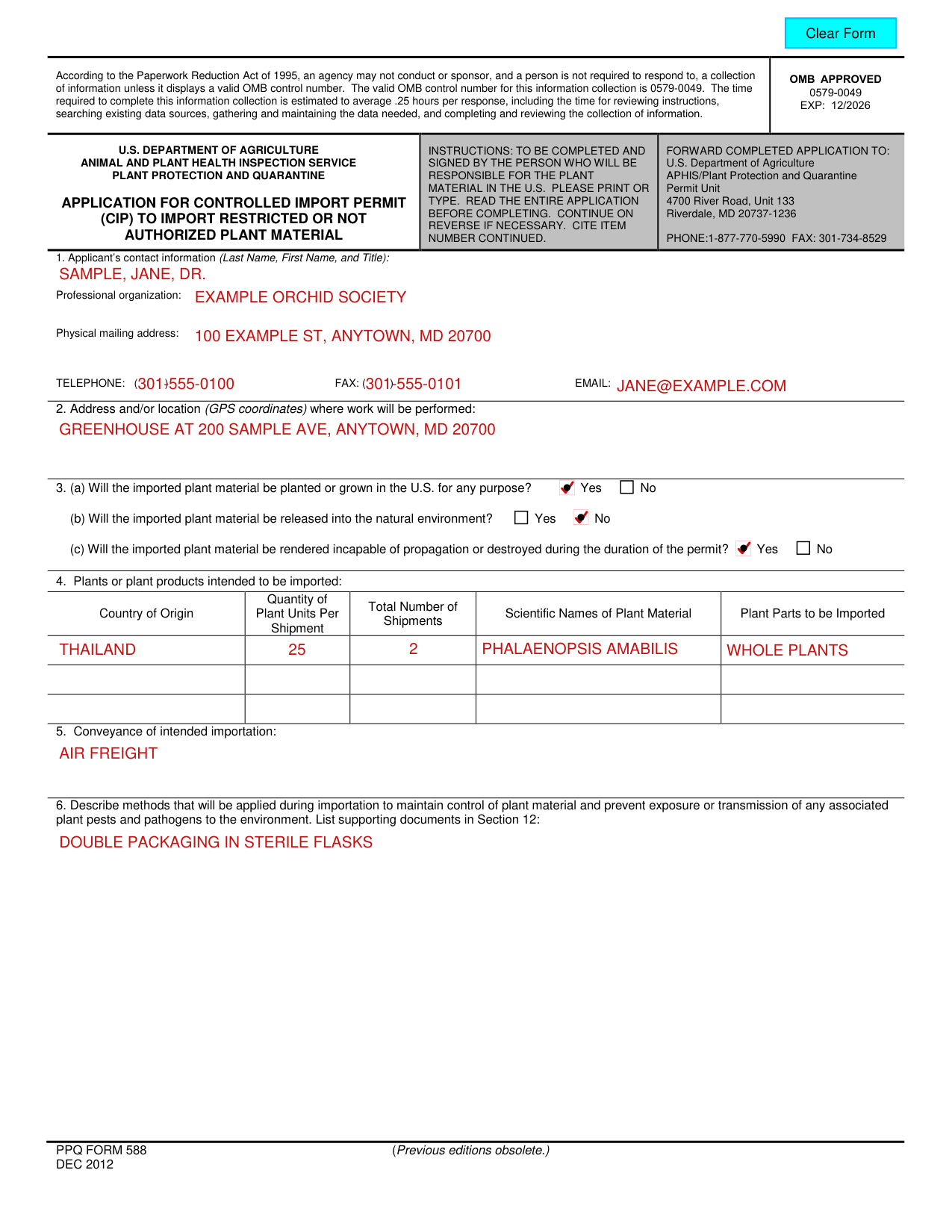
A filled-in PPQ Form 588 example: an orchid importer fills out the first page
How to fill out PPQ Form 588, box by box
Applicant's contact information

In box 1, enter the applicant's contact information (Last Name, First Name, and Title), the professional organization, the physical mailing address, and the telephone, fax and email.
Provide the applicant's title (Mr., Mrs., Dr., etc.), the applicant's first and last name, and the name of the applicant's professional organization.
Address and/or location (GPS coordinates) where work will be performed

In box 2, enter the address and/or location (GPS coordinates) of the U.S. facility where work will be performed.
In some cases, the address of the facility is different from the contact address of the applicant.
In some situations, the GPS coordinates may be necessary to properly identify the location where the work will be conducted.
Will the imported plant material be planted, released or destroyed

For 3 (a), mark Yes or No: will the imported plant material be planted or grown in the U.S. for any purpose?
For 3 (b), mark Yes or No: will the imported plant material be released into the natural environment?
For 3 (c), mark Yes or No: will the imported plant material be rendered incapable of propagation or destroyed during the duration of the permit?
Plants or plant products intended to be imported

In box 4, for the plants or plant products intended to be imported, fill in the Country of Origin, Quantity of Plant Units Per Shipment, Total Number of Shipments, Scientific Names of Plant Material and Plant Parts to be Imported.
Quantity of plant units (whole plant or tissue culture replicates, separated parts of the plant, such as, but not limited to, roots, bulbs, tubers, stems, trunk or bole, leaves, flower, fruit, seed, or any other part of a plant).
Conveyance of intended importation

In box 5, identify the conveyance of intended importation: how the plant material will be imported (air freight, vehicle, ship, small parcel, commercial carrier, international or domestic mail, hand carry).
Methods that will be applied during importation
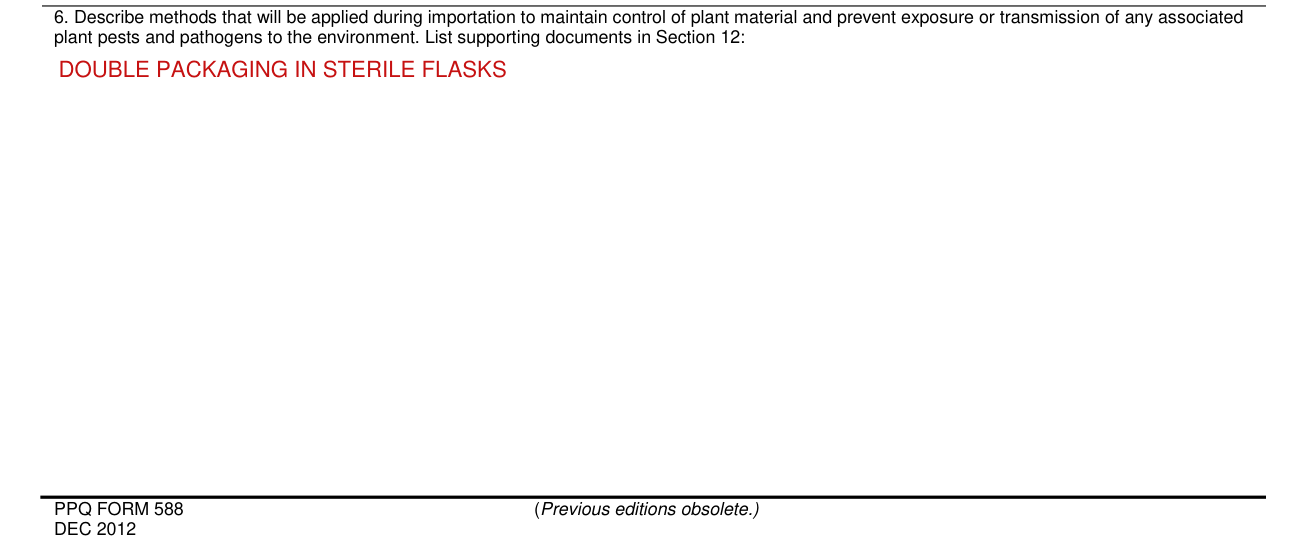
In box 6, describe methods that will be applied during importation to maintain control of plant material and prevent exposure or transmission of any associated plant pests and pathogens to the environment, and list supporting documents in Section 12.
Examples include, but are not limited to, double packaging, netting, isolation, flasks, sterile media, propagation processes, therapy verification, and validation of pest freedom.
Proposed control and monitoring of the plant material
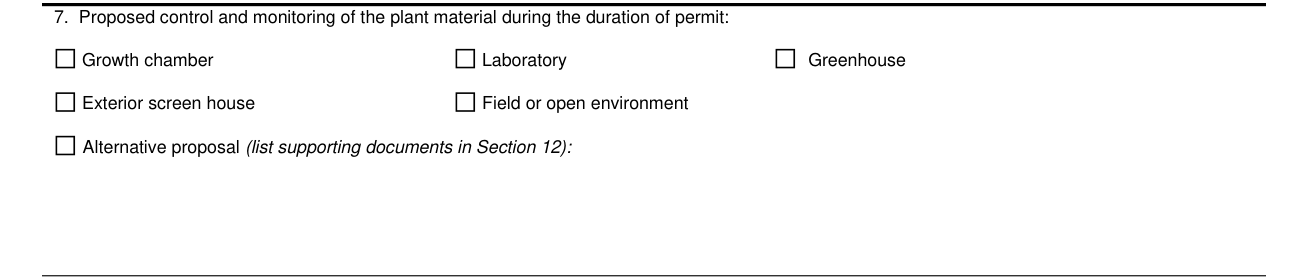
In box 7, mark the proposed control and monitoring of the plant material during the duration of permit: Growth chamber, Laboratory, Greenhouse, Exterior screen house, Field or open environment, or Alternative proposal (list supporting documents in Section 12).
Describe how the plant material will be stored, grown, and/or propagated to prevent the introduction of associated plant pests and pathogens to the environment.
Mobile plant pests that could be associated with the plant material must be taken into consideration when proposing adequate control measures.
Genetically engineered plant material

If the imported plant material is genetically engineered as regulated by 7 CFR Part 340, it requires a USDA/APHIS/Biotechnology Regulatory Services (BRS) permit or authorization which will accompany the importation. Contact BRS via phone (301) 851-3935 or email Biotechquery@aphis.usda.gov for additional assistance.
In box 8, mark No if the imported plant materials are not regulated by 7 CFR Part 340.
Mark Yes if the plant material will be imported with a valid BRS Permit or Notification (in addition to the CIP).
Exposure to or infection with plant pests or pathogens
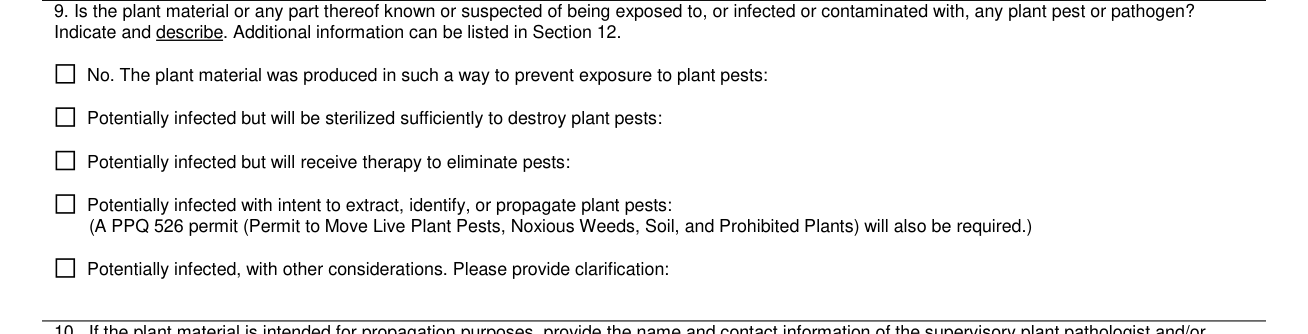
For box 9, the plant material or any part thereof known or suspected of being exposed to, or infected or contaminated with, any plant pest or pathogen: indicate and describe. Additional information can be listed in Section 12.
Mark No if the plant material was produced in such a way to prevent exposure to plant pests, and describe it.
Mark Potentially infected but will be sterilized sufficiently to destroy plant pests, and describe it.
Mark Potentially infected but will receive therapy to eliminate pests, and describe it.
Mark Potentially infected with intent to extract, identify, or propagate plant pests, and describe it. A PPQ 526 permit (Permit to Move Live Plant Pests, Noxious Weeds, Soil, and Prohibited Plants) will also be required.
Mark Potentially infected, with other considerations, and provide clarification.
If the previous conditions do not apply, provide a description of the proposal, justification for consideration, and appropriate control measures.
Propagation: the supervisory plant pathologist or horticulturalist

In box 10, if the plant material is intended for propagation purposes, provide the name and contact information of the supervisory plant pathologist and/or horticulturalist designated to monitor the plants at the approved facility throughout the duration of the permit.
These individuals are not required to make quarantine decisions about the plants nor a determination of the quarantine status.
Mark Not applicable; no propagation intended.
Final disposition of imported plant materials

In box 11, mark the final disposition of imported plant materials, or of plants grown from imported plant materials, growing media, and residues and products thereof: Incineration, Autoclaving (minimum of 15 minutes at 15 lbs. per square inch at 121 o C / 250 oF), Chemical sterilization (describe process) or Other (describe process).
Enter the proposed date of final disposition/termination of permit.
Permits are eligible for renewal following APHIS review of a new application.
Continuing an item or identifying supporting documents

In box 12, this area may be used to continue any item on the form or to identify supporting documents. Cite the item number being continued or supported.
Additional documents may accompany the application for clarification purposes and to provide PPQ with additional information that could be useful in making a determination to the permit requirements.
Signing as the person responsible for the plant material

In box 13, sign on the Signature of Applicant line and enter the Date.
You are the person who will be responsible for the plant material described in Section 4.
You agree to observe the conditions specified on a permit which may be issued by APHIS.
Inspection and approval of the facilities to be used for imported plant materials may be required before a permit is issued and during the duration of the permit.
The kinds of plant materials listed in Section 4 may not be released or sold in the U.S. without proper authorization from USDA/APHIS.
By completing this section, you affirm your request for authorization to import plant commodities as stated in this application and will be responsible for the authorized material.
By inserting his/her signature, the applicant understands that APHIS will review his/her qualifications to maintain the plant material in addition to the adequacy of the facilities that will be used.
All information provided in this application is subject to verification, validation, and inspection before a permit is issued.
More rules for PPQ Form 588
Do not leave any boxes unfilled. For items that do not apply, enter “N/A.”
Common questions about PPQ Form 588
Where do I file it?
Forward the completed application to the U.S. Department of Agriculture APHIS Plant Protection and Quarantine Permit Unit, 4700 River Road, Riverdale, MD 20737.
Sources
[1] PPQ Form 588 (DEC 2012), Application for Controlled Import Permit (CIP) to Import Restricted or Not Authorized Plant Material, U.S. Department of Agriculture, Animal and Plant Health Inspection Service (the Official source link on this page).