
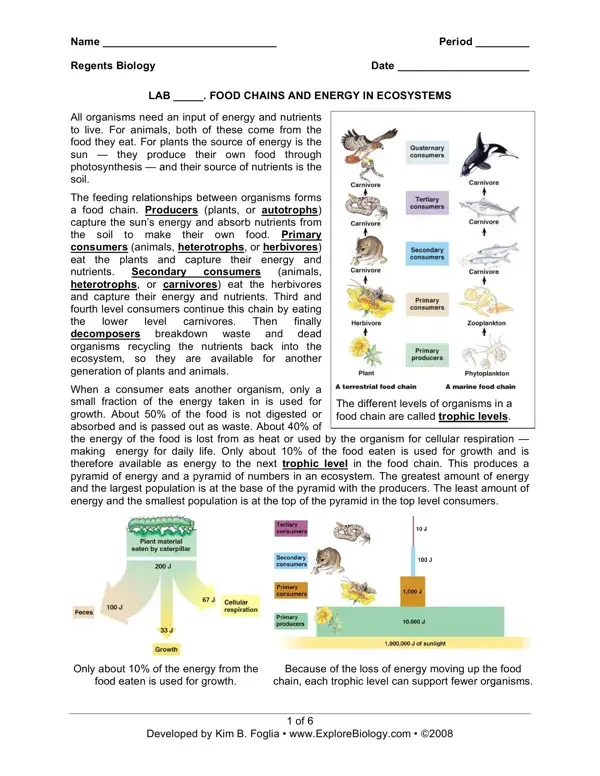
The Regents Biology Lab Food Chains form intricately outlines the cascading relationships and energy flow within ecosystems through an exploration of food chains. Addressing the pivotal roles of producers, primary consumers, secondary consumers, and decomposers, this comprehensive resource offers a vivid portrayal of how energy and nutrients cycle through various trophic levels. Central to the form's educational aim is the demonstration of the sun's integral role in fueling photosynthesis in plants, setting the foundation for life's energy pyramid. Furthermore, it highlights the inefficiencies of energy transfer between these levels—a mere 10% of consumed energy contributes to growth, with the rest lost as waste or expended during cellular respiration. Accompanying activities, including the assembly of a food chain pyramid and the quantification of organism numbers across different trophic levels, facilitate a hands-on understanding of these concepts. The form also delves into the broader ecological implications of human impacts, such as pesticide use and habitat reduction, prompting students to consider the delicate balance of natural systems. Developed by Kim B. Foglia, this educational tool not only serves as an introduction to fundamental ecological principles but also engages students in critical thinking about the sustainability of ecosystems.
| Question | Answer |
|---|---|
| Form Name | Regents Biology Lab Food Chains Form |
| Form Length | 7 pages |
| Fillable? | Yes |
| Fillable fields | 51 |
| Avg. time to fill out | 11 min 57 sec |
| Other names | regents biology ecosystems and food webs answers, ecosystem food chain worksheet, regents biology lab food chains and energy in ecosystems answers, lab food chains and energy in ecosystems worksheet answers |
Regents Biology Lab Food Chains Form isn’t the one you’re looking for?