

Form PA 586 at a glance
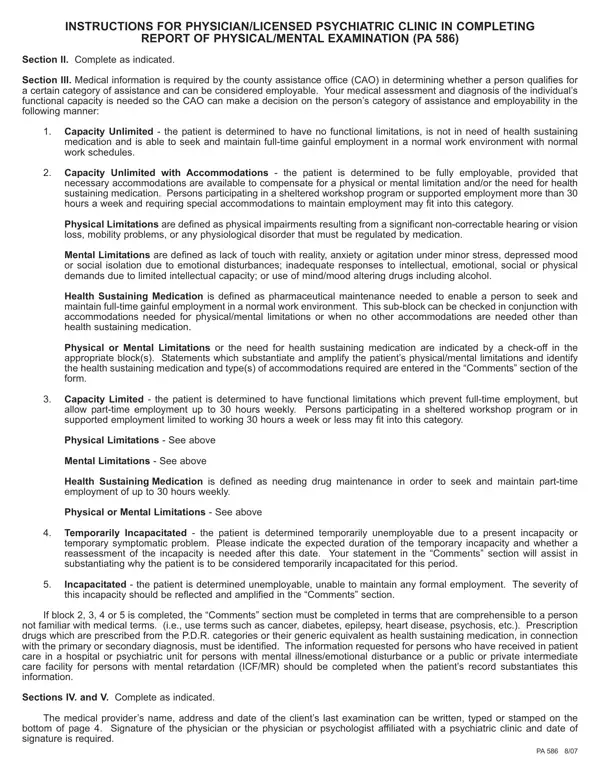
What it is: Report of Physical/Mental Examination (PA 586): medical information the county assistance office (CAO) requires in determining whether a person qualifies for a certain category of assistance and can be considered employable.
Who signs: The public assistance applicant or recipient signs and dates Section I, which authorizes the release of medical/clinical information to the Department of Public Welfare. The medical provider's name, address and date of the client's last examination can be written, typed or stamped on the bottom of page 4. Signature of the physician or the physician or psychologist affiliated with a psychiatric clinic and date of signature is required.
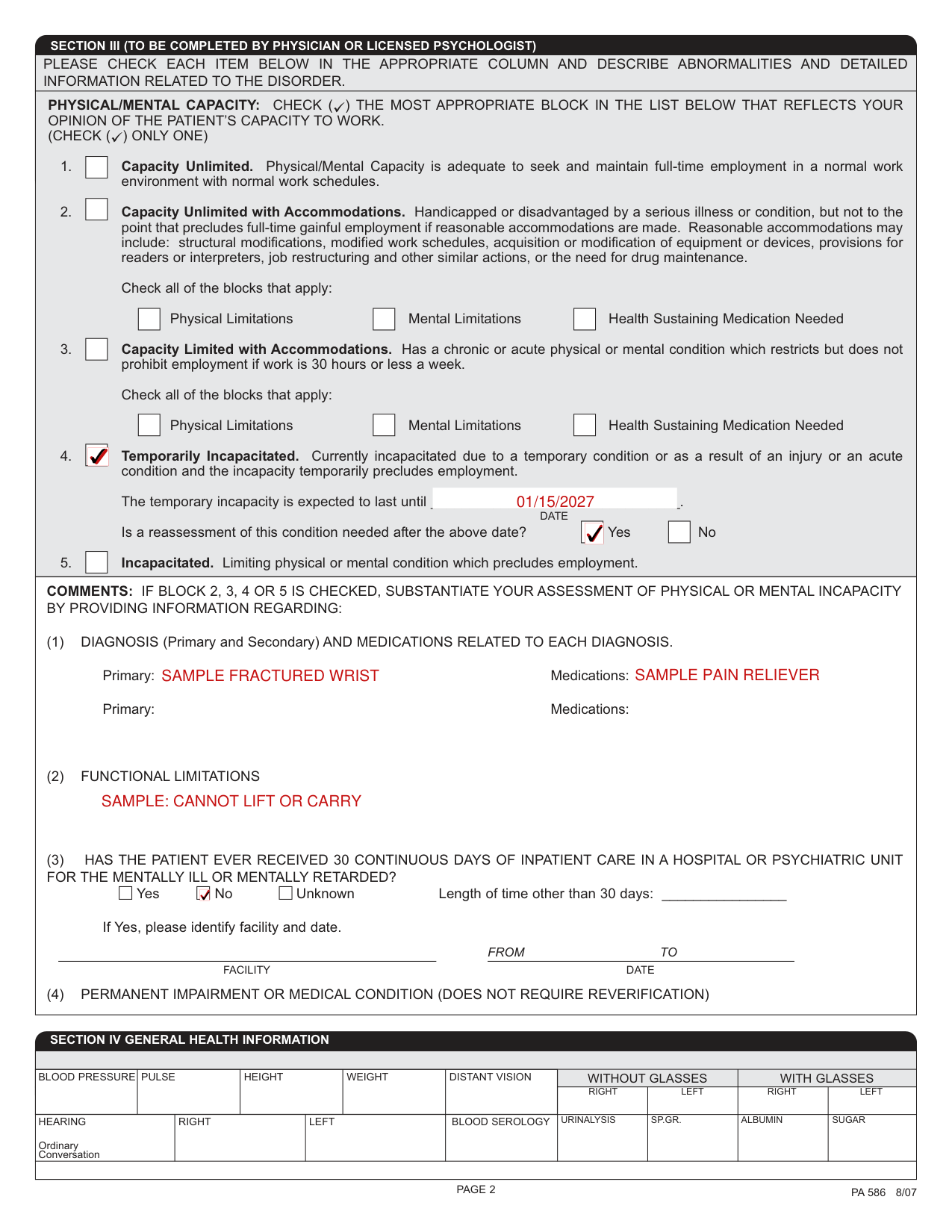
A filled-in Form PA 586 example: a physician marks a temporary incapacity
How to fill out Form PA 586, box by box
Section I, completed by the CAO
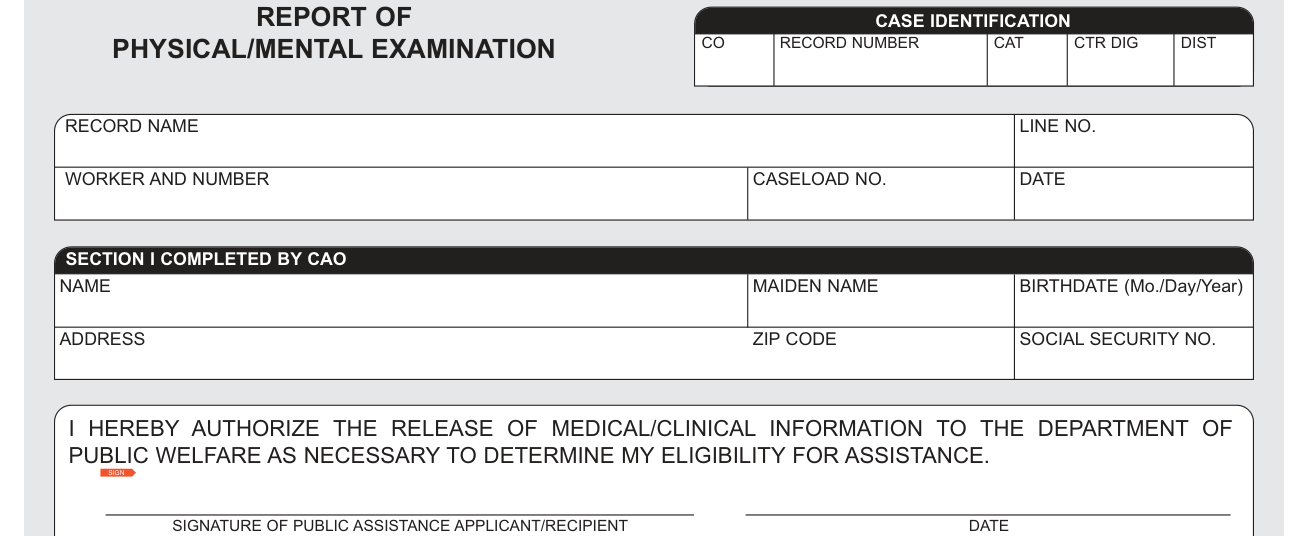
Section I is completed by the CAO.
Signature of public assistance applicant/recipient and date: I hereby authorize the release of medical/clinical information to the Department of Public Welfare as necessary to determine my eligibility for assistance.
Arrange for an appointment and return the form
Arrange for an appointment with a physician or licensed psychiatric clinic. Mail or return the form to the county assistance office as soon as possible. Ask the CAO worker for help to schedule an appointment if necessary.
Section II, history and diagnostic studies
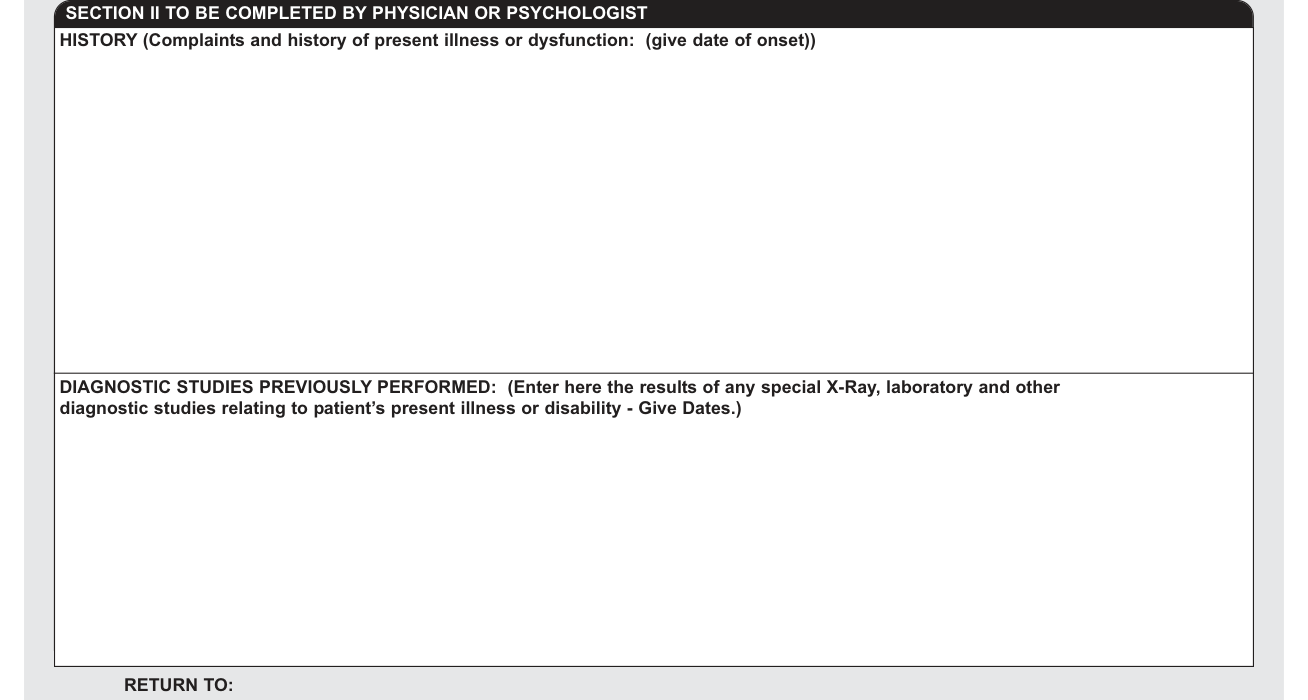
Section II is to be completed by the physician or psychologist. History: complaints and history of present illness or dysfunction, give date of onset.
Diagnostic studies previously performed: enter the results of any special X-Ray, laboratory and other diagnostic studies relating to the patient's present illness or disability, give dates.
Section III, Physical/Mental Capacity
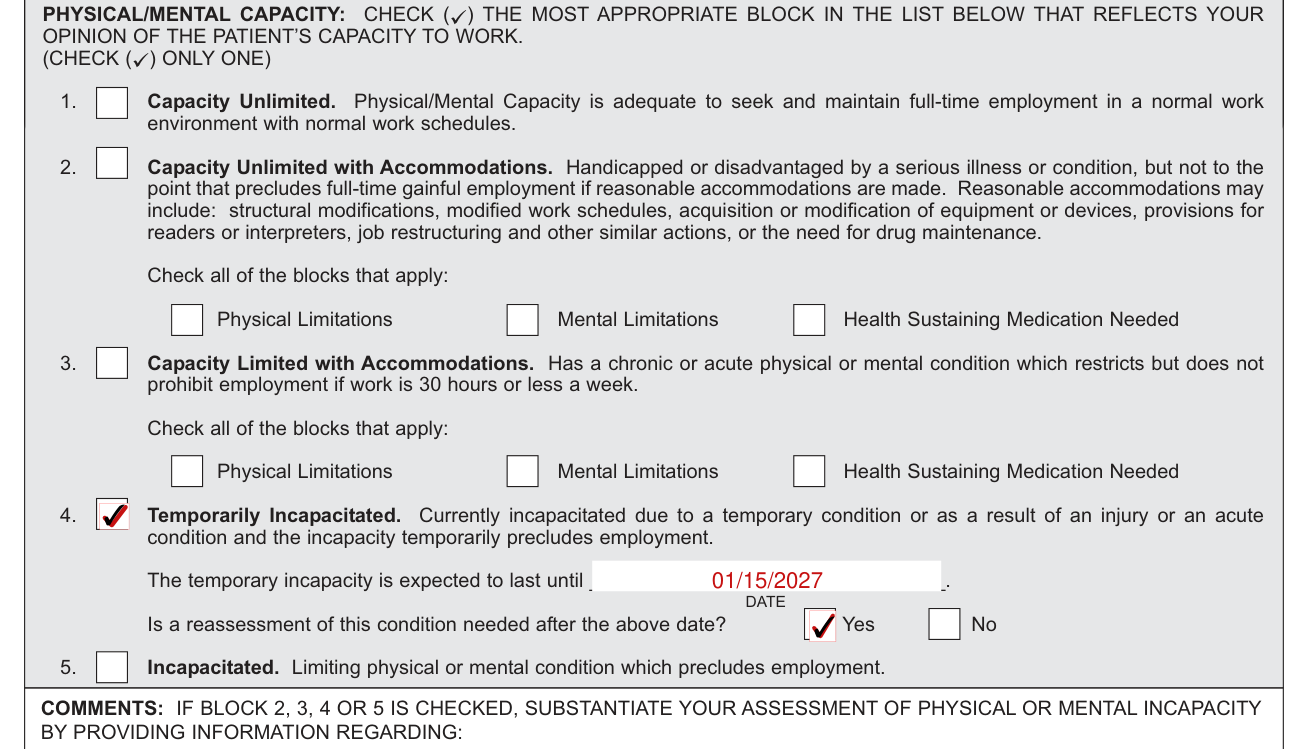
Section III is to be completed by the physician or licensed psychologist: check each item in the appropriate column and describe abnormalities and detailed information related to the disorder.
Physical/Mental capacity: check the most appropriate block that reflects your opinion of the patient's capacity to work. Check only one.
1. Capacity Unlimited: the patient is determined to have no functional limitations, is not in need of health sustaining medication and is able to seek and maintain full-time gainful employment in a normal work environment with normal work schedules.
2. Capacity Unlimited with Accommodations: the patient is determined to be fully employable, provided that necessary accommodations are available to compensate for a physical or mental limitation and/or the need for health sustaining medication. Handicapped or disadvantaged by a serious illness or condition, but not to the point that precludes full-time gainful employment if reasonable accommodations are made. Persons participating in a sheltered workshop program or supported employment more than 30 hours a week and requiring special accommodations to maintain employment may fit into this category.
Reasonable accommodations may include: structural modifications, modified work schedules, acquisition or modification of equipment or devices, provisions for readers or interpreters, job restructuring and other similar actions, or the need for drug maintenance.
3. Capacity Limited with Accommodations: the patient is determined to have functional limitations which prevent full-time employment, but allow part-time employment up to 30 hours weekly. Persons participating in a sheltered workshop program or in supported employment limited to working 30 hours a week or less may fit into this category.
4. Temporarily Incapacitated: the patient is determined temporarily unemployable due to a present incapacity or temporary symptomatic problem. Please indicate the expected duration of the temporary incapacity and whether a reassessment of the incapacity is needed after this date. Your statement in the "Comments" section will assist in substantiating why the patient is to be considered temporarily incapacitated for this period.
5. Incapacitated: the patient is determined unemployable, unable to maintain any formal employment. The severity of this incapacity should be reflected and amplified in the "Comments" section.
Physical Limitations, Mental Limitations and Health Sustaining Medication
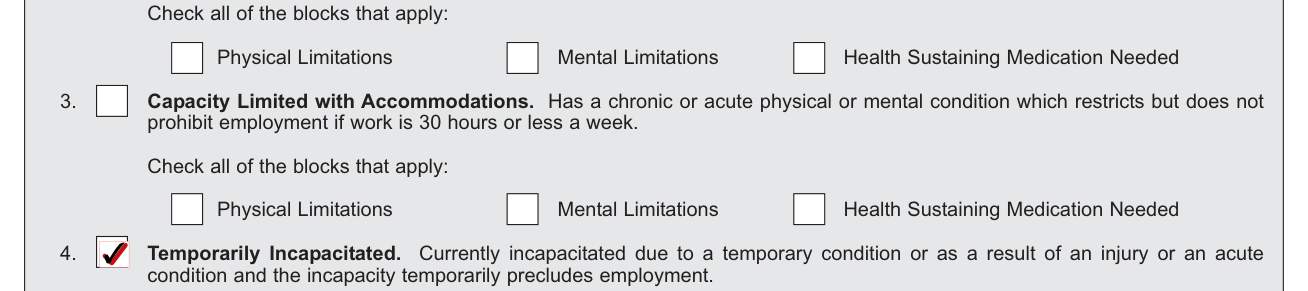
In 2 and 3, check all of the blocks that apply: Physical Limitations, Mental Limitations, Health Sustaining Medication Needed.
Physical Limitations are defined as physical impairments resulting from a significant non-correctable hearing or vision loss, mobility problems, or any physiological disorder that must be regulated by medication.
Mental Limitations are defined as lack of touch with reality, anxiety or agitation under minor stress, depressed mood or social isolation due to emotional disturbances; inadequate responses to intellectual, emotional, social or physical demands due to limited intellectual capacity; or use of mind/mood altering drugs including alcohol.
In 2, Health Sustaining Medication is defined as pharmaceutical maintenance needed to enable a person to seek and maintain full-time gainful employment in a normal work environment. This sub-block can be checked in conjunction with accommodations needed for physical/mental limitations or when no other accommodations are needed other than health sustaining medication.
In 3, Health Sustaining Medication is defined as needing drug maintenance in order to seek and maintain part-time employment of up to 30 hours weekly.
Temporarily Incapacitated, the date and the reassessment

The temporary incapacity is expected to last until the date entered. Is a reassessment of this condition needed after the date? Yes No
Comments for block 2, 3, 4 or 5
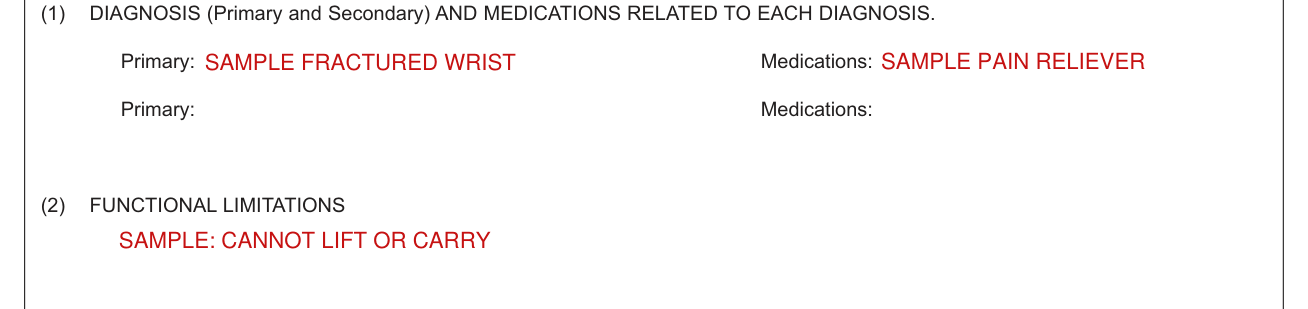
Comments: if block 2, 3, 4 or 5 is checked, substantiate your assessment of physical or mental incapacity by providing information regarding: (1) diagnosis (Primary and Secondary) and medications related to each diagnosis. Primary: Medications: (2) functional limitations.
Statements which substantiate and amplify the patient's physical/mental limitations and identify the health sustaining medication and type(s) of accommodations required are entered in the "Comments" section of the form.
If block 2, 3, 4 or 5 is completed, the "Comments" section must be completed in terms that are comprehensible to a person not familiar with medical terms. (i.e., use terms such as cancer, diabetes, epilepsy, heart disease, psychosis, etc.). Prescription drugs which are prescribed from the P.D.R. categories or their generic equivalent as health sustaining medication, in connection with the primary or secondary diagnosis, must be identified. The information requested for persons who have received in patient care in a hospital or psychiatric unit for persons with mental illness/emotional disturbance or a public or private intermediate care facility for persons with mental retardation (ICF/MR) should be completed when the patient's record substantiates this information.
Inpatient care in a hospital or psychiatric unit

(3) Has the patient ever received 30 continuous days of inpatient care in a hospital or psychiatric unit for the mentally ill or mentally retarded? Yes No Unknown Length of time other than 30 days. If Yes, please identify facility and date: Facility, Date from, to.
Section IV, general health information

Section IV, general health information: blood pressure, pulse, height, weight, distant vision without glasses and with glasses, right and left, urinalysis Sp.Gr., albumin, sugar, hearing right and left, ordinary conversation, and blood serology.
Section V, clinical findings
Section V, clinical findings (to be completed by physician): the information in this section will be used by the CAO to make an assessment of your patient's qualification for (1) general assistance or (2) exemption from public assistance work requirements because of a physical or mental condition. Sections IV and V: complete as indicated.
The certification and signature

By signing you certify that the information is based on an examination of the patient on the date and that it is true to the best of your knowledge, information and belief.
Enter the physician's/psychologist's printed name, address & license no. and the physician's/psychologist's signature, and mark physician or psychologist.
More rules for Form PA 586
Section II. Complete as indicated.
Sources
[1] Form PA 586 (8/07), Report of Physical/Mental Examination, Pennsylvania Department of Public Welfare (the Official source link on this page).