

Residential Roof Inspection Form at a glance
What it is: Residential Roof Inspection Form: mark G, F or P and enter the Location and Action Taken.
A filled-in Residential Roof Inspection Form example: an inspector records a roof inspection
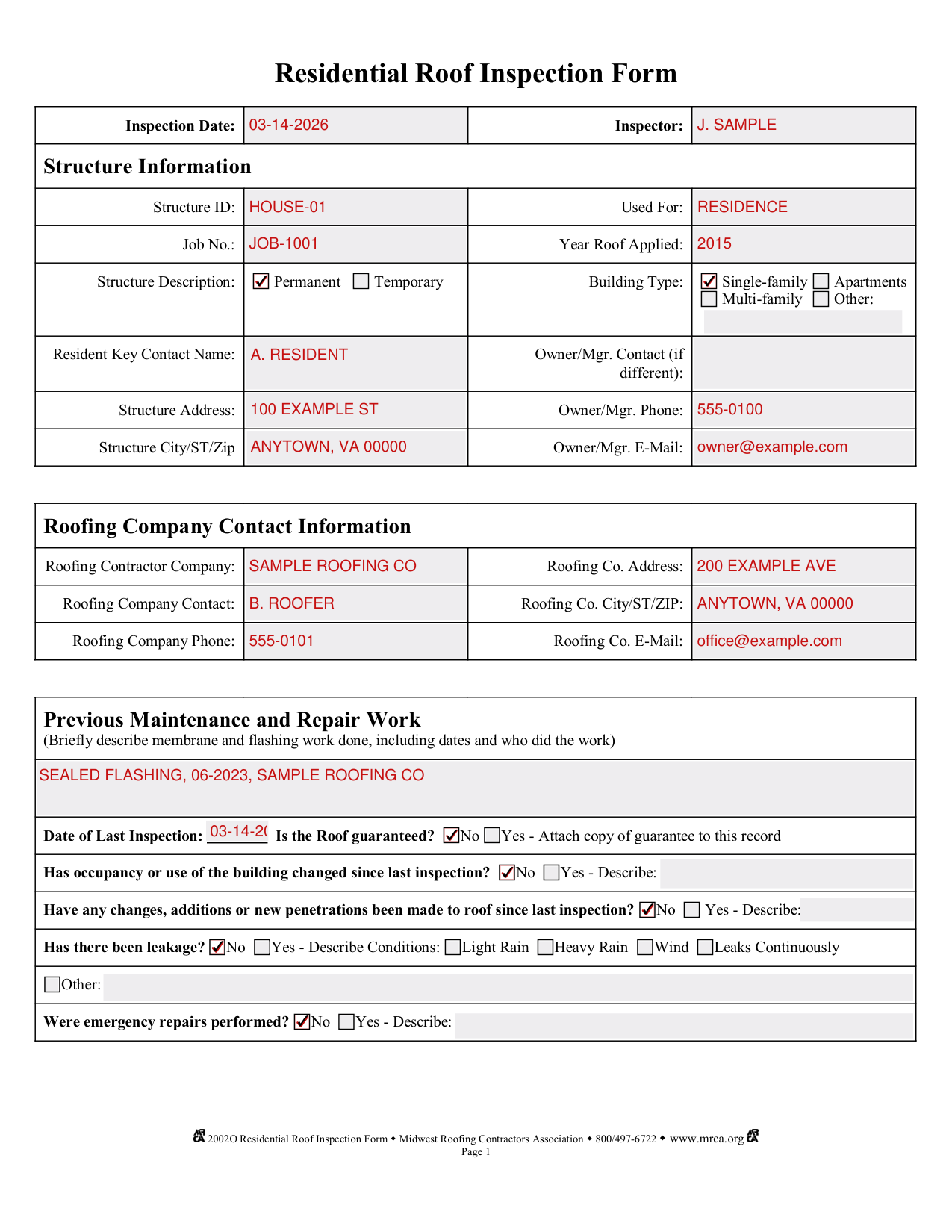
How to fill out Residential Roof Inspection Form, box by box
Inspection Date and Inspector

Enter the Inspection Date and the Inspector.
Structure Information
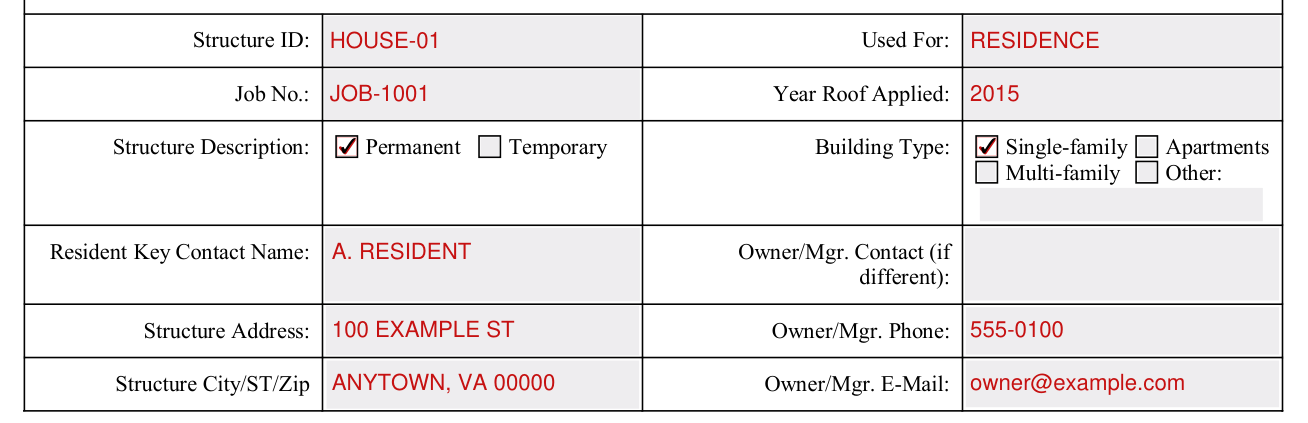
Enter the Structure ID and Used For.
Enter the Job No. and Year Roof Applied.
Under Structure Description, mark Permanent or Temporary, and mark a Building Type: Single-family, Apartments, Multi-family or Other.
Enter the Resident Key Contact Name and, if different, the Owner/Mgr. Contact.
Enter the Structure Address and the Owner/Mgr. Phone.
Enter the Structure City/ST/Zip and the Owner/Mgr. E-Mail.
Roofing Company Contact Information

Enter the Roofing Contractor Company and the Roofing Co. Address.
Enter the Roofing Company Contact and the Roofing Co. City/ST/ZIP.
Enter the Roofing Company Phone and the Roofing Co. E-Mail.
Previous Maintenance and Repair Work

Briefly describe membrane and flashing work done, including dates and who did the work.
Date of Last Inspection
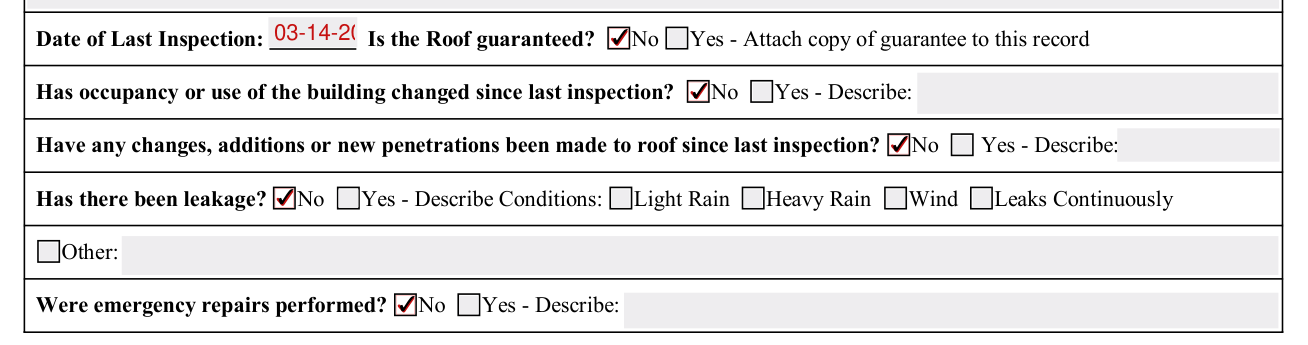
Enter the Date of Last Inspection. Is the Roof guaranteed? Mark No or Yes - Attach copy of guarantee to this record.
Has occupancy or use of the building changed since last inspection? Mark No or Yes - Describe.
Have any changes, additions or new penetrations been made to roof since last inspection? Mark No or Yes - Describe.
Has there been leakage? Mark No or Yes - Describe Conditions: Light Rain, Heavy Rain, Wind, Leaks Continuously, Other.
Were emergency repairs performed? Mark No or Yes - Describe.
More rules for Residential Roof Inspection Form
Mark each G = Good, No Action, F = Fair, Monitor Periodically, or P = Poor, Immediate Action, and enter the Location and Action Taken.
Interior, Roof Deck: A1 Corrosion, A2 Spalling (chipping or crumbling), A3 Cracking, A4 Buckling, A5 Sagging, A6 Open Joints, A7 General Deck Condition, A8 Stains/Drips, A100 Other.
Walls: B1 Movement, B2 Settling, B3 Cracks, B4 Spalling (chipping or crumbling), B5 Paint Peeling, B6 Water Stains, B100 Other.
Exterior, Walls: C1 Deteriorated Mortar Joints, C2 Settlement Cracks, C3 Stains, C4 Efflorescence, C5 Windows, C7 Fascia Displaced.
Metal Flashings, Counter Flashing: E1 Loose/Missing Fasteners, E2 Loose/Displaced Metal, E3 Deformed Metal, E4 Corrosion, E6 Sealant Joints, E7 Punctures, E100 Other.
Drains/Downspouts: L1 Strainers/Clamping Ring, L2 Clear of Debris, L3 Flashing, L4 Overall Cleanliness, L5 Gutter Anchors, L6 Drains/Downspouts, L7 Gutter General Condition, L100 Other.
Penetrations, General: K1 Pitch Pocket Sealant, K2 Loose Flashing, K3 Drawbands, K100 Other.
Conduit or Pipe: N1 Sagging, N2 Supports Moving, N3 Joints, N4 Corrosion, N100 Other.
Membrane/Shingle, General: O1 Discoloration, O2 Coating/Surfacing, O3 Cracking, O4 Wrinkles, O5 Punctures, O9 Delamination, O10 Alligatoring, O11 Granule Adhesion, O12 Standing Water, O13 Vandalism, O14 Foot Traffic Damage, O17 Mechanical Damage, O18 Exposed Felt/Deck, O19 Hail Damage, O100 Other.
Miscellaneous: R1 Antennas, R2 Guy Wires, R3 Ice or Icicles, R4 Oil Deposits, R5 Surface Contamination, R6 Soft Areas, R7 Vandalism, R8 Vegetative Growth, R100 Other.
Photographic Record: U1 Film/Digital Photograpy, U2 Video, U100 Other.
*Mark all items with the appropriate code on the roof plan grid.
Keep copies of inspection forms and photographic or other evidence with the Roof Historical Record.
Sources
[1] Residential Roof Inspection Form (the Official source link on this page).
