

Facility Inspection Chart for Water Pollution Prevention at a glance
What it is: Facility Inspection Chart for Water Pollution Prevention, with questions directly related to Best Management Practices for restaurant managers and employees.
Who signs: If affirmative answers can be given to the questions in each numbered section, place your initials in the box corresponding to the day and shift during which each inspection was made. Do not initial the box until the standards described are obtained. Keep the chart updated weekly. Observe the inspection frequency rating for each section.
Restaurant management posts and completes this checklist as a part of its routine daily activities. Doing so ensures that the restaurant achieves and maintains continued compliance with the City of Fremont's storm water management and discharge control requirements under Title VIII, Chapter 11 of the municipal code, and Union Sanitary District's discharge ordinance no. 36.
A filled-in Facility Inspection Chart for Water Pollution Prevention example: a restaurant manager's week of inspections
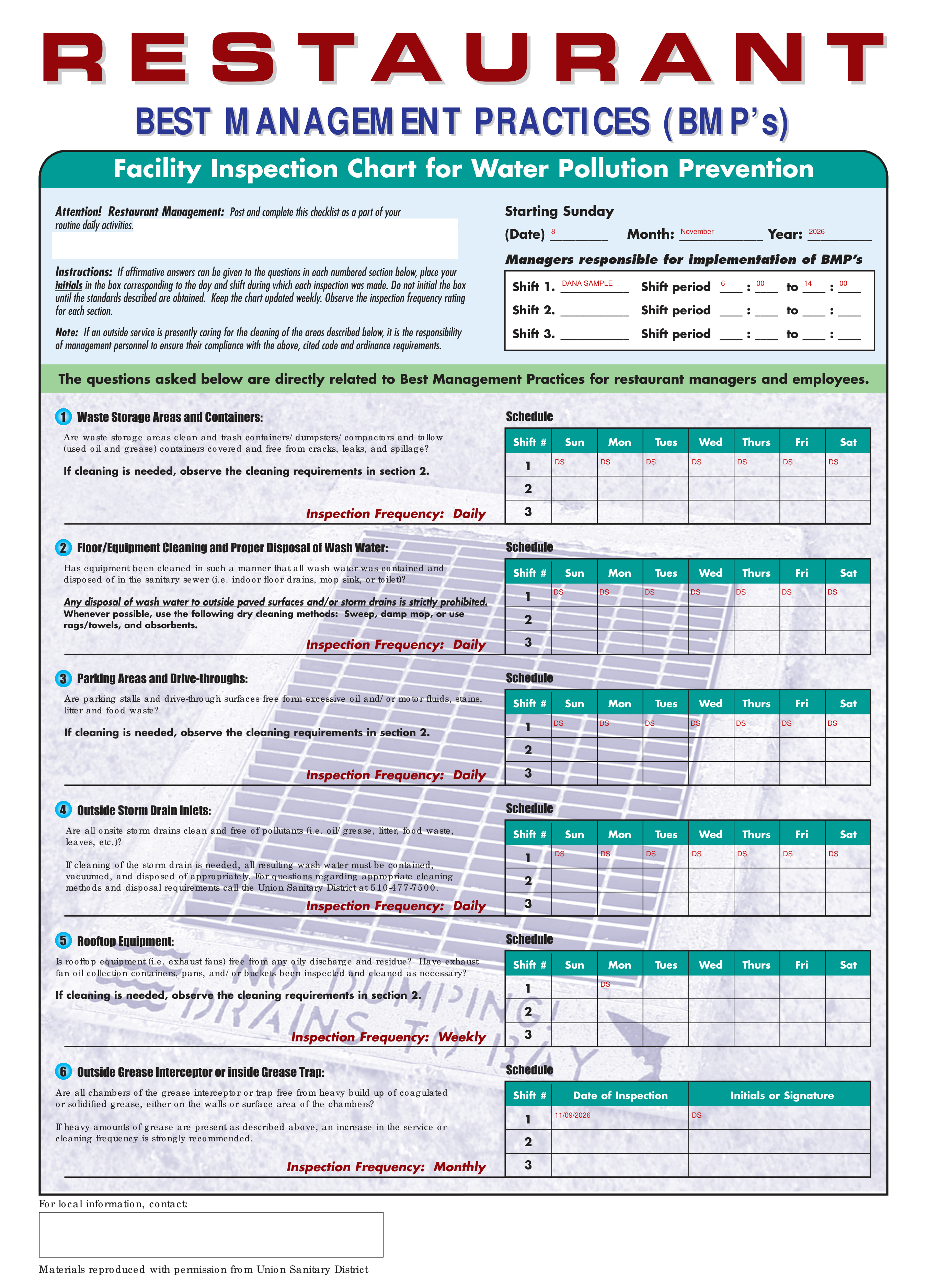
How to fill out Facility Inspection Chart for Water Pollution Prevention, box by box
Starting Sunday

Starting Sunday: enter the date, the month and the year.
Managers responsible for implementation of BMP's

For Shift 1, Shift 2 and Shift 3, enter the managers responsible for implementation of BMP's and each shift period.
Waste Storage Areas and Containers

Waste Storage Areas and Containers: Are waste storage areas clean and trash containers/ dumpsters/ compactors and tallow (used oil and grease) containers covered and free from cracks, leaks, and spillage? Inspection Frequency: Daily. If cleaning is needed, observe the cleaning requirements in section 2.
Floor/Equipment Cleaning and Proper Disposal of Wash Water

Floor/Equipment Cleaning and Proper Disposal of Wash Water: Has equipment been cleaned in such a manner that all wash water was contained and disposed of in the sanitary sewer (i.e. indoor floor drains, mop sink, or toilet)? Any disposal of wash water to outside paved surfaces and/or storm drains is strictly prohibited. Whenever possible, use dry cleaning methods: sweep, damp mop, or use rags/towels, and absorbents. Inspection Frequency: Daily.
Parking Areas and Drive-throughs

Parking Areas and Drive-throughs: Are parking stalls and drive-through surfaces free form excessive oil and/ or motor fluids, stains, litter and food waste? Inspection Frequency: Daily. Here too: if cleaning is needed, observe the cleaning requirements in section 2.
Outside Storm Drain Inlets

Outside Storm Drain Inlets: Are all onsite storm drains clean and free of pollutants (i.e. oil/ grease, litter, food waste, leaves, etc.)? If cleaning of the storm drain is needed, all resulting wash water must be contained, vacuumed, and disposed of appropriately. For questions regarding appropriate cleaning methods and disposal requirements call the Union Sanitary District at 510-477-7500. Inspection Frequency: Daily.
Rooftop Equipment

Rooftop Equipment: Is rooftop equipment (i.e. exhaust fans) free from any oily discharge and residue? Have exhaust fan oil collection containers, pans, and/ or buckets been inspected and cleaned as necessary? Inspection Frequency: Weekly. Observe the cleaning requirements in section 2 if cleaning is needed.
Outside Grease Interceptor or inside Grease Trap

Outside Grease Interceptor or inside Grease Trap: Are all chambers of the grease interceptor or trap free from heavy build up of coagulated or solidified grease, either on the walls or surface area of the chambers? If heavy amounts of grease are present in the chambers as described, either on the walls or surface area of the chambers of the grease interceptor or trap, an increase in the service or cleaning frequency is strongly recommended. Inspection Frequency: Monthly. For each shift, enter the Date of Inspection, then add your initials or signature in the Initials or Signature box.
More rules for Facility Inspection Chart for Water Pollution Prevention
If an outside service is presently caring for the cleaning of the areas described in the form, it is the responsibility of management personnel to ensure their compliance with the cited code and ordinance requirements.
Sources
[1] Facility Inspection Chart for Water Pollution Prevention (Best Management Practices), Union Sanitary District (the Official source link on this page).
