
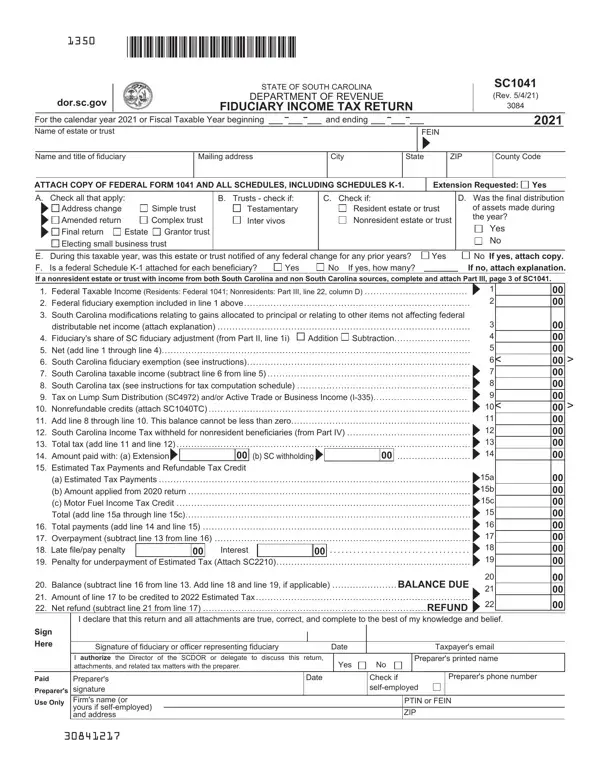
Form SC1041 at a glance
What it is: The SC1041 is the State of South Carolina Department of Revenue Fiduciary Income Tax Return for an estate or trust.
Where and when to file: If filing by paper, mail balance due returns to SCDOR, Taxable Fiduciary, PO Box 125, Columbia, SC 29214-0038. Mail refunds or zero tax returns to SCDOR, Nontaxable Fiduciary, PO Box 125, Columbia, SC 29214-0039.
The fiduciary of a resident estate or trust must file an SC1041, South Carolina Fiduciary Income Tax Return, if the estate or trust is required to file a federal Fiduciary Income Tax return for the taxable year, had any South Carolina taxable income for the taxable year, or had a beneficiary who is a nonresident. The fiduciary of a nonresident estate or trust must file a South Carolina Fiduciary Income Tax return if the estate or trust had income or gain that came from South Carolina sources.
The blank Form SC1041: print it and complete it by hand
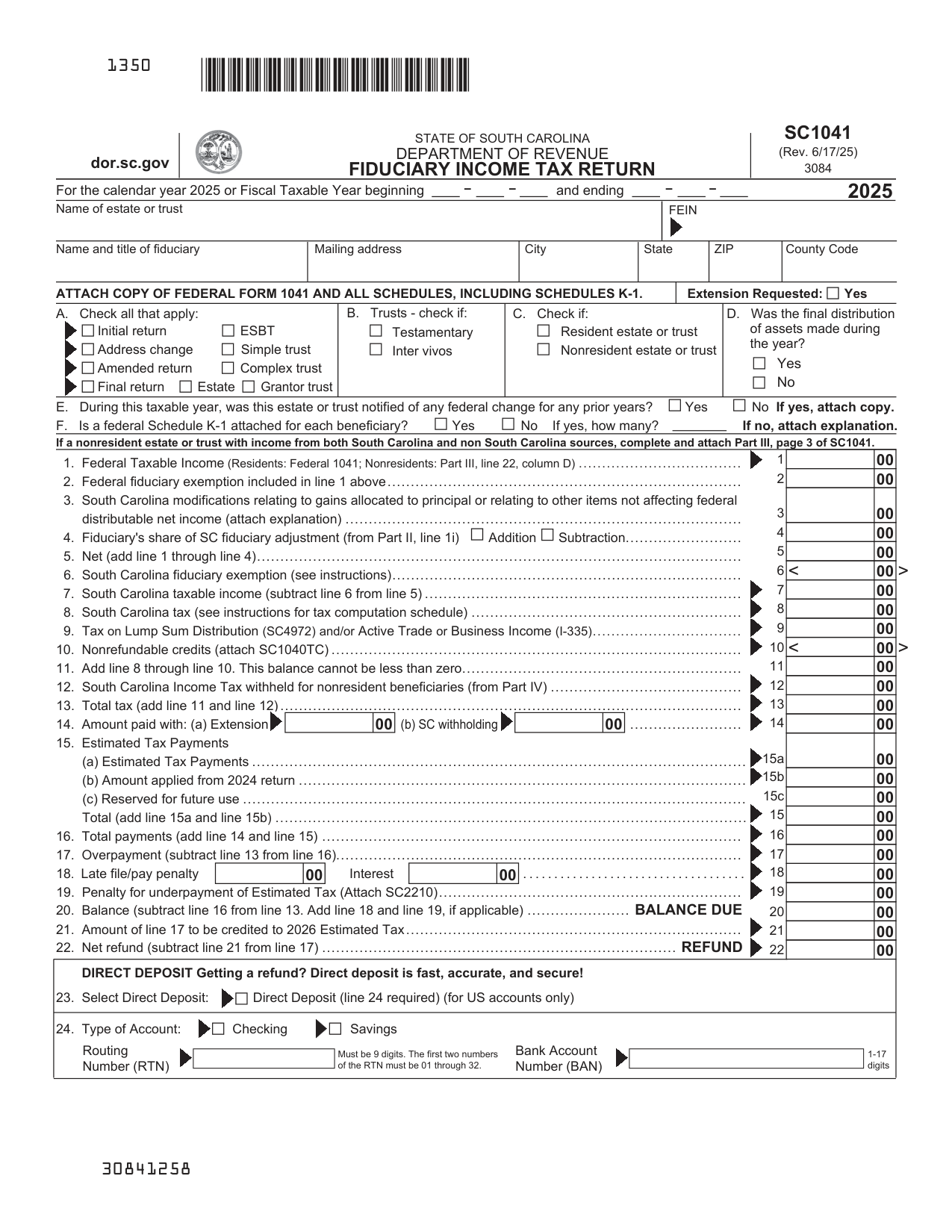
How to fill out Form SC1041, box by box
Income from South Carolina sources
Income from South Carolina sources includes income or gain from real or tangible personal property located within South Carolina, a business, profession, or occupation carried on in South Carolina, and services performed within South Carolina.
Resident and nonresident estates and trusts
A resident estate is the estate of a person who was a South Carolina resident at the time of death. All other estates are nonresident estates.
A resident trust is any trust administered in South Carolina. All other trusts are nonresident trusts, including a trust administered outside of South Carolina that is required to follow the laws of South Carolina for administration of the trust.
Exempt trust
A trust exempt from federal Income Tax because of its purpose or activities is also exempt from South Carolina Income Tax.
When and where to file
When to file: your South Carolina Fiduciary Income Tax return is due by the 15th day of the fourth month after the close of the taxable year.
Failure to file the return by the due date may result in a penalty.
If you need additional time to file your SC1041, you must request an extension by the due date of the return.
The fastest, easiest way to request your extension to file is by paying your balance due using the free online tax portal at dor.sc.gov/pay. Your payment on the portal automatically submits your filing extension request.
You can also request an extension by filing a paper copy of the SC8736, available at dor.sc.gov/forms.
The SCDOR will accept a federal extension instead of the SC8736 if the South Carolina Income Tax return does not have a balance due when the return is filed.
Attach a copy of the federal extension when you file your SC1041 within the extended period. Mark the Extension Requested box on page 1 of your SC1041.
If filing by paper, mail balance due returns to SCDOR, Taxable Fiduciary, PO Box 125, Columbia, SC 29214-0038.
Mail refunds or zero tax returns to SCDOR, Nontaxable Fiduciary, PO Box 125, Columbia, SC 29214-0039.
Attach copy of your federal return
You must attach a copy of your federal Fiduciary Income Tax return as filed with the IRS (including all schedules) to your SC1041.
Heading: name, address, FEIN and county code
Write the name, address, FEIN, and county code of the estate or trust in the fields on page 1.
Line 1 to line 11
On line 1, write the federal taxable income shown on page 1 of the federal 1041. Nonresident estates and trusts should write on line 1 the amount reported on Part III, line 22, column D of the SC1041.
A resident fiduciary should write on line 4 its portion of the fiduciary adjustment from Part II, line 1, column 4. A nonresident estate or trust should not make adjustments on this line.
Write the South Carolina fiduciary exemption on line 6. Nonresident estates or trusts should complete Part V to determine the portion of the federal fiduciary exemption which is allowed as the South Carolina fiduciary exemption.
To determine the amount of the Fiduciary Income Tax liability, refer to the tax computation schedule, and compute the tax. Write the amount on line 8.
Which parts to complete
If a resident estate or trust has only resident beneficiaries, or if no amounts are distributable to nonresident beneficiaries, only complete Parts I and II.
If a resident estate or trust has nonresident beneficiaries, it is generally necessary to complete all parts. You do not have to complete Part IV if amounts distributed to nonresidents are not taxable.
If all income of a resident estate or trust is taxable to the fiduciary and no distributions are made, or required to be made, only Part I must be completed.
If a nonresident estate or trust has resident and/or nonresident beneficiaries, all parts must be completed. If all the income is taxable to the fiduciary, only Parts III and V must be completed.
Line 20 to line 24
Subtract line 16 from line 13, add line 18 and/or 19, if applicable, and write the total on line 20.
To apply any or all of the refund toward next year's Estimated Tax, write the amount on line 21. If you have an amount on line 21, subtract line 21 from line 17 and write the Net refund on line 22. Otherwise, write the amount from line 17.
Mark an X in the box on line 23 to receive your refund by direct deposit. Write your bank information on line 24.
On line 24, you must write complete and correct account information. If you are requesting direct deposit of your refund and your account information is not complete and correct, a paper check will be mailed to the address listed on your return. You cannot have your funds directly deposited into an account located outside of the United States.
Mark an X to choose checking or savings account. Write your 9 digit routing transit number (RTN). Do not use a deposit slip to verify the RTN. Write your bank account number (BAN). The BAN contains 17 or fewer alphanumeric digits. Do not write hyphens, spaces, special symbols, or the check number.
Payment of tax
The balance of tax due on page 1, line 20 of your SC1041 must be paid in full. Failure to pay your tax on time can result in penalty and interest.
The fastest, easiest way to pay your balance due is by using the free online tax portal at dor.sc.gov/pay. Select Business Income Tax Payment to get started.
You can also attach a check to your SC1041. Include the name and FEIN of the estate or trust, SC1041, and the tax year in the memo. Do not send cash.
If you owe $15,000 or more in connection with any SCDOR return, you must file and pay electronically according to SC Code Section 12-54-250, available at dor.sc.gov/policy. (checked November 12, 2026)
Federal adjustments
An amended SC1041 must be filed whenever the IRS adjusts a federal 1041.
File an amended SC1041 for the appropriate tax year to report the federal adjustment to the SCDOR. Attach a copy of the IRS revenue agent's report showing the adjustments. Mark the Amended return box on page 1 of your SC1041.
Signature
The fiduciary of the estate or trust must sign the Fiduciary Income Tax return.
Check the Yes box for release of confidential information. This authorizes the Director of the SCDOR or delegate to discuss this return, its attachments, and any notices, adjustments, or assessments with the preparer whose name is provided.
Declare that this return and all attachments are true, correct, and complete to the best of your knowledge and belief.
Common questions about Form SC1041
What expenses are deductible on a 1041 estate return?
Expenses of administering an estate must be deducted in the same way they are deducted for federal tax purposes. If these expenses are deducted on the federal 1041, they may be deducted on the SC1041. If these expenses are deducted for federal Estate Tax purposes, they may not be deducted on the SC1041.
Sources
[1] Form SC1041 (Rev. 6/17/25), Fiduciary Income Tax Return, South Carolina Department of Revenue (the Official source link on this page).